Credit Claiming in the European Union | The Journal of Politics: Vol 87, No 3
Incumbents in multilevel systems are assumed to exploit uncertainty of responsibility by claiming credit and shifting blame, yet little is known about when and how they engage in these rhetorical stra...
🚨 New(ish) Publication Alert! Delighted to see my article Credit Claiming in the EU @thejop.bsky.social I explore a classic question for accountability in Europe: when and why do govs claim credit for the work of the EU and shift blame onto Brussels to avoid responsibility? doi.org/10.1086/732970
08.10.2025 11:02 —
👍 28
🔁 13
💬 1
📌 0


Glorious
19.09.2025 14:33 —
👍 5
🔁 1
💬 1
📌 0

Perfect day for a Lehrstuhlausflug!
19.09.2025 10:33 —
👍 30
🔁 2
💬 1
📌 0

DISINTEGRATION: Tracking Europeans' opinions of Brexit and the EU: An EU-wide, six wave cross-sectional survey, 2017–2019
Brexit marked a turning point in EU history. For the first time an EU member state left the EU, leading to concerns about the stability of the EU as a whole. Indeed, Brexit carried significant spillov...
DISINTEGRATION data feature #1: A 6-wave EU-wide panel survey (2017–2019) of 10,000+ respondents per wave across all 28 member states. Tracks EU attitudes, Brexit perceptions & political views—country-level analyses possible for FR, DE, IT, PL, ES & UK.
doi.org/10.48573/4bj...
20.05.2025 08:55 —
👍 2
🔁 2
💬 1
📌 0

Responding to Unilateral Challenges to International Institutions
Abstracts. How do international institutions respond to unilateral challenges by its member states, such as non-compliance, blocking of reforms, renegotiat
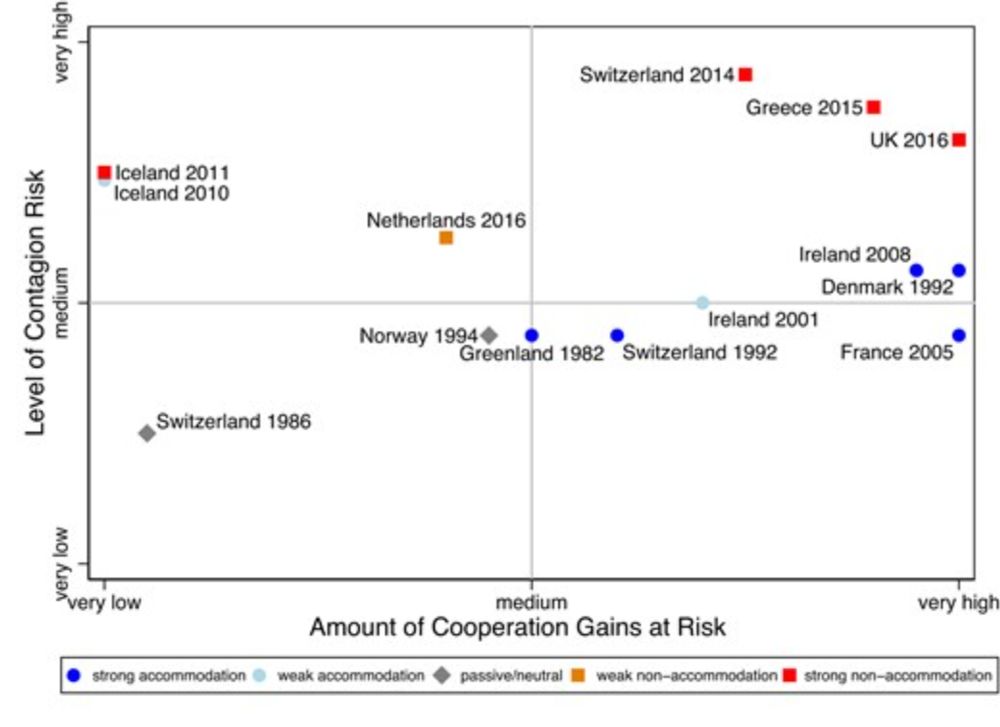
DISINTEGRATION publ #14: How do international institutions respond to unilateral challenges like non-compliance or withdrawal? @stefwalter.bsky.social & Nicole Plotke-Scherly develop a framework showing how IOs balance cooperation losses vs. contagion risks.
doi.org/10.1093/isq/...
19.05.2025 13:05 —
👍 1
🔁 1
💬 1
📌 0

Disintegration and party competition: evidence from parliamentary speeches on Brexit
How do political parties in the European Union (EU) react to disintegration bids from a member state? This question is important, as scholars have argued that framing by elites (particularly Eurosc...
DISINTEGRATION #10: How did parties in the EU react to Brexit? Analyzing parliamentary statements, @tommccraehunter.bsky.social finds that after the referendum, Eurosceptic challengers moderated their tone, while mainstream parties ramped up pro-EU rhetoric. No domino effect
doi.org/10.1080/1350...
13.05.2025 13:57 —
👍 0
🔁 1
💬 1
📌 0
Sage Journals: Discover world-class research
Subscription and open access journals from Sage, the world's leading independent academic publisher.
DISINTEGRATION publication #5: @stefwalter.bsky.social analyzes how voter-endorsed attempts to withdraw from IOs reverberate abroad. With original survey data from EU-27 Europeans and Swiss voters, she finds both encouragement and deterrence effects. doi.org/10.1177/0010...
06.05.2025 16:22 —
👍 0
🔁 1
💬 1
📌 1
The Backlash Against Globalization | Annual Reviews
In recent years, the world has seen a rising backlash against globalization. This article reviews the nature, causes, and consequences of the globalization backlash. It shows that, contrary to a popul...
DISINTEGRATION publication #4: @stefwalter.bsky.social reviews the globalization backlash. She shows that the backlash is not associated with large swings in public opinion against globalization but is rather a result of its politicization by skeptical actors doi.org/10.1146/annu...
05.05.2025 08:01 —
👍 2
🔁 1
💬 1
📌 2

Today marks the final day of the DISINTEGRATION project, a project on the mass politics of disintegration generously funded by the @erc.europa.eu .
We celebrate with a thread on all we have done and found:
1/20
30.04.2025 10:13 —
👍 29
🔁 10
💬 1
📌 3
Concluding three inspiring and insightful days of talking research and thinking about EU integration, its boundaries, and integration and disintegration dynamics with a fantastic set of people on Monte Verità.
12.03.2025 13:02 —
👍 7
🔁 4
💬 0
📌 1
Huge congratulations to @nkortendiek.bsky.social for this well deserved award - Chadwick Alger Prize, the IO Section Best Book Award! 🎉
Buy her book or recommend it to your library!
#ISA2025
05.03.2025 13:15 —
👍 9
🔁 2
💬 0
📌 0

***GRAPH OF THE MONTH***
Does media-reported EU policy focus shape legitimacy perceptions? Our new study finds that ideological leanings matter: left-wing voters reward EU focus on regulation & climate, while right-wing voters prefer immigration policies.
05.03.2025 13:17 —
👍 1
🔁 1
💬 0
📌 1
How should we study party polarization in Europe?
Happy to share that our paper on *multidimensional* polarization is now out @bjpols.bsky.social! (more 👇)
26.02.2025 09:39 —
👍 74
🔁 32
💬 2
📌 3
Great idea Lisa, please add me to the list :)
07.01.2025 11:35 —
👍 0
🔁 0
💬 0
📌 0

"Do external crises unite or divide international organizations? Evidence from 1,443 UNSC resolutions (1995-2018) suggests external crises, like humanitarian disasters, civil conflicts, floods, and terrorist attacks, divide rather than unite the Security Council. Graph by Johannes Scherzinger #UNSC
02.12.2024 14:20 —
👍 1
🔁 1
💬 1
📌 0

Graph of the month:
Analyzing 167 arguments made in 25 direct democratic voting campaigns on international issues in Switzerland, @giorgiomalet.bsky.social and @stefwalter.bsky.social show that the framing of arguments in favor and against international cooperation differ significantly.
28.03.2024 12:40 —
👍 1
🔁 3
💬 0
📌 0

Now published:
How do populist-right parties respond when their preferred policies are implemented abroad? Focusing on Brexit, Marco Martini and @stefwalter.bsky.social show that nationalist parties adjusted their aggressiveness towards the EU in line with the ups and downs of the Brexit process.
26.03.2024 08:09 —
👍 1
🔁 1
💬 1
📌 1
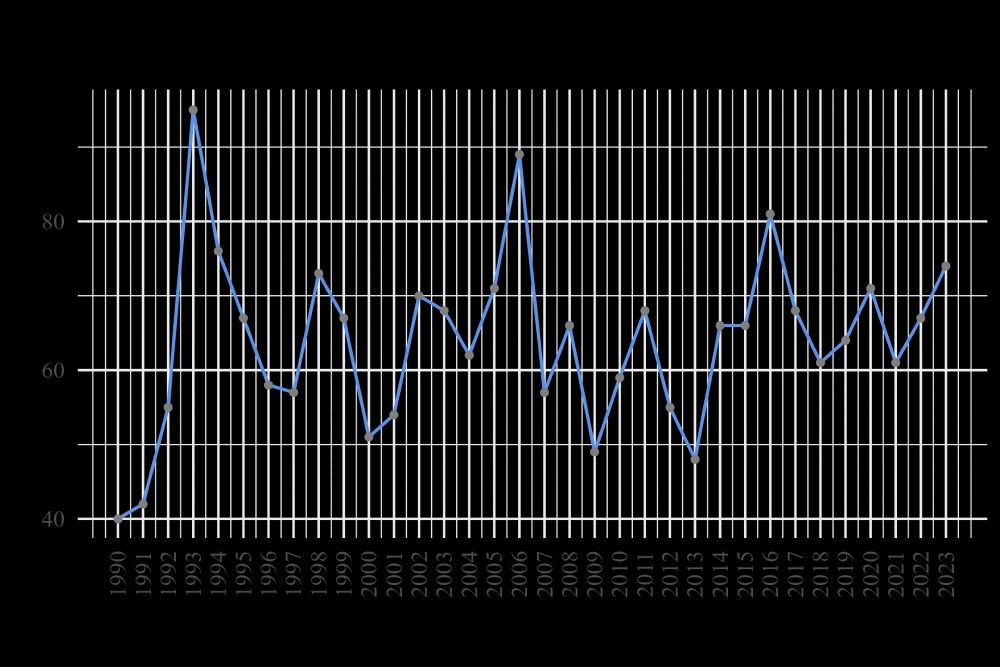
Number of resos fluctuates. Average of authorized resos is 64 per year. Mean share of failure is 4% but growing over time (see righthand scale of the other plot as well)
28.02.2024 14:14 —
👍 1
🔁 0
💬 1
📌 0

Since the mid-2010s, the number of resolutions in the UNSC that have failed or been vetoed has markedly increased, providing another indicator for growing international dissensus amidst a surge of global crises.
Data & Visualization by Johannes Scherzinger.
#UnitedNations
26.02.2024 10:13 —
👍 5
🔁 3
💬 1
📌 0

Socialized with "old cleavages" or "new dimensions": An Age-Period-Cohort analysis on electoral supp...
Across Western Europe, the electoral base of formerly dominating parties on the left and the right has been eroding in the past decades. In contrast, …
sciencedirect.com/science/arti...
New publication out in Electoral Studies!
In this study, I analyze generational voting differences in Western European multiparty systems - focusing on generational realignment *within* political blocs and using individual survey data spanning over 70 years.
19.01.2024 11:02 —
👍 32
🔁 18
💬 0
📌 2
How do leaders from CEE countries present the EU at home? Evidence collected by Tom Hunter from HU and SK leader statements in the aftermath of EU summits.
01.12.2023 15:10 —
👍 4
🔁 2
💬 0
📌 0