#Neuroscience #BrainNetworks #Dementia #EarlyOnsetDementia #Neurodegeneration #NetworkResilience #ClinicalNeuroscience #GraphTheory #NetworkNeuroscience #ComputationalNeuroscience
20.11.2025 06:33 —
👍 2
🔁 0
💬 0
📌 0
If you’re working in cognitive neuroscience, network approaches to brain disorders, early‐onset dementia, connectomics or translational neurology, let’s collaborate to make a real impact.
20.11.2025 06:33 —
👍 1
🔁 0
💬 1
📌 0
Thanks to my co-authors (Hema Nawani, Sredha Sunil) and reviewers, and a huge thank you to our professor Veeky Baths for his guidance and support throughout this work.
20.11.2025 06:33 —
👍 0
🔁 0
💬 1
📌 0
I believe this work contributes to bridging neuroscience, network theory, and clinical neurology, and invites discussion on how we can design interventions that strengthen brain network resilience in dementia.
20.11.2025 06:33 —
👍 1
🔁 0
💬 1
📌 0
-Gaps&opportunities:The need for models that integrate network resilience, longitudinal data, multimodal connectivity(structural+functional+ electrophysiological)&early‐onset cohorts;translational potential for biomarkers&interventions that support network integrity rather than just reduce pathology
20.11.2025 06:33 —
👍 0
🔁 0
💬 1
📌 0
- Review of methodological findings: how graph‐theoretic metrics (clustering coefficient, global/local efficiency, modularity, assortativity, small‐worldness) are being applied to neuroimaging and electrophysiology in early dementia.
20.11.2025 06:33 —
👍 0
🔁 0
💬 1
📌 0
- The concept of network resilience as a key lens: rather than only asking “where damage occurs”, the paper argues we should ask “how the network topology fails to compensate, reorganise or maintain function under pathology”. This shifts the view to resilience‐focused models.
20.11.2025 06:33 —
👍 0
🔁 0
💬 1
📌 0
-Evidence that brain networks lose their optimal organisational properties(e.g., balance of segregation & integration)in early‐onset dementia, reflecting decline in network resilience. For e.g.,previous work has shown disrupted segregation/integration in large‐scale brain networks in Alzheimer’s/MCI
20.11.2025 06:33 —
👍 0
🔁 0
💬 1
📌 0
In this review, we highlight several important insights:
-A summary of how early‐onset forms of dementia(including Alzheimer’s disease, frontotemporal dementia(FTD),and behavioral variant FTD)show disruption in brain network topology(both structural and functional)rather than purely focal pathology.
20.11.2025 06:33 —
👍 0
🔁 0
💬 1
📌 0

A picture of and quote from lead author Dr Mats Van Es, Postdoctoral Researcher at the Department of Psychiatry, University of Oxford:
"This is a pivotal finding in our understanding of brain function, showing that the brain’s functional networks are organised into periodic cycles...These cyclical dynamics occur not only at rest but also when replaying memories and during other cognitive tasks, where they predict response speed."
📢 NEW RESEARCH
The brain’s networks activate in structured cycles.
Led by @matsvanes.bsky.social, a team analysed MEG data from 800+ people. The strength & speed of the cycles was influenced by genetics & associated with factors such as age.
www.psych.ox.ac.uk/news/brain20... in @nature.com Neuro
27.08.2025 10:59 —
👍 13
🔁 5
💬 1
📌 0
![What do representations tell us about a system? Image of a mouse with a scope showing a vector of activity patterns, and a neural network with a vector of unit activity patterns
Common analyses of neural representations: Encoding models (relating activity to task features) drawing of an arrow from a trace saying [on_____on____] to a neuron and spike train. Comparing models via neural predictivity: comparing two neural networks by their R^2 to mouse brain activity. RSA: assessing brain-brain or model-brain correspondence using representational dissimilarity matrices](https://cdn.bsky.app/img/feed_thumbnail/plain/did:plc:e6ewzleebkdi2y2bxhjxoknt/bafkreiav2io2ska33o4kizf57co5bboqyyfdpnozo2gxsicrfr5l7qzjcq)
What do representations tell us about a system? Image of a mouse with a scope showing a vector of activity patterns, and a neural network with a vector of unit activity patterns
Common analyses of neural representations: Encoding models (relating activity to task features) drawing of an arrow from a trace saying [on_____on____] to a neuron and spike train. Comparing models via neural predictivity: comparing two neural networks by their R^2 to mouse brain activity. RSA: assessing brain-brain or model-brain correspondence using representational dissimilarity matrices
In neuroscience, we often try to understand systems by analyzing their representations — using tools like regression or RSA. But are these analyses biased towards discovering a subset of what a system represents? If you're interested in this question, check out our new commentary! Thread:
05.08.2025 14:36 —
👍 170
🔁 53
💬 5
📌 0

Gave this talk some time ago. Touched to know it still resonates with students.
20.07.2025 21:47 —
👍 1
🔁 0
💬 0
📌 0
Home
First Workshop on Interpreting Cognition in Deep Learning Models (NeurIPS 2025)
Excited to announce the first workshop on CogInterp: Interpreting Cognition in Deep Learning Models @ NeurIPS 2025! 📣
How can we interpret the algorithms and representations underlying complex behavior in deep learning models?
🌐 coginterp.github.io/neurips2025/
1/4
16.07.2025 13:08 —
👍 58
🔁 19
💬 1
📌 3

Detecting dementia earlier
With $4 million grant, UC Irvine researcher seeks to develop inexpensive assessment of cognitive ability
Detecting dementia earlier | With $4 million grant, UC Irvine cognitive scientist Aaron Bornstein seeks to develop inexpensive assessment of cognitive ability
@ucirvine.bsky.social @aaronbornstein.bsky.social @uofcalifornia.bsky.social
14.07.2025 17:46 —
👍 23
🔁 9
💬 0
📌 0
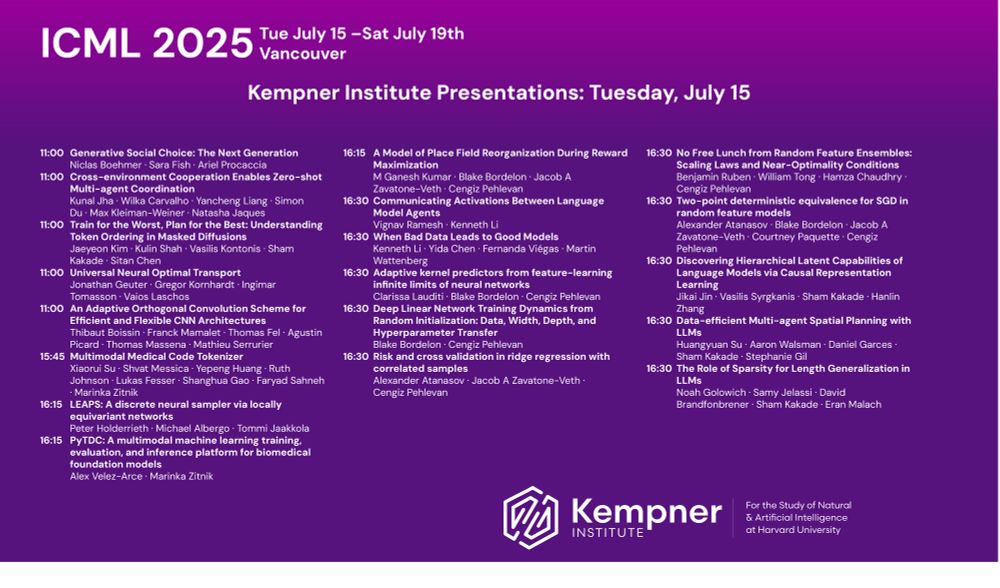
Check out the #KempnerInstitute's presentations at #ICML2025 today!
#AI #NeuroAI #LLMs
🧵Here's a thread of abstracts.
(1/20)
15.07.2025 13:31 —
👍 7
🔁 3
💬 1
📌 0

Excited to announce the Foundation Models for the Brain and Body workshop at #NeurIPS2025! 🧠📈 🧪
We invite short papers or interactive demos on AI for neural, physiological or behavioral data.
Submit by Aug 22 👉 brainbodyfm-workshop.github.io
11.07.2025 17:01 —
👍 33
🔁 10
💬 0
📌 3
If it doesn’t eat up your time, do a ~10-15 min, or less than that, virtual meeting with the responders.
02.06.2025 12:01 —
👍 2
🔁 0
💬 0
📌 0
A useful resource to learn the breadth of cognitive science
02.06.2025 11:58 —
👍 4
🔁 0
💬 0
📌 0

𝗕𝗲𝘆𝗼𝗻𝗱 𝗡𝗲𝘁𝘄𝗼𝗿𝗸𝘀: 𝗧𝗼𝘄𝗮𝗿𝗱 𝗔𝗱𝗮𝗽𝘁𝗶𝘃𝗲 𝗠𝗼𝗱𝗲𝗹𝘀 𝗼𝗳 𝗕𝗶𝗼𝗹𝗼𝗴𝗶𝗰𝗮𝗹 𝗖𝗼𝗺𝗽𝗹𝗲𝘅𝗶𝘁𝘆
How can network science tackle complex biological systems?
Substantially reworked version
Largely conceptual, would be happy to see others fill in details or collaborate if people find it of value
osf.io/preprints/os...
#complexity
08.04.2025 17:55 —
👍 56
🔁 16
💬 1
📌 0

A systematic review of air pollution exposure and brain structure and function during development
Air pollutants are known neurotoxicants. In this updated systematic review, we evaluate new evidence since our 2019 systematic review on the effect of…
New review from Jess Morrel & the @hertinglab.bsky.social exploring links between air pollution and the developing brain.
tl;dr: this literature is growing, but there are still gaps in time (sensitive exposure windows, timing of exposure -> brain changes) and space (most data from US/Europe)
01.04.2025 16:45 —
👍 9
🔁 7
💬 0
📌 1

𝗪𝗵𝘆 𝗱𝗼 𝗮𝗻𝗲𝘀𝘁𝗵𝗲𝘁𝗶𝗰𝘀 𝗵𝗮𝘃𝗲 𝗮𝗻𝘅𝗶𝗼𝗹𝗶𝘁𝗶𝗰 𝗲𝗳𝗳𝗲𝗰𝘁𝘀?
One reason might be that the bed nucleus of the stria terminalis suppresses anxiety.
(Btw this region is as important as the amygdala in anxiety, likely more).
(h/t @ajshackman.bsky.social)
#neuroscience #neuroskyence
doi.org/10.1016/j.ce...
04.03.2025 17:02 —
👍 45
🔁 13
💬 4
📌 0
🚨 🧠
We have a new preprint out where we studied which brain networks are engaged during mental imagery and self-generated thought.
We used a precision fMRI approach along with multidimensional experience sampling (mDES) to get trialwise self-reports from each participant about what they imagined.
28.02.2025 16:24 —
👍 86
🔁 37
💬 3
📌 2

Preparing slides for the talk on aesthetics, but no pressure to make the slides… you know, aesthetic! 😅
#Neuroaesthetics 🧠
26.01.2025 13:42 —
👍 4
🔁 0
💬 0
📌 0
Interesting read
21.01.2025 22:14 —
👍 2
🔁 0
💬 0
📌 0
Interesting study on curiosity based spatial exploration
07.01.2025 10:33 —
👍 4
🔁 0
💬 0
📌 0
Interesting modelling challenge — how the human brain responds to multimodal movies!
06.01.2025 16:29 —
👍 2
🔁 0
💬 0
📌 0
Very useful tool to study object recognition
21.12.2024 06:50 —
👍 2
🔁 2
💬 0
📌 0


