Many thanks to the editors for the invitation. Free access tᴏ the article: authors.elsevier.com/a/1mIlz3PtAV...
22.12.2025 02:23 — 👍 2 🔁 2 💬 0 📌 0Many thanks to the editors for the invitation. Free access tᴏ the article: authors.elsevier.com/a/1mIlz3PtAV...
22.12.2025 02:23 — 👍 2 🔁 2 💬 0 📌 0
Lastly, the cytosol𝗶c domain dictates signaling output. By swapping or engineering intracellular domains, receptor outputs can be modified or fine-tuned to activate different biological processes.
22.12.2025 02:23 — 👍 1 🔁 0 💬 1 📌 0
The juxta-membrane region is primarily responsible for receptor–receptor/co-receptor association. By modifying these regions, we can tune co-receptor preferences and, in turn, modify signaling oᴜtpᴜts.
22.12.2025 02:23 — 👍 0 🔁 0 💬 1 📌 0
The receptor ectodomain is primarily involved in ligand perception. By swapping ectodomains or modifying them in different ways, we can զuickly reprogram receptors to perceive new ligands.
22.12.2025 02:23 — 👍 0 🔁 0 💬 1 📌 0
Plant cell-surface receptors regulate diverse biological processes. They perceive a wide range of ligands via distinct ectodomainꜱ, then assemble into different receptor/co-receptor complexes to activate downstream responses.
22.12.2025 02:23 — 👍 0 🔁 0 💬 1 📌 0
We wrote a review on the mᴏdular properties of plant cell-surface receptors, and how this knowledge can be used to reprogram and engineer them:
www.sciencedirect.com/science/arti...
Thank you Mary!!
09.09.2025 23:51 — 👍 1 🔁 0 💬 0 📌 0Thanks Nacho!
08.09.2025 01:20 — 👍 1 🔁 0 💬 0 📌 0Thank youuuu Pingtao
05.09.2025 09:38 — 👍 1 🔁 0 💬 0 📌 0Thank you Tatsuya!!
05.09.2025 09:37 — 👍 0 🔁 0 💬 0 📌 0Thanks Adam!
05.09.2025 01:04 — 👍 0 🔁 0 💬 0 📌 0I am very grateful to Michele & Marc, Takehiro & Dohmae-san, Markus, @yasukadota.bsky.social & @shirasulab.bsky.social for their support. Also big thanks to the reviewers and editors for improving our manuscript!
04.09.2025 19:30 — 👍 3 🔁 2 💬 0 📌 0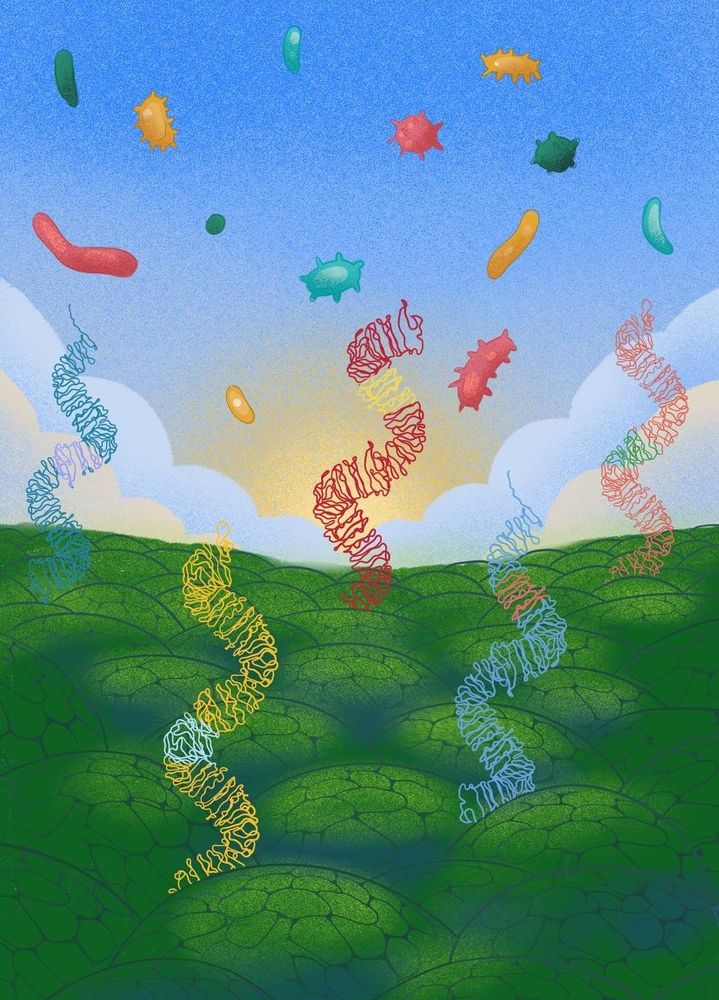
With this approach, we aim to characterize more PRRs against different pathogens & pests in the future.
04.09.2025 19:30 — 👍 4 🔁 2 💬 1 📌 0
To summarize, we reported the strategies to discover and engineer plant immune receptors.
As usual, we have uploaded the data, including RCM analysis, receptor & peptide sequences, raw data…etc etc on Zenodo
(zenodo.org/records/1546... )

Together with structural prediction, phylogenomics data, and lots of in-planta validations, we engineered synthetic SCORE that perceive CSPs from a range of plant pathogens and pests.
04.09.2025 19:30 — 👍 0 🔁 0 💬 1 📌 0
With the polymorphic CSP recognition specificity, we wonder if SCOREs can be engineered.
We predicted receptor-peptide structures to narrow down the region of interest.

They do!
Across the 22 SOCRE orthologs we tested, most exhibit unique recognition specificity towards different CSP peptides.

Bioinformatic analyses indicate that CSPs are very diverse across organisms (not just found in bacteria).
We wonder if SCORE orthologs across the flowering plant lineage can perceive different CSP peptides.

Unlike the previously identified PRR CORE, "181" exhibits a more selective recognition towards csp15 variants, so we named it “Selective CORE” (SCORE).
In addition, CORE and SCORE are not closely related; these receptors convergently evolved to perceive CSPs.

We screened for chimeric receptors activated by the plant pathogen Agrobacterium, and identified the receptor “181” from Pomelo.
Following biochemical analyses, we discovered that 181 perceives cold shock protein (CSP) peptides.

To characterize immune receptors (PRRs) in plants, we cluster PRRs into subgroups based on conservation of their inner LRR residues.
We obtained >1000s subgroups with this approach, and cloned ~210s into receptor chimeras for further characterization.
A🧵of the full story here:
bsky.app/profile/brun...
Below is an illustrative summary:

Very happy to share our latest work “Systematic discovery and engineering of synthetic immune receptors in plants” out in @science.org !
www.science.org/doi/10.1126/...
Yes! We are close to getting Arabidopsis transgenic lines that would recognize CSP from clubroot. Would be great to colab and test it!
18.03.2025 03:16 — 👍 2 🔁 0 💬 1 📌 0This has truly been one of my fav projects. Huge thanks to Michele & Marc, Takehiro & Dohmae-sensei for the bioinformatic & MS support, @yasukadota.bsky.social & @shirasulab.bsky.social for their unwavering support & belief in me & this project. Hope you enjoyed the thread & happy to discuss!
18.03.2025 01:55 — 👍 6 🔁 2 💬 0 📌 0
To summarize, we:
-Designed a system to characterize the pathogen recognition landscape of LRR-RLK-XIIs in plants
-Identified an ancient but lineage-specific PRR that exhibits remarkable polymorphism in MAMP recognition
-Designed PRRs to perceive specific MAMPs from multiple crop pathogens

Through this mini scan, we designed SCORE variants that robustly perceives CSPs from many devastating crop pathogens. Hopefully these would improve disease resistance against pathogens in crops
(XXI)

We did a mini-mutational scan on these 3 AAs, generated 37 SCORE variants and tested them against 104 csp15 peptides. To a certain extent, the surface charges in this region determine csp15 recognition specificity in SCORE
(XX)

Due to the AF prediction of ionic bonds between csp15 & 10th LRR of SCORE, we noticed that the surface charges in this region are different between SCORE orthologs. We can also drastically modify the surface charges, simply by mutating 3 AA residues in the 10th LRR
(XIX)

This indicates that 8th-11th LRR determines csp15 recognition specificity in SCOREs. We perform a bunch of LRR swaps between orthologs and narrow it further down to the 10th LRR. csp15 recognition specificity can, in an extend, be transferred between SCORE orthologs
(XVIII)