Bluesky
Big thanks to the team @torsteinslettmoen.bsky.social, @hannaeneqvist.bsky.social, Nienke L. De Jong, @emilierskytoen.bsky.social, @weijianzong.bsky.social,
@m-bmoser.bsky.social, at @kavlintnu.bsky.social. Funded by Norges forskningsråd, @erc.europa.eu via #KiloNeurons, and @kavlifoundation.org.
19.02.2026 11:53 —
👍 8
🔁 1
💬 0
📌 0

Place cells in CA1 lack topographical organization of firing locations | PNAS
Topography is a well-described and well-known concept for cortical organization in
primary sensory and motor cortices of mammalian brains. Similar ...
A half-century old question may have its final answer. Using high-resolution #Mini2P microscopes, we find no evidence of local topography in #PlaceCells. Place fields of neighbouring cells are no more similar than those of randomly selected cells. 🧠🗺️ Out now in @pnas.org www.pnas.org/doi/10.1073/...
19.02.2026 11:53 —
👍 146
🔁 43
💬 4
📌 8
I recommend this school to anyone interested in computation in the brain - it receives excellent reviews year after year, it is highly interactive and social, and the setting is remarkable.
18.02.2026 09:51 —
👍 32
🔁 10
💬 0
📌 1
Correct text for post (4/6):
Sweeps bias towards a fast-moving bait during spontaneous pursuit, reorient when the animal loses and regains the target, and even reverse during backward locomotion to align with intended movement direction.
See 📹
28.01.2026 13:31 —
👍 3
🔁 0
💬 0
📌 0
Correct text for post (4/6):
Sweeps bias towards a fast-moving bait during spontaneous pursuit, reorient when the animal loses and regains the target, and even reverse during backward locomotion to align with intended movement direction.
See 📹
28.01.2026 13:23 —
👍 5
🔁 0
💬 1
📌 0
Thrilled to share w/ my eminent colleagues: @azvollan.bsky.social
@mschellenberger.bsky.social
@m-bmoser.bsky.social at @kavlintnu.bsky.social
Grateful for support by Norwegian Research Council; @erc.europa.eu by #KiloNeurons, & @kavlifoundation.org
Thanks to @rjgardner.bsky.social (6/6)
28.01.2026 10:03 —
👍 9
🔁 0
💬 1
📌 0
These changes occur instantly, without learning or trained goals. Rather than encoding routes to goals, theta sweeps act as a general, attention-like mechanism for continuously and selectively sampling of behaviourally relevant locations within an allocentric map. (5/6)
28.01.2026 10:03 —
👍 13
🔁 0
💬 2
📌 0
Whether the system can be flexibly redirected to prioritize specific locations has been unclear. Using large-scale #Neuropixels recordings in freely behaving rats, we find that both sweeps – and the internal direction signals driving them – are dynamically modulated moment by moment. (4/6)
28.01.2026 10:03 —
👍 34
🔁 9
💬 3
📌 2
Whether the system can be flexibly redirected to prioritize specific locations has been unclear. Using large-scale #Neuropixels recordings in freely behaving rats, we find that both sweeps – and the internal direction signals driving them – are dynamically modulated moment by moment. (3/6)
28.01.2026 10:03 —
👍 10
🔁 0
💬 1
📌 0
Theta sweeps are population sequences in #gridcells and #placecells that, once per theta cycle, radiate outward from the animal’s location. In baseline conditions, they alternate rigidly left-right around the head axis, generating broad, forward-oriented sampling of nearby #space. (2/6) 🧠🧹
28.01.2026 10:03 —
👍 10
🔁 0
💬 1
📌 0
Attention-like regulation of theta sweeps in the brain's spatial navigation circuit
Spatial attention supports navigation by prioritizing information from selected locations. A candidate neural mechanism is provided by theta-paced sweeps in grid- and place-cell population activity, which sample nearby space in a left-right-alternating pattern coordinated by parasubicular direction signals. During exploration, this alternation promotes uniform spatial coverage, but whether sweeps can be flexibly tuned to locations of particular interest remains unclear. Using large-scale Neuropixels recordings in freely-behaving rats, we show that sweeps and direction signals are rapidly and dynamically modulated: they track moving targets during pursuit, precede orienting responses during immobility, and reverse during backward locomotion — without prior spatial learning. Similar modulation occurs during REM sleep. Canonical head-direction signals remain head-aligned. These findings identify sweeps as a flexible, attention-like mechanism for selectively sampling allocentric cognitive maps. ### Competing Interest Statement The authors have declared no competing interest. European Research Council, Synergy Grant 951319 (EIM) The Research Council of Norway, Centre of Neural Computation 223262 (EIM, MBM), Centre for Algorithms in the Cortex 332640 (EIM, MBM), National Infrastructure grant (NORBRAIN, 295721 and 350201) The Kavli Foundation, https://ror.org/00kztt736 Ministry of Science and Education, Norway (EIM, MBM) Faculty of Medicine and Health Sciences; NTNU, Norway (AZV)
The hippocampal map has its own attentional control signal!
Our new study reveals that theta #sweeps can be instantly biased towards behaviourally relevant locations. See 📹 in post 4/6 and preprint here 👉
www.biorxiv.org/content/10.6...
🧵(1/6)
28.01.2026 10:03 —
👍 183
🔁 62
💬 4
📌 10
Whether the system can be flexibly redirected to prioritize specific locations has been unclear. Using large-scale #Neuropixels recordings in freely behaving rats, we find that both sweeps – and the internal direction signals driving them – are dynamically modulated moment by moment. (4/6)
28.01.2026 09:50 —
👍 0
🔁 0
💬 0
📌 0
Whether the system can be flexibly redirected to prioritize specific locations has been unclear. Using large-scale #Neuropixels recordings in freely behaving rats, we find that both sweeps – and the internal direction signals driving them – are dynamically modulated moment by moment. (3/6)
28.01.2026 09:50 —
👍 0
🔁 0
💬 1
📌 0
Whether the system can be flexibly redirected to prioritize specific locations has been unclear. Using large-scale #Neuropixels recordings in freely behaving rats, we find that both sweeps – and the internal direction signals driving them – are dynamically modulated moment by moment. (3/6)
28.01.2026 09:50 —
👍 0
🔁 0
💬 1
📌 0
Theta sweeps are population sequences in #gridcells and #placecells that, once per theta cycle, radiate outward from the animal’s location. In baseline conditions, they alternate rigidly left-right around the head axis, generating broad, forward-oriented sampling of nearby #space. (2/6) 🧠🧹
28.01.2026 09:50 —
👍 0
🔁 0
💬 1
📌 0
Gratulerer til Magnar Bjørås - en velfortjent og solid anerkjennelse av forskning i verdensklasse ved #NTNU!
09.01.2026 21:42 —
👍 2
🔁 0
💬 0
📌 0

Board chair Bjarne Foss, @m-bmoser.bsky.social @edvardmoser.bsky.social @torgrande.bsky.social HM King Harald V, Secretary General of @nasjonalforeningen.no Bo Gleditsch, Centre Directors @asgeirkf.bsky.social Gøril Rolfseng Grøntvedt and Minister of Research Sigrun Aasland @kd.regjeringen.no
15.12.2025 20:55 —
👍 6
🔁 1
💬 1
📌 1
Come and join us tomorrow morning to discuss the latest findings from our lab(s)! We have many highlights to share!
18.11.2025 23:15 —
👍 11
🔁 0
💬 1
📌 0
1/8
How can the brain create countless unique memories using a single, universal metric of space? We’ve been waiting for the answer to this for two decades!
Read it here:
www.biorxiv.org/content/10.1...
25.09.2025 04:14 —
👍 59
🔁 23
💬 2
📌 3
5/5 Big thanks to the team and collaborators @clykken.bsky.social @beneuroscience.bsky.social @anagelhus.bsky.social @jocarpenter.bsky.social @matteoguardamagna.bsky.social @m-bmoser.bsky.social @kavlintnu.bsky.social
#Neuroscience #GridCells #PlaceCells #EpisodicMemory #Neuropixels #KiloNeurons
25.09.2025 04:06 —
👍 8
🔁 0
💬 0
📌 0
4/5 Conclusion: Independent phase changes across grid modules are sufficient to generate a vast array of distinct hippocampal representations.
Why this matters: Such combinatorial flexibility is a key requirement for forming episodic memories, offering a mechanism for high-capacity memory.
25.09.2025 04:06 —
👍 9
🔁 0
💬 1
📌 0
3/5 We discovered that when grid cell modules realigned differently between environments, hippocampal place cells remapped. Strikingly, the extent of this remapping was directly predicted by the disparity in phase changes across grid modules.
25.09.2025 04:06 —
👍 7
🔁 0
💬 1
📌 0
2/5 After two decades, our hypothesis for this space-to-memory transformation finally met a decisive test.
Led by our outstanding postdoc @clykken.bsky.social, we performed multi-area #Neuropixels recordings simultaneously from hippocampal place cells and multiple MEC grid cells modules in rats 🧠
25.09.2025 04:06 —
👍 7
🔁 0
💬 1
📌 0
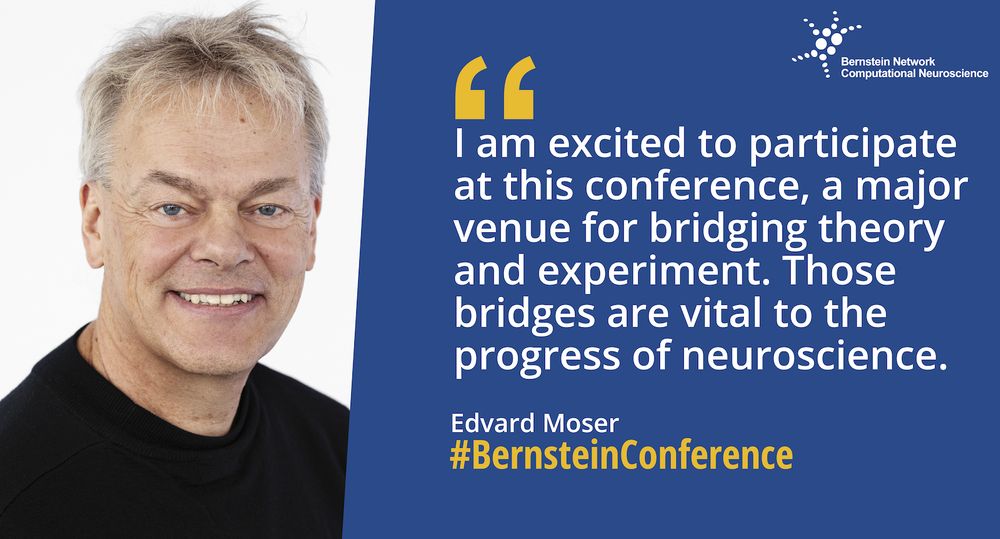
A portrait photo of Edvard Moser, next to it the following quote: "I am excited to participate at this conference, a major venue for bridging theory and experiment. Those bridges are vital to the progress of neuroscience."
In case you still need a reason to attend the #BernsteinConference, let us remind you of this year's great speaker line-up 🤩
First up is Nobel laureate @edvardmoser.bsky.social!
Be part of the bridge -- registration is open! 👉 bernstein-network.de/bernstein-co...
17.07.2025 07:02 —
👍 10
🔁 2
💬 0
📌 0
BonnBrain 2026 is a go!
March 23–25, Bonn (DZNE, Bonn, Germany).
Apply now: www.bonnbrain.de
Limited slots. Presentations (posters/talks) selected from submitted abstracts.
Keynotes & invited speakers 👇
09.09.2025 09:45 —
👍 27
🔁 16
💬 1
📌 0
Excellent work, and very interesting observations - congratulations!
13.08.2025 13:34 —
👍 0
🔁 0
💬 1
📌 0
So beautiful up there, only 58 min to the trailhead!
09.08.2025 19:44 —
👍 18
🔁 0
💬 1
📌 0


Storskarven 🤩
09.08.2025 18:35 —
👍 26
🔁 1
💬 2
📌 1
🧠⏳ This discovery would not be possible without #Neuropixels and the dedication and talent of @beneuroscience.bsky.social @clykken.bsky.social @nachopolti.bsky.social @m-bmoser.bsky.social at the @kavlintnu.bsky.social (2/2)
26.06.2025 18:06 —
👍 14
🔁 1
💬 0
📌 1