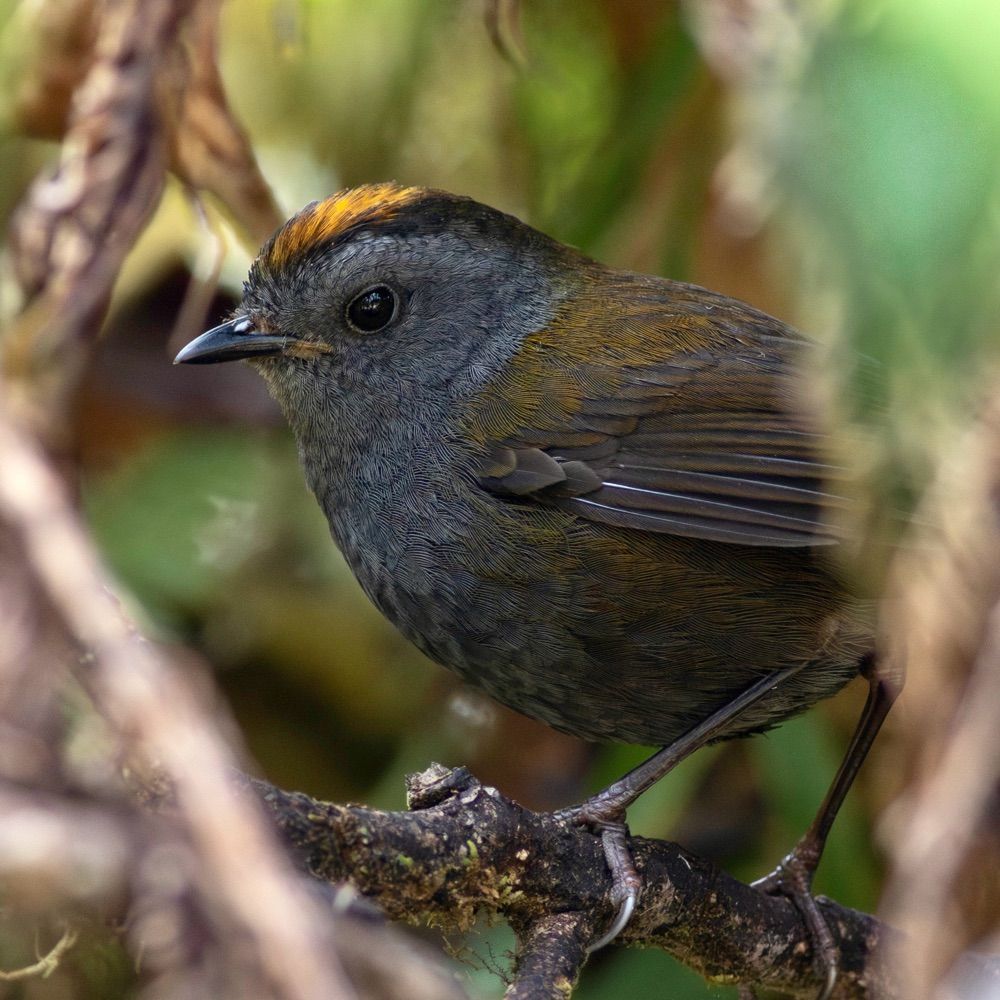
Photo montage of Tinamus resonans sp. nov., a new species of tinamou from the montane forests of the Serra do Divisor, western Amazonia, Brazil. The species is distinguished by a unique combination of plumage pattern, vocal repertoire, and ecological characteristics, including a conspicuous dark slate facial mask, vivid rufous-cinnamon underparts, and a uniform brownish-gray back. Its vocalizations are remarkable, consisting of long and powerful songs that echo strikingly across the steep montane slopes, producing a characteristic resonant effect. The species was documented exclusively at higher elevations within a transitional zone between submontane and stunted forests, where the understory is densely structured by root mats. A preliminary population estimate, based on field detections and spatial extrapolation, suggests approximately 2,106 individuals restricted to the Serra do Divisor massif. Although no immediate anthropogenic pressures were observed within its range, the species may be highly vulnerable to climate change and to proposed infrastructure projects that threaten the integrity of this federally protected region. The discovery of T. resonans highlights the biological uniqueness of the Serra do Divisor, reinforces its status as a center of montane endemism, and underscores the critical importance of maintaining its long-term conservation.
Huge News from the Western Amazon: it's the year 2025 and we are still describing entirely new, strikingly-distinctive large-bodied bird species! Behold Tinamus resonans sp. nov. the Slaty-masked Tinamou mapress.com/zt/article/v... #Ornithology @tetzoo.bsky.social 🪶
02.12.2025 07:20 —
👍 314
🔁 96
💬 9
📌 15
Among many others, huge thanks go to Carla Mere Roncal, Arianna Basto, Zuzana Burivalova, and my advisor Christopher Searcy for seeing me through to the end of this wild project. Can't wait to share what we're able to do with this workflow in the future…
🧵(8/8)
08.07.2025 20:46 —
👍 1
🔁 0
💬 0
📌 0
We think this hybrid approach could be a flexible and repeatable means to answer questions about interior forest birds in the tropics that wouldn't be possible using a single data source
🧵(7/8)
08.07.2025 20:46 —
👍 1
🔁 0
💬 1
📌 0
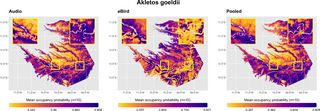
The pooled models outperformed eBird-only models for predicting fine grain species-habitat associations in intact forest, but also retained information from eBird about species occurrence patterns in non-vegetated areas away from intact forest, including those subject to human disturbance
🧵(6/8)
08.07.2025 20:46 —
👍 1
🔁 0
💬 1
📌 0
For a five interior forest suboscine species in Madre de Dios, southeastern Peru, we combined long duration acoustic monitoring survey data and a filtered subset of eBird data available for the region with a high resolution land cover dataset of the region’s key ecological gradients
🧵(5/8)
08.07.2025 20:46 —
👍 1
🔁 0
💬 1
📌 0
Acoustic monitoring data is also becoming more available in the tropics… it is only cost and time-effective over small areas, but is still a great way to survey important ecological gradients for vocal organisms. CS tech for rapidly processing audio data, such as BirdNET, greatly helps
🧵(4/8)
08.07.2025 20:46 —
👍 1
🔁 0
💬 1
📌 0
There is less biodiversity data available for the tropics than the temperate zone, but citizen science data has been accumulating over time. eBird data are free to use and cover a large spatial extent, but sometimes have problems with survey evenness and quality
🧵(3/8)
08.07.2025 20:46 —
👍 1
🔁 0
💬 1
📌 0