These vessels have the shape of glass lamps intended for mosques and tombs, but since they are opaque and could have emitted no light, their function was purely decorative.
Mosque Lamp https://clevelandart.org/art/1944.236
04.03.2026 14:20 —
👍 3
🔁 0
💬 0
📌 0

In this dynamic large-format painting, Bahram Gur plunges his sword into the breast of a dragon. Iranian painting during the Mongol period borrowed stylistic and spatial elements from Chinese models, such as the rock formations, tree trunk, and dragon. The surging landscape and writhing dragon create a painting of extraordinary vitality and unity. Bahram Gur (ruled ad 420-438) was a popular king from pre-Islamic Sasanian Iran and a great hunter. He took the name "Gur," meaning onager (a wild ass), because it was his preferred game-although he also excelled at killing dragons.
Bahram Gur Slays a Dragon (verso), from a Shahnama (Book of Kings) of Firdausi (940-1019 or 1025), known as the Great Mongol Shahnama https://clevelandart.org/art/1943.658.b
04.03.2026 11:27 —
👍 2
🔁 0
💬 0
📌 0

Page from a Koran (recto)
Page from a Koran (recto) https://clevelandart.org/art/1933.488.a
04.03.2026 08:31 —
👍 3
🔁 0
💬 0
📌 0

Because of its connection with the Koran, calligraphy was elevated above all other art forms in the Islamic world. From an awkward and nearly illegible form of writing, Arabic script was transformed during the 600s and 700s to make it worthy of recording the Divine word. By the 800s, Muslim scribes were producing copies of the Koran that were true calligraphic masterpieces. This Koran, written entirely in gold, exemplifies the angular form of writing known as Kufic at its majestic best. The text on the right page is the opening of the Chapter of the Star (53:1–21), which begins: “By the star when it plunges, your comrade is not astray, neither errs, nor speaks he out of caprice. This is naught but a revelation revealed, taught him by one terrible in power, very strong. . . . ”
Qur'an Manuscript Folio (verso); Left side of Bifolio https://clevelandart.org/art/1993.39.2.b
03.03.2026 16:44 —
👍 2
🔁 0
💬 0
📌 0

This small illustration of ringdoves incorporates the influence of Chinese naturalism in the drawing of the tree trunk and lotus blossom. In contrast, the reverse side is more traditional. The innovative page layouts feature cursive <em>nashki</em> script with bold angular <em>kufic</em> script headings. Derived from Aristotelian sources, this treatise deals with the physical characteristics and organs of animals. The text was translated into Persian from Arabic for the Ilkhanid ruler Ghazan Khan (reigned 1295–1304). Roughly a dozen pages from this long-lost manuscript are known. It is dated by comparison with a similar manuscript made at Maragha, near Tabriz, in 1297 or 1299.
Qualities of Ringdoves (recto); On the Benefits of Quails (verso), from a Manafi' al-Hayawan (On the Usefulness of Animals) of Ibn Bakhtishu' (d. 1058) https://clevelandart.org/art/1945.382
03.03.2026 12:24 —
👍 4
🔁 0
💬 0
📌 0

Bowl
Bowl https://clevelandart.org/art/1915.594
03.03.2026 10:40 —
👍 1
🔁 0
💬 0
📌 0

The carved surface with raised outlines allowed glazes of different colors to be side-by-side without running together when fired.
Dish with Falcon Attacking a Water Bird https://clevelandart.org/art/1938.7
02.03.2026 19:28 —
👍 4
🔁 1
💬 0
📌 0

Illuminated Folio (verso) from a Gulistan (Rose Garden) of Sa'di (c. 1213-1291)
Illuminated Folio (verso) from a Gulistan (Rose Garden) of Sa'di (c. 1213-1291) https://clevelandart.org/art/2006.148.b
02.03.2026 15:29 —
👍 0
🔁 0
💬 0
📌 0

A prince from Iran’s early legendary history, Siyavush was sent by his father, the shah, to train under the great warrior Rustam in the arts of hunting, archery, and horseback riding. In this painting, Siyavush demonstrates his considerable skill by hitting the bulls eye on a rolling target from horseback. The gold sky, pastel ground with grassy tufts, and dense leafy riverbank are distinctive features of Persian painting during this period.
Siyavush on his Horse Hitting a Rolling Target (recto) and Persian verses (verso) from a Shahnama (Book of Kings) of Firdausi (940-1019 or 1025) https://clevelandart.org/art/1942.871
02.03.2026 13:27 —
👍 2
🔁 0
💬 0
📌 0

Under Shah Abbas, the tradition in which painting was employed to illustrate a literary work was all but abandoned. In its place came a new concern with single-page illustrations, such as this one, which have no specirfic content or meaning. They often illustrate albums of collections of verses about love and beauty, in which these themes often appear to serve as allegories of things divine.
Persian Couplets (recto), Calligraphy, Persian Verses; Single Page Manuscript https://clevelandart.org/art/1944.494.a
02.03.2026 10:57 —
👍 0
🔁 0
💬 0
📌 0

Pottery with plant designs painted in black and under a clear or turquoise glaze was produced from about 1460 until 1700. Typically these vessels have a soft and porous white clay body with a thin glassy glaze that is apt to crackle. Characteristic of later production, the design on this dish is freely and vigorously drawn. Because many of these vessels were found in peasant houses in the town of Kubacha in Caucasus, the name "Kubachi" ware was given to the entire group.
Dish https://clevelandart.org/art/1915.595
01.03.2026 18:13 —
👍 0
🔁 0
💬 0
📌 0

This unfinished painting—the left side of a double- page composition—shows a group of musicians on the far side of a stream and figures trying to gain entry to the royal encampment on the near side. Below, a cook prepares meat on a brazier while a servant holds a stick of kabobs over a dish. One man has fallen to the ground, probably intoxicated.<br>One of the most famed painters from the Timurid court, Bihzad is known for his carefully balanced compositions and precise draftsmanship, and other artists emulated his style. After his death his works were regarded as the exemplars of Persian painting, both in Iran and in Mughal India, whose emperors collected his work.
Folio from an Album with Musicians and Servants Outside a Royal Encampment (recto) and Calligraphy, Persian Verses (verso) https://clevelandart.org/art/1944.490
01.03.2026 16:38 —
👍 2
🔁 0
💬 0
📌 0

"The Forty-Eighth Year of Nushirwan's Reign. The Combat of the Khaqan of China with the Haithalians in the manuscript of Shahnama of Firdawsi.
"The Forty-Eighth Year of Nushirwan's Reign. The Combat of the Khaqan of China with the Haithalians in the manuscript of Shahnama of Firdawsi. https://clevelandart.org/art/1962.25.b
01.03.2026 11:51 —
👍 0
🔁 0
💬 0
📌 0

Preface, verso of the left folio from a double-page frontispiece of a Shahnama of Firdausi (940-1019 or 1025)
Preface, verso of the left folio from a double-page frontispiece of a Shahnama of Firdausi (940-1019 or 1025) https://clevelandart.org/art/1956.10.b
01.03.2026 09:14 —
👍 0
🔁 0
💬 0
📌 0

This bowl with white slip designs on gray slip grounds, was made after the Mongol conquest of Iran in the 13th century and show Chinese influence in its flat rim.
Bowl with Flying Birds https://clevelandart.org/art/1915.589
28.02.2026 17:20 —
👍 3
🔁 1
💬 0
📌 0

Bottle
Bottle https://clevelandart.org/art/1951.291
28.02.2026 15:55 —
👍 2
🔁 0
💬 0
📌 0

Jug
Jug https://clevelandart.org/art/1915.584
28.02.2026 13:25 —
👍 2
🔁 0
💬 0
📌 0

Two powerful lions appear to guard the central hitching ledge to which travelers and merchants could secure their horses and other animals, possibly at a caravanserai, predecessor of the modern motel, located along trade routes such as the Silk Road. Animals and human figures are often represented in art made in Islamic countries, but they are not portrayed on items associated with the Muslim faith -- the Koran, mosques, and prayer rugs.
Hitching Post https://clevelandart.org/art/1944.481
27.02.2026 18:38 —
👍 1
🔁 0
💬 0
📌 0

Sultanabad wares were the first new type of pottery made in Iran after the Mongol conquest. These underglaze painted wares are characterized by a somber color scheme of gray, black, and white. The name "Sultanabad" comes from the modern city near which they were first discovered. This type of pottery was widely exported, perhaps even imitated, for it has been excavated over a vast area from central Asia to Egypt.
Bowl https://clevelandart.org/art/1915.591
27.02.2026 16:11 —
👍 1
🔁 0
💬 0
📌 0

In Iran between the 1630s and 1650s, the court painter Shafi’ ‘Abbasi, son of the renowned painter Riza ‘Abbasi, specialized in a new fashion depicting naturalistic plants and birds, some adapted from European sources such as botanical engravings or herbals. Several have been identified as patterns for textiles, evidenced by pricked holes along the contours, which allowed designs to be transferred to another surface. The inscription indicates that Shafi’ ‘Abbasi made this painting for Shah Abbas II in 1651-52. Presumably, he copied this composition from a European engraving.
Black and White Bird Perched on a Shrub https://clevelandart.org/art/1971.84
27.02.2026 11:24 —
👍 2
🔁 0
💬 0
📌 0

This inlaid bowl has interlacing geometric designs in 12 arched panels that radiate from a star on the base. A pinwheel of six fish is engraved in the interior. Scholars recently reattributed them to Islamic manufacture, possibly for export to Europe.
Bowl with Geometric Designs https://clevelandart.org/art/1945.133
27.02.2026 08:14 —
👍 0
🔁 0
💬 0
📌 0
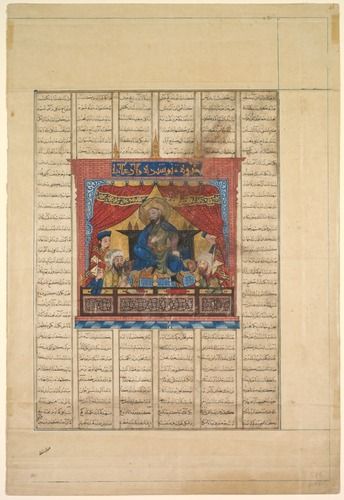
Mongol interest in the production of illustrated manuscripts eventually focused on Persian epic poetry. The Shahnama, a compilation of the epics and tales of Iran's legendary heroes, was a natural choice; the book included many subjects that suited Mongol taste, such as banquets, battles, hunting, and magical or fantastic events. Seated on the throne in the center of the painting is the Sasanian ruler of Iran, Khusraw I Anushirwan (531–579), descendant of Bahram Gur. Above the king's head an inscription reads, "Picture of Nushirwan the Just." The figure in the elaborate turban to the left of the king is probably the young Minister Buzurgmihr, famous for his wisdom and virtue. To celebrate the explanation of a troublesome dream by Buzurgmihr, Nushirwan held a series of seven banquets. The text around this painting describes the fifth banquet.
Text Page, Persian Verses (Recto); Portrait of Nushirwan the Just (Verso) https://clevelandart.org/art/1959.330
26.02.2026 17:09 —
👍 4
🔁 0
💬 0
📌 0

Bahram Gur meets Arzu, the Daughter of Mahiyar (verso); Illustration and Text, Persian Verses, from the Shahnama of Firdawsi
Bahram Gur meets Arzu, the Daughter of Mahiyar (verso); Illustration and Text, Persian Verses, from the Shahnama of Firdawsi https://clevelandart.org/art/1945.387.b
26.02.2026 16:53 —
👍 4
🔁 1
💬 0
📌 0

"Benefits of the Parts of Vultures" (From the Manafi' al-Haywan of Abu Sai'd Ubayd-Allay Ibn Bakhtishu) (recto)
"Benefits of the Parts of Vultures" (From the Manafi' al-Haywan of Abu Sai'd Ubayd-Allay Ibn Bakhtishu) (recto) https://clevelandart.org/art/2006.149.a
26.02.2026 11:54 —
👍 7
🔁 1
💬 0
📌 0

Incense Burner
Incense Burner https://clevelandart.org/art/1937.26
26.02.2026 09:06 —
👍 1
🔁 0
💬 0
📌 1

This finely pierced steel plaque is said to have adorned the royal tomb of Shah Suleyman II (reigned 1666-93). The Qur’anic inscription reads: "Verily, God and His Angels send blessings on the Prophet" (33:56). Metalworkers exploited the steel’s tensile strength to its highest artistic possibilities.
Inscription Plaque, Possibly from a Door https://clevelandart.org/art/1994.1
25.02.2026 17:52 —
👍 2
🔁 0
💬 0
📌 0

Qur'an Manuscript Folio. Left Folio of a Bifolio (verso)
Qur'an Manuscript Folio. Left Folio of a Bifolio (verso) https://clevelandart.org/art/1933.473.2.b
25.02.2026 16:30 —
👍 2
🔁 0
💬 0
📌 0

This leaf from a 1315 Syrian copy of Ibn al-Razzāz al-Jazarī’s <em>The Book of Knowledge of Ingenious Mechanical Devices</em>, written in 1206, depicts a peacock basin automaton for ritual hand washing. There are 15 surviving manuscript copies of al-Jazarī’s work, ranging from the early 13th to the late 19th century. An engineer from upper Mesopotamia, al-Jazarī was in the service of King Nasrī al-Dīn when he completed his masterwork, an anthology of automated devices including clocks, trick vessels for drinking sessions, devices for washing, fountains, water-raising machines, and measuring instruments. His designs clearly illustrate that automata were not innovations from Western Europe, but they stemmed from a tradition known in the ancient, Islamic, and Byzantine worlds. We do not know with certainty that al-Jazarī’s device was ever actually constructed.
Peacock-shaped Hand Washing Device (recto); Text Page, Arabic Prose (verso) https://clevelandart.org/art/1945.383
25.02.2026 12:11 —
👍 2
🔁 0
💬 0
📌 0

Bottle
Bottle https://clevelandart.org/art/1915.548
25.02.2026 08:47 —
👍 4
🔁 2
💬 0
📌 0

The painting on the verso of this folio is the first half of a double-page frontispiece now detached from a <em>Shahnama</em> (Book of Kings) manuscript. CMA 1956.10 is the left half of the frontispiece.<br><br>As though setting the scene for royal stories and activities, these two opening pages of Iran’s national epic present a luxurious gathering in an idyllic outdoor setting. Groups of nobles and international diplomats have come bearing gifts, including costly vessels and hunting animals. <br><br>At the upper right, seemingly uninterested in the emissaries and gifts, a prince kneels with six royal women under an open tent. He pulls one of them toward him, apparently to coax her to drink a cup of wine. At the bottom a musician plays a harp that has been mounted over a stream, painted with now tarnished silver paint. Drama and intrigue seem to be brewing, given the knowing glances and whispers between figures.
Royal Feast in a Garden, verso of right folio from the double-page frontispiece of a Shah-nama of Firdausi (Persian, about 934–1020) https://clevelandart.org/art/1945.169.b
24.02.2026 17:22 —
👍 3
🔁 2
💬 0
📌 0