
Thanks Luca!
27.02.2026 13:59 — 👍 0 🔁 0 💬 0 📌 0Thanks Luca!
27.02.2026 13:59 — 👍 0 🔁 0 💬 0 📌 0Amazing peppered moth story from Saccheri lab - same locus, but different structural variants, underly parallel evolution of industrial melanism in the UK and across continental Europe.
27.02.2026 13:41 — 👍 31 🔁 17 💬 1 📌 0
A mini review on the seasonal plasticity of butterfly eyespots. www.sciencedirect.com/science/arti...
13.02.2026 00:03 — 👍 6 🔁 1 💬 0 📌 0Very excited to share that my first first-author pre-print is out today! Many thanks go out to all of our collaborators, especially those who helped with the fieldwork in Peru - it really wouldn't have been possible without you! 🦋
23.01.2026 09:35 — 👍 20 🔁 10 💬 1 📌 1

Evolution rarely invents from scratch.
Our recent study reveals that butterfly eyespots evolved by co-opting an ancient wing vein gene network. New trait, old genes. The study is now published in Communications Biology (featured: Jan26) www.nature.com/articles/s42...

Our eLetter github.com/caseywdunn/s... responding to a recent Science paper was just posted. The paper found more genes with consistent support for sponge-sister than ctenophore-sister. We found several technical issues that, when corrected, reverse the conclusions and recover ctenophore-sister.
09.01.2026 11:44 — 👍 131 🔁 57 💬 5 📌 9Congrats @jeffgroh.bsky.social et al. Some avocado trees open female-phase flowers in the morning & then male in afternoon. Others show complementary pattern (m->f), to synchronize pollination of two types. Jeff show this to be a >45Mya polymorphism at a transcription factor across 100s of species.
25.12.2025 18:47 — 👍 142 🔁 61 💬 1 📌 3
GWAS has been an incredible discovery tool for human genetics: it regularly identifies *causal* links from 1000s of SNPs to any given trait. But mechanistic interpretation is usually difficult.
Our latest work on causal models for this is out yesterday:
www.nature.com/articles/s41...
A short🧵:
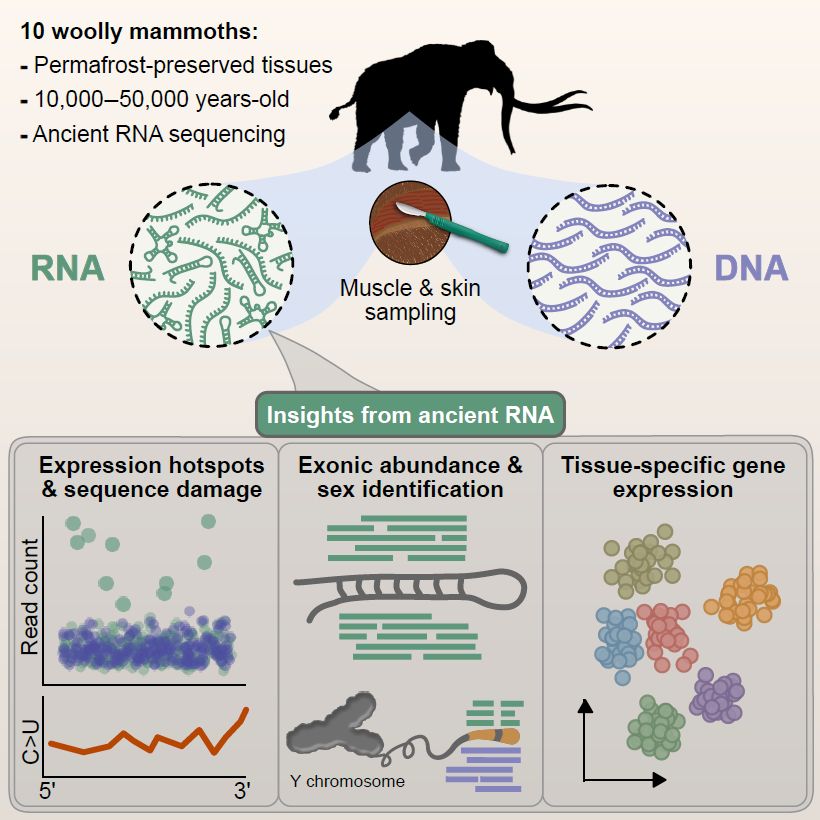
🦣🧬🦣🤯💥We are pleased to share our new paper about ancient RNA expression profiles from the Woolly Mammoth, now published in Cell @cellpress.bsky.social
www.cell.com/cell/fulltex...
If you want to know more, read the 🧵 below:

NEW pub in @science.org 🥳
Is it sponges (panels A & B) or comb jellies (C & D) that root the animal tree of life?
For over 15 years, #phylogenomic studies have been divided.
We provide new evidence suggesting that...
🔗: www.science.org/doi/10.1126/...
Hi, I'm setting up a peer support platform for ECRs in ecology & evolution in China, aiming to address a huge problem --- academic burnout driven by hyper-competition and a system that often prioritizes elite background/title over actual research.
#ECR #AcademicSupport #科研互助 #ecology #evolution

🔥🔥🔥🔥New paper out; a opinion piece in @narjournal.bsky.social with Michael Hackenberg, @panosbino.bsky.social, Kevin K Peterson and @marcfriedlander.bsky.social 🔥🔥🔥🔥
„Knowing is not enough, we must apply“
academic.oup.com/nar/article/...

Project overview

About the lab

Entry requirements

Funding & eligibility
PhD position for Chinese nationals! London-based, funded by China Scholarship Council & @qmul.bsky.social
"Ecology & genomics of climate adaptation: mapping functional genetic variation in wild insect populations"
shorturl.at/Vfi8W
DM for more info!
#conservation #genomics #ecology #biodiversity

A personal favorite, long time in the making. Adelina and David (@dduneau.bsky.social) were instrumental in getting this done.
doi.org/10.1186/s129...

For those interested in GRN evolution, please join us!
28.10.2025 00:31 — 👍 10 🔁 8 💬 1 📌 0Hi Aaron, sure, will pm you
27.10.2025 09:48 — 👍 0 🔁 0 💬 1 📌 0
A news article about the paper by Jennifer Brisson:
www.nature.com/articles/s41...

This study @science.org finds what appears to be the long-lost RNA subunit of C. elegans telomerase. The TERC RNA is encoded within an intron of a germline-upregulated gene, nmy-2🪱🔬🧬Nematode telomerase RNA hitchhikes on introns of germline–up-regulated genes | Science www.science.org/doi/10.1126/...
23.10.2025 21:38 — 👍 46 🔁 14 💬 1 📌 1This is the final piece of my PhD thesis. A big thanks to Bonnie, @tirthabanerjee.bsky.social, Suriya, and @monteirolab.bsky.social for their support! 9/9
24.10.2025 10:14 — 👍 0 🔁 0 💬 0 📌 0
Cr. to William Piel
We found a novel promoter of a Hox gene promoting adaptive temperature sensitivities across a large clade of butterflies. This highlights the essential roles of novel cis-regulatory elements in fueling adaptations on a macroevolutionary scale. 8/9
24.10.2025 10:14 — 👍 1 🔁 0 💬 1 📌 0
In B. anynana, disrupting this novel promoter reduced the butterfly’s ability to adjust eyespot size with temperature, showing that this genetic element contributed to the evolution of temperature-mediated eyespot size plasticity in satyrid butterflies. 7/9
24.10.2025 10:14 — 👍 0 🔁 0 💬 1 📌 0
How is Antp activated in eyespots of a specific clade of butterflies? We found a genetic switch, a promoter, that evolved specifically in satyrid butterflies, and it activates Antp expression specifically in eyespot central cells. 6/9
24.10.2025 10:14 — 👍 0 🔁 0 💬 1 📌 0
Disrupting Antp in two satyrid butterflies reduced eyespot size, especially when the insects were raised at warmer temperatures, confirming Antp’s role in boosting the levels of eyespot size plasticity. 5/9
24.10.2025 10:14 — 👍 0 🔁 0 💬 1 📌 0
From the tissue-specific transcriptomic data, we pinpointed a Hox gene Antennapedia (Antp), showing higher eyespot expression levels at warmer temperatures. Notbly, among all butterflies with eyespots, Antp is only activated in the eyespots of satyrid butterflies. 4/9
24.10.2025 10:14 — 👍 1 🔁 0 💬 1 📌 0
How did satyrid butterflies evolve such temperature sensativities? In a model satyrid Bicyclus anynana, we profiled gene expression from both eyespot and non-eyespot developing wing tissues across two temperatures, using laser-microdissection. 3/9
24.10.2025 10:14 — 👍 1 🔁 0 💬 1 📌 0
Many tropical satyrid butterflies look strikingly different in different seasons. In the hot wet season, these butterflies develop large eyespots on their wings. In the cold dry season, these eyespots are small. This change enhances their survival in each season. 2/9
24.10.2025 10:14 — 👍 1 🔁 0 💬 1 📌 0
Cr. to Shen Tian
My main PhD work @monteirolab.bsky.social is now in @natecoevo.nature.com! We found a Hox gene promoter that helps butterflies🦋adjust their wing eyespots in response to seasonal temperatures🍃🍂, shedding light on the evolutionary origin of phenotypic plasticity. 1/9 www.nature.com/articles/s41...
24.10.2025 10:14 — 👍 69 🔁 26 💬 2 📌 31/3 Excited that my final PhD MS is online! Big thanks to Ullasa (PI) (vanasiri.in) & collaborators Freerk and Urszula. Turns out humidity, not just temperature, plays a major role in butterfly eyespot plasticity. doi.org/10.1101/2025...
16.10.2025 07:26 — 👍 20 🔁 9 💬 1 📌 0
