🎉 New face database just dropped!
The Israeli Face Database (IFD) is a massive, diverse, and richly annotated set of facial images — now published in Behavior Research Methods.
Thread 🧵👇
20.06.2025 14:55 —
👍 37
🔁 19
💬 1
📌 0
Maybe that's the lesson:
In an age of infinite information, we don't just need more data, we need data that withstands scrutiny, aligns with credible sources, and helps us build more accurate models of the world, not just more confident ones.
19.09.2025 22:19 —
👍 0
🔁 0
💬 0
📌 0
🔹 It helps us calibrate our own thinking around what we believe is true, by comparing our thoughts and assumptions to those of others.
🔹 And it helps everyone make better inferences about what is factual and true.
19.09.2025 22:17 —
👍 0
🔁 0
💬 1
📌 0
What the game reminded me is that having more of the right kind of data, the kind that has predictive power to uncover the truth (in this case, the true number assigned to each player), and that converges with other sources, helps everyone:
19.09.2025 22:16 —
👍 0
🔁 0
💬 1
📌 0
We're surrounded by a flood of data—news, posts, opinions, algorithmic suggestions—but quantity alone doesn't improve understanding. Unless those data points carry useful signal, they don’t help with calibration or inference. In fact, too many noisy or low-quality data points can make things worse.
19.09.2025 22:15 —
👍 1
🔁 0
💬 1
📌 0
🔹 Better context for players to calibrate their responses based on others’, and
🔹 Better signal for the question-asker to fine-tune their interpretation.
It made me think: what if we applied this logic to how we process information in real life?
19.09.2025 22:15 —
👍 0
🔁 0
💬 1
📌 0
What surprised me was that the game got easier with 9 players.
More players = more data points.
That helped in two key ways:
19.09.2025 22:12 —
👍 0
🔁 0
💬 1
📌 0
Here’s how it works:
One person asks a question.
Everyone else (with a unique number 1–10) gives an answer based on their number. Ideally something funny.
The asker tries to rank the answers from 1–10 based on how well they match the scale using inference.
19.09.2025 22:12 —
👍 0
🔁 0
💬 1
📌 0
I was playing the party game That Escalated Quickly with friends recently—and it struck me:
This game is actually a fun lesson in statistical inference.🎲🧠
🧵
19.09.2025 22:11 —
👍 1
🔁 0
💬 1
📌 0
Psychologists & related fields: what is a big methods question that you believe remains somewhat unanswered & that you'd love to see adressed? There may be an opportunity for a large-scale meta-science project with many teams trying to figure out a question.
Any thoughts welcome! #psychscisky
30.07.2025 14:03 —
👍 146
🔁 57
💬 37
📌 7

Virtual pre-conference symposia - Metascience
In the two weeks leading up to the conference, Metascience 2025 will host a series of ten pre-conference virtual symposia. These sessions will be free to attend and held on Zoom.
The #Metascience2025 conference is hosting a series of ten pre-conference virtual symposia over Zoom in the weeks leading up to the conference. These sessions are all free to attend!
⬇️ Register here ⬇️
metascience.info/virtual-symp...
#Metascience #OpenScience
02.06.2025 14:02 —
👍 13
🔁 7
💬 0
📌 1

'We need less research, better research, and research done for the right reasons…' | BPS
Marcus Munafo on academics’ responsibilities as publicly funded employees, and when further research is not needed.
'We need less research, better research, and research done for the right reasons…'
Marcus Munafo on academics’ responsibilities as publicly funded employees, and when further research is not needed.
www.bps.org.uk/psychologist...
27.05.2025 10:20 —
👍 5
🔁 3
💬 0
📌 0
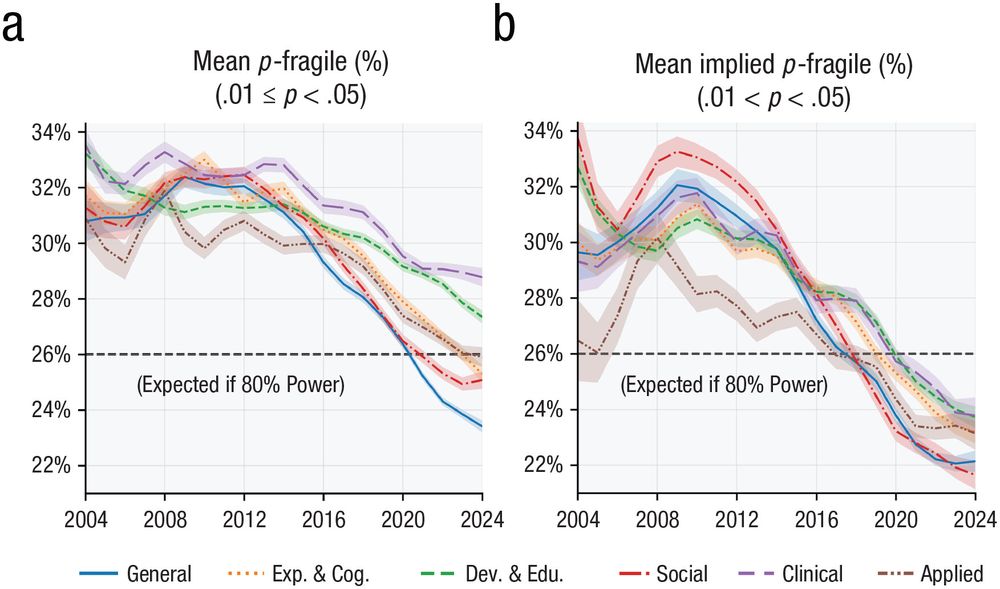
The proportion of p-values between .01 and .05 declined in psychology over the last decade, a strengthening of credibility.
Papers with fewer fragile p-values are cited more. Higher ranked journals assoc. with > improvement, but not higher ranked universities.
journals.sagepub.com/doi/10.1177/...
02.06.2025 10:56 —
👍 151
🔁 56
💬 4
📌 16
The future of brain and mental health research won’t come from static tasks or narrow models. It’ll be built through adaptive systems - ones that learn, reason, and scale with us. That’s what I’m building with Gearshift Fellowship 👇 1/2
30.05.2025 15:21 —
👍 3
🔁 2
💬 1
📌 0
Gap Map
Explore R&D Gaps and their related Foundational Capabilities.
v1.0 of the Fundamental Development Gap Map, a new web portal for exploring the landscape of bottlenecks holding back science and the fundamental technologies to solve them. Very exciting and promising database: www.gap-map.org
05.05.2025 05:07 —
👍 1
🔁 0
💬 0
📌 0
Research Scientist | Current Openings
About the role The Research Scientist will play a central role in coordinating the work with our current collaborators and engaging the bro...
NEW: 2-year Research Scientist position at COS
Come to lead our latest funded project to create benchmarks for evaluating LLM agents' capabilities to do (and not do) science.
Details in the job ad, and ask if you have questions!
(Remote; US-based; $78-88k)
ats.rippling.com/cos-careers/...
07.01.2025 13:27 —
👍 21
🔁 20
💬 2
📌 1
Excited to have our Automated Research Assistant (AutoRA) published. While initially developed for the behavioral sciences, AutoRA is designed as a general framework for closed-loop scientific discovery. Visit the doc to construct your own closed-loop studies: autoresearch.github.io/autora/
05.12.2024 21:06 —
👍 17
🔁 8
💬 0
📌 1

The dominance of impact factors
Journal impact factors now play a major role in determining the path of scientific careers, with researchers working hard to get into the highest-ranked journals. However, since impact factors are [��...
#NobelPrize announcements have started. Here are some thoughts on Impact Factor and research assessment from Nobel winners.
TL:DR; “(Impact factors) are clearly too broad a measure with which to judge the quality of an individual scientist’s work.”
02.10.2023 11:02 —
👍 2
🔁 1
💬 0
📌 0