

Read our full report in THE LANCET "Tinnitus prevalence, associated characteristics, and related healthcare use in the United States: a population-level analysis" here: www.thelancet.com/journals/lan...
08.05.2025 16:19 — 👍 0 🔁 0 💬 0 📌 0
Read our full report in THE LANCET "Tinnitus prevalence, associated characteristics, and related healthcare use in the United States: a population-level analysis" here: www.thelancet.com/journals/lan...
08.05.2025 16:19 — 👍 0 🔁 0 💬 0 📌 0
Individual pressing their finger against their ear, appearing to be in discomfort
The burden of #tinnitus affects millions. A recent
@nytimes.com article, "What Can You Do About Tinnitus?" cites #SICHL’s study showing that 11% of U.S. adults experience it, with 41% hearing it nonstop.
#Research is key to improving treatment options.
🔗 nyti.ms/4cZ0iBn

A little girl whispering in the ear of an elder woman who is smiling.
👂 Hearing is more than just sound; it’s what connects generations and fosters meaningful relationships.
We’re dedicated to advancing research and solutions that preserve these vital connections and improve quality of life.
Support our initiative: sichl.stanford.edu

🐦 Dr. Stefan Heller’s lab is studying how birds naturally regenerate hair cells to restore hearing, something mammals, including humans, cannot do.
This research could lead to groundbreaking treatments for permanent #HearingLoss.
youtu.be/80qbU1mFlvg

Quote from Katharine Miller, a research scientist at Stanford Medicine, discussing the use of SIHCL funding for high-resolution imaging techniques to study structural changes in the ear due to hearing loss. The image includes the Stanford Medicine logo.
💡 Research is only as powerful as the tools behind it. Thanks to SICHL’s funding, scientists have access to cutting-edge equipment that’s changing the game for inner ear studies.
Join us in advancing hearing research: stan.md/4ek8Ku5
#HearingResearch #SICHL

Infographic by Stanford School of Medicine stating that 466 million people have disabling hearing loss globally, according to the World Health Organization as of February 2024.

Stanford School of Medicine infographic stating that 1 out of 3 adults between 65 and 74 have hearing loss. Source: NIH Publication, February 2023.

Stanford Medicine informational graphic stating that 2 to 3 out of every 1,000 children are born with hearing loss, citing Dr. Betty Vohr from Brown University in 2003.

Informative graphic from Stanford School of Medicine stating that hearing loss costs the world nearly one trillion dollars annually, according to the World Health Organization, February 2024.
🦻 #HearingLoss is more than a health concern—it’s a global crisis.
#SICHL is tackling this growing challenge through innovative research and solutions that aim to improve lives.
Learn more about our initiative and how you can be a part of it.
🔗 stan.md/40ItNDc
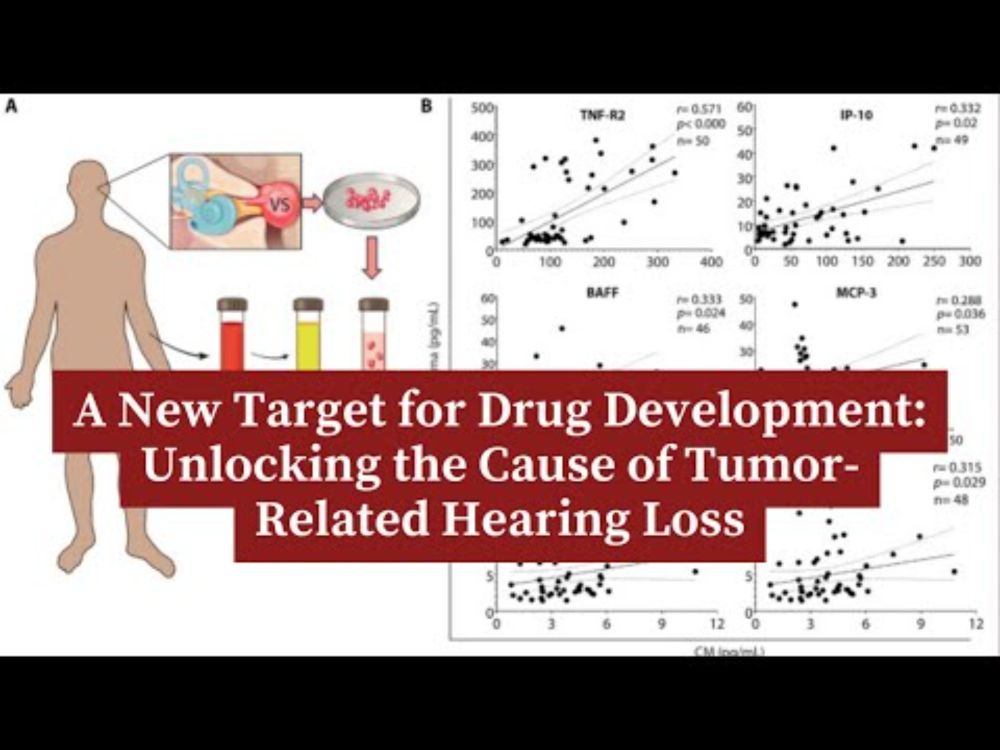
#SICHL researchers may have uncovered how vestibular schwannoma (VS) tumors cause hearing loss. Dr. Stankovic’s team found that these tumors release toxic molecules that damage inner ear sensory cells. This discovery paves the way for new drug treatments to protect hearing.
youtu.be/tnVtEKNj8ps
🦻 1.5 billion people worldwide live with #HearingLoss, yet no cure exists. #SICHL is determined to change that. With over 100 dedicated scientists, we’re pushing for progress.
Support our research: stan.md/40ItNDc

Quote by Pei Wang, OHNS research scientist at Stanford School of Medicine, discussing fortunate funding for genetic research on a large gene using mouse models, set on a dark background with the Stanford Medicine logo at the top.
💡High-risk projects often spark major discoveries, but they face an uphill battle for funding. #SICHL bridges that gap, investing in research that explores the unknown, like understanding complex deafness genes.
Your support helps us drive science forward.
stan.md/4ek8Ku5

A scientist wearing a lab coat and gloves works with samples in a lab. The background is filled with lab equipment and diagrams.
👩🔬 At #SICHL, our core facilities are essential hubs for researchers, offering state-of-the-art resources and a space for collaboration.
Your philanthropic support helps empower the science that leads to #HearingLoss solutions.
🔗 Learn more: stan.md/4ek8Ku5
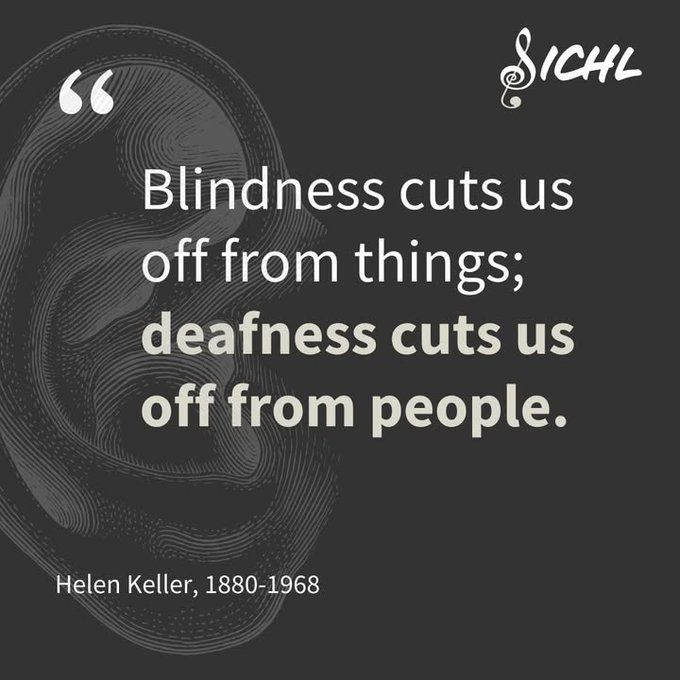
Quote by Helen Keller on a dark background: "Blindness cuts us off from things; deafness cuts us off from people." The image features the SICHL logo at the top right.
Hearing loss isn’t just a physical condition—it has severe social and mental health implications. At #SICHL, we’re committed to addressing these challenges through research and innovation.
Support our mission to reconnect people with their world. stan.md/4ek8Ku5
This is an image licensed through Adobe Stock, so we can't grant usage rights. It is accessible here with a free trial: stock.adobe.com/images/smile...
07.03.2025 17:59 — 👍 0 🔁 0 💬 1 📌 0
Graph from SICHL showing a rising trend in millions of people per billion from 1990 to 2040, with a solid line indicating actual data and a dotted line projecting future figures. A world map is in the background. A red upward arrow indicates growth.
📈 The number of people with more than 20 dB of hearing loss is very large and growing rapidly. At #SICHL, we’re committed to advancing research and developing innovative ways to address this escalating issue.
Support our efforts: stan.md/4ek8Ku5
#philanthropy

Hearing Loss is Everywhere infographic by Stanford School of Medicine stating that hearing loss costs the world nearly one trillion dollars annually, according to the World Health Organization, February 2024.
💰 According to @who.int, unaddressed #HearingLoss comes with a staggering price tag. It’s more than a medical issue. It's an economic and social challenge.
We’re dedicated to developing solutions that can reduce these impacts and improve hearing health worldwide.
➡️ sichl.stanford.edu
#SICHL

Empower Yourself: Changing Mindsets about Hearing Loss #WorldHearingDay #HearingLoss #LivingWithHearingLoss #HearAndBeyond @WHO @WorldHearingForum
18.02.2025 13:30 — 👍 6 🔁 2 💬 0 📌 0
Person wearing a hearing aid smiles while looking into the distance, outdoors.
🔬 Dr. Stankovic’s team at #SICHL found that vestibular schwannoma tumors release molecules that harm sensory cells, leading to #HearingLoss. This breakthrough opens the door for treatments that could block the molecules and help preserve hearing.
Read more: pubmed.ncbi.nlm.nih.gov/39923035/

Hearing loss doesn’t have to mean the end of a musical journey. 🎶
Read more about Paul Simon's inspiring return to the stage and how we worked with him to get him ready to perform again.
#PaulSimon #HearingLossCure #SICHL

Illustration showing the anatomy of the human ear labeled with parts such as outer ear, middle ear, inner ear, and hearing nerves, titled "How Hearing Works.
👂 Ever wondered how we hear? Sound causes vibrations that are converted into electrical signals sent to the brain. Damage to any part of this pathway can lead to #hearingLoss.
Learn about our efforts to diagnose & treat hearing loss. sichl.stanford.edu

Close-up grayscale image of proteins forming a ring on the tips of sound-sensing cilia viewed under a scanning electron microscope.
Smaller than a light wave.
🔬 #SICHL scientists are using an electron microscope to pinpoint exactly where crucial proteins are located on the tip of the sound-sensing cilia.
Learn more about our work and how you can support it.
👂 stan.md/40ItNDc
#HearingLossResearch

a close up image of an ear
🔬 Accessing viable human inner ear cells for research has always been a major hurdle in #HearingScience. But #SICHL has pioneered a way to collect viable inner ear cells from organ donors.
Support the groundbreaking research making this possible:
➡️ stan.md/4ek8Ku5

Infographic by Stanford School of Medicine stating that 466 million people have disabling hearing loss globally, according to the World Health Organization, February 2024.
🌍 #HearingLoss is a global challenge with profound implications.
We’re dedicated to finding solutions that address this critical issue, pushing research that can make life better for millions.
Join us in supporting this mission: stan.md/40ItNDc

Text on a black background: Hearing Loss is Everywhere. It affects adults. 1 out of 3 adults between 65 and 74 have hearing loss. NIH Pub No. 23-DC-4235, Feb. 2023 Stanford Medicine logo in top right
👂 Hearing loss is more than a statistic—it’s a barrier for millions of people.
Help us drive research and solutions to remove this barrier.
Your support makes a difference: sichl.stanford.edu
#SICHL #HearingHealth #philanthropy #StanfordMedicine

Infographic from Stanford Medicine displaying causes and consequences of hearing loss. Causes include age, infection, physical trauma, and genetic defects. Consequences include communication problems, employment limitations, lower quality of life, social isolation, cognitive decline, and increased stress. Image features an illustration of a human ear at the center with arrows pointing to various text boxes outlining each cause and consequence.
🎧 Noise exposure, aging, infections, genetic defects—hearing loss has many causes, and its impact is profound: isolation, cognitive decline, and more.
SICHL is working to combat these effects.
Support us: sichl.stanford.edu
#SICHL #HearingLossResearch #HearingLoss
