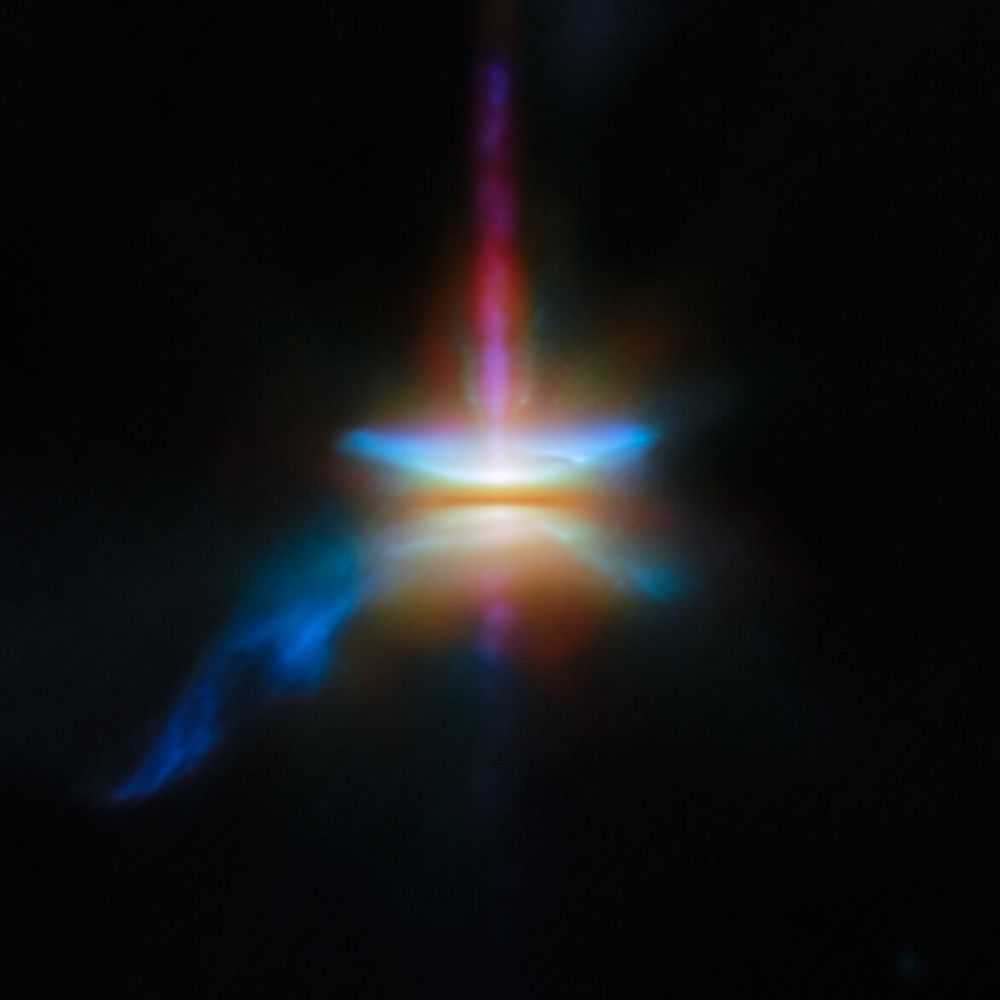
A close-in image of a protoplanetary disc around a newly formed star. Many different wavelengths of light are combined and represented by separate and various colors. A dark line across the center is the disc, made of opaque dust: the star is hidden in here and creates a strong glow in the center. A band going straight up is a jet, while other outflows form flares above and below the disc, and a tail coming off to one side.

A large galaxy is at center, and a significantly smaller galaxy is to its left. The large galaxy is mostly face-on, but the top appears slightly tilted away. It has several rings. Its circular core is bright white at the very center, but light yellow overall. Going outward, there are gaps between the rings. The core is surrounded by two slightly lighter yellow rings, which also appear to be overlapping. The next ring is slightly more transparent and yellow. The two or three rings that are farther out are bluer, sometimes with blue clumps. The widest ring is also blue, but also the most transparent. At 9 o’clock is a small dwarf galaxy. It is about the same size as the yellow core of the Bullseye. The dwarf galaxy is blue, with many dots. It looks like the edge of the Bullseye might touch the dwarf galaxy. Both galaxies are set on the black background of space, which is dotted with a range of galaxies in different shapes, colors, and sizes, along with one foreground star at left.
i LOVE when a new jwst and hubble image drop on the same day
05.02.2025 04:34 —
👍 611
🔁 74
💬 12
📌 4
Beautiful colors 💙
03.02.2025 10:41 —
👍 1
🔁 0
💬 0
📌 0

This Hubble Space Telescope image shows GAL-CLUS-022058s, a galaxy cluster dominated by a bright elliptical galaxy at the center. A distinct, almost complete ring of light surrounds the central galaxy. This is an Einstein ring, formed by the gravitational lensing of light from a distant background galaxy as it passes through the massive cluster. The image also reveals numerous other galaxies of various shapes and colors scattered across the field.
Rings of Relativity.
GAL-CLUS-022058s is the largest and one of the most complete Einstein rings ever discovered in our Universe. The light from the background galaxy has been distorted into the curve we see by the gravity of the galaxy cluster sitting in front of it.
(Hubble)
🔭 🧪
02.02.2025 20:06 —
👍 598
🔁 86
💬 9
📌 7
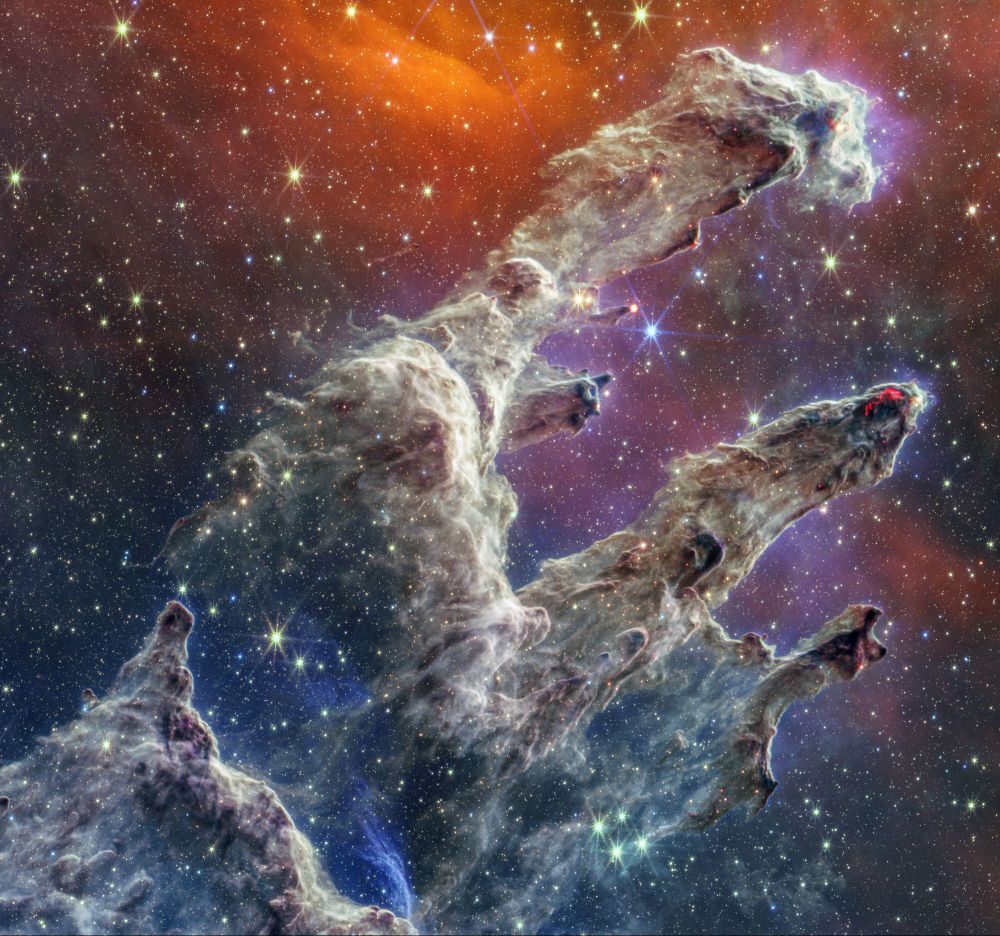
Semi-opaque layers of blue, purple, and grey gas and dust start at the bottom left and rise toward the top right. There are three prominent pillars. The left pillar is the largest and widest. The background is orange near the top and dark blue and purple near the bottom. Some blue and white stars dot the overall scene.
Iconic Pillars of Creation.
MIRI + NIRCam composite image.
🔭 🧪
01.02.2025 20:10 —
👍 4346
🔁 396
💬 57
📌 21
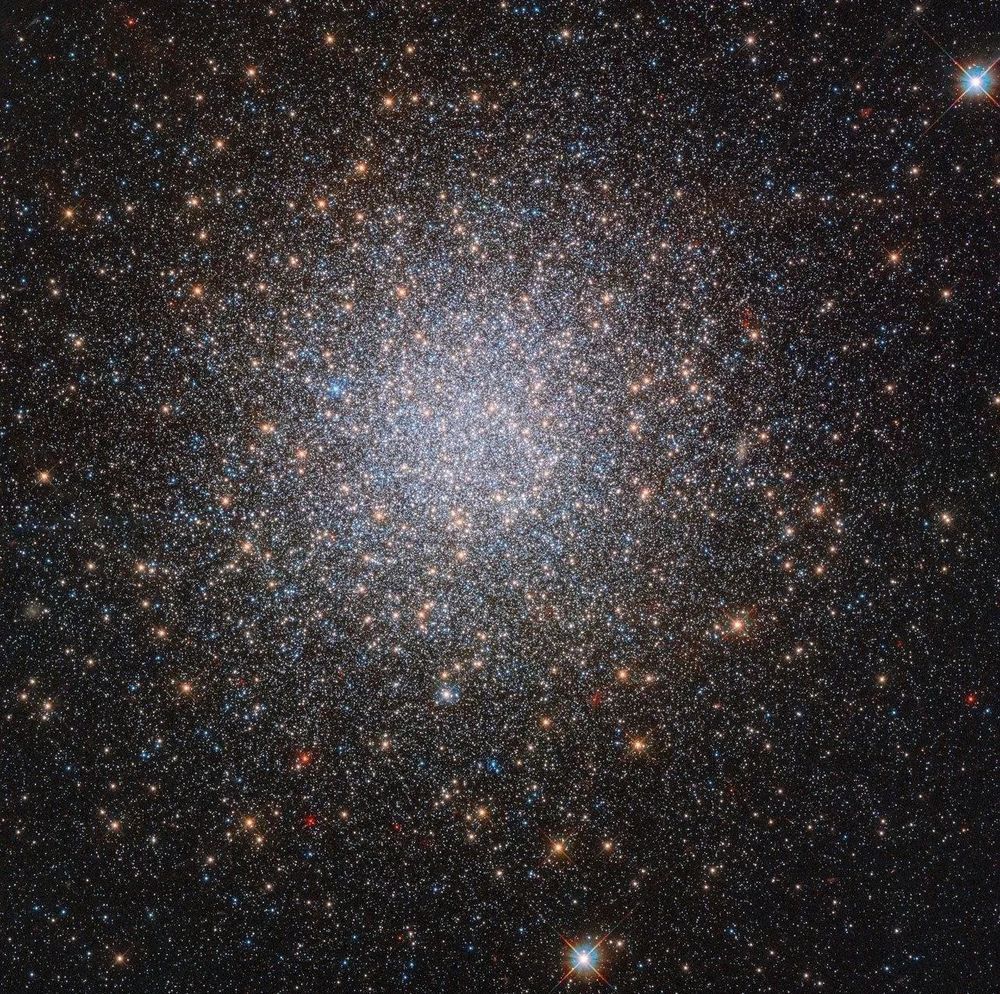
Many stars crowd the image, shining in shades of white, blue, and orange, and more closely concentrated at the center.
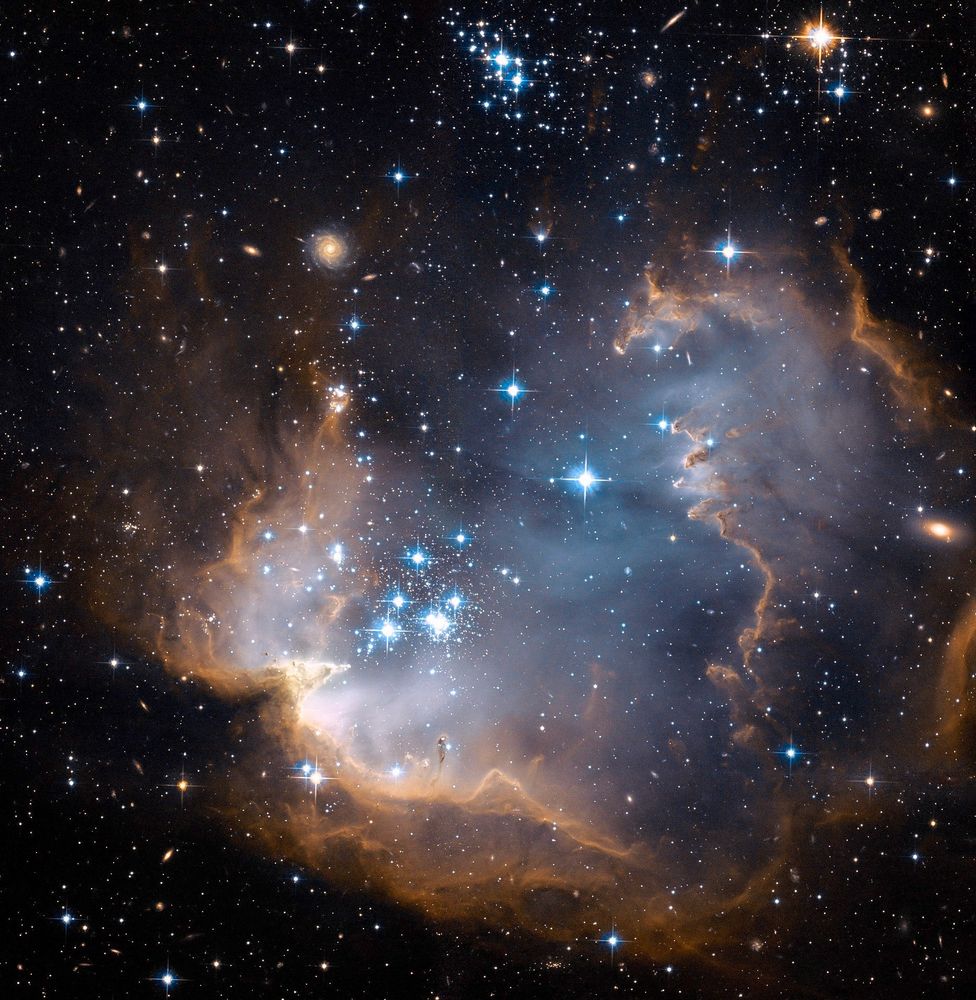
Bright blue stars are in a cluster at the center of the image. They are surrounded by a shell of brownish and burnt orange dust and gas. The shell has ridges that reach towards the stars like teeth. Stars within the dust and gas are hidden from Hubble but visible to Webb in the infrared. A number of more distant galaxies also appear in the background.
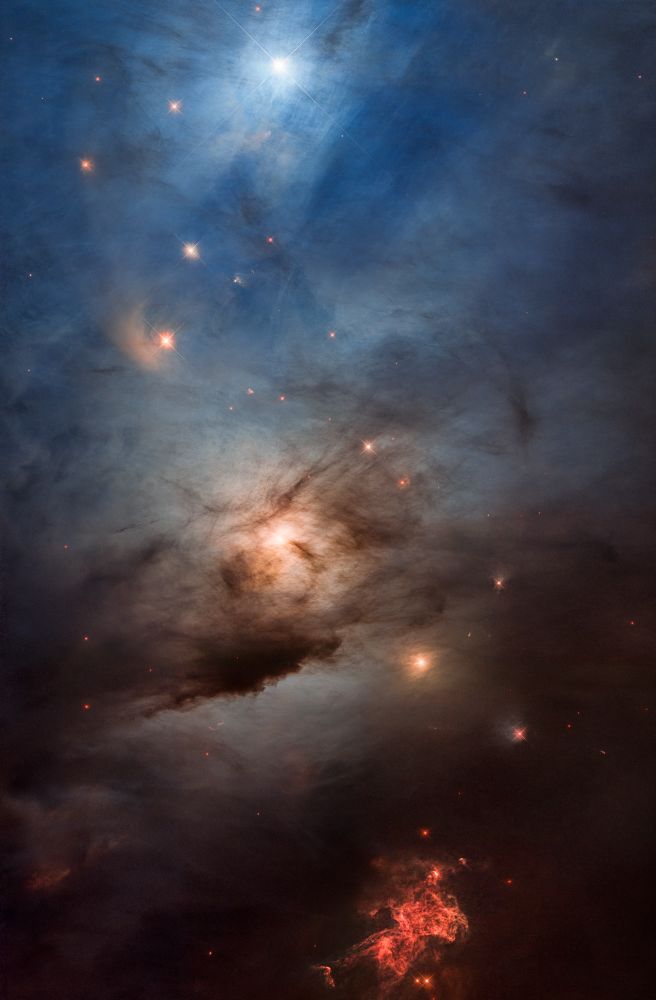
Ferocious stellar winds, likely from the bright blue star at the top of the image, are blowing through a curtain of dust. The fine dust scatters the starlight at blue wavelengths. Farther down, another bright, super-hot star shines through filaments of obscuring dust, looking like the Sun shining through scattered clouds. A diagonal string of fainter accompanying stars looks reddish because dust is filtering starlight, allowing more of the red light to get through. The bottom of the picture presents a keyhole peek deep into the dark nebula. Hubble captures the reddish glow of ionized hydrogen. It looks like a fireworks finale, with several overlapping events.
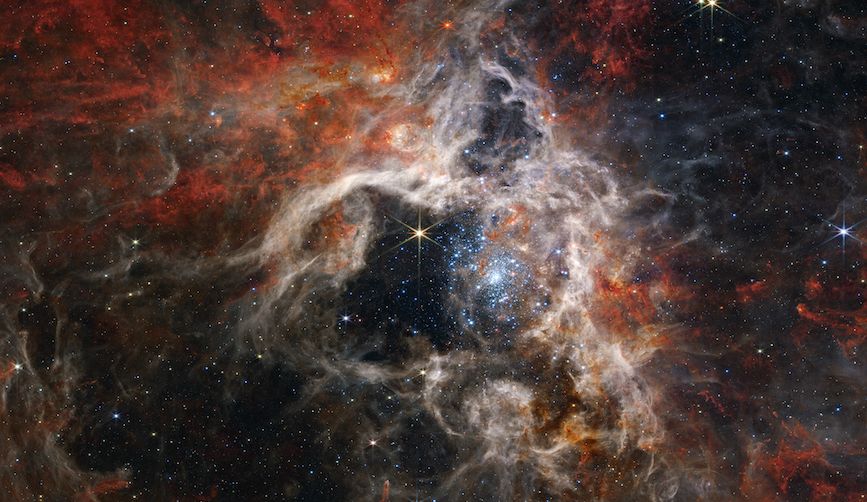
Fluffy tan-colored nebula clouds, with rust-colored highlights, surround a black central area. Within that area, the focal point of the image is one large yellow star with eight long thin points. To the right of this star is a bright star cluster in an oval shape. The stars within the cluster look like tiny pale blue sparkles. The cluster is more densely packed at its core and scatters outward. Towards the bottom of the image, multiple arms appear to spiral out of a cloudy tan knob. Taken together, the structures resemble a spider or a squid. Other blue and yellow eight-pointed stars, as well as distant galaxies, are dotted throughout the image. Credits: NASA, ESA, CSA, STScI, Webb ERO Production Team
i can’t fix anything that’s going on right now, but i can show you some beauty that’s out there… 🌌✨
28.01.2025 21:19 —
👍 9197
🔁 917
💬 215
📌 44
It's beautiful!
28.01.2025 18:07 —
👍 0
🔁 0
💬 0
📌 0
Hi Alec!!!! 🤗
28.01.2025 17:56 —
👍 1
🔁 0
💬 1
📌 0

The Eagle nebula (with the Pillars of Creation ❤️) in RGB + Hydrogen-alpha!
#astrophotography
28.01.2025 17:39 —
👍 20
🔁 2
💬 0
📌 0
The processed images are then combined into a single color image using editing softwares. Also, what I captured with the infrared filter is added in purple.
28.01.2025 13:10 —
👍 3
🔁 0
💬 0
📌 0
To create a color image, each filter is assigned a RGB color. In my case, I used red for hydrogen-alpha and green and blue for oxygen (this is known as the HOO palette)->
28.01.2025 13:08 —
👍 3
🔁 0
💬 1
📌 0
Might as well add some info!What you see is the Rosette Nebula, captured using three different filters: one for the emission of ionized hydrogen (Ha), one for oxygen (OIII), and one for the infrared (IR). Since my camera is monochrome, the images are initially in grayscale. ->
28.01.2025 13:06 —
👍 2
🔁 0
💬 1
📌 0
Of course! Feel free to ask anything you want, I'm happy to help 🤗 (and yeah I know it can be frustrating trust me, but keep trying!)
28.01.2025 12:48 —
👍 1
🔁 0
💬 0
📌 0
Back then, I started the same way for the same reason 🤣 astrophotography is a fantastic hobby no matter what gear you use!
28.01.2025 12:46 —
👍 1
🔁 0
💬 1
📌 0
It really is ❤️ thank you so much!
28.01.2025 12:19 —
👍 1
🔁 0
💬 0
📌 0
And that's great! Watching through a telescope instead of taking pictures is another kind of magic ✨ I should do that more!
28.01.2025 12:19 —
👍 1
🔁 0
💬 1
📌 0
Thank you! It's my backyard, but I live in a small town with not much light pollution, and that helps a lot!
28.01.2025 12:16 —
👍 1
🔁 0
💬 0
📌 0
🤗
28.01.2025 12:15 —
👍 1
🔁 0
💬 0
📌 0
Nice to meet you! ✨❤️ (P.s. Bulbasaur is one of my favorite Pokemons 💚)
28.01.2025 12:05 —
👍 1
🔁 0
💬 0
📌 0
Thanks ❤️
28.01.2025 12:03 —
👍 0
🔁 0
💬 0
📌 0
Thank you so much ❤️
28.01.2025 12:03 —
👍 1
🔁 0
💬 0
📌 0
Hi Ellie, nice to e-meet you 🤗 I started with just a phone as well, so no worries! Any pic of the sky is beautiful no matter what ❤️
28.01.2025 12:03 —
👍 0
🔁 0
💬 0
📌 0
Thank you so much, Peter!
28.01.2025 11:59 —
👍 0
🔁 0
💬 0
📌 0
That's a fantastic setup 🥹 RASA is my dream telescope and I'm planning to buy exactly that one with 400mm in the future!
28.01.2025 11:59 —
👍 1
🔁 0
💬 1
📌 0
❤️
28.01.2025 11:56 —
👍 1
🔁 0
💬 0
📌 0
Meraviglia 😍😍😍
28.01.2025 11:53 —
👍 0
🔁 0
💬 0
📌 0

My baby 🔭 #astrophotography
27.01.2025 15:51 —
👍 15
🔁 0
💬 0
📌 0
Thank you ✨
27.01.2025 15:32 —
👍 0
🔁 0
💬 0
📌 0
That's sooo nice ❤️
27.01.2025 15:31 —
👍 1
🔁 0
💬 1
📌 0
Hello! Thank you so much! I've seen your photos and they're amazing, keep it up!!!
27.01.2025 15:29 —
👍 0
🔁 0
💬 0
📌 0
These grayscale images are then combined and color-mapped in post-processing to create a final image (it's actually similar to how a color sensor works, but in that case, filters are in front of each pixel in a specific pattern to create similar results to how our eyes see the colors!)
27.01.2025 15:27 —
👍 2
🔁 0
💬 1
📌 0