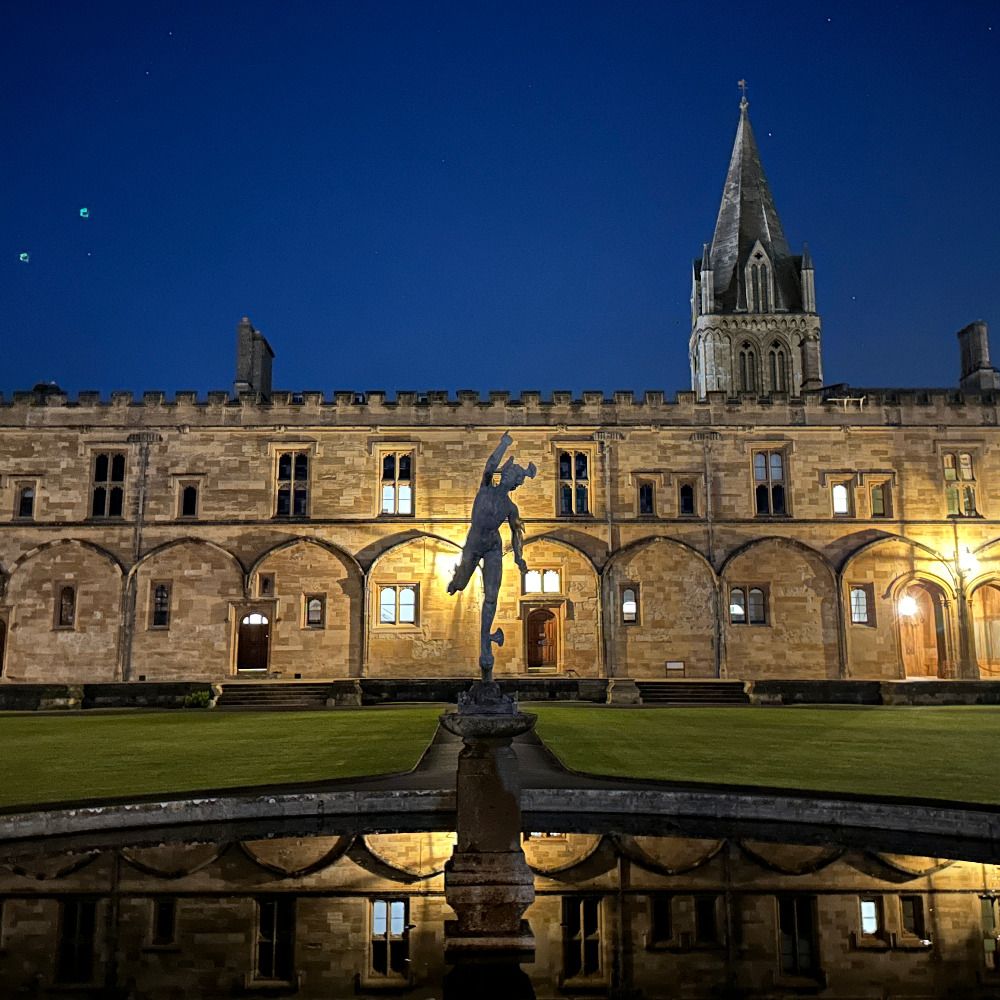

Feature Article in @elife.bsky.social about four women whose pioneering contributions to science have been largely overlooked.
elifesciences.org/articles/110...
(1/6)
Feature Article in @elife.bsky.social about four women whose pioneering contributions to science have been largely overlooked.
elifesciences.org/articles/110...
(1/6)

An image if Professor Mina Fazel sitting around a table with several pupils at a school. Text reads: Oxwell School Compass Platform to provide schools with personalised strategies and interventions to support students’ mental health The project will track student responses over time, aiming to build a clearer picture of student wellbeing and needs, generating learning that can benefit the schools taking part, but also the wider education sector in the UK and internationally.
📢 NEWS: The University of Oxford has received a £1.5 million gift from Bukhman Philanthropies to support research into young people’s mental health.
This gift will enable the creation of OxWell School Compass, which builds on the work of @oxwell.bsky.social Student Survey 👇
lnkd.in/eBdwAKMv
(for transparency we also have our repro code on osf: osf.io/t3wya/ for some reason i don't think it linked with the other link)
06.02.2026 21:15 — 👍 1 🔁 0 💬 0 📌 0yes that's our report! fine with me too :-) super appreciate the original authors' detailed prereg + code + STAR team effort, because it made computational reproducibility that much easier! it was a pleasure to work on this during the replication games @i4replication.bsky.social
06.02.2026 21:12 — 👍 2 🔁 0 💬 1 📌 0
Reward models (RMs) are supposed to represent human values. But RMs are NOT blank slates – they inherit measurable biases from their base models that stubbornly persist through preference training. #ICLR2026 🧵
04.02.2026 16:30 — 👍 18 🔁 7 💬 1 📌 1I don't even buy the 'LLMs will make work faster' argument these days - we've had two projects where LLM used (for code and writing) have actively delayed the project, because of slop, errors, and poor quality. Good luck with the talk, would love to see the recording :)
15.12.2025 10:20 — 👍 21 🔁 6 💬 0 📌 1

It has been a while since @flavioazevedo.bsky.social asked me to take over the Reversals project at @forrt.bsky.social...
It has since evolved beyond my wildest dreams, mostly thanks to @aufdroeseler.bsky.social & @lukaswallrich.bsky.social.
We are very proud of the Replication Hub & Database ♥️
Check our preprint out for some specific recommendations and examples on neurodiversity-affirming language for ADHD 🎉 osf.io/preprints/ps...
18.11.2025 10:18 — 👍 2 🔁 1 💬 0 📌 0


Results from study of mental health in 92 countries (n>53,000): People are not doing well.
- U-shape for age is gone: Young adults lowest health, highest illness
- Education still matters (a lot)
- 45% of older people live alone
- Hybrid work > 100% remote or in-person
Preprint: osf.io/3jyda_v1

Adolescents' trajectories of mental health in the MYRIAD trial

Abstract Background This study explored adolescent's mental health trajectories over the course of a school-based mindfulness-based intervention trial (MYRIAD). It examined whether intervention condition (mindfulness vs. teaching-as-usual), individual-level and contextual-level factors were associated with different trajectories. Methods This pre-registered study used data from 11- to 14-year-olds who participated in the MYRIAD trial. We used growth mixture models to examine distinct trajectories in risk for depression, social-emotional-behavioural functioning, and wellbeing (co-primary outcomes), and anxiety (secondary outcome), across pre-intervention, post-intervention and 12-month follow up (ns = 7198–7727). We then used multinomial and binomial logistic regression models to examine factors associated with individual trajectory membership.

Results Distinct trajectories emerged for each outcome: A five-trajectory model best explained the changes in risk for depression, whilst four-trajectory models best explained changes in social-emotional-behavioural functioning, wellbeing, and anxiety. While 69%–80% of adolescents followed stable low-problem trajectories for each outcome, 11%–23% experienced stable high-problem trajectories, 2%–16% experienced increasing-problem trajectories and 1%–5% experienced decreasing-problem trajectories. Receiving the mindfulness intervention was not associated with any mental health trajectory in models adjusted for confounders. Several individual-level factors, including executive functioning difficulties and risk of mental health problems at baseline, and school-level factors, such as school climate, predicted adolescents' classification into different trajectories, but they did not vary according to intervention group. Conclusions Individual differences in mental health trajectories emerged over the course of a 1-year mindfulness-based intervention, with most adolescents experiencing low-stable problem trajectories for each outcome. However, the intervention itself had no impact on individual trajectory membership, mirroring null results found in the main trial. Our findings suggest that universal interventions may not be sensitive enough to address the diverse needs of all students, however, tailoring interventions to address a range of different individual and contextual factors might maximise their impact.
New paper from my group, led by Carolina Guzman Holst
This is a secondary analysis of data from the high-quality MYRIAD trial, a universal school-based mindfulness intervention
Summary below (🧵)
acamh.onlinelibrary.wiley.com/doi/10.1002/...
NEW: Mood, "Equalization through Deterioration: The Shrinking Gender Gap in Swedish School Grades" sociologicalscience.com/articles-v12...
30.09.2025 16:15 — 👍 20 🔁 8 💬 0 📌 2My pick!
08.10.2025 10:11 — 👍 1 🔁 0 💬 0 📌 0
A lot of psych is already conducted with online convenience samples & ppl are probably excited about silicon samples bc it would allow them to crank out more studies for even less 💸
How about we reconsider the idea that sciencey science involves collecting own data.
www.science.org/content/arti...
Come work on a super cool project with a super cool team, led by the fanstastic @minafazeloxford.bsky.social & @drhollybear.bsky.social
29.09.2025 10:08 — 👍 1 🔁 0 💬 0 📌 0thanks to amazing partners & collaborators - from the Pleasure Project, WHO, The Young and Alive Initiative
26.09.2025 20:13 — 👍 0 🔁 0 💬 0 📌 0
For some coverage, check out this WHO page: www.who.int/news/item/26...
26.09.2025 20:13 — 👍 0 🔁 0 💬 1 📌 01 in 20 people who discontinue contraception while still needing it – whether for pregnancy prevention or safer sex – do so because they perceive negative impacts on their sex lives. Our new paper is out now at the journal of Sexual and Reproductive Health Matters www.tandfonline.com/doi/metrics/...
26.09.2025 20:13 — 👍 1 🔁 0 💬 1 📌 0
An illustration of a puzzle with the title 'What's the Missing Piece of Contraception Discontinuation?'
AmplifyChange proudly supports orgs improving access to #SRHR incl. #contraception in their communities. Read a new report that shows that #pleasure drives people’s decision-making around contraceptive use: https://www.tandfonline.com/doi/full/10.1080/26410397.2025.2552589
#WorldContraceptionDay

Come to our webinar on the 26th where we'll present results from our latest systematic review on contraceptive discontinuation! W/ colleagues from WHO, Pleasure Project, Young and Alive. events.humanitix.com/sex-satisfac...
16.09.2025 08:57 — 👍 1 🔁 0 💬 0 📌 0

a wonderful few days at a writing retreat with @mhrincubator.bsky.social got lots of writing done & met some great colleagues 📝🔬 do check out for future retreat dates and other events mentalhealthresearch.org.uk
12.09.2025 22:39 — 👍 3 🔁 1 💬 0 📌 0"The character of a growing share of psychological research is determined not by a method-neutral commitment to the best ideas and techniques, but in large part by the capabilities, proclivities and biases of the AI systems driving research activity."
09.08.2025 11:26 — 👍 0 🔁 0 💬 0 📌 0"the author did not respond to a request to provide evidence that ethics approval had been received for the study." 🫠
02.08.2025 15:26 — 👍 0 🔁 0 💬 1 📌 0Thrilled our work received a SIPS Commendation Prize 🥳
25.07.2025 13:06 — 👍 4 🔁 2 💬 0 📌 0Reward models steer LLM behavior but we’ve never looked this closely at them. This deep analysis reveals big inconsistencies, surprising biases, and base-model effects. Insightful work. Catch @brianchristian.bsky.social & @tsvetomira.bsky.social at #FACCT2025
23.06.2025 17:38 — 👍 3 🔁 0 💬 0 📌 0Congrats on publishing this - what a great commentary! Powerfully written and really appreciate your Figure 1 too.
06.06.2025 10:43 — 👍 1 🔁 0 💬 1 📌 0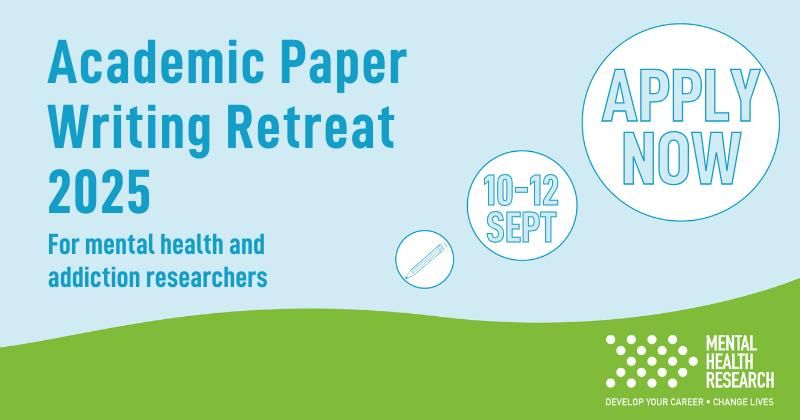
Applications for our 2025 Paper Writing Retreat are open!
Trying to find the time, space & energy to work on that #mentalhealth and/or #addiction #research paper? Apply for our fully-funded retreat with dedicated writing time, tasty food & the chance to network!👇
mentalhealthresearch.org.uk/pwr25/
Are adolescents sensitive about sensitive data?
In our new @oxwell.bsky.social publication, we explore students' concerns about taking part in research including sensitive topics such as mental health & maltreatment.
Headlines below, w/ substantial implications for research design & analysis ⬇️
Congratulations Ben & all! Really wonderful paper with some amazing data viz!
06.05.2025 10:48 — 👍 1 🔁 0 💬 0 📌 0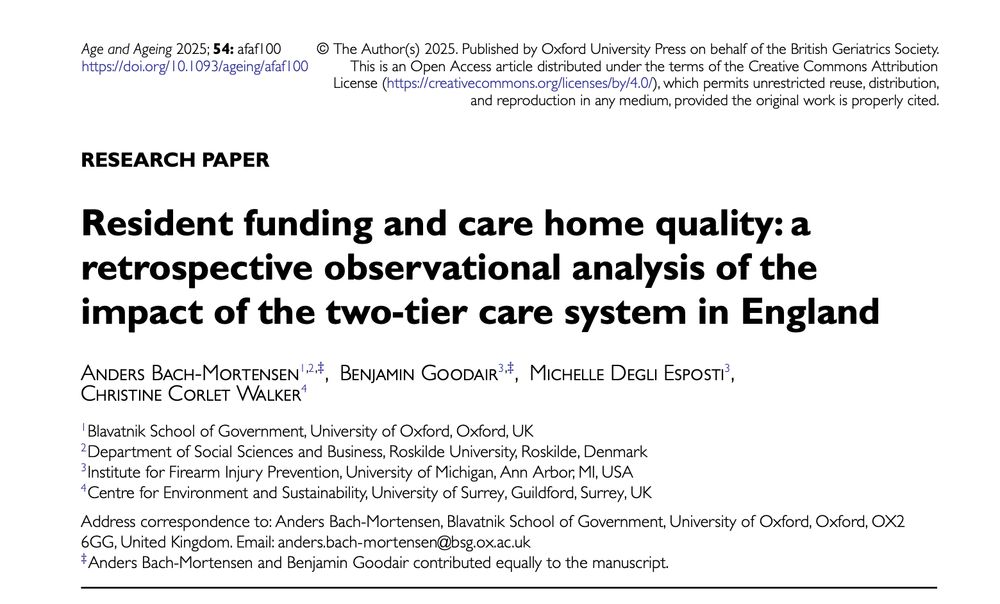
New paper out today reveals scale of inequalities in social care!
💰 Care homes are better rated with more self-funded residents
👔 But inequalities in care only exist in the for-profit sector
📈 Outsourcing to for-profit sector accelerates inequalities of two-tier care
Link: doi.org/10.1093/agei...
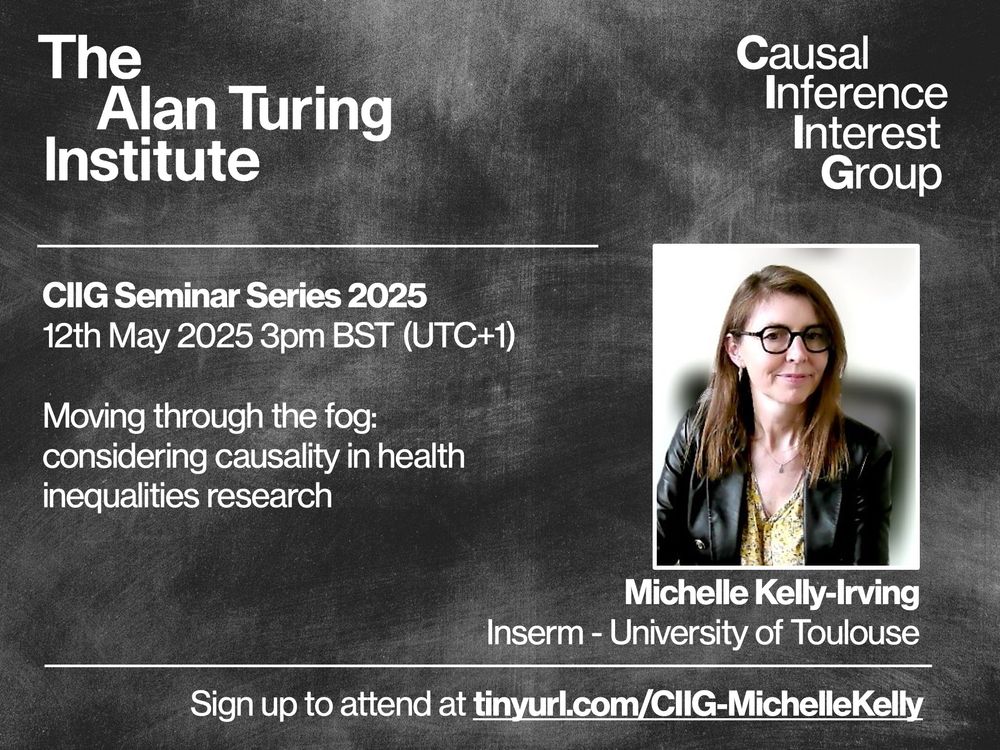
Advert for the next causal inference interest group seminar with Michelle Kelly-Irving
DON'T MISS: "Moving through the fog: considering #causality in health inequalities research"
The next Alan Turing Institute Causal Inference Interest Group seminar with @mkellyirving.bsky.social on 12th May 2025 at 3pm BST!
Register at: turing-uk.zoom.us/meeting/regi...
#CIIG #EpiSky #CausalSky