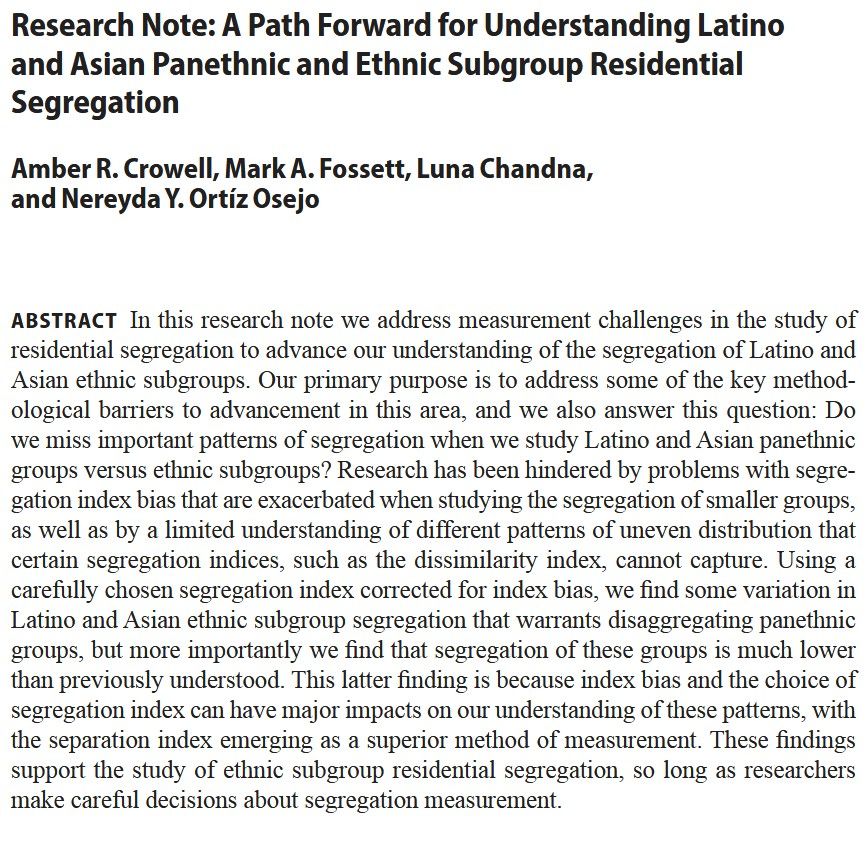
“Understanding Latino & Asian Panethnic & Ethnic Subgroup Residential Segregation”: @acrowell.bsky.social et al. recommend that researchers adopt the described measurement practices "to accurately assess patterns of ethnic group segregation.” @tamusoci.bsky.social read.dukeupress.edu/demography/a...
04.12.2025 18:05 — 👍 5 🔁 3 💬 0 📌 0

"Captain Gains" on Capitol Hill
Shang-Jin Wei & Yifan Zhou
WORKING PAPER 34524
DOI 10.3386/w34524
ISSUE DATE November 2025
Using transaction-level data on US congressional stock trades, we find that lawmakers who later ascend to leadership positions perform similarly to matched peers beforehand but outperform them by 47 percentage points annually after ascension. Leaders' superior performance arises through two mechanisms. The political influence channel is reflected in higher returns when their party controls the chamber, sales of stocks preceding regulatory actions, and purchase of stocks whose firms receiving more government contracts and favorable party support on bills. The corporate access channel is reflected in stock trades that predict subsequent corporate news and greater returns on donor-owned or home-state firms.

令
1
1
-9
-8
-7
-6
-5
-4
-3
-2 -1
1
2
3
4
5
7
8
9
Year
Figure 2: Estimated dynamic quasi-difference-in-differences coefficient, di, of equation(3), with vertical dashed lines representing 90 percent confidence intervals. The point estimate of the year in which the lawmaker became a congressional leader (Year 0) is normalized to zero. BHAR over the 250 days following each trade is the dependent variable and calculated using the Fama-French five-factor plus momentum as the benchmark model.
After becoming a congressional leader, a politician’s stock portfolio beats out those of peers by 47 (!!!) percentage points a year through trades timed around bills and firms that later get government contracts
www.nber.org/papers/w34524
via @florianederer.bsky.social
03.12.2025 01:42 — 👍 1442 🔁 639 💬 33 📌 85
Looks like a super interesting paper! Looking forward to reading.
02.12.2025 21:19 — 👍 1 🔁 0 💬 1 📌 0
ICYMI: New paper for causal effects with panel data, subsuming other approaches. We generate realistic synthetic data based on commonly studied datasets, showing our method substantially outperforms others and providing insight about what in the data-generating process corresponds to gains.
23.11.2025 22:39 — 👍 81 🔁 24 💬 3 📌 5
That seems totally plausible. N=1, but I know that Light Rail development in Seattle faced major opposition for years from different citizen’s groups which could be bc of perceived problems.
13.11.2025 15:29 — 👍 0 🔁 0 💬 1 📌 0

New working paper up on SocArxiv! osf.io/preprints/so.... I use the 1940 Census and linked mortality records in combination with an IV-design to study the causal effects of racial segregation on longevity. I show that segregation reduces both Black and White longevity.
13.11.2025 14:52 — 👍 12 🔁 7 💬 1 📌 0

So grateful for this office view!
07.11.2025 17:31 — 👍 4 🔁 0 💬 0 📌 0
A huge congratulations to DOCTOR Haowen Zheng, who defended a fantastic dissertation on how changes in family formation and in the spatial distribution of jobs in US affects who moves, where they move to, & who benefits most from moving.
Haowen starts a post-doc at Michigan's Stone Center in Jan.
30.10.2025 11:56 — 👍 31 🔁 4 💬 0 📌 0
Other academics are fighting (sometimes literally) one another to publish Nature papers. But I am just sitting here writing abstraction layers for probabilistic programming frameworks.
28.10.2025 12:33 — 👍 79 🔁 5 💬 1 📌 0
The pronatalists have done an excellent job of using bad demography to convince the legacy media that low birth rates are a crisis.
They are using bad demography to whitewash their sexism, racism, Christian nationalism, classism, & anti-LGBTQ sentiments.
It’s why my colleagues & I wrote this:
02.09.2025 13:06 — 👍 38 🔁 12 💬 1 📌 2
Congrats! This is huge! 🥳
28.08.2025 21:34 — 👍 1 🔁 0 💬 1 📌 0
Both the Brown and Columbia agreements require the universities to report the test scores and GPAs of applicants, admits, and matriculating students by race *and color,* among other attributes.
Wait, what? What's "color" doing in there?
A sociologist weighs in.
1/9
31.07.2025 19:27 — 👍 157 🔁 51 💬 7 📌 10
Used this as a reference for a working group discussion on family FE designs. Great paper and led to a generative discussion!
23.07.2025 14:34 — 👍 1 🔁 0 💬 1 📌 0
the destruction of chattel slavery is one of the great accomplishments in our nation's history and the reason conservatives hate celebrating it is because doing so legitimizes the black counter-narrative of the united states
19.06.2025 16:01 — 👍 22188 🔁 5341 💬 173 📌 122
I want to highlight 3 things from this excellent report:
1) Women's reproductive labor is too often the solution to "population problems."
2) Low birth rates aren't a rejection of children & parenthood.
3) Supporting families is a worthy goal in itself, even if policies don't raise birth rates. 1/
11.06.2025 15:53 — 👍 18 🔁 6 💬 1 📌 0
Sad that this has to be my first post here, but the gutting of the FSRDC program is disastrous for demographic research.
06.06.2025 19:36 — 👍 11 🔁 4 💬 2 📌 0

Internal migration in early adulthood, a critical life stage marked by frequent job transitions and demographic events, contributes to income disparities between married men and women. This study adopts a life course perspective to elucidate the development of this gender inequality pre- and post-migration. Using the NLSY79 data from 1979 to 2018 and an event studies model that leverages within-individual variations in both pre- and post-migration income trajectories relative to non-migrants, I observe a steadily growing migration premium for men over 15 years post-migration. By contrast, I show a prolonged migration penalty for women that peaks around five years after migration and lasts for a decade. While improved employment status accounts for about half of men’s migration income premium consistently over time, detachment from the labor market explains a smaller proportion of women’s migration income penalty mostly in the short term. Although occupational changes and fertility do not impact men's gains from migration, they account for women’s migration penalty in the long run. Ignoring pre-migration income trends underestimates income gains among male migrants and overestimates income losses among female migrants. These results emphasize the importance of temporal dynamics in family migration and gender inequality studies.
The honorable mention goes to Haowen Zheng, “Diverging Trajectories: Gendered Income Dynamics Pre- and Post-Family Migration.” 2/3
04.06.2025 13:59 — 👍 6 🔁 1 💬 1 📌 0
An example of the disruption to science caused by the NSF’s 15% overhead dictate: At the University of Washington, all newly awarded NSF grants are now on hold indefinitely with no advance spending allowed.
06.05.2025 22:55 — 👍 601 🔁 198 💬 13 📌 5
Credible Answers to Hard Questions: Differences-in-Differences for Natural Experiments
This book introduces applied researchers to modern Differences-in-Differences (DID) methods, that they can use to obtain credible answers to hard causal inferen
Just posted updated version of our DID textbook! We now have drafts of all chapters, including the one on general designs! Now you can tell your friends still on X that they are DID-outdated :-) Happy easter for those of you that celebrate it. papers.ssrn.com/sol3/papers....
18.04.2025 14:29 — 👍 257 🔁 79 💬 13 📌 3
Feeling thrilled to have successfully defended my M.A. thesis today to advance to Ph.D. candidacy!
01.05.2025 22:02 — 👍 1 🔁 0 💬 0 📌 0
Three Ways of Looking at Black–White Mortality Differences in the United States | Annual Reviews
Everyone agrees that US Black deaths happen earlier than white deaths on average, but it is surprisingly challenging to find the best ways to summarize, quantify, and compare this gap. This review arg...
The biggest project I've worked on for the last chunk of years was just published. It asks, how big are US Black-white lifespan differences?
This might seem like a narrow question. I hope to convince you by the end that there are answers you didn't anticipate. And I hope some of them will move you.
30.04.2025 20:27 — 👍 447 🔁 139 💬 29 📌 6
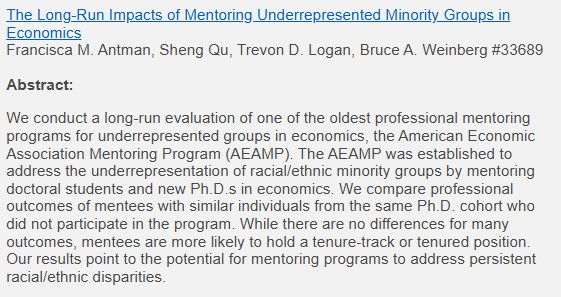
Very excited to have this paper with @franciscaantman.bsky.social Bruce Weinberg, and Sgeng Qu out on the (positive!) long run effects of the @aeainformation.bsky.social Mentoring program.
www.nber.org/papers/w33689
14.04.2025 13:53 — 👍 29 🔁 10 💬 0 📌 0
these people are literally trying to destroy america’s future
14.03.2025 13:21 — 👍 11955 🔁 2592 💬 214 📌 97
Post-doc at NYU Grossman School of Medicine (this account is solely in my personal capacity, all views are my own etc). Non-parametric statistics, causal inference, Bayesian methods. Herbsusmann.com
Spatial inequality, housing, education, and quantitative social science | Sociology and Social Policy PhD @ Princeton + Office of Population Research
institutions, inequality, geography, democracy | asst law prof at UCLA
Daniel Patrick Moynihan Chair in Public Policy, @maxwellsu.bsky.social. Also @cprmaxwell.bsky.social @nber.org, @uniofgalway.bsky.social, AEA Committee on the Job Market. Studying health economics and policy, economics of risky behaviors.
Sociology Prof @ Upenn. Feminist studying gender, families, inequality, and social policy. She/her. The nuclear family is radioactive ⚠️⚠️
Assistant Professor of Sociology researching the roots of the racial wealth gap and their consequences for health inequality. Views are my own | https://chinyereagbai.com/
PhD student at Cornell studying intergroup cognition | NSF GRFP fellow | baking enthusiast | she/her
kirstanbrodie.github.io
Sociologist at Colorado State University | Parenting, Inequality, Stratification, Econ Soc, Family Demography, Quantitative Methods, Computational Social Science, whatever seems interesting right now…
https://ophastings.com
Epidemiologist with an interest in causal inference methods at @universityofleeds.bsky.social.
Check out my Intro to Causal Inference Course: https://www.causal.training/
#Epidemiology, #EpiSky, #CausalInference, #CausalSky, #AcademicSky
Ukrainian. American. Associate Professor at UofI. Co-editor at AER:I and EEPE. Co-founder of http://econ4ua.org. deryugina.com https://ukraineinsights.substack.com/
Assoc. Prof of Linguistics at Berkeley. Language, identity & prosody, esp. in politics & human-computer interaction. Trivia person, marathoner, coach. LA & the Bay! No one is illegal on stolen land. Views are my own.
https://nicolerholliday.wordpress.com
Associate Professor of Political Science at Northwestern University
alexandercoppock.com
Persuasion in Parallel: https://alexandercoppock.com/coppock_2023.html
Research Design: Declaration, Diagnosis, and Redesign: book.declaredesign.org
Demographer | PhD student, @lseechist.bsky.social | Usually working on the 1918 flu | he/him | https://hggaddy.github.io/
Assistant professor at Georgia State University, formerly at BYU. 6 kids. Study NGOs, human rights, #PublicPolicy, #Nonprofits, #Dataviz, #CausalInference.
#rstats forever.
andrewheiss.com
Signal: andrewheiss.01
Helen Gould Shepard Professor of Social Science and Director of the Institute for Public Knowlege at NYU. New book: *2020: One City, Seven People, and the Year Everything Changed.*
Social Scientist, Harvard University
https://www.ryandenos.com/
https://ryandenos.substack.com/
Professor of Social Policy, Inequality, and Opportunity at University of Oxford. Director, Inequality Programme at INET Oxford. Professorial Fellow at Nuffield College.
Associate Professor of Sociology, Penn. Research interests including Social Mobility, Occupation, Asian Americans, Demography, Social Statistics
Consider giving us a follow if you like non toxic politics!