
In case you missed this awesome new paper about science communication in 68 countries, check out the details below!
👇👇👇
In case you missed this awesome new paper about science communication in 68 countries, check out the details below!
👇👇👇
Very excited to hear that we won SPSP's Robert Cialdini Prize this year for our International Climate Psychology Collaboration!! Huge thank you to our 258 collaborators!! 🍾🎉🤩
08.10.2025 10:03 — 👍 9 🔁 0 💬 1 📌 0@monabielig.bsky.social and Celina Kacperski will be presenting and discussing our new Heat and Cognition Manylabs at the virtual Big Team Science Conference! October 6th at 3pm UTC. Register now (for free or pay-what-you-want) at bigteamscience.github.io!
04.10.2025 18:40 — 👍 1 🔁 0 💬 0 📌 0This unconference is presented by
01.10.2025 14:20 — 👍 0 🔁 0 💬 0 📌 0
Where: online!
When: 7th of Oct. at 3pm CEST/ 9am EDT
Want to join? Sign up here (registration is by donation): bigteamscienceconference.github.io
With @epronizius.bsky.social, @monabielig.bsky.social, @clauslamm.bsky.social, @protzko.bsky.social, Olena Vitkovska, and Celina Kacperski, we'll explore the ethical tensions, institutional constraints, and political risks of doing science across borders—especially in times of war or crisis.
01.10.2025 14:20 — 👍 4 🔁 2 💬 1 📌 0
🧠🌍 Big Team Science aims to make global science thrive. But what happens when collaborators come from countries in conflict? Or when researchers are unwilling, unable, or legally barred from working together?
Join our online #BTScon2025 UNconference:
"Big Team Science in a Divided World"
It is great to see the Manylabs Climate (ICPC) dataset being reused in new and important ways! @saschakuhn.bsky.social and @wilhelmhofmann.bsky.social looked more in-depth into the societal-level structures that shape public support for policy acceptance across the globe.
More info 👇👇👇
BIG thanks to the coauthors: Lukas Lengersdorff,
@shawnrhoadsphd.bsky.social,
@todorova.bsky.social,
@jonasnitschke.bsky.social, Jamie Druckman,
@madalina.bsky.social, The Many Labs Climate Consortium (i.e., the academic expert forecasters),
@clauslamm.bsky.social, and @jayvanbavel.bsky.social
📄 Full preprint here: osf.io/preprints/ps...
Would love your thoughts and feedback! #openscience #climatepsych #forecasting
Takeaway: If we want to improve behavioral science and intervention design, we need better ways of evaluating expert judgment—and clearer benchmarks.
Forecasting experiments also give unique insights into how experts (and nonexperts) think and act!
So what does this mean?
➡️ Being an expert helps—but it doesn’t guarantee accuracy.
➡️ Predicting behavioral outcomes is especially hard.
➡️ And heuristics can be more useful than expected.
We also looked at who tends to be a better forecaster.
The only consistent predictor across outcomes? Age.
Older participants were more accurate.
Other traits (e.g., open-mindedness, political orientation) mattered for beliefs and policy—but not behavior.
That heuristic?
Just assume the interventions do nothing. No effect.
It turns out this "do nothing" model was surprisingly hard to beat—especially when predicting real behavior.
How did they do?
▶️ Academics were more accurate than the public—especially for belief and policy outcomes.
▶️ But their predictions were less accurate for behavior.
▶️ However, nobody outperformed a simple heuristic model.
We tested four groups:
Academics (N = 242)
Government officials (N = 23)
Climate communicators (N = 23)
General public (N = 574)
We then compared their predictions to actual results from a nationally representative U.S. sample (N = 6,954).
Forecasters were asked to predict how 11 climate interventions would impact:
✅ Beliefs about climate change
✅ Support for climate policy
✅ A costly pro-environmental behavior
These weren’t hypotheticals—these were real interventions, with real data.
🧵New preprint!
Can experts accurately predict real-world effectiveness of 11 climate change interventions?
We ran a preregistered forecasting study with 862 participants and compared their predictions to real-world outcomes from 6,954 Americans.
What we found surprised us.
osf.io/preprints/ps...
BIG thanks to all coauthors @todorova.bsky.social, David Steyrl, Matthew Hornsey, @cameronbrick.bsky.social Florian Lange, @jayvanbavel.bsky.social @madalina.bsky.social
09.05.2025 08:25 — 👍 2 🔁 0 💬 0 📌 0
📣 We hope this work helps refine climate models and guide global interventions by:
🔹 Prioritizing modifiable psychological research targets
🔹 Accounting for national context
🔹 Emphasizing outcome specificity
🧩 One size doesn’t fit all.
Public vs private, easy vs effortful behaviors are driven by different factors.
Designing effective interventions means targeting the right outcome with the right lever.
⚠️ One of the most striking findings:
Political orientation strongly predicts beliefs and policy support,
but not actual behavior—and even predicts less info sharing.
Is polarization appears more psychological than behavioral?
Explained variance ranged widely:
🔹 Belief: 57% 🥳
🔹 Policy support: 46%🍾
🔹 Info sharing: 74% accuracy🎉
🔹 Actual behavior: just 10%🫣
Private, effortful actions are harder to predict—likely influenced by unmeasured situational factors.
People in lower-HDI countries showed stronger climate beliefs and behaviors—supporting the precarity hypothesis that less affluent nations, with fewer resources to buffer climate impacts, are more attuned to the need for action.
09.05.2025 08:25 — 👍 0 🔁 0 💬 1 📌 0
📊 Top 4 predictors consistently mattered across all outcomes:
✅ Environmentalist identity
✅ Trust in climate science
✅ Internal environmental motivation
✅ HDI
Most other predictors had inconsistent or even opposing effects (positive relationship with one outcome, neg with another).
We ranked 19 predictors across 4 climate outcomes:
1️⃣ Belief in climate change
2️⃣ Policy support
3️⃣ Willingness to share info
4️⃣ Actual effortful behavior (not self-report!)
Most research on climate beliefs/behaviors is from Global North countries.
We use data from the International Climate Psychology Collaboration (manylabsclimate.wordpress.com) to analyze diverse predictors across 55 countries, offering a very global perspective🌍
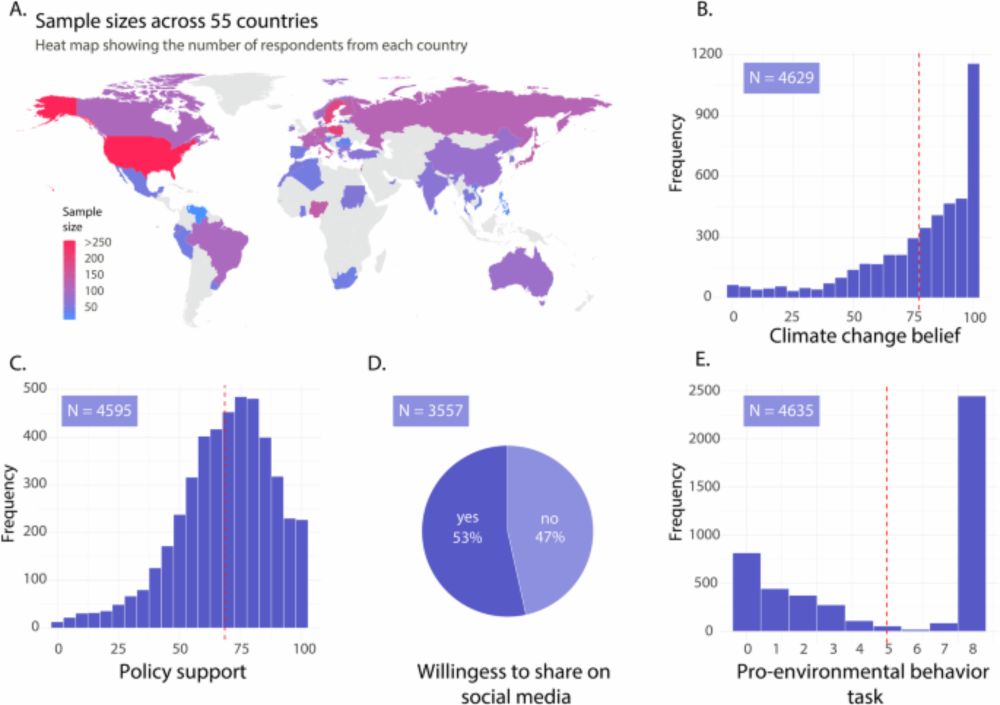
🚨 New paper out! 🚨
We used interpretable machine learning on data from 55 countries (N = 4,635) to identify the most important individual- and nation-level factors predicting climate beliefs, policy support, and behaviors.
📄 doi.org/10.1038/s441...
Led by @todorova.bsky.social
@monabielig.bsky.social @clauslamm.bsky.social @scanunit.bsky.social @cbehav.bsky.social @jayvanbavel.bsky.social @icouzin.bsky.social @todorova.bsky.social
07.05.2025 10:48 — 👍 0 🔁 0 💬 0 📌 0
📣In case you're still interesting in joining the Heat & Cognition Manylabs🔥🧠 , we are now running the task tournament. Collaborators can suggest tasks, scales, and items to be included in the project! Deadline to submit is May 11th! More info at: heatandmind.wordpress.com
07.05.2025 10:48 — 👍 11 🔁 10 💬 1 📌 0