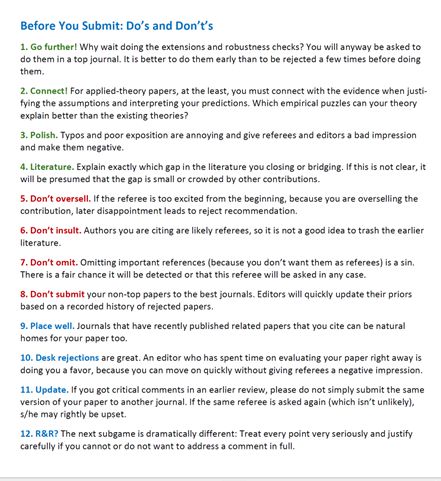
After being an editor for 6.5 years (4 REStud; 2.5 JEEA), I have accumulated a few suggestions that can help you avoid unnecessary rejections.
08.04.2025 20:03 — 👍 225 🔁 70 💬 5 📌 7
@benjonomics.bsky.social
Just trying to stay on top of the literature without ending up underneath the memes Environmental and urban economics Job Market Candidate, The Wharton School, University of Pennsylvania
After being an editor for 6.5 years (4 REStud; 2.5 JEEA), I have accumulated a few suggestions that can help you avoid unnecessary rejections.
08.04.2025 20:03 — 👍 225 🔁 70 💬 5 📌 7
Ok, following on that last thread, here are my suggestions about how to be a good mentor (though this is still a work in progress!)
(And others should feel free to add to my list!)
A🧵
As you’re pointing out, the news is a realization that businesses are in better off than expected, pushing up asset prices. But the news also suggests higher interest rates, pushing down asset prices.
Today, the downward effect dominated; but plenty of the time the upward effect is larger!
we’re all just vibing into climate impacts
30.12.2024 20:24 — 👍 238 🔁 47 💬 6 📌 6
I have created a list of environmental, resource, energy and agricultural economists which you can "pin to home". It already includes 263 people - and I keep adding accounts. So please let me know if you or someone else should be added!
bsky.app/profile/did:...
Check out the rest of the thread for some other great job market candidates from the Wharton applied economics program this year!
27.11.2024 21:54 — 👍 0 🔁 0 💬 1 📌 0And finally, thanks to my advisors, classmates, funders, family, and to anyone who made it down this far! 🎉 11/10
19.11.2024 19:09 — 👍 2 🔁 0 💬 0 📌 0
Thanks for reading! My larger research agenda focuses on water, cities, and housing within environmental, urban, and public economics. I am on the academic job market this year and am very much hirable. You can find my full JMP here: sites.google.com/view/benjono...
10/10
The mandate reduces utility-level water use. These results suggest that resource management is why some local environmental and urban policies are designed as inefficient mandates: incentives induce larger rebound effects which in turn induce some environmental or urban harm. 9/10
19.11.2024 19:09 — 👍 2 🔁 0 💬 1 📌 0
Variable pricing results in greater welfare gains disproportionately benefitting homebuyers. However, even though both policies lower metropolitan-area level water use the same amount, variable WIFs cause a large local rebound effect, increasing water use for adopting utilities. 8/10
19.11.2024 19:09 — 👍 2 🔁 0 💬 1 📌 0
Finally, using the model I compare variable pricing to another counterfactual, common tool to manage water scarcity: mandating that new housing limit outdoor irrigated areas. 7/10
19.11.2024 19:09 — 👍 2 🔁 0 💬 1 📌 0
I develop a parcel-level equilibrium model of the new housing market where landowners adjust lot sizes and water use based on costs.📊
The model replicates the reduced-form evidence, and I find that variable pricing improves consumer welfare by $3,500 per household. 6/10

Increased density may create a *local* rebound effect where more homes are built, raising water use in areas with variable WIFs.
➡️We need a model to untangle these effects and assess welfare implications of variable WIFs and counterfactual urban water management policies. 5/10


Using 🚨new data 🚨 on utility policies and water use from aerial imagery, I find that variable WIFs cause builders to reduce lot sizes by 15% and irrigated areas by 30%, cutting household water use by 15%. I also find that fees are fully capitalized into house prices. But... 4/10
19.11.2024 19:09 — 👍 5 🔁 1 💬 1 📌 0
Some utilities use variable WIFs, pricing fees based on expected water use, rather than flat fees.
These fees are steep—the average new single-family house in Colorado had a $20,000 WIF in 2019! 💸 3/10
The textbook solution to the rising cost of providing water for urban growth? Usage-based water rates.
But in practice, many water utilities rely on water impact fees (WIFs)—fees paid by builders to connect new homes to the public water system. 💧 2/10
🚨JMP Thread 🚨
🚰🏡Water scarcity is a global challenge, especially in the context of climate change. How do local water scarcity management policies affect housing markets, water use, and welfare? My job market paper explores these questions in the Front Range of Colorado.🧵