Moral conformity in a digital world: Human and nonhuman agents as a source of social pressure for judgments of moral character | PLOS One
26.04.2025 02:23 — 👍 10 🔁 6 💬 0 📌 0
@shreevallabha.bsky.social
PhD @ Michigan State University | social, moral, political psychology Website: https://shreevallabha.wixsite.com/shree-vallabha
Moral conformity in a digital world: Human and nonhuman agents as a source of social pressure for judgments of moral character | PLOS One
26.04.2025 02:23 — 👍 10 🔁 6 💬 0 📌 0(PDF) Essential moral self remains unchallenged: Successful replication of Strohminger and Nichols (2014) with extensions comparing morality to ideology and religion www.researchgate.net/publication/...
25.04.2025 17:07 — 👍 4 🔁 3 💬 0 📌 0😇👩🎓
02.04.2025 17:31 — 👍 1 🔁 0 💬 0 📌 0#PhDone
02.04.2025 17:30 — 👍 14 🔁 0 💬 0 📌 0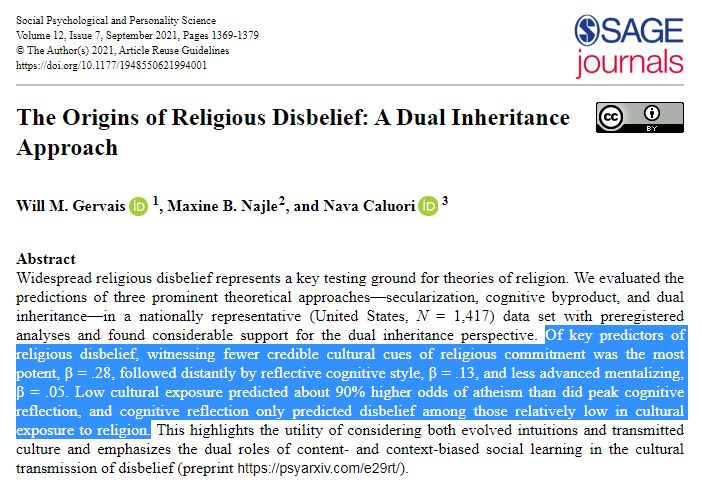
What predicts religious disbelief? Is it primarily about thinking deeply on religion & finding claims incredible? Not really. Authors find it's mostly about a lack of credible religious examples (parents not attending worship, being good religious role models). In other words, mostly socialization.
22.03.2025 13:14 — 👍 56 🔁 10 💬 11 📌 2New Preprint!
We find that close and distant future generations get less moral concern than even the most neglected human and non-human groups today. This is noted for boundless and zero-sum moral trade-offs.
🔗https://osf.io/preprints/psyarxiv/c9p8f_v1
#FutureGenerations#MoralPsychology#Psychology


Nice article about fertility technology — really appreciate the framing that isn’t “something gotta give” but rather “society loses out if women can’t have it all.” Featuring Kleven’s child penalties in a very pretty plot!
worksinprogress.co/issue/fertil...

And this personal experience has also blended into research, and with Brian Earp and colleagues, we actually have a new pre-print on this exact topic on how we judge people who lose weight by both typical and "artificial" means
www.researchgate.net/publication/...

Imagine a person who acts one way online (by email, on social media) but a different way in person. Which of the two is more revealing of their true self?
Our new paper: This seemingly simple question shows something about how people see certain environments as ‘natural’
osf.io/preprints/ps...

New paper out in SPPS w/
@jaimiekrems.bsky.social
(open access)
doi.org/10.1177/1948...
People who oppose abortion typically suggest that their position is motivated by concern for the unborn. But is there more going on?

🚨 Excited to share work in collaboration with Sarah Seraj, Andreas Weyland, @ryanboyd.io , @radamihalcea.bsky.social, @ashwinia.bsky.social, and Jamie Pennebaker out now in Scientific Reports! 🚨
www.nature.com/articles/s41...

How do LLMs shape writing? Our research shows they make language more uniform, reducing diversity and altering how personal traits appear in text. These shifts have big implications for identity, culture, and fairness.
#LLMs #NLProc
arxiv.org/abs/2502.11266
Aww😘
18.02.2025 20:28 — 👍 1 🔁 0 💬 0 📌 0All the best! Looks amazing!
18.02.2025 20:28 — 👍 0 🔁 0 💬 0 📌 0
Hey all - I’ll be giving a talk this year at SPSP that’s part of a symposium exploring novel work on conspiratorial beliefs.
Would be great for anyone attending to come see me, alongside some other remarkable researchers!
Re-upping this once more before the conference. I’ll be presenting some work on the relationships between conspiracy mentality, counterfactuals, and free will/det beliefs on Saturday at SPSP! Come by, listen, say hello!
Also, I’m on the market, looking for post-docs - keep me in mind!
Super duper cool work on moralization by my superstar labmate @abbycassario.bsky.social 😍. Check it out at @spspnews.bsky.social !
18.02.2025 20:23 — 👍 7 🔁 1 💬 1 📌 0
How do attitudes become moralized? We find that moral conviction spreads between connected attitudes over time. + Those with highly connected belief systems (ideologues) have highly moralized belief systems!
Come see us at the moral psych pre-con poster session @spspnews.bsky.social to learn more😃

Join us for our SPSP symposium! We present research on responses to personal, blatant, systemic, and historical racial prejudice. Featuring 3 in-person talks & a recorded session from Keith on Whova.
#SPSP2025
Friends tend to agree if you're ready or not for a long-term, committed relationship. Friends are important for forming/maintaining relationships, so that can be either good OR horrible for you/your relationship.
Congrats Hyewon Yang on her first first-author paper!
doi.org/10.1177/0265...
Currently putting together SRCD SECC Conversation Hour "Building Your Career: Postdoc and Academic Job Market Insights" to take place during the conference.
Who has been on the postdoc and/or job market **this** year and can talk about their experiences and will be at the SRCD conference?

Latest from @mjbsp.bsky.social et al.
With a lovely title that tells us the effect, meaning I don't need to write about their findings here!
(folks, I'm sure that also helps people cite your work!)
journals.sagepub.com/doi/abs/10.1...

1/
Our lab's new paper #SPPS, w/ PhD student Hanna Puffer
Using nationally representative data 2004-2020, asked: generalized prejudice (GP) remained invariant or evolved in US?
Answer: Evolved.
Answer: And it has become more politically affiliated.
#PrejudiceResearch #AcademicSky
New open-access paper in Annual Review of Psychology with @mjbsp.bsky.social: “Ideology: Psychological Similarities and Differences Across the Ideological Spectrum Reexamined”
www.annualreviews.org/content/jour...
Check out my recently published commentary where my collaborators and I discuss how those tapped to do DEI work is disproportionately placed on individuals with minoritized identities. We also briefly discuss how to improve this.
www.cambridge.org/core/journal...

Abstract: The cross-lagged panel model (CLPM) is an analytic technique used to examine the reciprocal causal effects of two or more variables assessed on two or more occasions. Although widely used, the CLPM has been criticized for relying on implausible assumptions, the violation of which can often lead to biased estimates of causal effects. Recently, a triangulation method has been proposed to identify spurious effects in simple CLPM analyses (e.g., Sorjonen & Melin, 2024b). We use simulations and a discussion of the formulas underlying regression coefficients to show that this method does not provide a valid indicator of spuriousness. This method identifies true causal effects as spurious in realistic situations and should not be used to diagnose whether a causal effect estimated from the CLPM is spurious or not. There are clear reasons to doubt causal estimates from the CLPM, but the results of the triangulation method do not add information about whether such estimates are spurious.

The problems w/ two-wave cross-lagged models are becoming widely known. Some proposed a "triangulation method" (2nd screenshot) to identify spurious effects in such designs
We show that this test doesn't work in plausible situations. It shouldn't be used.
journals.sagepub.com/doi/10.1177/...

I’ve said it before (as have others) and I’ll say it again, there’s no such thing as a non-causal mediation analysis.
journals.sagepub.com/doi/10.1177/...
I’ve got a lot of new followers, so I wanted to introduce myself a bit!
I’m a 5th year doctoral candidate, looking for post-docs. I am primarily an identity researcher, with a focus on how political identity affects misinformation belief, exacerbates polarization, and impacts DEI pushback.
The first of many (collabs) to come 🤍😍
06.10.2024 14:53 — 👍 1 🔁 0 💬 1 📌 0Registered Report: Cognitive Ability, But Not Cognitive Reflection Predicts Expressing Greater Political Animosity and Favouritism: http://osf.io/sdx3v/
06.10.2024 14:11 — 👍 1 🔁 2 💬 0 📌 0