
Veiled Turkish woman
1870s
Félix Bonfils

@siulk6.bsky.social
● They/Them/Any ● NB - Demi - Cuir ● 32- IDIC🖖🏼- ASD△ ● Communist ☭📕🛸 ● I like science, linguistics, arts, media, and propaganda ● I want to believe / The truth is out there 🛸👽☢️🐬 https://en.pronouns.page/@Siulk6 https://boxd.it/1ZTYR
Veiled Turkish woman
1870s
Félix Bonfils
you're never too old to simp
11.09.2025 16:41 — 👍 4 🔁 1 💬 0 📌 0
We should be extremely clear about this: fascists like Charlie Kirk have spent the last decade inciting political violence. They created the current climate and the only way to change course and end the violence we’re witness is to comprehensively defeat fascism.
www.jphilll.com/p/charlie-ki...
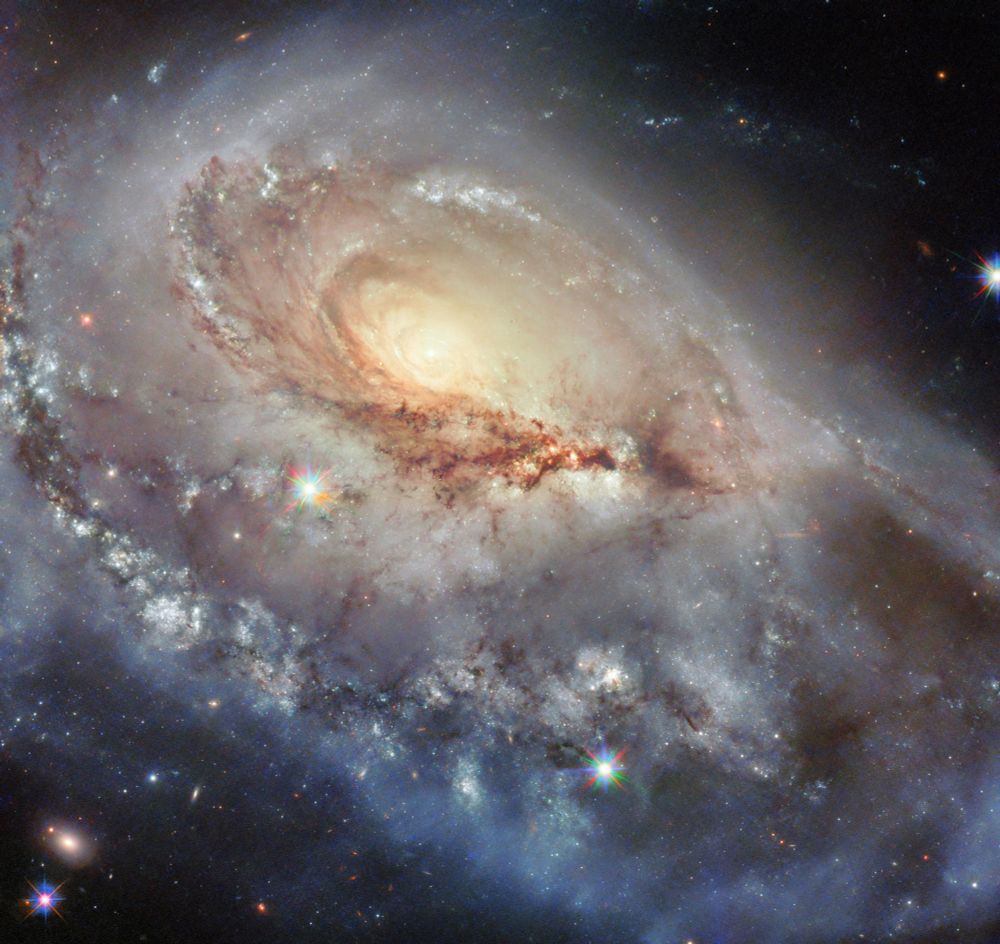
A spiral galaxy seen at a skewed angle. Its center is a bright spot radiating light. A thick, stormy disk of material surrounds this bright center, with swirling strands of dark dust and bright spots of star formation strewn through the disk. A large spiral arm extends from the disk toward the viewer. Some foreground stars are visible atop the galaxy.

A spiral galaxy, seen tilted at a slight angle, on a dark background of space. It glows softly from its center and out to its edge. The disk is a broad swirl of dark-reddish dust webs and sparkling blue patches where stars have formed. Atop the center of the galaxy is a foreground star that appears very large and bright with four diffraction spikes emanating from it. The star is relatively close to Earth compared to the galaxy.

A large galaxy is at center, and a significantly smaller galaxy is to its left. The large galaxy is mostly face-on, but the top appears slightly tilted away. It has several rings. Its circular core is bright white at the very center, but light yellow overall. Going outward, there are gaps between the rings. The core is surrounded by two slightly lighter yellow rings, which also appear to be overlapping. The next ring is slightly more transparent and yellow. The two or three rings that are farther out are bluer, sometimes with blue clumps. The widest ring is also blue, but also the most transparent. At 9 o’clock is a small dwarf galaxy. It is about the same size as the yellow core of the Bullseye. The dwarf galaxy is blue, with many dots. It looks like the edge of the Bullseye might touch the dwarf galaxy. Both galaxies are set on the black background of space, which is dotted with a range of galaxies in different shapes, colors, and sizes, along with one foreground star at left.
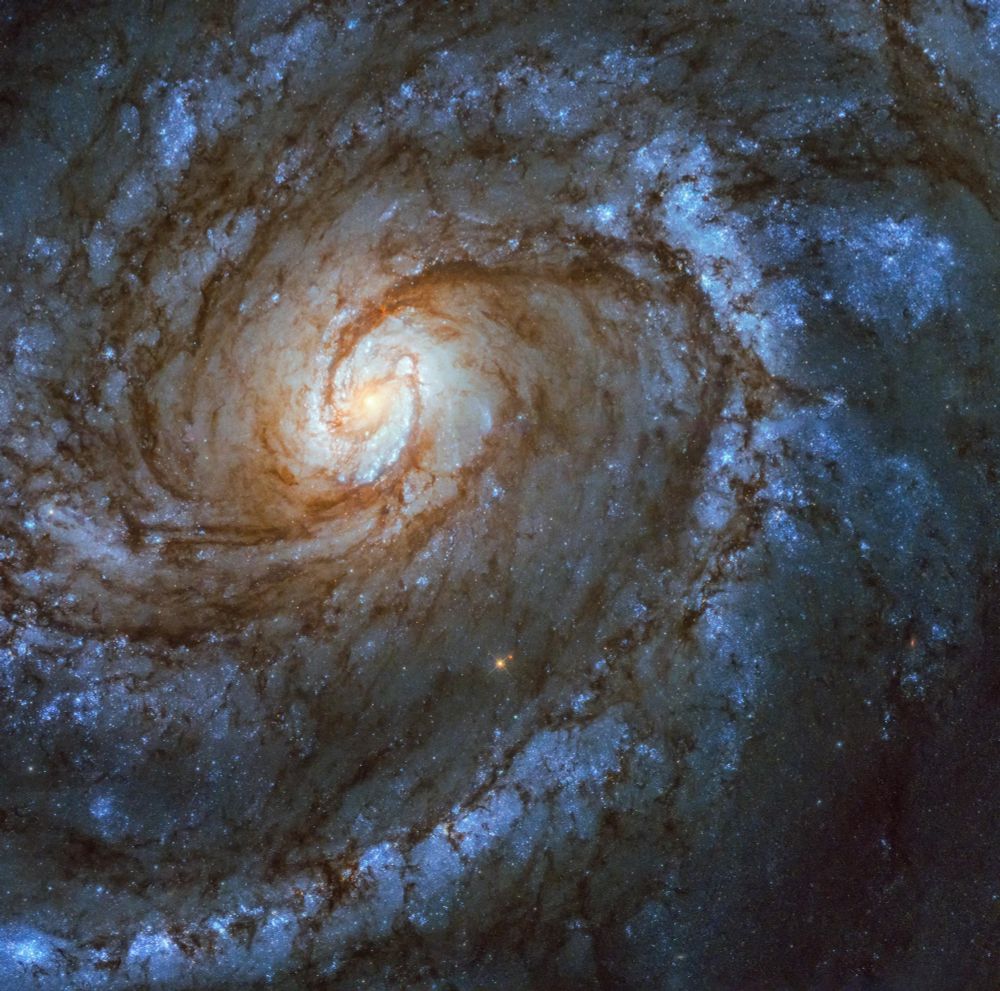
A massive spiral galaxy fills the image, with its bright yellow core seen near the upper left. Spiral arms whirl outward, laced through with dark brown dust and bright blue patches of star formation.
literally me if i was a galaxy
08.05.2025 03:47 — 👍 425 🔁 57 💬 9 📌 1
Close-up photo of the cloudtops across Jupiter's higher latitudes, featuring the distinctly blue-green colours present in the planet's polar areas.
A bit of #Jupiter (NASA / JPL-Caltech / SwRI / MSSS / Gerald Eichstädt / @theseaning.bsky.social)
08.05.2025 04:00 — 👍 156 🔁 32 💬 3 📌 1
A clumpy galaxy from the Galaxy Zoo: Hubble project, classified by 49 volunteers.
A clumpy galaxy, observed with the Hubble Space Telescope in the COSMOS survey.
It is at redshift 0.78 (lookback time 6.94 billion years) with coordinates (150.26617, 1.98823).
49 volunteers classified this galaxy in Galaxy Zoo: Hubble.

Ichiro Tsuruta, from JCA Annual 9
1990
Carl Sagan when asked, "Are you a Socialist?"
21.04.2025 13:40 — 👍 24421 🔁 7299 💬 548 📌 597
Link from Ocarina of Time stares out towards the viewer readying his bow, Phantom Ganon looms behind him jumping out of a painting in the forest temple
‼️
21.04.2025 15:44 — 👍 30340 🔁 9000 💬 169 📌 55 13.04.2025 03:31 —
👍 25700
🔁 4567
💬 296
📌 189
13.04.2025 03:31 —
👍 25700
🔁 4567
💬 296
📌 189

Lady with a Lute
1886
Thomas Wilmer Dewing

I love the lighting in the early TOS episodes.
05.04.2025 23:31 — 👍 28 🔁 1 💬 2 📌 0
A clumpy galaxy from the Galaxy Zoo: Hubble project, classified by 122 volunteers.
A clumpy galaxy, observed with the Hubble Space Telescope in the GEMS survey.
It is at redshift 0.32 (lookback time 3.73 billion years) with coordinates (52.88109, -28.04847).
122 volunteers classified this galaxy in Galaxy Zoo: Hubble.

Happy Socialist Sunday
Good Morning Comrades
Happy #SocialistSunday!
🌻

Things are so bad, Spock is back on the lollipops.
16.02.2025 13:28 — 👍 22 🔁 3 💬 2 📌 0 25.11.2024 10:56 —
👍 4208
🔁 2051
💬 11
📌 17
25.11.2024 10:56 —
👍 4208
🔁 2051
💬 11
📌 17

A merger from the Galaxy Zoo CANDELS project, classified by 73 volunteers.
A merger, observed with the Hubble Space Telescope in the CANDELS-GOODS survey.
It is at redshift 1.71 (lookback time 10.00 billion years) with coordinates (53.17443, -27.87915).
73 volunteers classified this galaxy in Galaxy Zoo CANDELS.

a historical-style portrait of Nandor the Relentless, from the tv show "What We Do in the Shadows". He sits in a suit of armour against a curtain backdrop.
Nandor the Relentless - watercolour and acryla gouache
I'm on the last episode of What We Do in the Shadows. Going to miss it terribly 🦇
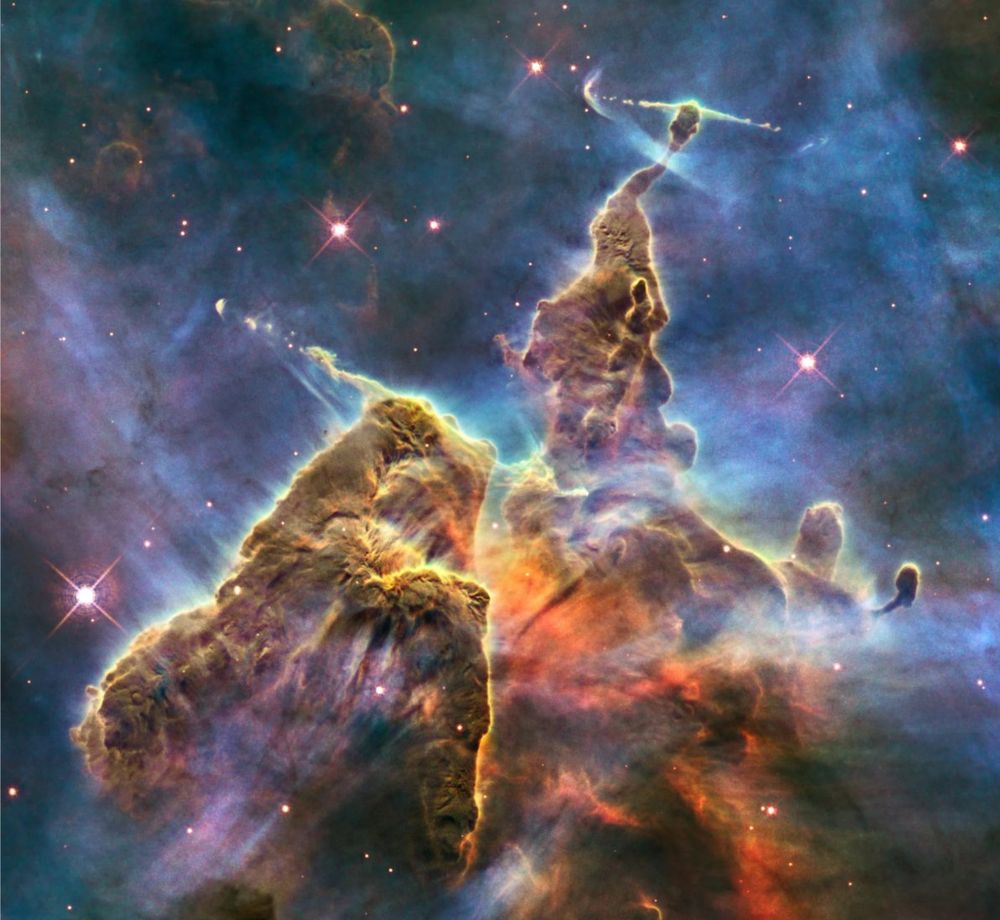
Large orange, yellow, and red clouds of dust and gas tower in the image, interspersed with a few pink stars.
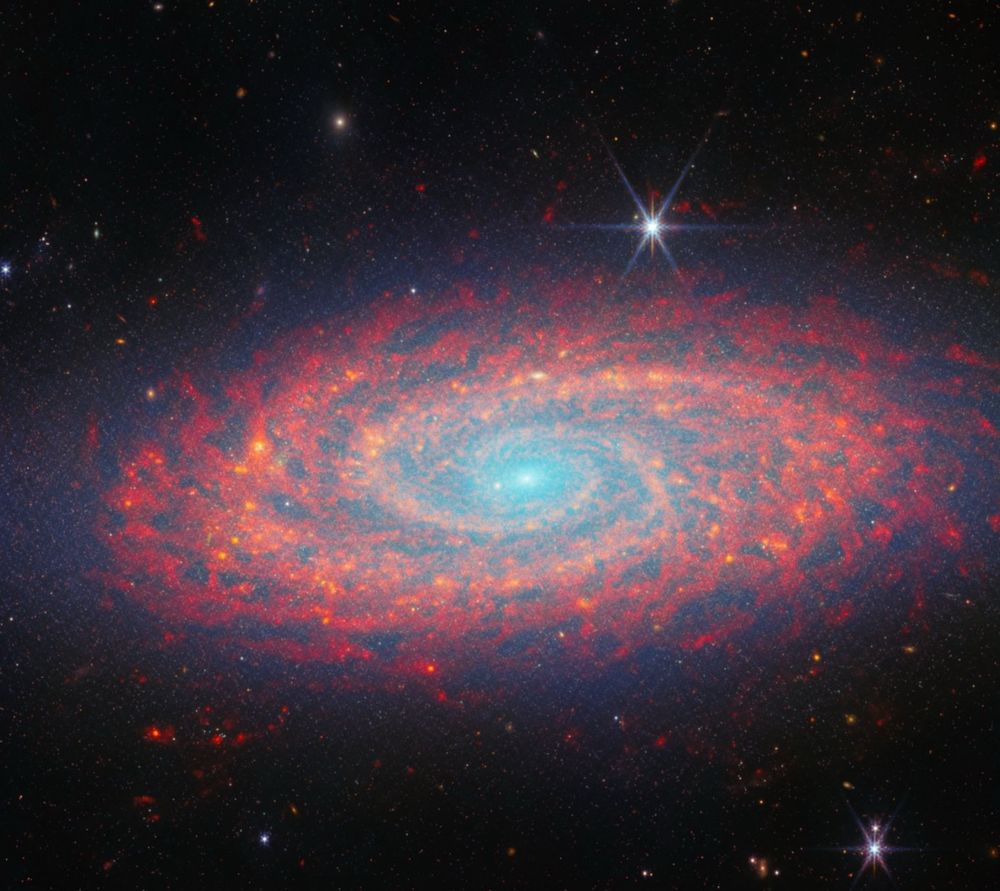
A spiral galaxy with a wide, oval-shaped disk. It has a shining spot at the center from which two curving, pale red spiral arms emerge, wrapping once each around the galaxy. They’re surrounded by a whirl of bright threads and patches of dust, with spots of star formation scattered throughout. The glow of the disk fades smoothly into the background where some patches of dust can be seen, as well as foreground stars.
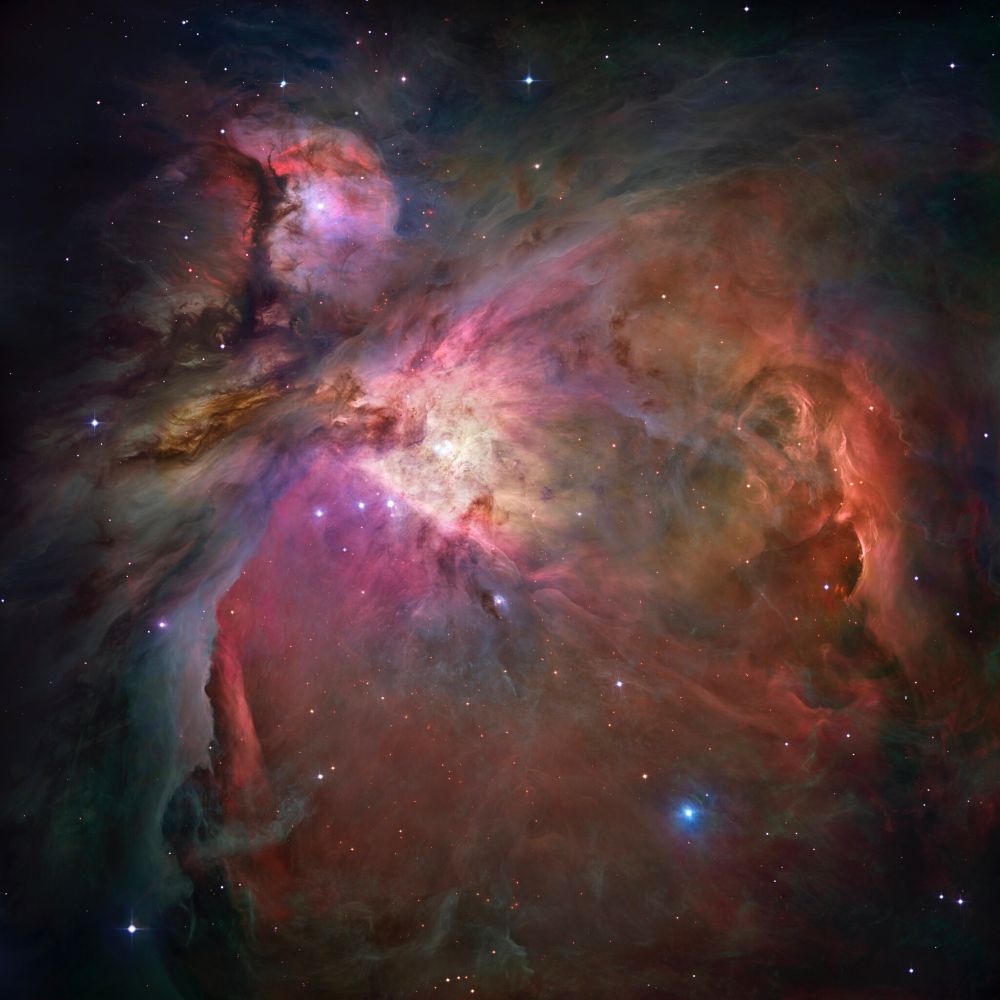
The Orion Nebula is an expansive and cloudy cosmic landscape. Sweeping clouds that shine in pink, yellow, orange, and other colors are bright against the black backdrop of space. Big stars are forming and glowing within the nebula.
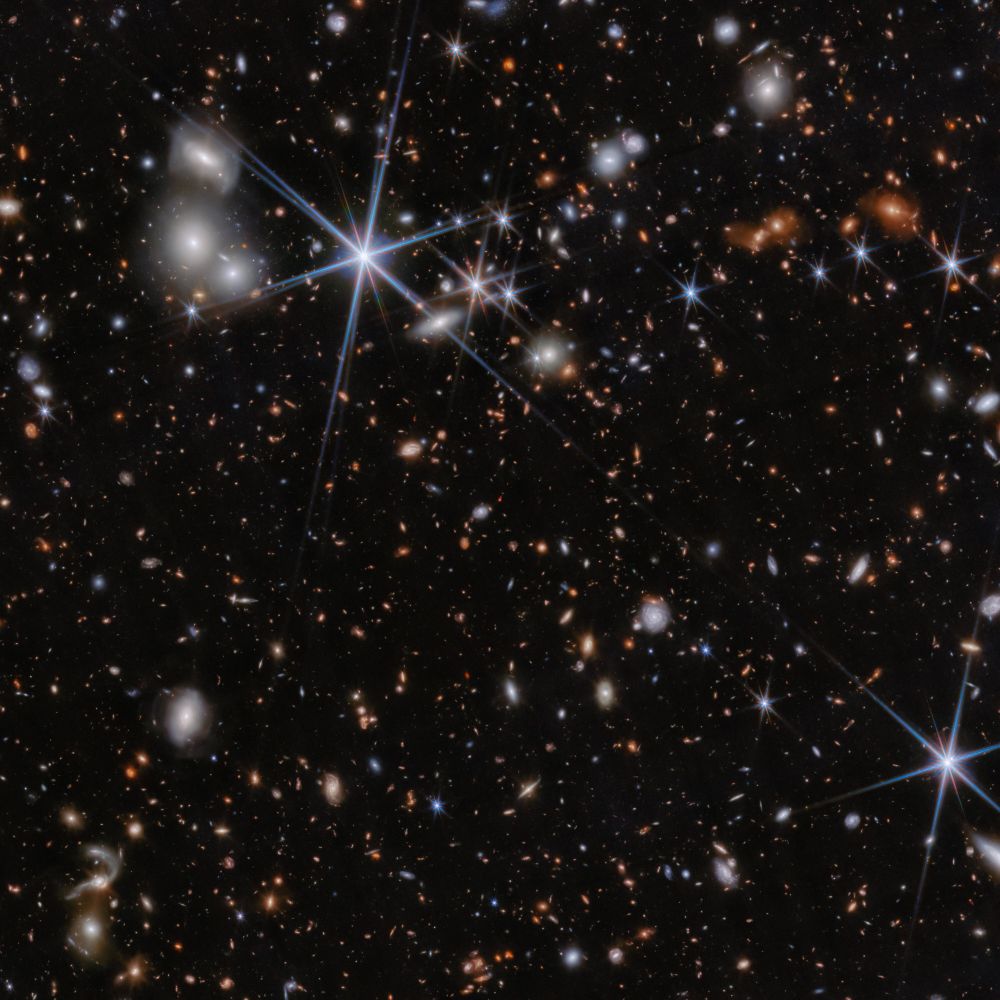
Hundreds of stars and galaxies in varying shapes, sizes and colors on a black background. Two of the largest, most prominent stars can be found in the top left quadrant and near the bottom right edge, respectively. They are tinged with blue and have an eight-point diffraction spike pattern. Near the center of this image is the ZS7 system, made up of a merger between two galaxies and their black holes. The ZS7 system is not easily seen by the naked eye in this image, as it looks like very small red dots.
lots of devastation and negativity on the feed today.
i know this won’t solve anything, but maybe it’ll make someone smile and just forget for a small moment.
the beauty of the cosmos 🌌
Happy new year comrades 🖤
01.01.2025 04:13 — 👍 0 🔁 0 💬 0 📌 0
A personification of the moon watches over the land, her cloak of gems glittering as stars in the night sky.
Happy holidays and merry Christmas to those who celebrate ✨
24.12.2024 17:04 — 👍 763 🔁 163 💬 6 📌 0Bon réveillon 🖤
24.12.2024 17:26 — 👍 0 🔁 0 💬 0 📌 0
Mars...
19.12.2024 11:28 — 👍 1001 🔁 78 💬 23 📌 5
This is a composite image of star cluster NGC 602, in vibrant and festive colors. The shape of the star cluster strongly resembles a holiday wreath. The cluster includes a giant dust cloud ring, shown in greens, yellows, blues, and oranges. The green hues and feathery edges of the ring cloud create the appearance of a wreath made of evergreen boughs. Hints of red representing X-rays provide shading, highlighting layers within the wreath-like ring cloud. The image is aglow with specks and dots of colorful, festive light, in blues, golds, whites, oranges, and reds. These lights represent stars within the cluster. Some of the lights gleam with diffraction spikes, while others emit a warm, diffuse glow. Upon closer inspection, many of the glowing specks have spiraling arms, indicating that they are, in fact, distant galaxies. Credit: X-ray: NASA/CXC; Infrared: ESA/Webb, NASA & CSA, P. Zeilder, E.Sabbi, A. Nota, M. Zamani; Image Processing: NASA/CXC/SAO/L. Frattare and K. Arcand
OH MY GOD!! WE HAVE THE COMBINED WEBB AND CHANDRA VIEW OF NGC 602!! IT’S SO BEAUTIFUL 🤩🌌
17.12.2024 19:09 — 👍 658 🔁 108 💬 17 📌 11
The WITCH HEAD NEBULA
15.12.2024 12:03 — 👍 15613 🔁 1139 💬 190 📌 57
A well-dressed “Flusher”, a man who helped maintain London’s sewer system
1950s

simple pencil sketch of Captain Janeway from Star Trek Voyager

digital art of Captain Janeway from Star Trek Voyager with a coffee mug
One of the greatest things I did this year - I started drawing a bit more consistently.
Started in February, tried to do at least smth every day. Eventually I even picked up a simple tablet and this is where I am now 💫
I see lots of areas where I need to improve, but I'm grateful for the journey

The closest known black hole to Earth is just 1,560 light-years away.Credit|NASA
15.12.2024 14:15 — 👍 1253 🔁 129 💬 30 📌 9
James Webb Space Telescope’s infrared view of the Pillars of Creation
15.12.2024 06:46 — 👍 1381 🔁 141 💬 9 📌 8
btw this is an actual east german poster
marxism is kind of radical,,,
