
5️⃣/🔟 In Scientific Reports, 5 of the top 10 most cited articles have an article number of 1.
5️⃣/🔟 In Nature Communications the same: 5 of the top 10 are article 1s.
Coincidence? 👇
scirate.com/arxiv/2511.0...
I think not.
5️⃣/🔟 In Scientific Reports, 5 of the top 10 most cited articles have an article number of 1.
5️⃣/🔟 In Nature Communications the same: 5 of the top 10 are article 1s.
Coincidence? 👇
scirate.com/arxiv/2511.0...
I think not.

And as per quantum Bluesky tradition, here’s a meme about the work! ( @dulwichquantum.bsky.social )
22.09.2025 11:00 — 👍 5 🔁 1 💬 1 📌 1These are early steps, but the results are promising. We are excited to extend the protocol to different system geometries and interaction structures. Many thanks to the whole team ( @egle-pagliaro.bsky.social , @luplaciano.bsky.social , Leonardo Zambrano, Antonio Acín) 😁
22.09.2025 11:00 — 👍 3 🔁 0 💬 1 📌 0
We tested the protocol with tensor-network simulations up to 128 qubits and also implemented it on IBM superconducting hardware, successfully learning a 109-qubit Hamiltonian.
22.09.2025 11:00 — 👍 0 🔁 0 💬 1 📌 0
A few repetitions of the Zeno reshaping + local tomography pipeline, combined with careful merging of the estimates from different patches, are sufficient to reconstruct the global Hamiltonian. In this work, we focus on 1D geometrically 2-local Hamiltonians.
22.09.2025 11:00 — 👍 0 🔁 0 💬 1 📌 0
Following this idea, we implement a coherence-preserving reshaping of the Hamiltonian via the quantum Zeno effect, using virtual-Z gates. Each reshaping configuration isolates different parts of system, and within each configuration, these patches can be learned in parallel via process tomography.
22.09.2025 11:00 — 👍 0 🔁 0 💬 1 📌 0HL is a hard but important problem. As quantum computers and simulators grow in size and complexity, there is a need for experimentally-friendly protocols. A natural approach is to exploit the local structure of many systems and reshape the Hamiltonian so that each part can be learned locally.
22.09.2025 11:00 — 👍 0 🔁 0 💬 1 📌 0
New preprint! arxiv.org/abs/2509.15713
We propose an experimentally-friendly Hamiltonian learning (HL) protocol using the quantum Zeno effect (via virtual-Z gates) to reshape dynamics, enabling local tomography and global reconstruction. Tested with TN simulations and on IBM hardware.
8th International Conference for Young Quantum Information Scientists
www.quantiki.org/conference/8...

Greenly illuminated cat
Researchers led by Gerhard Kirchmair & Oriol Romero-Isart have demonstrated that it is possible to create quantum superpositions from thermally excited states.
Hot Schrödinger cat states 🐈⬛ in a microwave resonator: iqoqi.at/en/current/n...
📸: Harald Ritsch @oeaw.bsky.social @fwf-at.bsky.social
Et non, en physique quantique, le paradoxe EPR n'a rien à voir avec un voyage dans le temps raté... Pour enfin y voir clair derrière les étrangetés que sont le chat de Schrödinger et l'intrication, partez à leur rencontre De l'autre côté du miroir quantique, dans les librairies à partir du 16 avril.
20.03.2025 21:16 — 👍 3 🔁 1 💬 0 📌 0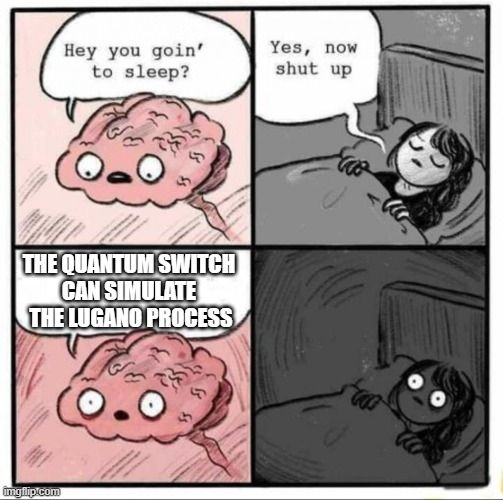
New paper out 🥳
With Anna Steffinlongo, a brillant PhD student in our group, we show that noncausal classical communications (CC), where all the parties are both in the past and future of each other, can be simulated by a superposition of CC. arxiv.org/abs/2502.15579 1/14
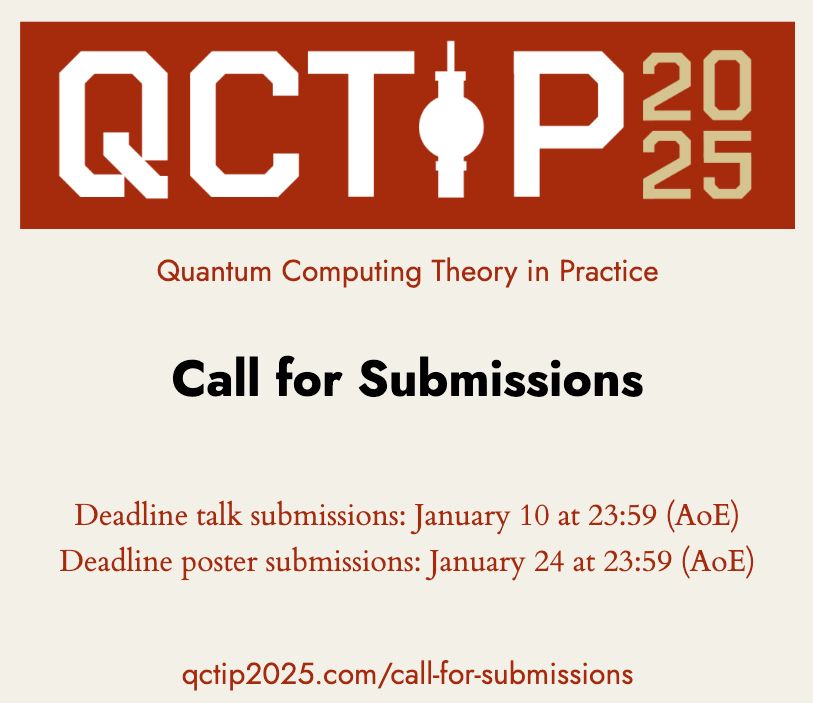
Submissions for QCTiP 2025 are now open.
05.12.2024 10:45 — 👍 24 🔁 16 💬 1 📌 2