Hi Bluesky! 👋 We’re the Philosophical Moral Psychology Lab, based at the Uehiro Oxford Institute. We use experimental philosophy and moral psychology methods to study morality, with the aim of contributing to normative and philosophical debates in ethics. Follow us to keep up with our work!
02.03.2026 12:49 —
👍 30
🔁 18
💬 0
📌 0

Ignoring the Science: The Curious Case of Cell Phone Bans
The push to “protect” children from cell phones and social media is gaining momentum worldwide. As EU and Asian countries consider legal limits on minors’ access to social
In my essay today for @RCInvestigates I look at the burgeoning #digitalabstinencemovement, including #socialmedia bans, #cellphone bans and the claims that Edtech "ate" kids' education.
None of these policies or claims are well-based in actual data.
www.realclearinvestigations.com/articles/202...
24.02.2026 18:18 —
👍 1
🔁 3
💬 0
📌 0
A rational agent ought to be entirely indifferent to life on other planets (if it has no discernible effect on the agent)
20.02.2026 13:37 —
👍 0
🔁 0
💬 0
📌 0
Problem about the loneliness epidemic is, it's everywhere except in representative survey data. Let's look at where the claim comes from. 1/
17.02.2026 07:13 —
👍 597
🔁 228
💬 21
📌 35

ABSTRACT
The extended evolutionary synthesis (EES) is a school of thought that maintains that genetic determination and natural selection are over-emphasized in the study of evolution at the expense of non-genetic inheritance and processes of evolution beyond selection. Its proponents call for the de-emphasis of genetics and the adoption of a broader model of inheritance that includes cultural and epigenetic transgenerational effects and strong adaptive phenotypic plasticity. Presenting itself as a radical alternative to what it claims is a rigid and ossified theoretical orthodoxy, the EES has lately gained considerable traction among scholars of human evolution, and a distinct sub-branch of the EES unique to the biological anthropological study of human evolution has emerged (the EES in human evolution). To date, however, no direct comparison between the EES in human evolution and other contemporary evolutionary approaches has been attempted to evaluate whether the EES in human evolution affords researchers an edge in articulating good questions and structuring research programs to answer them. After reviewing the landscape of evolutionary theory, we evaluate whether the EES in human evolution is capable of delivering the processually pluralistic vision of evolution it has long promised and whether it brings something that the decades-long ongoing synthesis (OS) of evolutionary theory since the modern synthesis does not. We then conduct a head-to-head comparison to evaluate the relative explanatory efficacy of the EES and our preferred OS theoretical framework on several issues of human morphological evolution. We demonstrate that evolutionary perspectives as drawn from the OS have a much more clarifying effect on the investigation of human evolution than their EES-based competitor. Far from being a radical extension of evolutionary thought, the EES in human evolution offers little more than another idiom in which to tell adaptationist stories and triumphalist narr…
A much-needed critique of the Extended Evolutionary Synthesis (EES) as applied to human evolution, by @evoroseman.bsky.social and Ben Auerbach (2026).
Evolving a Field: Can Evolutionary Theory Provide What the Study of Human Evolution Requires? 🧪 #BioAnth
onlinelibrary.wiley.com/doi/10.1002/...
12.02.2026 19:51 —
👍 23
🔁 11
💬 4
📌 2

The “I” in egalitarianism: Hadza hunter-gatherers averse to inequality primarily when personally unfavorable
Abstract. Many economists contend that humans have strong, universal, other-regarding equality preferences with deep evolutionary roots. Indeed, many hunte
📢 New Paper 🚨
Hadza food-sharing is egalitarian, yet offers in giving games have never matched the equitable redistribution seen in real life.
In this study, we allowed people to give *or* take. Lifelike equitable distributions only appeared when people took from peers in surplus.
bit.ly/4kvLOwA
10.02.2026 16:23 —
👍 95
🔁 38
💬 1
📌 4

Thrilled to share our latest paper, out now in Science Advances! We explored the development of cooperative behaviors — fairness, trustworthiness, forgiveness, & honesty — across five societies, culturally contextualizing them & seeing how they correlate. (1/5) www.science.org/doi/full/10....
07.02.2026 15:09 —
👍 126
🔁 44
💬 1
📌 3
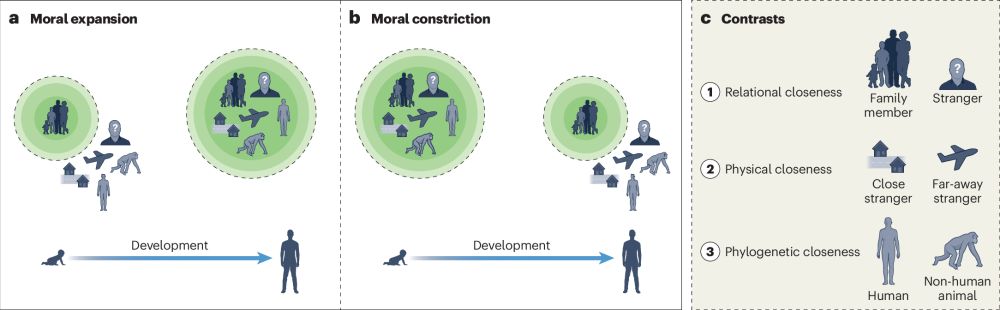
When development constricts our moral circle
Nature Human Behaviour - Although many believe our moral circles expand with age, this Perspective discusses an early-emerging tendency to care for others.
🥳🥳 New paper in @nathumbehav.nature.com: “When development constricts our moral circle." Contrary to popular belief, younger kids may start out with broader moral circles than older ones. Check it out here 👉 rdcu.be/eoaSe
w/ @mattiwilks.bsky.social @karrineldner.bsky.social & Lucius Caviola
28.05.2025 17:49 —
👍 117
🔁 45
💬 2
📌 9

Motivational context does not influence children’s third-party punishment in intergroup contexts
Children punish to reciprocate harm (retributive motives) and to prevent future wrongdoing (consequentialist motives). Building on this idea, we wante…
Excited to share our new paper in Cognitive Development! We replicate that children punish for both retributive and consequentialist reasons — and, surprisingly, intergroup context doesn’t change these effects. tinyurl.com/ycyhcn5a Check in out! ✨
30.11.2025 16:35 —
👍 11
🔁 8
💬 1
📌 0
PNAS
Proceedings of the National Academy of Sciences (PNAS), a peer reviewed journal of the National Academy of Sciences (NAS) - an authoritative source of high-impact, original research that broadly spans...
A very important study. Many figured that chimp warfare was adaptive. Now we have proof. Lethal displacement of a neighbor doubled fertility and even had a greater impact on survivorship. However, as usual we need more details as other questions emerge.
www.pnas.org/doi/full/10....
19.11.2025 15:20 —
👍 7
🔁 3
💬 0
📌 0

People don't like individuals who vigilantly monitor and reprimand wrongdoings at work.
These "hall monitors" are seen as less moral and hyper competitive (the only people who like them are other vigilantes).
www.sciencedirect.com/science/arti...
05.02.2026 19:24 —
👍 19
🔁 7
💬 3
📌 1
So what was their alternative sociological explanation of your results?
05.02.2026 23:10 —
👍 1
🔁 0
💬 1
📌 0
What was their point/objection?
05.02.2026 16:24 —
👍 0
🔁 0
💬 1
📌 0
Thanks. I wasn’t familiar with all of these examples. But, what’s wrong with someone who studies dating writing a popular book or teaching a course on dating?
04.02.2026 20:36 —
👍 1
🔁 0
💬 1
📌 0
Which actual EP writings/activities/people do you have in mind?
04.02.2026 18:16 —
👍 1
🔁 0
💬 1
📌 0
Do you think you can test whether other species have evolved mate preferences?
04.02.2026 16:27 —
👍 0
🔁 0
💬 0
📌 0
I'm sorry to hear that. I hope you are on the road to recovery 🤞
04.02.2026 15:30 —
👍 1
🔁 0
💬 0
📌 0
Did you read the thread?
04.02.2026 13:14 —
👍 0
🔁 0
💬 0
📌 0
Do you really think it is implausible to suggest that human males have evolved to be attracted to secondary sexual characteristics in females? (And yes, birds liking clouds is a dumb comparison.)
04.02.2026 13:08 —
👍 0
🔁 0
💬 1
📌 0
Just-so stories are eminently testable x.com/Oliver_S_Cur...
04.02.2026 12:49 —
👍 0
🔁 0
💬 1
📌 0
Why would clouds make birds happy? (Happy enough to evolve wings?) Your theory makes no sense.
You seem to think that it is easy to come up with adaptationist hypotheses ('just so stories'), but you haven't managed to come up with one that even gets off the starting blocks.
04.02.2026 12:36 —
👍 0
🔁 0
💬 1
📌 0
It depends on what the mechanism is supposed to be, which you haven't explained.
04.02.2026 09:34 —
👍 0
🔁 0
💬 1
📌 0
Above all you would need to propose a theory of why being close to clouds was an adaptive benefit, ie why natural selection would have favoured it. (And, you can never control for 'all' other variables ever; so which other control variables did you have in mind?)
04.02.2026 09:32 —
👍 0
🔁 0
💬 0
📌 0
"We can analyze the data without hypotheses about what it might show." 😂 There speaks a person who has never analysed data.
04.02.2026 09:27 —
👍 3
🔁 0
💬 0
📌 0
Why would birds find clouds attractive?! In any case, you could test whether they do. In fact, the theory makes lots of testable predictions. Flight evolved in cloudy places. Less flying in clear skies… etc
04.02.2026 00:33 —
👍 0
🔁 0
💬 1
📌 0
Ok, so you think that the human body and brain contains adaptations (such as the visual system), but you draw the line for some reason at sexual psychology. Do you think mate preferences evolved in other animals? Why not in humans?
02.02.2026 09:23 —
👍 1
🔁 0
💬 0
📌 0