
Heute Abend gibts bei Astro & Co Astronomie und Chemie: Um 19 Uhr wirft Klaus Paschek vom @mpi-astro.bsky.social live einen Blick auf die Entstehung der Bausteine des Lebens im All und auf der jungen Erde 🔭
www.youtube.com/watch?v=nWiT...

@klauspaschek.bsky.social
Postdoc @mpi-astro.bsky.social. Passionate about #OriginOfLife 🌠🧬🦠🪐 research, #Geocaching, #ViaFerrata 🧗. @oolen.bsky.social Executive Board member. New paper: https://bit.ly/spacevitamin
Heute Abend gibts bei Astro & Co Astronomie und Chemie: Um 19 Uhr wirft Klaus Paschek vom @mpi-astro.bsky.social live einen Blick auf die Entstehung der Bausteine des Lebens im All und auf der jungen Erde 🔭
www.youtube.com/watch?v=nWiT...
More info: www.sciencecafenijmegen.nl/actueel/2025...
22.10.2025 08:09 — 👍 0 🔁 0 💬 0 📌 0
I'll be featured at the outreach event of the Science Café in Nijmegen 🇳🇱, talking about astrochemistry and the origins of life and its building blocks in space and on early Earth.
Stop by if you're in the area on Thu, Oct. 23, 7.45 PM. Admission is FREE, and there will be jazz! 🎶🎷🌌🔭☄🦠
Thank you very much for the shout out! Go @oolen.bsky.social!
02.07.2025 16:19 — 👍 4 🔁 0 💬 0 📌 0


Had a great time presenting my work on Assembly Theory and molecular phylogenetics at the GRS and GRC on Molecular Mechanisms of Evolution in Boston, and the FALCON origin of life and astrobiology conference at Reykjavik. Feeling inspired!
28.06.2025 14:35 — 👍 4 🔁 3 💬 0 📌 0


#FALCON2025 was wrapped up by a career development workshop, featuring @seanfj.bsky.social and Filipa Sousa, giving us valuable and honest advice on how to progress in one's career to becoming a PI and how to write good proposals, as well as a lively poster session.
28.06.2025 16:26 — 👍 5 🔁 2 💬 1 📌 0
Thank you to everyone for coming! A special thanks to AbGradE and @euroastrobiology.bsky.social for joining forces to make this incredible event here in Iceland 🇮🇸 possible! It was a privilege to collaborate, and we truly owe you for making it all happen! Enjoy the conference excursion tomorrow! 🌋🐑🏔️🌊
28.06.2025 16:26 — 👍 4 🔁 3 💬 0 📌 0


The origins of life session during #FALCON2025 featured an amazing keynote talk by our very own @silkeasche.bsky.social, intriguing roundtable discussions about the very definition of life and how to detect it, and, of course, many exciting contributed talks! Thanks to all the speakers! 👏
28.06.2025 16:05 — 👍 4 🔁 3 💬 0 📌 0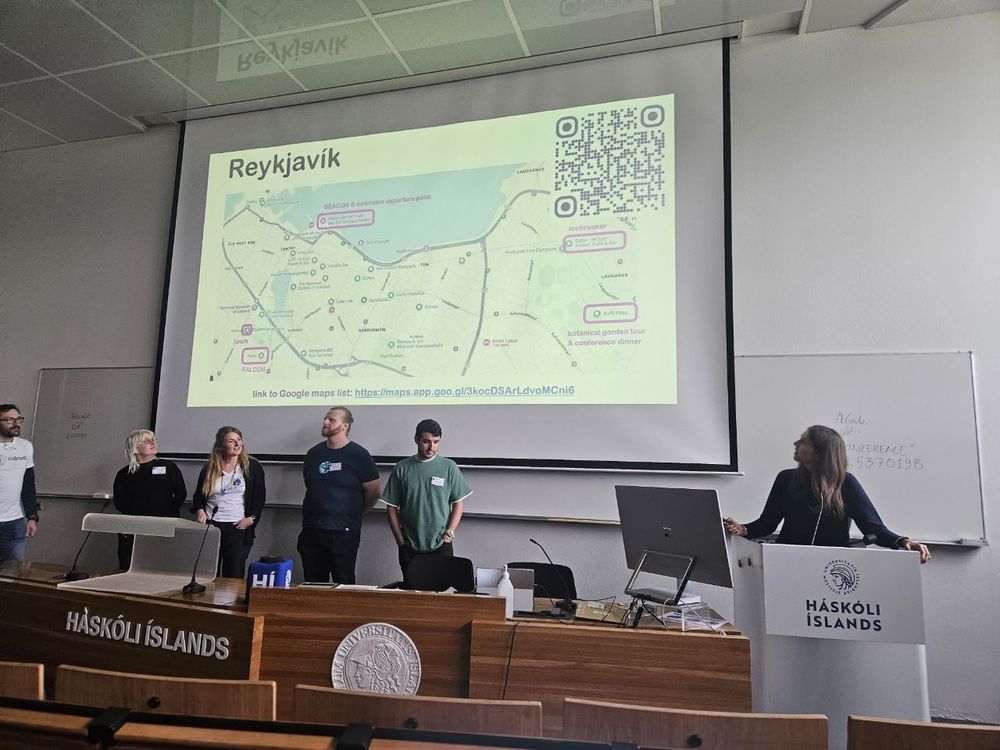


On the first full day of #FALCON2025, we enjoyed an amazing lineup of astrobiology talks, a lovely tour of the botanical gardens, and a great conference dinner. We hope that many new connections will be made between the astrobiology and origins of life communities here in Iceland!
28.06.2025 15:55 — 👍 5 🔁 3 💬 0 📌 0
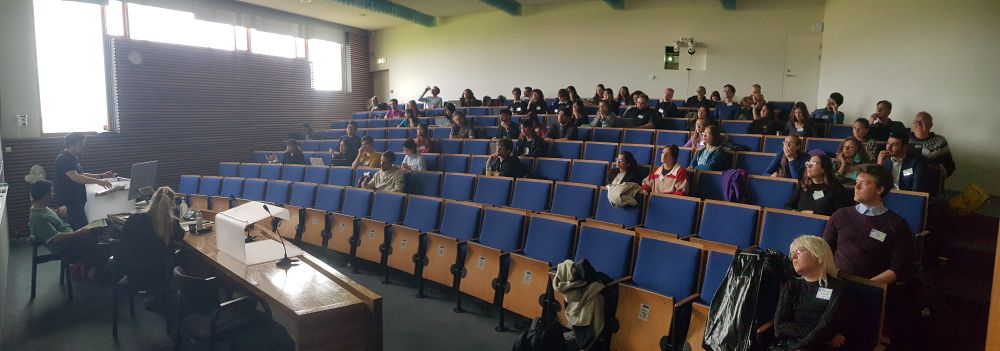


#FALCON2025 is in full swing, uniting Astrobiology and the Origins of Life sciences in a fun, relaxed gathering surrounded by 🇮🇸 Iceland's picturesque volcanic early Earth analogue landscape. 🌋🧬🦠
Let's go!


I'm so excited to be on my way to #FALCON2025, our first jointly organized early-carrer conference of AbGradE and @oolen.bsky.social in Reykjavik 🇮🇸🌋! Can't wait to meet everyone and talk exciting science! 🤩
More info
oolen.org/news-and-events/in-person-meetings/falcon2025
and
abgrade.eu/falcon2025

Group of people participating in a groundbreaking ceremony outdoors. A diverse crowd stands in the background, smiling and watching the event, while six individuals at the front are equipped with orange construction helmets and shovels. They are actively digging into a pile of sand, symbolizing the start of a construction project. The setting is a grassy area near a modern building, with a tall evergreen tree visible to the right. The atmosphere appears celebratory and collaborative, showcasing community engagement and teamwork.
MPIA is growing, and it needs more space for offices, meetings, and lunch. Therefore, it will get a new extension building. The groundbreaking ceremony was yesterday, attended by prominent guests such as Heidelberg's Lord Mayor Eckart Würzner.
www.mpia.de/6215101/2024... (Credit: M. Pössel/MPIA)

Find the published cover here: doi.org/10.1002/cplu...
Read more in our press release published on the website of our HIFOL initiative @mpi-astro.bsky.social.
=> mpia.de/en/research/...
Thanks to Mijin Lee, Dmitry Semenov, and Thomas Henning for the great joint effort.

[Re-posting Twitter, Apr 16, 2024]
We made it to the cover of ChemPlusChem!!!
Vitamins from outer space and the origins of life? Yes!
=> doi.org/10.1002/cplu...
Amazing what you can do yourself with #opensource @blender3d.bsky.social just following tutorials by youtube.com/@blenderguru (thanks!).

You can also go directly to the open-source chapter here: doi.org/10.5772/inte...
17.11.2024 00:28 — 👍 0 🔁 0 💬 0 📌 0
To get a complete but concise overview of (cryo-)volcanism in our solar system, and how this might help to understand its potential on exoplanets, follow the link: klauspaschek.com/publication/...
What are your thoughts? Let me know!

And, most importantly, tidal heating might allow these tiny worlds to stay in this state for long time periods, giving a potential emergence of life plenty of time to arise and thrive. 👽🪸🦑
17.11.2024 00:28 — 👍 0 🔁 0 💬 1 📌 0
Our main conclusion in the book chapter is that tidal forces allow even very tiny planets or moons to pass into this state of cryovolcanism. This might expand the number of potentially habitable worlds out there immensely.
17.11.2024 00:28 — 👍 0 🔁 0 💬 1 📌 0
Silicate volcanos on the grounds of these extraterrestrial oceans might give rise to hydrothermal vents, a popular site for many theories around the origins of life. 🦠🌋🦠
17.11.2024 00:28 — 👍 0 🔁 0 💬 1 📌 0
This often gives rise to a special "cool" type of volcanism, #cryovolcanism, that might produce subsurface liquid water oceans on these ice moons, e.g. #Europa, #Enceladus, or the often underrated and forgotten #Triton, hiding under their hostile-looking ice crusts.
17.11.2024 00:28 — 👍 1 🔁 0 💬 1 📌 0
We found in a recent study doi.org/10.3390/app1... that tidal forces might have a bigger potential to heat up moons around the gas giants in our solar system than previously assumed.
17.11.2024 00:28 — 👍 0 🔁 0 💬 1 📌 0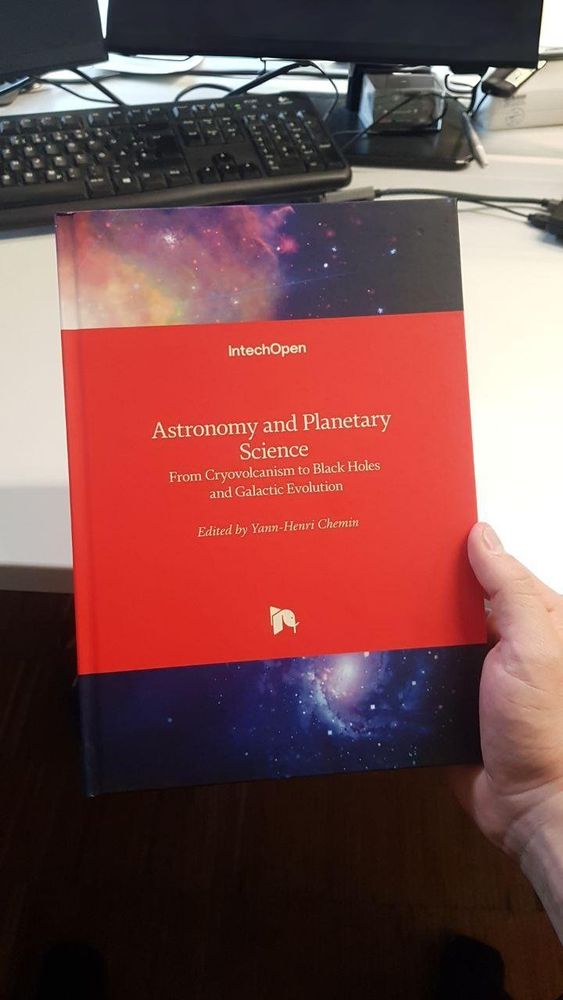
[Re-posting Twitter; Feb 3, 2023]
It is nice to see something materialize in your own hands!
Volcanos 🌋 are awesome, right?
But how about volcanos on other planets and moons? Or even on exoplanets? 🪐🌋🌕
Hooked? Then read more about their potential to make alien worlds habitable (+👇🧵): bit.ly/cryovol
Here is again the link to the paper: doi.org/10.3847/1538...
Hope you enjoy reading it!
Hungry for more drama? Read here more about the sugar ribose, another building block of the RNA world, sharing the same “impacting” 😉 story: doi.org/10.3390/life...
8/8
And maybe, one day your grand-...-grandparents crawled out of this soup as living creatures. And after all this, your less-grand-parents 🦕 got hit by a similar stone 🌠 and almost died. Wow, let’s thank cold rocks from space for being alive, and pray they have mercy on us...
7/8

And the nucleobase abundances our model predicts (dashed lines) are agreeing with measurements in real meteorites (yellow bars)! Seems like the early solar system was packed with organics, which fell onto the early Earth, 🌍🌠 contributing to the primordial soup. 🥣
6/8
The planetesimals are very porous and warm up due to the decay of radioactive isotopes. ☢️ This allows for liquid water inside these pores! Therefore, fast aqueous chemistry gets going and converts the warm chemical cocktail 🍸 into nucleobases and other prebiotic organics.
5/8
Using thermodynamic models of these asteroids (aka planetesimals) and lab data from the Origins of Life Lab @mpi-astro.bsky.social allowed us to constrain the physical conditions and chemical composition prevailing in these planetesimals in a never before achieved precision.
4/8
We looked at the parent bodies of these meteorites, asteroids born together with our solar system. In there, we simulated the synthesis of the nucleobases, key building blocks for the RNA world, one possible starting point for the emergence of life billions of years ago.
3/8
The KT impactor, being a major cause for ending the life of the dinosaurs, was a carbonaceous chondrite of type CM (Trinquier+2006,EPSL,241,780). These meteorites (Murchison is a famous member) might also have seeded the building blocks of life on Earth in the first place.
2/8

[Re-posting from Twitter; Jan 23, 2023]
Do you know what the death of all dinosaurs 🦕 and the origins of life 🧬 might have in common? Carbonaceous chondrites, carbon-rich meteorites, 🌠 might have caused both. Skeptical? Hear me out 👇🧵 and read our freshly published paper doi.org/10.3847/1538...
1/8