Regulations.gov
Action item: The Department of Education proposed a rule that would limit who counts as a professional degree. This affects loans students can get. Under the new definition, nurses and educational degrees are not professional degree.
Please comment!
Link: www.regulations.gov/document/ED-...
23.02.2026 14:12 —
👍 34
🔁 32
💬 3
📌 4
Counterpoint to the article: “Loss of promising talent supported by these [DEI] programmes will substantially weaken our research capacity, limit innovation and substantially reduce discoveries important for driving scientific advancements.”
pubmed.ncbi.nlm.nih.gov/41131402/
12.12.2025 16:05 —
👍 40
🔁 18
💬 2
📌 0

screenshot of my post
Big new blogpost!
My guide to data visualization, which includes a very long table of contents, tons of charts, and more.
--> Why data visualization matters and how to make charts more effective, clear, transparent, and sometimes, beautiful.
www.scientificdiscovery.dev/p/salonis-gu...
09.12.2025 20:28 —
👍 799
🔁 316
💬 22
📌 50

A table showing profit margins of major publishers. A snippet of text related to this table is below.
1. The four-fold drain
1.1 Money
Currently, academic publishing is dominated by profit-oriented, multinational companies for
whom scientific knowledge is a commodity to be sold back to the academic community who
created it. The dominant four are Elsevier, Springer Nature, Wiley and Taylor & Francis,
which collectively generated over US$7.1 billion in revenue from journal publishing in 2024
alone, and over US$12 billion in profits between 2019 and 2024 (Table 1A). Their profit
margins have always been over 30% in the last five years, and for the largest publisher
(Elsevier) always over 37%.
Against many comparators, across many sectors, scientific publishing is one of the most
consistently profitable industries (Table S1). These financial arrangements make a substantial
difference to science budgets. In 2024, 46% of Elsevier revenues and 53% of Taylor &
Francis revenues were generated in North America, meaning that North American
researchers were charged over US$2.27 billion by just two for-profit publishers. The
Canadian research councils and the US National Science Foundation were allocated US$9.3
billion in that year.

A figure detailing the drain on researcher time.
1. The four-fold drain
1.2 Time
The number of papers published each year is growing faster than the scientific workforce,
with the number of papers per researcher almost doubling between 1996 and 2022 (Figure
1A). This reflects the fact that publishers’ commercial desire to publish (sell) more material
has aligned well with the competitive prestige culture in which publications help secure jobs,
grants, promotions, and awards. To the extent that this growth is driven by a pressure for
profit, rather than scholarly imperatives, it distorts the way researchers spend their time.
The publishing system depends on unpaid reviewer labour, estimated to be over 130 million
unpaid hours annually in 2020 alone (9). Researchers have complained about the demands of
peer-review for decades, but the scale of the problem is now worse, with editors reporting
widespread difficulties recruiting reviewers. The growth in publications involves not only the
authors’ time, but that of academic editors and reviewers who are dealing with so many
review demands.
Even more seriously, the imperative to produce ever more articles reshapes the nature of
scientific inquiry. Evidence across multiple fields shows that more papers result in
‘ossification’, not new ideas (10). It may seem paradoxical that more papers can slow
progress until one considers how it affects researchers’ time. While rewards remain tied to
volume, prestige, and impact of publications, researchers will be nudged away from riskier,
local, interdisciplinary, and long-term work. The result is a treadmill of constant activity with
limited progress whereas core scholarly practices – such as reading, reflecting and engaging
with others’ contributions – is de-prioritized. What looks like productivity often masks
intellectual exhaustion built on a demoralizing, narrowing scientific vision.

A table of profit margins across industries. The section of text related to this table is below:
1. The four-fold drain
1.1 Money
Currently, academic publishing is dominated by profit-oriented, multinational companies for
whom scientific knowledge is a commodity to be sold back to the academic community who
created it. The dominant four are Elsevier, Springer Nature, Wiley and Taylor & Francis,
which collectively generated over US$7.1 billion in revenue from journal publishing in 2024
alone, and over US$12 billion in profits between 2019 and 2024 (Table 1A). Their profit
margins have always been over 30% in the last five years, and for the largest publisher
(Elsevier) always over 37%.
Against many comparators, across many sectors, scientific publishing is one of the most
consistently profitable industries (Table S1). These financial arrangements make a substantial
difference to science budgets. In 2024, 46% of Elsevier revenues and 53% of Taylor &
Francis revenues were generated in North America, meaning that North American
researchers were charged over US$2.27 billion by just two for-profit publishers. The
Canadian research councils and the US National Science Foundation were allocated US$9.3
billion in that year.

The costs of inaction are plain: wasted public funds, lost researcher time, compromised
scientific integrity and eroded public trust. Today, the system rewards commercial publishers
first, and science second. Without bold action from the funders we risk continuing to pour
resources into a system that prioritizes profit over the advancement of scientific knowledge.
We wrote the Strain on scientific publishing to highlight the problems of time & trust. With a fantastic group of co-authors, we present The Drain of Scientific Publishing:
a 🧵 1/n
Drain: arxiv.org/abs/2511.04820
Strain: direct.mit.edu/qss/article/...
Oligopoly: direct.mit.edu/qss/article/...
11.11.2025 11:52 —
👍 641
🔁 452
💬 8
📌 66
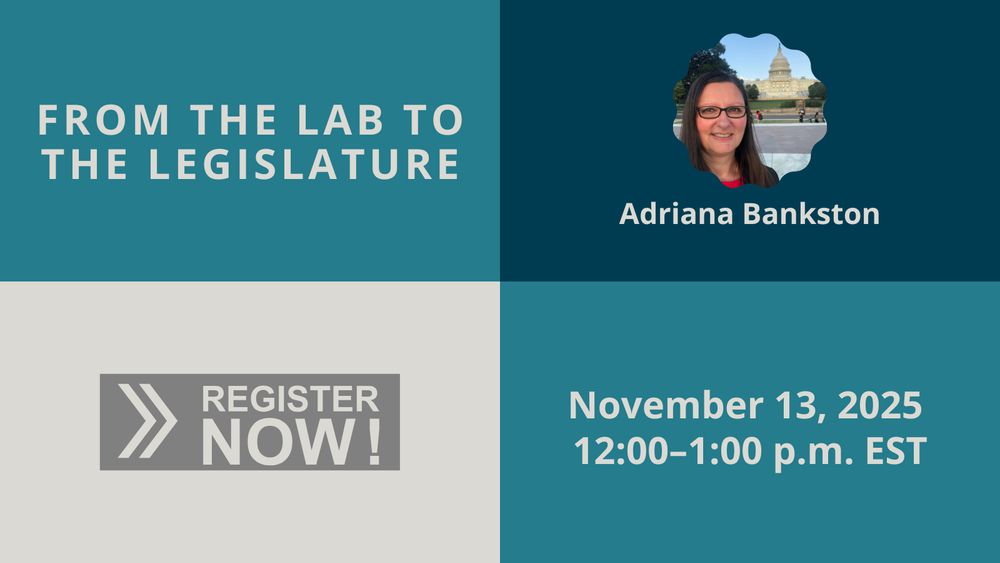
Curious how scientists influence policy? Join @abankston.bsky.social on Nov 13, 12–1 p.m. EST, for "From the lab to the legislature" and learn how your research experience can drive change in Congress. Register now: buff.ly/kDO5sln 🔗
29.10.2025 16:07 —
👍 2
🔁 5
💬 1
📌 0
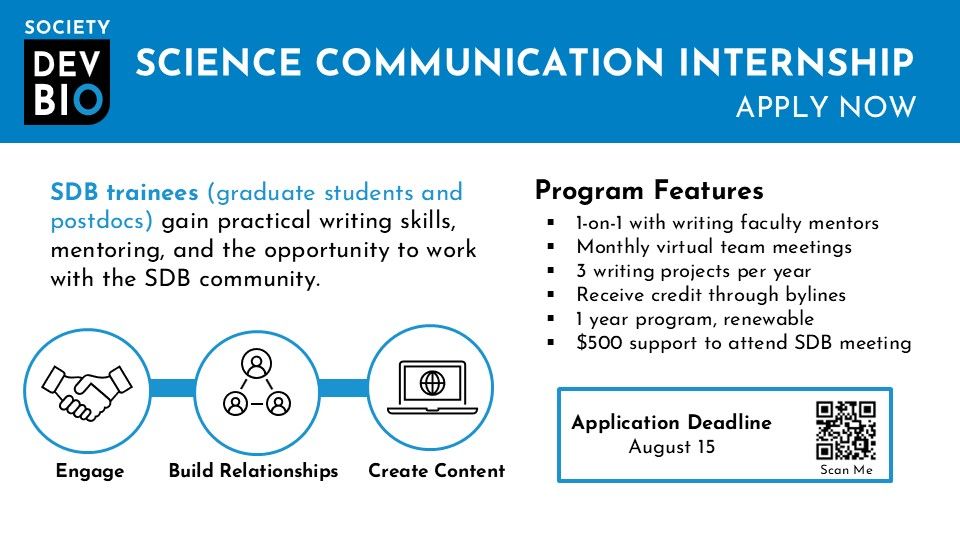
SDB logo, Science Communication Internship, Apply Now
SDB trainees (graduate students and postdocs) gain practical writing skills, mentoring, and the opportunity to work with the SDB community.
Engage, Build Relationships, Create Content
Program Features
1-on-1 with writing faculty mentors
Monthly virtual team meetings
3 writing projects per year
Receive credit through bylines
1 year program, renewable
$500 support to attend SDB meeting
Application Deadline: August 15
Applications are now open for the 2026 SDB Science Communication Internship. Graduate student and postdoc members of the Society for Developmental Biology are eligible to apply. Deadline: August 15. Learn more: www.sdbonline.org/science_comm...
23.07.2025 19:51 —
👍 13
🔁 9
💬 0
📌 5

Logo for “The Write In: Grad Student Narratives” podcast, featuring a pen writing in an open book and a glowing lightbulb above that book.
🌟 New podcast alert! 🌟 In “The Write In: Grad Student Narratives,” PhD students share tips for navigating grad school & grad-level writing. 3 short & sweet episodes out now - designing writing practices for your style and deadlines, crafting your career path, and finding your perfect lab.
23.07.2025 19:50 —
👍 6
🔁 1
💬 1
📌 0
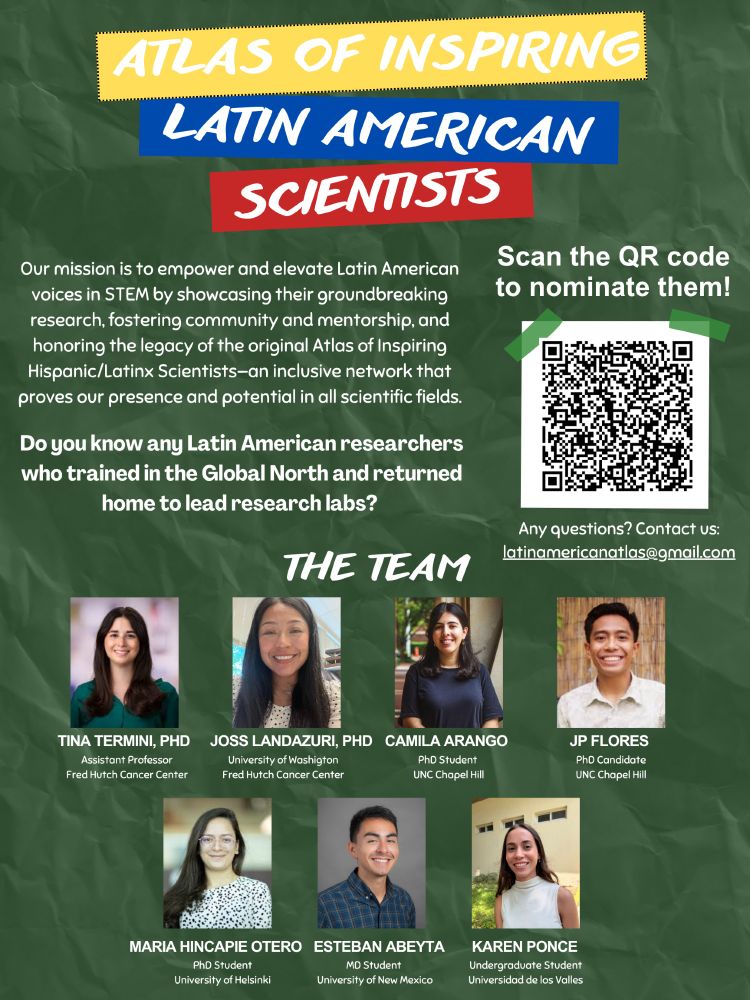
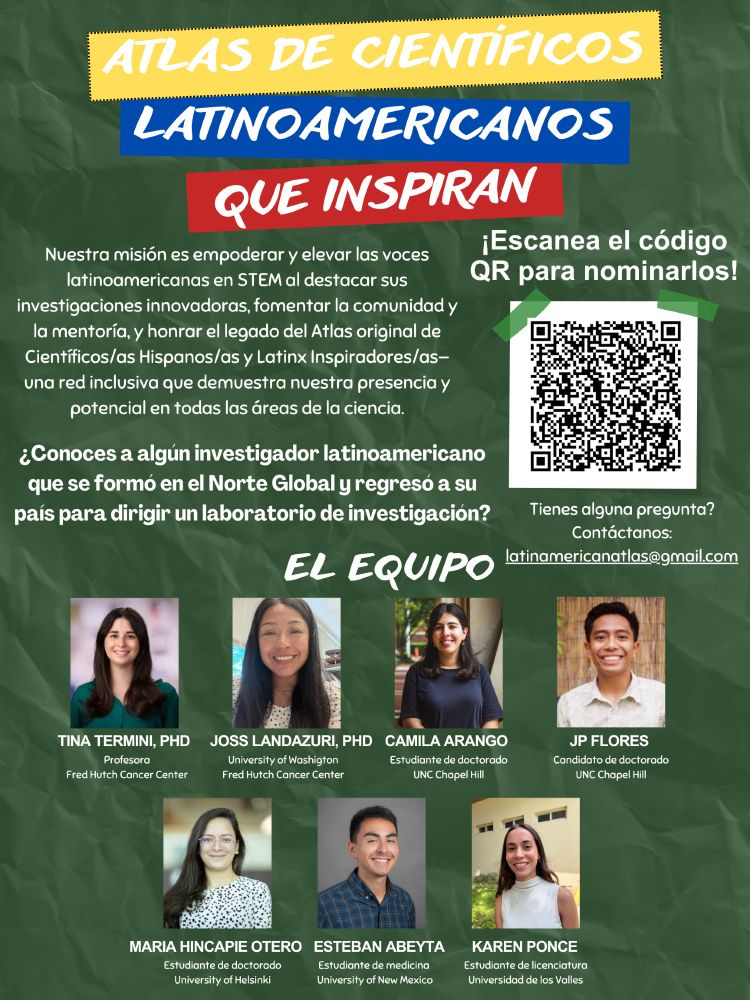
I’m so happy to share a project very close to my ❤️ launching this September: Atlas de Científicxs Latinoamericanxs que Inspiran ✨
We’re currently collecting nominations!
This atlas spotlights researchers from LATAM who trained in the North & returned home to lead labs. Here’s why this matters 🧵👇
03.07.2025 20:40 —
👍 15
🔁 12
💬 1
📌 1
Cornell University, Department of Communication
Job #AJO30219, WDR-00053939 Assistant Professor in Science, Environment, and Risk Communication, Department of Communication, Cornell University, Ithaca, New York, US
We're hiring!
academicjobsonline.org/ajo/jobs/30219
The Cornell Department of Communication is hiring an Assistant Professor in Science, Environment, and Risk Communication!
Applications received by September 15, 2025, will be given full consideration.
15.07.2025 17:21 —
👍 137
🔁 117
💬 1
📌 1

To Protest Budget Cuts, Young Scientists Try Letters to the Editor
Featuring @isakoditomassi.bsky.social
🧪 The McClintock Letters is getting the attention it needs.
Graduate students facing uncertainty as a result of Trump’s cuts want to draw attention to the disruptive research funding cuts by writing local Op Eds.
www.nytimes.com/2025/06/16/s...
17.06.2025 12:19 —
👍 22
🔁 15
💬 0
📌 0

Apply for a JEDI Award - Life Science Editors Foundation
“Before this backlash worsens, DEI advocates, the scientific community, universities, and federal agencies need to collectively call out the dangers of setting aside DEI and come up with robust ways t...
Opportunity Alert for Scientists Facing Unfair, Systemic Barriers!
Apply for a Justice Equity Diversity Inclusion award & receive in-depth feedback on a manuscript, grant proposal, or job application.
We have three great awardees this year - could YOU be next? 😊
lifescienceeditors.org/apply/
04.06.2025 20:48 —
👍 15
🔁 19
💬 0
📌 1
Such a thought-provoking and fun piece in @the-node.bsky.social about PhD candidate Reem Abu-Shamma’s brain organoid research!
02.06.2025 16:13 —
👍 1
🔁 0
💬 1
📌 0
“‘The genome is a really big place…It kind of feels like detective work because you’re trying to see where in this really big space it’s telling us to be human.’ By tweaking bits of human and chimp DNA so they behave more like their counterparts—a sort of genetic Freaky Friday—Reem can do just that”
02.06.2025 16:11 —
👍 4
🔁 0
💬 1
📌 0
NSF at 75 years, image of planetary shapes and starlight
The National Science Foundation marks its 75th anniversary this week.
Rather than celebrate, it's time to save it.
www.savensf.com/nsf-at-75-to...
09.05.2025 14:46 —
👍 179
🔁 75
💬 3
📌 6
Decided to drop a big op-ed project to help in this effort instead! (Sorry for those heavily invested lol 😬)
Super collaborative effort from STUDENTS @ Cornell, Penn, UNC, UCLA, UAB, Hopkins, Georgetown, UCSF, Stanford, Yale, Florida, Notre Dame, Cold Springs Harbor & more
@sciforgood.bsky.social
22.04.2025 21:38 —
👍 30
🔁 12
💬 1
📌 0
Science Homecoming
Join us! Science Homecoming helps scientists reconnect with communities by writing about the importance of science funding in their hometown newspapers. We’ve mapped every small newspaper in the U.S. and provide resources to get you started. Help science get back home 🧪🔬🧬 🏠
sciencehomecoming.com
18.02.2025 17:12 —
👍 906
🔁 683
💬 43
📌 93

An image with dark blue and turquoise brushstrokes with 3 yellow arrows on the left and an image of The Thinker on the right. In the top left is the logo: NIH National Institute of Neurological Disorders and Stroke. In the center is the text, which increases in size as it descends: Early-Career Rigor Champions Prize. In the top right is the text: 2025.
#neuroscience #metasci #science
📢 Calling all early-career scientists who are trying to change the culture of science and promote more rigorous research practices:
The NINDS Office of Research Quality just launched the NINDS Early-Career Rigor Champions Prize:
www.challenge.gov?challenge=ni...
06.01.2025 15:44 —
👍 25
🔁 20
💬 1
📌 1
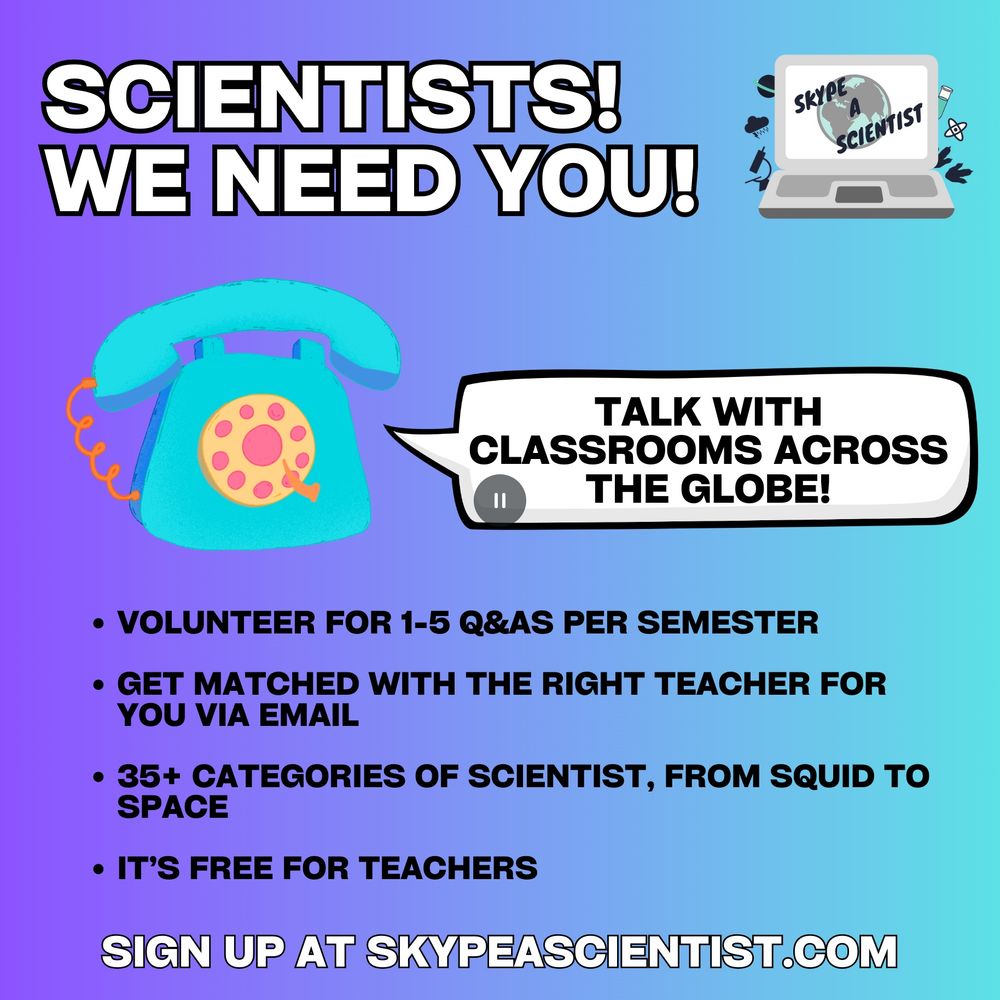
a graphic that says Scientists we need you, then an old school rotary phone that has a speech bubble saying "talk with classrooms across the globe" and a bulleted list Volunteer for 1-5 Q&As per semester
Get matched with the right teacher for you via email
35+ categories of scientist, from squid to space
It’s free for teachers" and then "sign up at skypeascientist.com"
Scientists!
We are trying to get 1000 of us into the volunteer database by Jan 1.
You'll be volunteering to speak with classrooms over video chat about your work, and answer their questions! You can volunteer for up to 5 sessions per semester.
Sign up here! www.skypeascientist.com/sign-up.html
30.12.2024 17:00 —
👍 357
🔁 334
💬 22
📌 34

Become a Node correspondent! Are you passionate about developmental and stem cell biology, writing, and communicating science? Apply to join the team.
Are you a #DevBio/#StemCell researcher and keen to do more #SciComm?
We're looking for new correspondents to work together with the Node team to develop and produce content over the coming year. We're open to any ideas💡
📅Apply by 20 Jan
Find out more:
thenode.biologists.com/become-a-nod...
28.12.2024 15:28 —
👍 13
🔁 10
💬 3
📌 1