My Diablo IV sorceress and I have similar public speaking styles (mysterious orb)
07.10.2025 23:23 —
👍 1
🔁 0
💬 0
📌 0
And today we’ve published this accompanying article in @croakeynews.bsky.social! Great to work with the Croakey team again to get our reflections in front of more eyes
www.croakey.org/rethinking-a...
25.09.2025 12:19 —
👍 5
🔁 2
💬 0
📌 1
Dear Editor,
Thank you for submitting your review request to Tomer Ullman.
As you may know, we decline a substantial proportion of reviews requests without sending them out for further evaluation. After careful consideration, we regret to say we cannot offer to take on this review.
24.09.2025 13:01 —
👍 85
🔁 12
💬 2
📌 1
I’d really love to hear the thoughts of anyone else working in this space on what we’ve said here and the suggestions we’ve made to improve systems and processes
25.09.2025 01:27 —
👍 1
🔁 0
💬 0
📌 0
We share some reflections on our experience with a recent Indigenous-targeted grant application and offer some feedback on improving the process for small or regional community-controlled partners. We hope this can be a constructive contribution to ongoing discussions on this topic
25.09.2025 01:27 —
👍 2
🔁 0
💬 1
📌 0

Save the date banner for next year’s conference, to be held from 14th to 17th September in Melbourne
That’s the end of the Joint Australasian HIV&AIDS and ASRH Conferences. For various reasons, it’s been a while since I attended a sexual health conference, and this was a great one to come back to. Lots of familiar faces and fascinating presentations. Looking forward to 2026! #HIVAIDS2025 #ASRH2025
18.09.2025 07:27 —
👍 3
🔁 0
💬 0
📌 0

Lessons from Other Regions:
Strong surveillance
Infectious diseases in pregnancy screening programme: ISOSS
Universal repeat screening
Investment in sexual health infrastructure
Systems change, not just clinician effort, is key

Congenital syphilis = sentinel health system failure
Universal + repeat screening = Normalising testing = reducing stigma
Implementation research closes the gap
Partnerships across 0&G, sexual health, paeds, public health essential
Stephanie again emphasises that congenital syphilis is an systems failure requiring systemic solutions: investment in sexual health infrastructure, system change, normalisation of testing, reduction of stigma, and meaningful partnerships #ASRH2025
18.09.2025 00:29 —
👍 2
🔁 0
💬 0
📌 0
The text on the slide about partner notification is too small to photograph, but Stephanie says it’s very poorly done in the antenatal setting and systemic change is needed to better facilitate communication between services to reach, test and treat partners to prevent reinfection #ASRH2025
18.09.2025 00:23 —
👍 1
🔁 0
💬 1
📌 0

Key Principles of Prevention
1. Early antenatal screening
2. Repeat screening later in pregnancy
3. Timely maternal treatment
4. Partner management
5. Infant follow-up
Stephanie’s key principles of prevention emphasise early and repeat screening and timeline treatment, but also the importance of partner notification and treatment - it’s not enough to just tell women to tell their partners #ASRH2025
18.09.2025 00:22 —
👍 1
🔁 0
💬 1
📌 0

Now speaking on the changes in the Australian testing guidelines (more tests recommended). Stephanie’s keynote is largely clinical, but here she’s talking about the vital role these guidelines play in normalising syphilis testing, which is a neat link for the social and cultural attendees #ASRH2025
18.09.2025 00:19 —
👍 1
🔁 0
💬 1
📌 0

Figure 6: Notifications (n) and notification rate (per 100,000 live births) of congenital syphilis, by Indigenous status, remoteness area, and year, 2016 - Q4 2024
There’s a lot of red
Notification data in Australia - the key detail in this graph is that the red represents congenital cases resulting in infant death #ASRH2025
18.09.2025 00:15 —
👍 1
🔁 0
💬 1
📌 0

Graph showing a tenfold increase in congenital syphilis in the USA in the last ten years
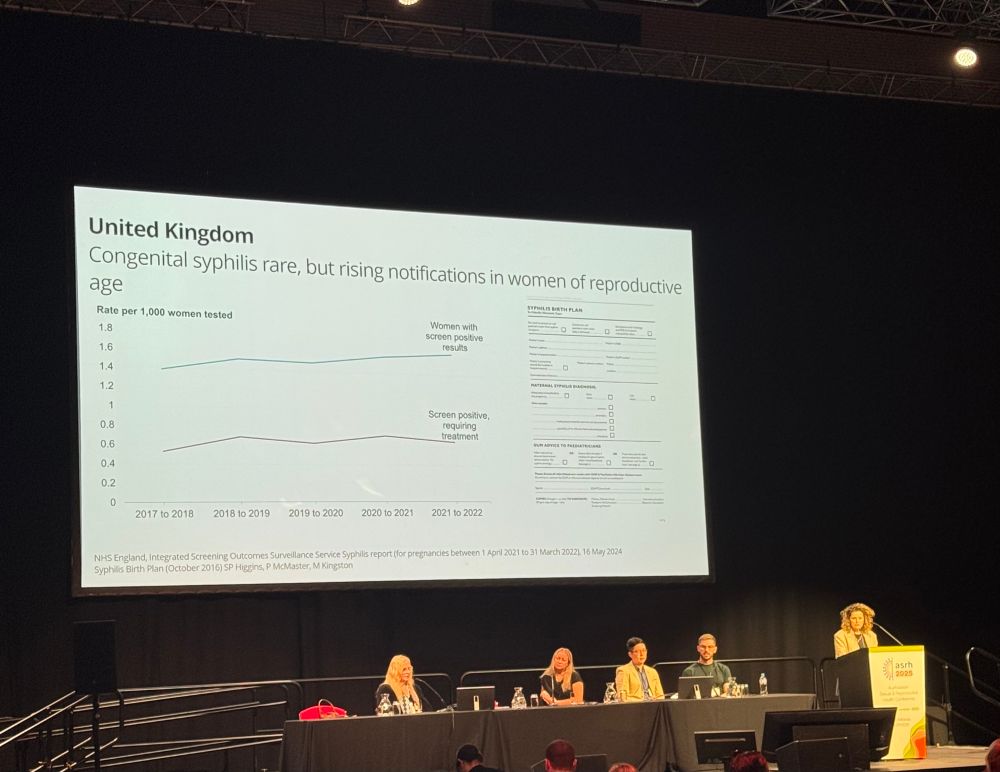
Graph showing rising rates of syphilis in women of reproductive age in the UK

Heat map of Pacific Island countries with highest prevalence of syphilis in ANC
Second keynote Stephanie Bond giving a sobering overview of congenital syphilis globally - the increase in the US over the last ten years is grim and some Pacific Island nations have among the highest rates in the world #ASRH2025
18.09.2025 00:12 —
👍 1
🔁 0
💬 1
📌 0

Indigenous
Sexual &
Reproductive
Justice through
Indigenous-led
Research:
Cross cutting themes
Social norms & assumptions
• Unravelling how social social forces such as colonisation, poverty, racism, sexism shape and constrain Mãori sexual and reproductive lives, decisions, opportunities and aspirations
Knowledge
• Unravelling whether knowledge produced 'about indigenous people is accurate, and creating space for indigenous knowledge to be developed in this space
Health Practice
• Unravelling how discourse might shape inequitable health practices, and working to correct that
Pedagogy
• Working to understand how we can educate our communities for healthy, safe, ethical, and happy sexual, reproductive, and family lives
Tying the cross-cutting themes together now into a framework for Indigenous sexual and reproductive justice, highlighting the role of discourse at the core of many health inequities and the role of Indigenous knowledges in addressing them #ASRH2025
18.09.2025 00:05 —
👍 1
🔁 0
💬 0
📌 0

Mãori & Pacific infertility discourse & knowledge
• Mãori and Pacific people in New Zealand have higher overall reproductive rates than European people (Khawaja et al., 2000;
Urale et al., 2019) that obscures the possibility of Mãori and Pacific infertility (Foese, 2018; Glover et al., 2008; Reynolds & Smith,
2012).
• The sociocultural norm of having many children within Mãori and Pacific communities created challenges for those experiencing infertility, reaching out and access support, creating intense pressures on their couple relationships (Le Grice et al., 2023).
• The absence of culturally resonant wrap around support across key pressure points in a journey of infertility - traversing pregnancy loss (miscarriage, still birth), seeking eligibility for public funding, and going through the process of medicalised treatments - created intense (and life-threatening) psychosocial impacts (Le Grice et al.
Artist: Riona Kipa, Tokipa des grasth
Le Grice’s final study is on infertility in the Māori context and the intersections here of medical fertility treatment and cultural values around family, pregnancy, childbirth and child rearing #ASRH2025
18.09.2025 00:01 —
👍 0
🔁 0
💬 1
📌 0
Particularly interested in the adaptation of the cultural practice of burying the placenta after birth to incorporate burying remains after termination #ASRH2025
17.09.2025 23:58 —
👍 0
🔁 0
💬 1
📌 0

Mãori & abortion:
Discourse & knowledge
• Dominant representations of traditional
Maori reproductive practice indicate disapproval of abortion (Turia, 2007
Rimene, Hassan, & Broughton, 1998;
Manihera & Turnbull, 1990).
• Yet, historical accounts of Mãori practices of abortion tell a more complex story.
• Abortion was not linguistically distinguished from miscarriage (T.
Smith, 2012).
• Known and accepted methods for 2002, 8. Slot, 2002, Tangon au, 2003).
Artist: Rawiri Horne
Gifted by Waikaremoana Waitoki

Mãori & abortion:
Colonising discourse, knowledge & health practice
• Existing research about Mäori engagement with abortion, written by Päkehã (European) psychiatrists.
Claims about Mãori and abortion drew from colonising, oppressive understandings about Mäori aligned with notions of Mãori 'savagery (Le Grice & Braun, 2017).
• Assumed patriarchal gender relations, and negative and vengeful subject positions for women (e.g. Hunton, 1977).
• Suggested abortion was widely practiced among Maon due to "savagery" (e.g. Hunton, 1977) -
• Suggested abortion was not practiced due to
"superstition" (e.g. Gluckman, 1973, 1981).
• Discourse informed the pathologisation & criminalisation of Mäori women who sought abortion as reproductive healthcare
• Discourse aligned with wider national narratives of missionaries
saving" Maori through British
colonisation and assumption of rule (Pool, 2015) through the construction of Mãori cultural "deficits'

Mãori &
abortion:
Mãori
discourse, knowledge & health practice
• The deliberate loss of conception (abortion) is not anathema to Mãori knowledges, ways of being and patterns of practice
• Mãori are diverse in their understanding and engagement with matauranga Mãori, with implications for their perspectives on abortion
• Christian influences, focus on protecting the new life (although often framed as personal choice)
• Mãori women's rangatiratanga, understood as women's self determination in the context of her unique circumstances, hopes, dreams and aspirations
• Focus and priorisation of whanau, and care for one another (whangai, and/or support for the individual woman)
• The practice of whenua ki te whenua (returning pregnancy tissue/placenta to ancestral lands) nurtures connections between atua, tangata and whenua providing kai atawhai (sheltering and protection) in these domains
Le Grice now speaking about her research on abortion among Māori women. Historically framed around some awful racist stereotypes, but in a the modern context more accepted in the community and often supported with cultural practice #ASRH2025
17.09.2025 23:57 —
👍 0
🔁 0
💬 1
📌 0

Mãori & Sexuality education: Pedagogy
• The growth of online media has seen understandings of relationships that reinforce Western social pressures
Relationships, sex, and sexuality are portrayed in ways that reinforce
sexism, racism, and heterosexism prevalent in our society
• Online contexts provide animportance site of intervention
• Creating accessible content informed by matauranga (Mãori knowledge) and tikanga Mãori (Mãori practices) provides young Mãori with a window into Mãori ways of knowing, being, and doing sexuality

Mãori & Sexuality Education: Discourse and Storytelling
Contemporary realities of Mäori youth are complex, shaped by the impacts of colonisation and intersecting vectors of oppression.
The marginalisation of Mãori ways of being, doing, and knowing opens a space for racialised understandings of
Mãori girls and boys to make sense of themselves, their choices, identities, pathways and futures.
education: . We share rangatahi prakau (stories) based on stories
shared by our research participants, alongside a set of
storytelling.
enquiry questions.
We make visible the challenges that young Mãori encounter, pathways to make sense of the social context that shapes them, and how they can overcome them.
• In context with the mätauranga (Mãori knowledge) we have shared, we want to support rangatahi to come back to who they are and shake off the conditioning
Opening keynote of the final day of the conference Jade Le Grice opening with some insights into sex and sexuality education among Māori young people in Aotearoa. Storytelling, language and culture strongly foregrounded #ASRH2025
17.09.2025 23:53 —
👍 0
🔁 0
💬 1
📌 0
The closing Q&A is tying the four presentations together really neatly, with Joanne Bryant specifically citing examples from each of the other three speakers that reflect the “relational” strengths-based approach she introduced at the start of the session #HIVAIDS2025 #ASRH2025
17.09.2025 07:47 —
👍 0
🔁 0
💬 0
📌 0

Strengths-based approaches actions
1. Engagement way before starting the grant application
2. Partnership agreements with Aboriginal organisations
a. Who owners the data, IP, authorship on papers (first/ last authors)
3. Community benefits not academic benefits - MY promotion, papers, grants
4. Hiring First Nations people as project manager not just to recruit or interviewers
6. PhD scholarships - knowing an Indigenous person to accept the PhD scholarships. Lets Including a PhD scholarship and then worry about find
someone after we win = handing to a white PhD student
6. First Nations Cis early in the list, not just the one at the end of the list
7. The deficit approach is great for a grant application

Next Generation Youth Cohort Study
• Pre-grant engagement and long lead up period
• Indigenous led
• Partnerships with local organisations at data collection sites
• Aboriginal ethics committees
• Indigenous PhD students
• Indigenous leads salaries paid for at sites
• Feedback sessions of analyses conducted
• Engagement about what would you like to see for phase 2 grant

Next Generation Youth Cohort Study
• Pre-grant engagement and long lead up period
• Indigenous led
• Partnerships with local organisations at data collection sites
• Aboriginal ethics committees
• Indigenous PhD students
• Indigenous leads salaries paid for at sites
• Feedback sessions of analyses conducted
• Engagement about what would you like to see for phase 2 grant
Simon Graham taking a novel angle on strengths-based approaches to sexual health research with Aboriginal and Torres Strait Islander people by opening talking explicitly about funding - how things are done, how they should be done, and some examples of doing it well #HIVAIDS2025 #ASRH2025
17.09.2025 07:38 —
👍 2
🔁 0
💬 1
📌 0

A diagram showing duty of care balanced against dignity of risk on a continuum between overprotection and neglect, with the centre point labeled risk enablement

Risk Enablement
• Risk enablement, also called positive risk taking, is a way of supporting people which helps to maintain people's choice and
control over activities.
Margaret explains many use the “duty of care” to justify “protecting” people with disability FROM sex but a strengths-based approach involves balancing duty of care with the dignity of risk to facilitate healthy risk enablement - neither overprotection or neglect #HIVAIDS2025 #ASRH2025
17.09.2025 07:29 —
👍 0
🔁 0
💬 1
📌 0
Whoops I borked my threading
17.09.2025 07:22 —
👍 0
🔁 0
💬 0
📌 0

Factors which affect the persons with intellectual disability exercising their right to sexual intimacy, and parenthood
• Societal threat (legacy of eugenics discourse)
• Ableism
• Deficit Approach
• Risk-averse practices

Being strengths-based involves:
1. Being Disability-Informed
2. Engaging well
3. Adopting a risk enablement approach
4. Prioritising supported decision-making
5. Fostering circles of support
Next speaker Margaret Spencer now articulating the principles of strengths-based approaches to reproductive rights with women with intellectual disability - a three-way combination that many working the sexual and reproductive health space might find challenging #HIVAIDS2025 #ASRH2025
17.09.2025 07:20 —
👍 0
🔁 0
💬 2
📌 0

TO CONCLUDE
2SLGBTQ+ communities are not utopias free from violence. What the study found, however, was that much of this violence reflected the reproduction of cisheteronormativity and the settler colonial logics of objectification, domination, and conquest
Queer and trans sexual joy confronted these logics and seemed to alchemize them. Through script breaking, participants described greater authenticity, embodied pleasure, care, and reciprocity vis a vis queer and trans sexual joy.
JJ refers to “script breaking” as the process by which study participants accessed the authenticity, care and reciprocity encapsulated by “queer and trans sexual joy” #HIVAIDS2025 #ASRH2025
17.09.2025 07:11 —
👍 1
🔁 0
💬 0
📌 0

JJ Wright joining via video call from their brightly lit living room

By highlighting queer sexual joy as a place to imagine sexual cultures away from rape culture, we might loosen up the rigid dominant sexual scripts and find more flexibility, ease, and joy in sex despite the ambiguitics inherent to it.
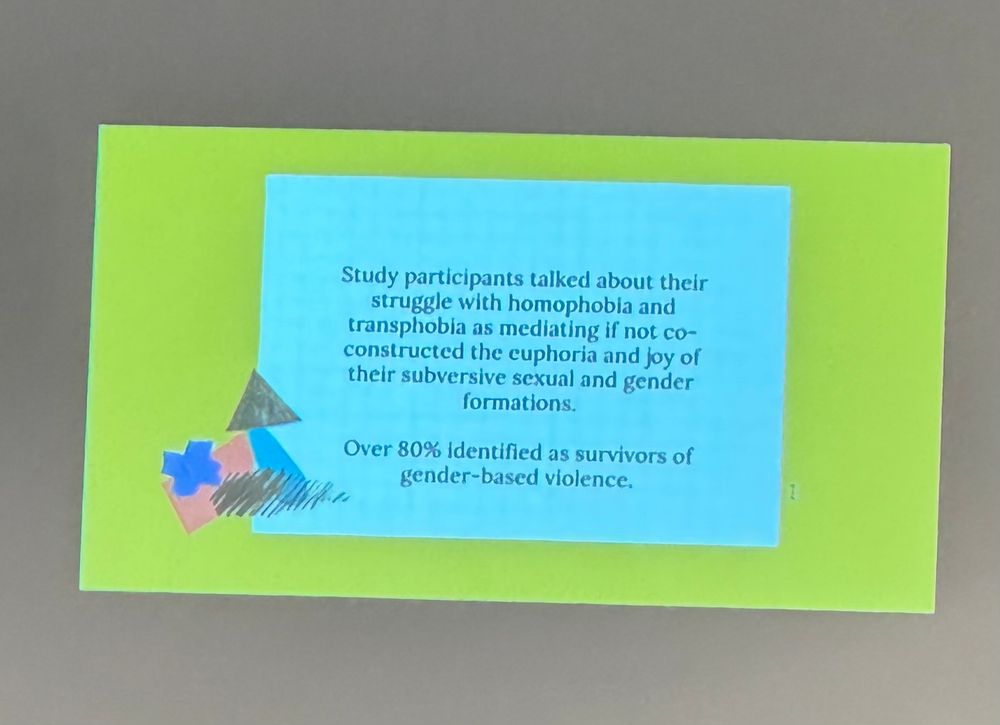
Study participants talked about their struggle with homophobia and transphobia as mediating if not co-constructed the euphoria and joy of their subversive sexual and gender formations.
Over 80% identified as survivors of gender-based violence.
JJ Wright joining remotely from Canada to share some incredible work on queer and trans joy as disruptive to heteronormativity, patriarchy, shame and rape culture. Delighted to see pleasure foregrounded as a strength at conference that often has a heavy biomedical focus #HIVAIDS2025 #ASRH2025
17.09.2025 07:09 —
👍 0
🔁 0
💬 2
📌 0
Critically, she’s not saying either approach is “wrong”: individual framing of strengths and resilience can be effective and important in one-on-one work with young people, but this approach proves lacking in the context of research and policy #HIVAIDS2025 #ASRH2025
17.09.2025 06:55 —
👍 0
🔁 0
💬 1
📌 0

Logics of individualism ('strengths' found within individuals and immediate environments)
Logics of relationalities (strengths' found in relationships, goods and opportunities)
Individualising logics can..
Cast young people as not 'resilient-enough'
• Perpetuate approaches that focus on changing individual behaviours and choices
• Hides other ways of understanding
'strengths-based approaches
Relational logics can….
Shift focus to changing relationships, goods and opportunities within networks
Joanne says that what we call “strengths” can be understood through two logics: logics of individualism and logics or relationalities, which position strengths as fixed traits residing in an individual vs as social practices and community resources #HIVAIDS2025 #ASHR2025
17.09.2025 06:52 —
👍 0
🔁 0
💬 1
📌 0
(Some of you may be aware that strengths-based approaches are an area of particular interest for me and I really enjoy Joanne’s critical interrogation of the concept itself and how it is deployed and articulated)
17.09.2025 06:47 —
👍 0
🔁 0
💬 1
📌 0

Joanne presenting in front of a slide that reads
Main approaches
Broadly characterised: "positive adaptation within the context of adversity"
(Alessi et al., 2020:11240)
Main language and concepts:
1. Resilience (n=19)
2. Protective factors (n=13)
3. Resilience and protective factors (n= 12)
4. Social capital (n=16)
Joanne Bryant opens session on strengths-based approaches in sexual and reproductive health research by summarising the main approaches identified in the literature to “strengths-based” work with marginalised young people #HIVAIDS2025 #ASRH2025
17.09.2025 06:44 —
👍 1
🔁 0
💬 1
📌 0

A painting featuring the four horsemen of the Apocalypse from the Christian Bible’s Book of Revelation
Nothing subtle about using this image to open a presentation on the global implications of funding cuts to HIV-related aid in the current political climate, but the data presented by Felicity Young from Health Equity Matters justifies the bold choice #HIVAIDS2025
17.09.2025 05:12 —
👍 2
🔁 0
💬 0
📌 0
