

Poster for Medieval Women module
My new module, Medieval Women, is available to book via Aberystwyth Lifelong Learning www.aber.ac.uk/en/lifelong-...
03.03.2026 18:58 — 👍 11 🔁 5 💬 0 📌 0
Poster for Medieval Women module
My new module, Medieval Women, is available to book via Aberystwyth Lifelong Learning www.aber.ac.uk/en/lifelong-...
03.03.2026 18:58 — 👍 11 🔁 5 💬 0 📌 0
More than 1.5 million girls were sent to maternity homes during the Baby Scoop era, where they were kept in seclusion, told they didn’t deserve to be mothers, and returned to their lives to pretend none of it happened.
This is the America the GOP wants to make great again.
Poster for Medieval Women module
My new module, Medieval Women, is available to book via Aberystwyth Lifelong Learning www.aber.ac.uk/en/lifelong-...
03.03.2026 18:58 — 👍 11 🔁 5 💬 0 📌 0
A recipe from Hannah Wolley's 1672 "The Ladies Delight" To make the Hands White. Take the flour of beans, of lupines, of starch-corn, rice, smalbedus, orris, each six ounces. Mix them and make a powder with which wash the hands in water.
EM hive mind - any ideas what Hannah Wolley means by "Smalbedus" here in this 1672 recipe for a powder to whiten hands? I'm stumped! I'm asking my plant scientist sister as well in case she has any ideas.
27.02.2026 15:33 — 👍 2 🔁 2 💬 3 📌 0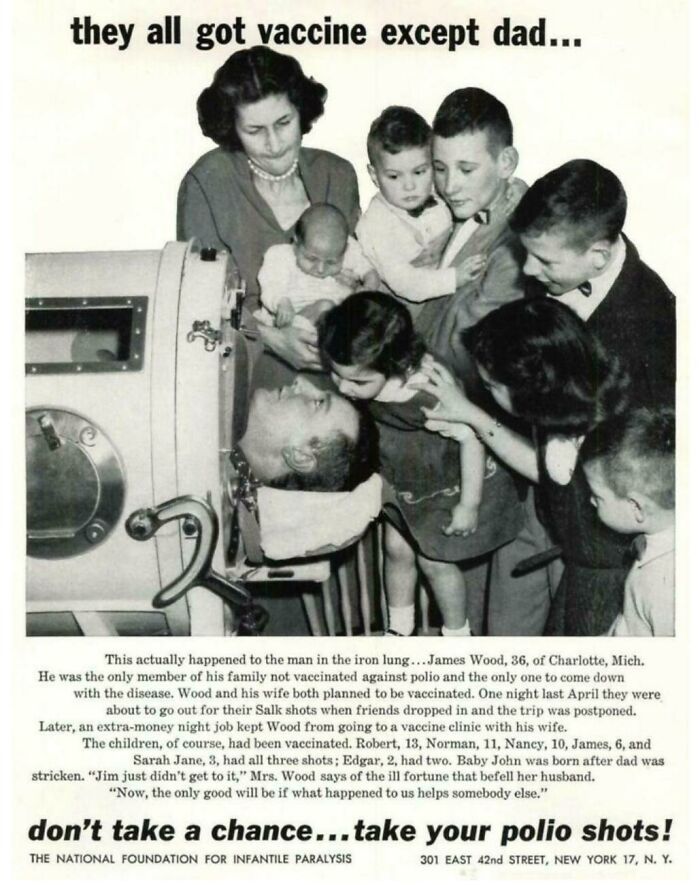
An advertisement for the polio vaccine which reads: "they all got vaccine except dad...don't take a chance...take your polio shots!" It depicts a photo of a family gathered around a father who is in an iron lung.
With science falling under increasing attack, this medical historian is here to remind people of the power of vaccines. THREAD👇
Hard-hitting polio advert from 1958. In the first half of the 20th century, polio was the leading cause of death in children and young adults. 1/7 #history #skystorians
The BAVS/Rosemary Mitchell Prize for a Second Monograph 2026 is now open! If you published your second scholarly monograph in Victorian studies between 17 February 2025 and 17 February 2026, please do consider submitting! You can find more information here: bavs.ac.uk/book-prize-2/
25.02.2026 17:02 — 👍 8 🔁 8 💬 0 📌 1You know who really has a good vantage on what universities can and should be? Faculty. Not always the organizational structure and operation, because that's not the job, But what it takes to educate? Yep. Yet the overwhelming media coverage is by and about ppl w very little to no experience.
21.02.2026 13:51 — 👍 367 🔁 89 💬 11 📌 8Ah, yeah, I understand that.
21.02.2026 12:04 — 👍 0 🔁 0 💬 0 📌 0
FACT OF THE DAY. 21 February 1946. Aneurin Bevan announced the Labour Government’s proposals for a National Health Service. The service began on 5 July 1948. Its introduction represented one of the greatest social reforms in British History which helped every citizen.
21.02.2026 09:21 — 👍 211 🔁 118 💬 5 📌 5Same. I hate making phone calls.
21.02.2026 11:52 — 👍 1 🔁 0 💬 1 📌 0


On the pioneering post-war survey of teenagers and young adults in Birmingham, funded by the Edward Cadbury Charitable Trust in 1950 archive.org/details/b327... Hope the new wave of strategic plans for England will commission similar. @oneplacestudies.bsky.social @historyandpolicy.bsky.social
14.02.2026 19:44 — 👍 10 🔁 7 💬 1 📌 0
For more examples see our post, thornton.kdl.kcl.ac.uk/posts/blog/2...
Image: Alice Thornton, Book of Remembrances, 137. © Derek Beattie. 2/2 📜 🗃️
Threatening to defund the Welsh university widely perceived to be a bastion of the Welsh language - it has one of the highest proportions of Welsh speaking students - isn’t a great look for a party looking to sweep the Senedd in May
10.02.2026 11:14 — 👍 25 🔁 9 💬 2 📌 0Thank you to everyone who shared their research with us yesterday! We enjoyed a brilliant first day of papers and a fantastic keynote from @sarahcrook.bsky.social. Looking forward to starting Day 2 shortly - look at this wonderful line up: 😊 voicesofmotherhood.wp.worc.ac.uk/index.php/20...
06.02.2026 08:12 — 👍 13 🔁 5 💬 1 📌 1This is good, as far as it goes - but sometimes the only way to avoid burnout and stress is for there to be more staff to do the work. That does not seem something that is of interest to university SMTs at the moment.
05.02.2026 08:36 — 👍 38 🔁 17 💬 7 📌 0This is Zeus. He's 13 and can't howl quite like he used to. But that doesn't stop him from stepping pup when his community needs him. 14/10 #SeniorPupSaturday (IG: zeustheoldiegoldie)
31.01.2026 17:24 — 👍 7307 🔁 634 💬 216 📌 71
a phd
27.01.2026 10:45 — 👍 875 🔁 100 💬 14 📌 11
One week left to sign up for our conference!
We will be emailing everyone who has registered early next week with all the details and the Zoom link 📩
 16.01.2026 09:55 —
👍 1149
🔁 174
💬 241
📌 78
16.01.2026 09:55 —
👍 1149
🔁 174
💬 241
📌 78

Call for papers for one-day colloquium: Charity, Humanitarianism, and Childhood. Monday 22nd June 2026. Centre for the History of Childhood, University of Oxford Magdalen College Oxford, UK, and online. We welcome papers that consider the theme of ‘Charity, Humanitarianism, and Childhood’ from a wide variety of perspectives. Areas that papers might explore include: Children’s experiences as recipients of charity and humanitarianism, including in the context of conflict and displacement. Children’s experiences as charitable and humanitarian actors and providers. Representations of childhood within charitable and humanitarian discourses. Institutions and communities that mobilise around charitable and humanitarian relief for children. Memories, intergenerational transmission, and legacies of charity and humanitarianism. Failures, limitations, and tensions resulting from charitable and humanitarian actions. Archives for, approaches to, and public engagement with the study of charity, humanitarianism, and childhood in the past. Conceptual connections between care, vulnerability, and age. We welcome papers from any disciplinary or professional background and career stage, including advanced undergraduate and graduate students. We encourage papers that engage with the diversity of children’s and young people’s experiences in any historical period and place. Please send abstracts of c. 250 words for a fifteen-minute paper and a brief bio to sian.pooley@magd.ox.ac.uk by midday on Friday 13th March 2026. We plan to offer in person and online participation, so please indicate your preference when submitting. Organising Committee: Charlotte Canizo, Joseph Leidy, Siân Pooley, Susannah Wright
📢Call for papers📢 for this year's Centre for the History of Childhood colloquium on Charity, Humanitarianism, and Childhood on 22 June 2026. Please send us your abstracts by midday on Friday 13 March. We look forward to hearing from you! More details here: www.history.ox.ac.uk/centre-histo...
15.01.2026 15:08 — 👍 20 🔁 16 💬 2 📌 3
How the financial problem is described is not neutral. It reflects and reinforces a particular way of understanding what a university is and how it should function. If the financial situation is framed as a classic demand-and-cost problem (i.e., demand is insufficient, prices are constrained, and unit costs are too high), then the university is, implicitly, being treated as a ‘service provider’ operating in a competitive international education market where students are customers. In that frame, the obvious actions are to emphasise tight cost controls and to strengthen output-focused performance metrics, targets and incentives such as promotions based on publications in highly rated journals, income generation or teaching satisfaction scores. If the same financial situation is framed instead as a system-level shock that threatens the conditions under which teaching, research and public service can flourish, then a different picture of the university comes into view: a ‘living knowledge ecosystem’ serving a public mission and facing financial constraints partly beyond its control. Within that frame, the responses appears quite different. Attention turns to protecting core capacities, reducing harm to the most vulnerable parts of the system and working with others to share risks and resources. In both cases, the numbers in the spreadsheets are the same. What differs is the story told about the problem, and the underlying image of the university that story presupposes. At present, the former factory-like framing is the most common. With it, the danger is that, under a narrative of financial constraints, universities take actions that emphasise governance practices that reshape behaviour so deeply that, over time, what remains may still be called a ‘university’, but no longer acts like one.
Three short paragraphs, and you've got the whole mind-bending mess that is #UKHE finance & governance neatly laid out.
This is why it's all so exhausting: our managers declare there's only one static frame, while we know their framing is part of the issue.
💡 www.hepi.ac.uk/2026/01/10/w...

My module 'The Weaker Vessel? The role of women in seventeenth century Britain' starts next week and is available to book! www.aber.ac.uk/en/lifelong-...
06.01.2026 22:06 — 👍 1 🔁 1 💬 0 📌 0
My module 'The Weaker Vessel? The role of women in seventeenth century Britain' starts next week and is available to book! www.aber.ac.uk/en/lifelong-...
06.01.2026 22:06 — 👍 1 🔁 1 💬 0 📌 0I hope she's ok. My parents currently have the tv on at volume 51. I can't think, it's so loud.
29.12.2025 18:55 — 👍 2 🔁 0 💬 1 📌 0"Are you ready for Christmas?" If by that you mean am I poised to do all I can to avoid shops and the gormless lying face of festive celebrity capitalism then thank the Goblin Animist Gods that these dispiriting mopwater days are getting lighter then yes, you bet, I am absolutely fucking ready.
17.12.2025 14:44 — 👍 34 🔁 4 💬 2 📌 2Thank you!
11.12.2025 11:40 — 👍 2 🔁 0 💬 0 📌 0Aw, thank you Lisa!
11.12.2025 10:38 — 👍 2 🔁 0 💬 0 📌 0Looking forward to speaking at this conference on the 'non-mothers' of the London Foundling Hospital.
11.12.2025 10:20 — 👍 6 🔁 1 💬 1 📌 0
Deadline to submit an abstract to the always fabulous @histchild.bsky.social conference at the University of Sheffield, 1-3 July 2026, coming up on 14th December!* #histchild #histyouth #skystorians
*this is also a reminder to myself
www.histchild.org/pages/sheffi...
My next module with Aberystwyth Lifelong Learning is now available to book! The Weaker Vessel examines the lives of women in seventeenth-century Britain
www.aber.ac.uk/en/lifelong-...
