And if you want to know more about this gigantic yet faint nebula 🔭, check out:
- the press release www.cefca.es/news/show/339
- our paper www.aanda.org/articles/aa/... 🧪
And if you want to know more about this gigantic yet faint nebula 🔭, check out:
- the press release www.cefca.es/news/show/339
- our paper www.aanda.org/articles/aa/... 🧪
Scientific controversy in the news! 🔭
What really is that mysterious blue nebula "near" the Andromeda galaxy?
Here @skyandtelescope.bsky.social reviews different theories, including our recent paper. ⚛️ We believe it's in the Milky Way but it's not a ghost planetary nebula.
What do you think? 🧪
Oh, wow, 21 years! I remember waiting for news of this landing, looking at the first images in a spaceflight forum. Too bad that we haven't had another probe inside Titan's atmosphere yet...
14.01.2026 19:01 — 👍 2 🔁 0 💬 1 📌 0
Here I am, solving baffling mysteries about nebulae in our neighborhood!🧪
Check out this great article by @philplait.bsky.social about our new paper, where we show that the giant nebula "near" Andromeda is actually within our Milky Way.🔭
⚛️More info in our press release: www.cefca.es/news/show/339
And you can see the new version of the paper here: arxiv.org/abs/2412.08327 🔭
This may be of interest for @clarakm.bsky.social @zacksavitsky.bsky.social @monisharavis.bsky.social
@jtimmer.bsky.social @nebulousnikki.bsky.social @markzastrow.com @chrislintott.bsky.social
bsky.app/profile/alum...
Regarding the Ghost Planetary Nebula hypothesis:
We don't think the velocities we measure in the gas agree with it. The turbulence (width of the emission lines) is also, we think, too low to be caused by shocks in the gas.
So...more research is needed to know for sure why is this nebula shining! 🔭

Diagram showing the velocity measured in the SDSO-1 nebula, peaking at ~ -20km/s, in the typical range for the Milky Way but different from that of Andromeda
In addition, with the @gtctelescope.bsky.social (largest optical telescope in the world!) we get spectra and measure the velocity of the nebula. It's moving at ~20 km/s toward us, while Andromeda is coming at ~300 km/s!
These two evidences show that the nebula is located within the Milky Way. 🔭

Composite image combining the original deep-exposure picture obtained by Strottner, Drechsler, and Sainty, complemented by Alejandro Lumbreras Calle and CEFCA. The SDSO-1 nebula appears as turquoise-colored arcs, and the white box marks the area observed from the OAJ (with white contours indicating oxygen emission).
We used the JAST80 from @cefca-oaj.bsky.social in Teruel (Spain), with a large field of view, to observe less ionized oxygen ([OII], white contours).
We see it separated from [O III], in layers. These structures are too small to be resolved in distant nebula, but easy to see in Milky Way objects. 🔭

Image of the Gran Telescopio Canarias (GTC) from outside.

Image of the JAST80 CEFCA telescope, from inside the dome.
Here is our press release: www.cefca.es/news/show/339
To sum up: Observing with two telescopes (GTC and JAST80) we confirm that SDSO-1 is in the Milky Way, but we don't think that its origin is clear yet.
We believe that the "Ghost Planetary Nebula" hypothesis doesn't agree with our data. 🔭
🔭 Now it's official, the nebula was never in Andromeda!
Our paper has been published and we show that the large 🧪 oxygen nebula is in the Milky Way.
This arc was discovered by amateurs photographing Andromeda with an [O III] filter, and now we have new things to say... ⚛️
Hi! I am Alejandro Lumbreras-Calle, I am postdoctoral researcher in Astrophysics, and I would like to join the Science feed. Here is my ORCID orcid.org/0000-0002-66...
11.12.2025 00:21 — 👍 2 🔁 0 💬 1 📌 0
Las megaconstelaciones de satélites de internet contaminarán el 40% de las imágenes del telescopio espacial Hubble y más del 96% de las observaciones de los telescopios SPHEREx, Xuntian, y ARRAKIHS.
Link a nuestro nuevo artículo en la revista Nature 👇:
nature.com/articles/s4158…
By 2040, ~40% of the images from Hubble Space Telescope, and more than 96% from new and future space telescopes like SPHEREx, ARRAKIHS, and Xuntian will be contaminated by internet satellite constellations.
Read our new NASA article in Nature:
nature.com/articles/s4158…
And, as @darksapiens.bsky.social points out, the velocity we measure doesn't quite match with the hypothesis presented in this new paper.
Even before us, others published different results (arxiv.org/abs/2303.09425 and arxiv.org/abs/2307.06308).
I think the nebula still remains (a bit) mysterious!
We actually have more evidence supporting that the nebula lies within the Milky Way: For example, the separated [O II] emission we detect with our telescope 🔭 at @cefca-oaj.bsky.social.
You can read a bit more about it in the thread I wrote when we presented the paper: bsky.app/profile/alum...
You heard it here first!
We already showed last December that this nebula was in the Milky Way, not in Andromeda. Here is the paper:
🔭 arxiv.org/abs/2412.08327
With the @gtctelescope.bsky.social we measured the speed of the nebula, and found that it was much too slow to be related to Andromeda
Great picture! In fact, we already showed last December that this nebula was in the Milky Way, not in Andromeda. Here is the paper: arxiv.org/abs/2412.08327
And here is a thread explaining it:
bsky.app/profile/alum...
Last week we submitted the revised version of a paper led by @alumbrerasc.bsky.social with our data and analysis of this nebula, somewhat in conflict with the conclusions of Ogle et al. 😅
04.08.2025 08:34 — 👍 3 🔁 1 💬 0 📌 0It is "slightly" sped up: Roughly one hour from the first to the last frame
23.07.2025 10:55 — 👍 1 🔁 0 💬 0 📌 0
We've been following 3I/ATLAS from @cefca-oaj.bsky.social in Spain (Teruel)!
This is just the 3rd interstellar object that we see enter the Solar System.
I created this video with the observations🔭 we have made: you can see the comet moving through the field of stars.
We hope to get more data!

🔭Researchers from @CEFCA_OAJ have followed the footsteps of the Lyman photons to CRETA.
There, a conference on Lyalpha emitters was held, organised by the @IAstroPt ✨
Juan Antonio Fernández Ontiveros, Alejandro Lumbreras, Rahna Payyasseri Thanduparackal and Stefano Zarattini🤳
CONGRATS!!!

Fotografía del sol parcialmente eclipsado sobre la estatua del Torico en Teruel Picture of the sun, partially eclipsed, over the "Torico" (little bull) statue in Teruel (Spain)
Hasta el Torico ha mirado al #EclipseSolar hoy en Teruel!
Even the statue of the Torico (little bull) was looking at the #solareclipse2025 today in Teruel (Spain)!
⚠️ A warning to my fellow astronomers🧪🔭: there seems to be a potentially systematic issue in ApJ introducing errors in citations in the production stage of papers, so if you have a current paper with them, check your proofs *very* carefully. ⚠️
04.02.2025 21:19 — 👍 23 🔁 13 💬 2 📌 3
An interesting occultation by PHA 2024YR4 on Feb 6 of a bright 11-mag star. The uncertainty is large and the occultation partial because of the diffraction but if we line up hundreds @unistellar.bsky.social telescopes along the path of uncertainty we will catch it, so refine its orbit. #needfunding
01.02.2025 02:05 — 👍 17 🔁 7 💬 1 📌 3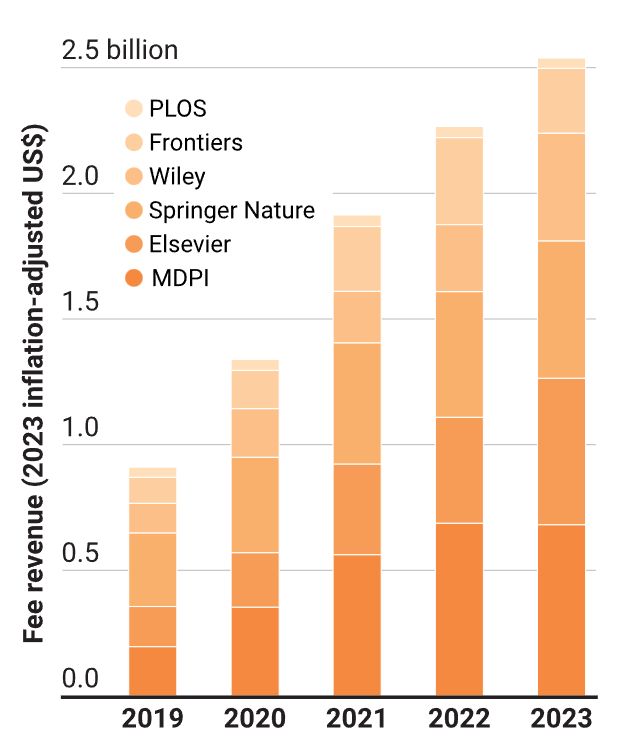
Between 2019 and 2023, researchers paid $8.968 billion to make papers open access. Imagine what else could be done with this money if it wasnt paid to for profit publishing companies...
👉 arxiv.org/abs/2407.16551

Imagen de Enrique Pérez-Montero al comienzo de la charla, con una transparencia con el título "Astroaccesible: Los sonidos de las galaxias"

Imagen de Enrique Pérez-Montero durante la charla, con una transparencia con el título "¿Qué hace un astrofísico?"
Charla muy interesante de Enrique Pérez-Montero (@iaacsic.bsky.social) ayer en @www.unizar.es (en Teruel) sobre la sonificación de datos astronómicos.
Muchos datos que mostramos como imágenes son adaptaciones para entenderlos mejor, y también se pueden traducir a sonidos y ser útil para todos.
En @pcoffeebreak.bsky.social comentaron mi paper sobre la misteriosa nebulosa "cerca" de la galaxia de Andrómeda!🔭 Qué ilusión! 🎉
¿Dónde está realmente? ¿Cómo la analizamos? ¿Qué es exactamente?Aquí @darksapiens.bsky.social, coautor del paper, cuenta lo que sabemos:
www.youtube.com/live/YXvicot...
Hi! I am the first author of the paper, thank you for sharing!
We used also a telescope from the OAJ (Teruel, Spain). And we are not sure of what it is exactly, but it does seem to be in the Milky Way.
For more info, the paper arxiv.org/abs/2412.08327 and my thread 👇
bsky.app/profile/alum...
Finally, I want to thank all the co-authors and the telescope🔭 operators! Also, thanks to the discoverers of the nebula (Strottner, Dreschler, and Sainty), and thanks to Bray Falls, whose tweet about the discovery I saw and pushed me to start this project!
12.12.2024 17:06 — 👍 3 🔁 1 💬 0 📌 0
Ok, it is in the Milky Way... but what kind of nebula is it?
We aren’t sure! It is a complex object, we haven't found anything like it before. It may be a gas filament in our galaxy, with an extra ionization source to explain the [OIII] emission.
More research is needed! 🔭

