New blogpost
sinoxenic.wordpress.com/2025/07/27/a-s…
27.07.2025 10:00 — 👍 0 🔁 0 💬 0 📌 0
It is a fascinating look at the diverse weaving traditions of Southwestern China in particular and Asia in general
Additionally it also attempts to reconstruct its history via what is basically the comparative method and how it intersects with the language families of the area
14.04.2025 19:25 — 👍 0 🔁 0 💬 0 📌 0
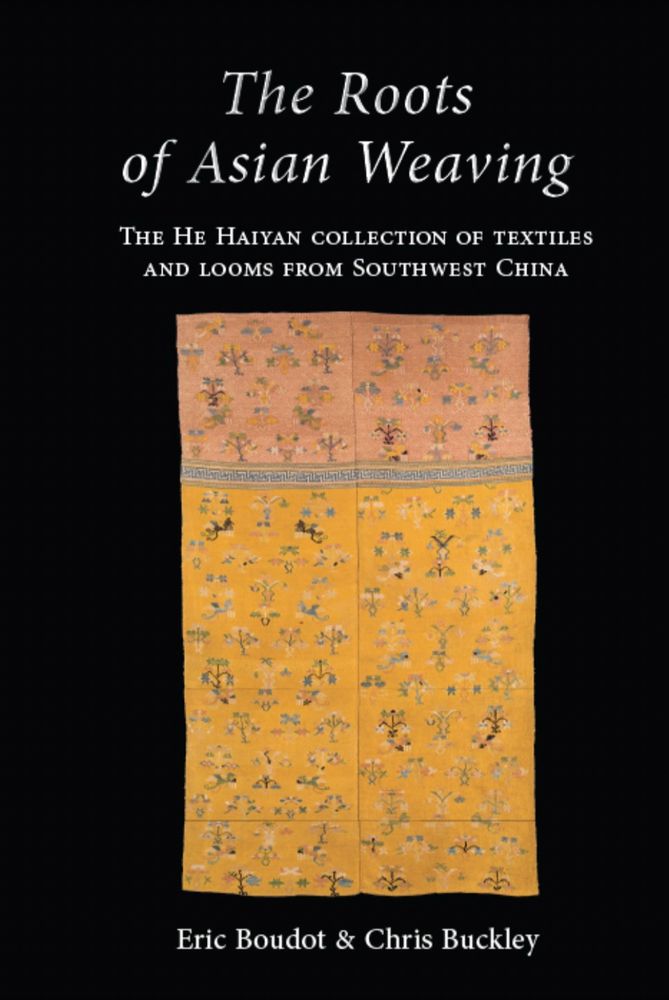
Interesting #BookOfTheDay
The roots of Asian weaving: the He Haiyan collection of textiles and looms from Southwest China by Eric Boudet & Chris Buckley
14.04.2025 19:25 — 👍 0 🔁 0 💬 1 📌 0
#Irish ☘️🇮🇪☘️ word of the day: nathair /ˈn̪ˠa.həɾʲ/ “snake”, from OIr. nathir /ˈNa.θʲərʲ/ “snake”, ultimately from PIE *nH̥tr-ík-s “adder”
Despite Ireland famously not having any snakes, this lexeme managed to persist all the way from PIE down to the modern day
17.03.2025 14:21 — 👍 1 🔁 0 💬 0 📌 0
On the other hand, if you show a reconstructed Middle Chinese reading you mid start a brawl amongst the Sinologists 🤣
23.02.2025 00:18 — 👍 1 🔁 0 💬 0 📌 0
Wonder if there has been a more recent study in Tibetan fortition of /*j/ than Gong (1977)
Hill (2019) has a brief discussion on it but it only includes Li Fang-kuei’s law: *rj- > rgʲ- and not the other proposed sound laws in Gong: *sj- > skʲ- and ɣj- > ɣkʲ-
21.02.2025 13:31 — 👍 1 🔁 0 💬 0 📌 0

Are you kidding me…
Hong Kong legco just passed a non-binding motion to “defend the one husband one wife, one man one woman framework of marriage” in the name of “protecting Chinese culture”
13.02.2025 18:46 — 👍 0 🔁 0 💬 0 📌 0
Wonder has there been a more recent study in Tibetan fortition of /*j/ than Gong (1977)
Hill (2019) has a brief discussion on it but it only includes Li Fang-kuei’s law: *rj- > rgʲ- and not the other proposed sound laws in Gong: *sj- > skʲ- and ɣj- > ɣkʲ-
09.02.2025 21:55 — 👍 0 🔁 0 💬 0 📌 0
The existence of evidently related roots རིས ris and རི་མོ ri-mo, both “painting” also suggest the initial b- is of secondary origin
The former evidently zero nominalised from the ‘imperative’ stem (likely original a stative passive) རིས ris and the latter from the root plus the nominal suffix -མོ -mo
06.02.2025 22:04 — 👍 3 🔁 0 💬 0 📌 0
This seems to suggest that in Old Tibetan, the underlying root is √རི √ri with the epenthesis of <d> when adding the prefix ɣ- as seen in the root √རལ √ral “to tear” with stems འདྲལ ɣdral (v1) and རལ ral (v2)
06.02.2025 22:04 — 👍 1 🔁 0 💬 1 📌 0
However, this is evidently an innovation as in Old Tibetan, instead of Classical འབྲེལ ɣbris and བྲེལ bris, we instead find the verbs forms འདྲིས ɣdris and རིས ris
06.02.2025 22:04 — 👍 1 🔁 0 💬 1 📌 0

In Classical Tibetan sources, this verb is reported with the stems འབྲེལ, བྲེལ, བྲེ and བྲེལ (ɣbris, bris, bri, bris), fitting into Coblin’s Paradigm I with the loss of preinitial b- before a labial consonant
06.02.2025 22:04 — 👍 1 🔁 0 💬 1 📌 0
#Tibetan word of the day:
√བྲེ √bri “to write”
This root is apparently related to the lexemes རིས ris and རི་མོ ri-mo, both “painting”
This root was apparently reformed from Old Tibetan √རི √ri based on analogy to the past and future stem
06.02.2025 22:04 — 👍 3 🔁 0 💬 1 📌 0
Georgetown Security Studies Program. Taiwan's defense, Taiwan military history, U.S.-Taiwan relations. Brock Purdy acolyte.
中文/上海话/ENG/FR
TW/SG/US. Linguist, grammar antifa, demi🖤🩶🤍💜 transbian, anarchist. RT ≠ endorsement. She/her/他/伊。
解放巴勒斯坦!黑命關天!解散警隊!這世上沒有從天而降的英雄,只有挺身而出的凡人
REVOLUTION EVERYWHERE
S.I.N.O.(Socialist.In.Name.Only)-phobic 中特社掘墓人,「馬鹿主義接班人」,anti-支黑,anti-大中華膠,World’s #1 Luol-Dengist🏀🐐(dengoids dni)
战无不胜的罗尔·邓思想万岁!!!
(he/him/他)
Author of 𝙎𝙞𝙣𝙤𝙜𝙧𝙖𝙥𝙝𝙮 (2019) & 𝘾𝙝𝙞𝙣𝙚𝙨𝙚 𝘾𝙝𝙖𝙧𝙖𝙘𝙩𝙚𝙧𝙨 𝘼𝙘𝙧𝙤𝙨𝙨 𝘼𝙨𝙞𝙖 (@uwapress, 2025). Chinese characters, writing systems, historical phonology, etc.
https://uwapress.uw.edu/book/9780295753027/chinese-characters-across-asia/
Interested in descriptive, historical & contact linguistics.
I like Caucasian and Indo-Iranic languages, and dabble (in decreasing order of oftenity) in the languages of the Pacific Northwest, the Himalayas and along the Nile. rẓ́w fan.
Linguist, mainly focused on historical change and contact in northern Africa (Arabic, Berber, Songhay - and now Nilotic...)
Historical Linguist; Working on Quranic Arabic and the linguistic history of Arabic and Tamazight. Game designer for Team18k
Linguist & Caucasologist • Professor at the Free University of Tbilisi • Research languages of the Caucasus, the Tonkawa language • Author of 'Tonkawa Texts' • Weekly Georgian Etymologies
Academic research: https://freeuni.academia.edu/ThomasWier
I post mostly about Linguistics and Tolkien | PhDing at @VUamsterdam about historical linguistics & North Halmahera langs | SilmariaPodcast | {female markers}
Prof of linguistics. 🇦🇺/🇺🇸; Australian languages, historical linguistics, Voynich Manuscript
Postdoc in comparative linguistics at the University of Potsdam.
Political views mine. 💚 🇪🇺 🇺🇦
andreashoelzl.de (under construction)
https://wipcad-potsdam.academia.edu/AndreasH%C3%B6lzl
/'dʑowɪn/
• taalkundige | linguist
• schrijver van 'Die goeie ouwe taal' en 'Woord voor woord' | author
• all graphics and videos: http://tumblr.com/yvanspijk
• Patreon: patreon.com/yvanspijk
• photo by Dirk-Jan van Dijk
Russian-American linguist, 1st amendment nerd, translator. Posts re: medieval literature, free speech, translation, poetry, & linguistic history of Arabic, English and other languages.
math👨🏫 linguist 🐝kpr, @deatherhixon's worse ½ ~ oqe/ghaH/𓇓𓅱/ⲛⲧⲁϥ/𒀀𒉈/𒋗𒌑/bí/ēme/tic/yè/yená/hã/à/re/are’/paluṟu/eh/𑀘𑁆𑀧𑀺/𐤡𐤦𐤳/𐬵𐬋/ᜐᜒᜌ/ia/ཁོ་ན/இவன்
Berber linguistics // linguistique amazighe // ⵜⵎⵓⵙⵏⵉ ⵏ ⵜⵎⴰⵣⵉⵖⵜ
Universiteit Leiden
https://www.universiteitleiden.nl/en/staffmembers/maarten-kossmann
Profile picture: RIL 176
"That etymology guy". Linguist, broadcaster (formerly on Czech Radio), writer, researcher, language fanatic. Get 'Why Q Needs U' here: https://geni.us/WhyQNeedsU. Host of ALILI podcast. Website: https://dannybate.com/. Inquiries: jaime@jpmarshall.co.uk
Asst Prof (Old English & Old Norse). Book on hell & apocrypha. Phil-lol-ogist, word-lover, pun-makar, collector of dictionaries, glamorer of grammar. He/his
Intellectual history @SinologieFAU & @mpilhlt.bsky.social 曩昔 @ceao_uam. PhD @tohoku_univ & @UniHeidelberg. 東亞政法史を硏鑽し、言語学についての豆知識を多く呟いとる。'Too much in love with my primary sources.'
Assistante diplômée & doctorante @Université de Lausanne. Historical linguistics, language contact, indigenous grammatical traditions, Christian and Buddhist translations on the Silk Road. Working on Barlaam&Josaphat.
https://unil.academia.edu/chiaweilin