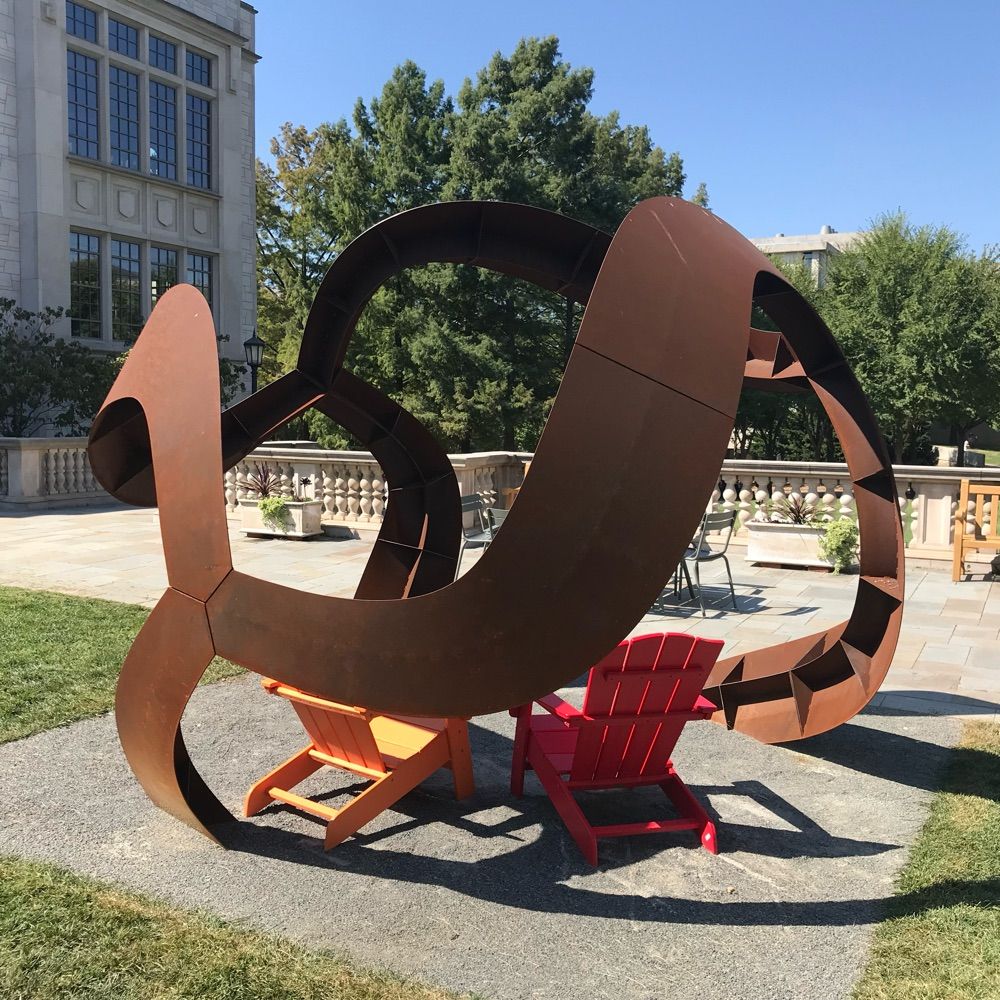
Crocheting at 180 mph 💨
08.02.2026 14:27 — 👍 10 🔁 1 💬 0 📌 0Crocheting at 180 mph 💨
08.02.2026 14:27 — 👍 10 🔁 1 💬 0 📌 0I'm very much looking forward to seeing this work in the #illustratingMath exhibition at the Maison Poincaré soon!
08.02.2026 17:30 — 👍 9 🔁 1 💬 0 📌 0New JHM is out. As always, #mathart and #mathgame and #mathforsocialjustice in abundance. Plus history, proofs and more. scholarship.claremont.edu/jhm/
02.02.2026 17:04 — 👍 7 🔁 2 💬 0 📌 0
Photo of a Book “Beading with Algorithms: Cellular Automata in Peyote Stitch” by Gwen Fisher and Roger Antonsen, World Scientific, with a QR code.

Text about the book and information about the two authors.
I started this project twelve years ago, and today I hold the result in my hand. It’s a book that combines bead weaving with math called, “Beading with Algorithms: Cellular Automata in Peyote Stitch.”
This book is the first of its kind, a recipe book of algorithms for making pixel art.


Day 1 (of 7) of the math art class I’m leading is in the books. We have 15 kids (9th and 10th graders). It’s exhausting! But I think it went well!
Kids built a George Hart Sculpture (actually we made two of them!) and we learned about V-E+F=2.
#MathArt #mtbos

A side-profile view of a person identified as Jean Schmitt standing at the front of a wood-paneled lecture hall. They are wearing a black jacket and black trousers, holding a smartphone in their left hand while gesturing with their right thumb up. They are facing a large chalkboard covered in complex mathematical drawings, including a torus, a multi-holed surface, and various geometric diagrams. In the foreground, a notebook with a blue pen is visible on a wooden desk.

A person identified as Gabriel Dorfsman-Hopkins (left), wearing a colorful patterned sweater, and a person identified as Edmund Harriss (right), in a pink button-down shirt, stand together at the front of the amphitheater. They are looking up toward a projection screen that displays a detailed, circular fractal-like pattern consisting of radiating lines and dots. Behind them, the chalkboard is filled with mathematical sketches and the website "illustratingmath.org."
In the afternoon at the Institut Henri Poincaré, we start with an introduction by Jean Schmitt on how to run an "Art Critique" session. Bravely, Gabriel Dorfsman-Hopkins and @gelada.bsky.social then provide their #illustratingMath works as examples to be critiqued. (3/4)
19.01.2026 19:46 — 👍 4 🔁 1 💬 1 📌 0
Edmund Harriss, wearing a pink button-down shirt and glasses, stands at the front of the lecture hall. They are holding a long red rope taut between their outstretched arms, demonstrating a mathematical concept. On the wooden table in front of them sits a blue and white 3D-printed spiral sculpture. The projection screen behind them lists various academic institutions and foundations.

A person identified as Robert Ghrist stands in front of a large chalkboard in a lecture hall. They are wearing a dark coat, a light-colored patterned tie, and glasses. Above them, a projection screen shows a slide titled "IMPOSSIBLE OBJECTS" featuring two versions of the Penrose triangle. Robert Ghrist is gesturing with their left hand while speaking. A wooden table in the foreground holds microphones and water bottles.

A person identified as Pierre Arnoux, wearing a bright pink shirt, stands to the right of a large chalkboard. They are pointing up toward a projection screen that displays a dense, purple geometric wireframe labeled "Figure – a bad connection." The chalkboard behind them is covered in hand-drawn mathematical diagrams, including a torus, a circle with Greek letters, and a commutative diagram involving $S^1$ and $T^2$.

A person identified as Ingrid Daubechies, with short grey hair and a dark t-shirt, stands at the front of the amphitheater with their arms wide in a descriptive gesture. Behind them, the projection screen shows complex mathematical equations related to "wavelets" and "F. transforms," along with a graph of colorful overlapping bell curves. The chalkboard below also contains various geometric sketches and formulas.
This morning, talks are given by @gelada.bsky.social (Why rigorous illustrations?), Robert Ghrist (Illuminating impossible objects), Pierre Arnoux (Counting the dots), and Ingrid Daubechies (Illustrating the development of wavelets). An amazing gallery of #illustratingMath. (2/4)
19.01.2026 19:46 — 👍 3 🔁 1 💬 1 📌 0
My featured-artist display at JMM 2026 in Washington DC. Four of the works are hanging on a zig-zag of beige, custom-cut mats, and the fifth is on three black jewelry stands. All pieces were accepted into one or more juried exhibits at JMM or Bridges in the past decade. The blue knitted wall hanging, second from the left, is the solo piece that was accepted into this year’s exhibition.

A closer view of the first two panels of the folded mat backing. The three pieces were 28 inches tall and 14, 28, and 28 inches wide, which is bigger than it sounds when you’re carrying them. On the left is Fundamental Frieze Scroll II from 2018, a tan knitted wall hanging which was the precursor for the new piece to its right. That new piece, The Fundamentals of Lace, is knitted in blue on smaller needles but is both wider and taller than the older work. Both wall hangings are composed of the same fundamental region, a small lace motif in a lambda or Y shape, and both have colored beads embedded in the fabric to mark the symmetries. For more details, go to the following post for the online catalog links.

A close up of the rightmost mat panel and the jewelry set. As before, for more details you can follow the catalog links in the following posts. The last mat panel has two knitting wall hangings suspended from pins at the top of the panel. To the left is Float Free, Bumblebee, a wall hanging in two-color mosaic knitting with yellow and black yarn. Like the two pieces in the previous photo, the knitted fabric is rectangular and lashed to dowels at the top and bottom. The fabric is divided into horizontal and vertical strips with different repeating abstract designs. On the right of the mat is Redistribution, a wall hanging that has the overall shape of an hourglass whose top segment is shorter than the bottom segment. The upper portion is fan-shaped, with a network of dark purple stitches over a background of pale green stitches. The lower portion is flared like a trumpet and juts away from the wall, with a network of light purple stitches on a background of dark green. To the right of the folding backdrop is Map Coloring Jewelry Set, the oldest artwork in this display. A bead crocheted necklace with pendant, a bead crocheted bracelet, and bead woven earrings in eight matte colors with gold accents hang on a black necklace form and black bracelet and earring stands. This jewelry set won a prize in the JMM 2015 exhibit, and now and then, I still wear it.
#mathart #mathknitting #JMM2026
This year, the math art exhibition at the Joint Mathematics Meetings invited me to be a featured artist, giving me the chance to assemble this mini-retrospective of my knitted and beaded work. Links to the catalog entries are in the following posts.
🧶 #knitsky ☺️
It's great to be at @cirm-math.bsky.social this week with our #illustratingMath graduate school on "Illustration as a Mathematical Research Technique". Looking forward to the trimester with the same name at the Institut Henri Poincaré in Paris, starting right with this graduate school week.
07.01.2026 23:09 — 👍 2 🔁 1 💬 0 📌 0Am I being grumpy saying those are not well defined sets? All values included infinitely often.
07.01.2026 19:13 — 👍 0 🔁 0 💬 1 📌 0
A photo of a person standing in a lecture hall in front of a projection screen. The screen displays "CindyScript Basics" with bullet points about syntax, such as "Lines end with semicolons" and "Typeless." In the foreground, there are several boxes of colorful chalk on a wooden table.

A person looks down at a laptop in a lecture hall while a software interface titled "Cinderella" is projected on the screen behind them. The screen shows a geometric pattern of green dots arranged in a circular, spiral formation on a grid.

A high-contrast digital image of a Mandelbrot set fractal. The central "body" is black, surrounded by a vibrant, glowing pink and white halo that reveals intricate, repeating branching patterns.

A digital screenshot of a shader program displaying a complex yellow geometric pattern on a dark background. The pattern consists of intersecting circles and arcs that create a symmetrical, tunnel-like effect toward the center.
On the second day of #illustratingMath at @cirm-math.bsky.social, we continue the mini-courses #CindyJS and #Shadertoy: We tackled the scripting abilities of CindyJS and immersed ourselves in the creation of fractals and circle inversions, learning to write functions and structs in #GLSL. (1/3)
06.01.2026 22:41 — 👍 9 🔁 1 💬 1 📌 0
A promotional poster for the "Illustration as a Mathematical Research Technique" program at the Institut Henri Poincaré in Paris, running from January 5 to April 3, 2026. The poster features a blue and white design with a central collage of complex mathematical visualizations, including fractals, geometric shapes, and topological models. Key Program Dates: Jan 5–9: CIRM Introductory School Jan 19–23: Rigorous Illustrations for Mathematical Research Feb 16–20: Bridging Visualization and Understanding in Geometry Mar 23–27: Integrating Research and Illustration in Number Theory The poster lists organizers such as David Bachman, Rémi Coulon, and Katherine E. Stange. It notes that registration is mandatory but free, and includes a QR code and URL (indico.math.cnrs.fr) for details. Logos for Sorbonne Université and CNRS are visible at the bottom. The poster is pinned to a white wall alongside other documents.

Exterior view of the entry to "Auditorium Lecture Hall A1," a low-profile, modern cream-colored building set against a wooded, hilly landscape under an overcast sky. A dark metal awning projects over glass double doors, which feature informational posters. To the right, lush green shrubs and trees partially obscure the building, leading the eye toward a large, rocky mountain peak in the background.

A close-up, high-angle shot focuses on the surface of a cafeteria-style tray featuring an intricate geometric pattern. The tray is a pale yellow or cream color, overlaid with a dense web of interlocking thin brown lines that form a repeating design of stars and hexagons. The pattern is sharp in the foreground and becomes slightly blurred toward the top edge of the tray. In the background, out of focus, a white sign with red text and some interior furniture are visible, suggesting a public dining or common area. The lighting is bright and reflects softly off the smooth, slightly glossy surface of the tray.

A tall, vertical informational poster titled "Kolibri" is mounted on a plain white wall in an indoor hallway. The top half of the poster features a dark background with a large, light-purple 3D mathematical visualization that resembles a swirling, folded surface. The name "Kolibri" is written in red script at the top right, and the equation x^2=y^2 z^2 +z^3 is displayed in red at the bottom right of the image. The bottom half of the poster is white with two columns of French text explaining the mathematical properties of the shape and details about hummingbirds. A small header reads "KOLIBRI (COLIBRI)" and the text attributes the work to author Herwig Hauser. A row of institutional logos, including CNRS and Aix-Marseille Université, runs along the bottom edge. To the right of the main poster, a smaller blue sign with information about visiting the Calanques is also visible on the wall.
This week, we start the Institut Henri Poincare program "Illustration as a mathematical research technique" (indico.math.cnrs.fr/event/13123/) with a graduate school at the @cirm-math.bsky.social. For the week, 53 participants will immerse themselves in all things #illustratingMath. (1/n)
05.01.2026 23:31 — 👍 9 🔁 3 💬 3 📌 0
🚨The call for submissions for this year's @BridgesMathart conference is out: www.bridgesmathart.org/b2026/bridge....
Regular papers: 1 February
Short paper: 1 March
Workshop papers: 1 March
Artworks: 15 March
Math + Fashion Show: 15 April
Short Film Festival: 09 May
Family Day: 15 June

Dan advocating for hands on math mathforlove.com/2026/01/mani... @mathforlove.bsky.social A wise teacher taught me his no.1 point and I >never< regret it.
04.01.2026 22:55 — 👍 13 🔁 6 💬 1 📌 1As pointed out by @paulakrieg.bsky.social and noted by @mpershan.bsky.social, longtime #mtbos partner and collaborator Malke Rosenfeld passed away last year. She investigated and taught the mind-body math connection, engaging hundreds of teachers and learners in #mathart - dance! RIP great friend!
31.12.2025 15:27 — 👍 17 🔁 6 💬 2 📌 0New video out just now, on a mechanism that uses racks and gears to expand and contract, this time in all three dimensions! youtu.be/NEJZlGuWGV8
30.12.2025 16:42 — 👍 18 🔁 5 💬 0 📌 0Shame! Wanted to learn what the mathematics of the lovely image was. Remember Andy from when I was doing my PhD at Imperial.
19.12.2025 10:47 — 👍 0 🔁 0 💬 1 📌 0You can’t comment like that and not cite the paper!
19.12.2025 10:18 — 👍 0 🔁 0 💬 1 📌 0Here's your chance to learn about some #illustratingMath while going through the lovely #MathArt by @mathzorro.bsky.social. Give the talk a watch!
17.11.2025 08:26 — 👍 5 🔁 1 💬 0 📌 0For all the #textile #art fans! 😍
26.08.2025 19:46 — 👍 8 🔁 2 💬 0 📌 0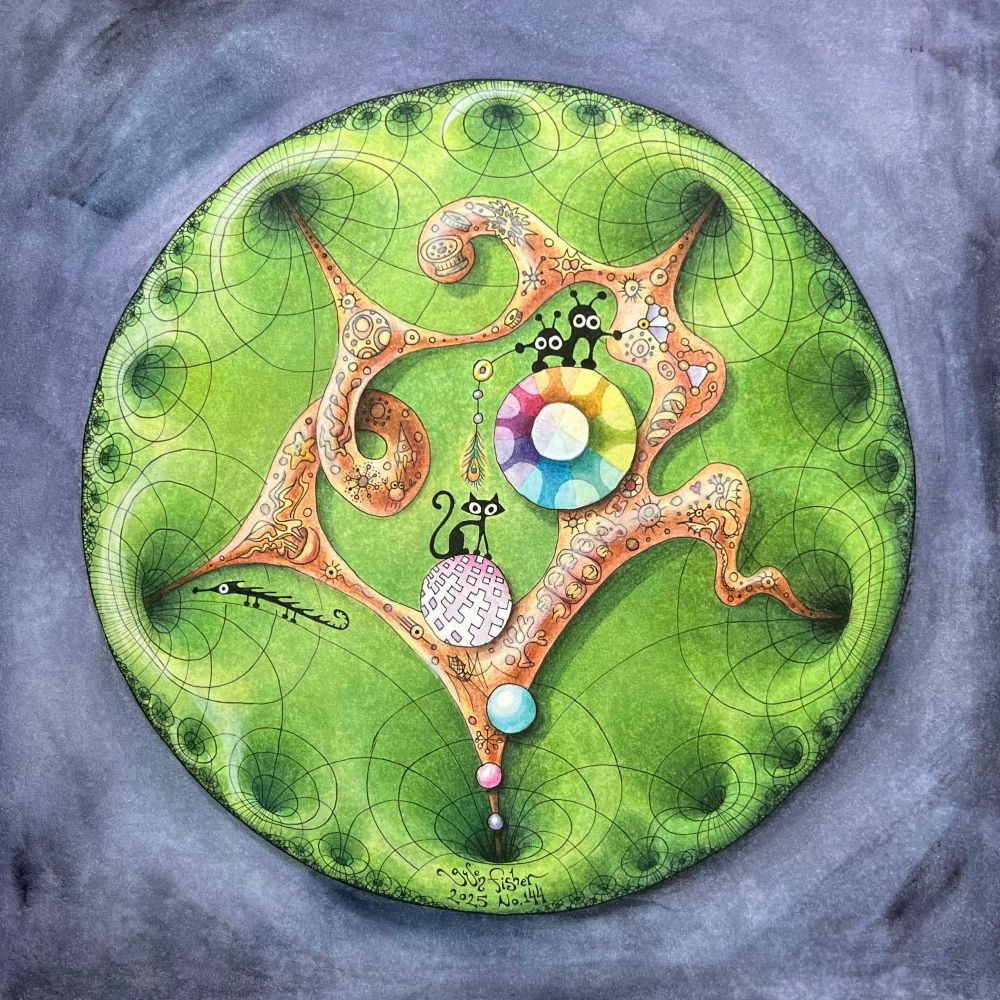
Orange goo containing plankton floats over and into the fractal surface of infinite holes. The surface is based upon an Apollonian gasket.
“Infinite Holes
and the Cosmic Goo”
10 inch square
I was delighted to learn that this #watercolor and pigment ink #painting won Best Photograph, Painting, or Print at the MAA Mathfest Art Exhibit 2025.
#mathart
Available
I can highly recommend the #pod. Cool and insightful conversations and great content overall, featuring @steckl.es and @peterrowlett.net among others.
14.08.2025 11:50 — 👍 5 🔁 4 💬 0 📌 0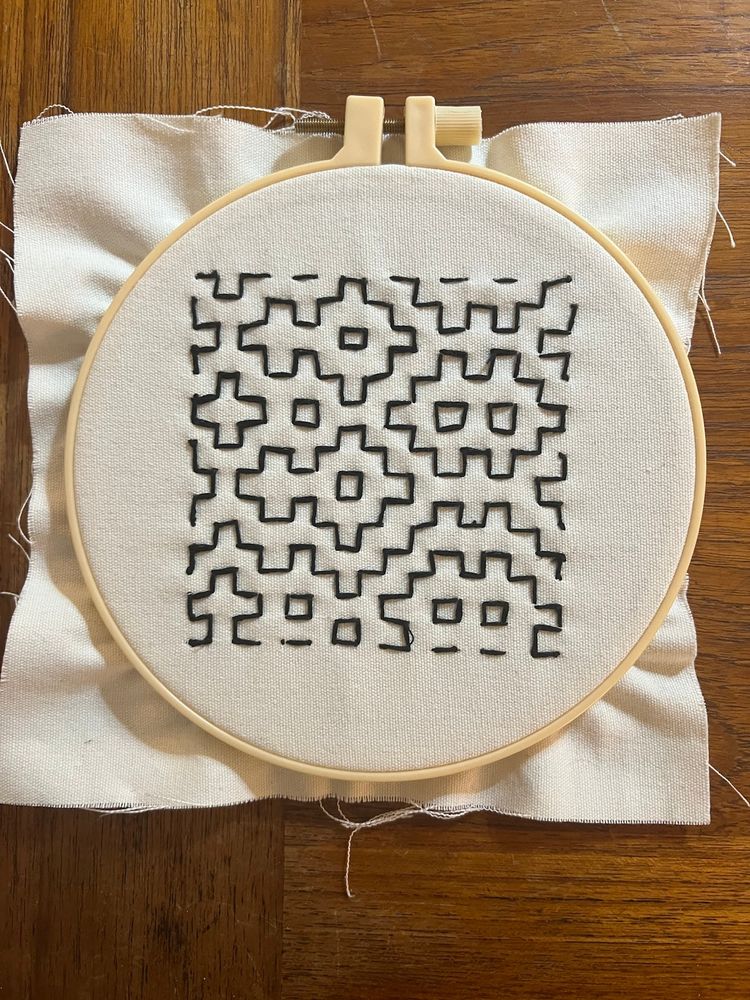
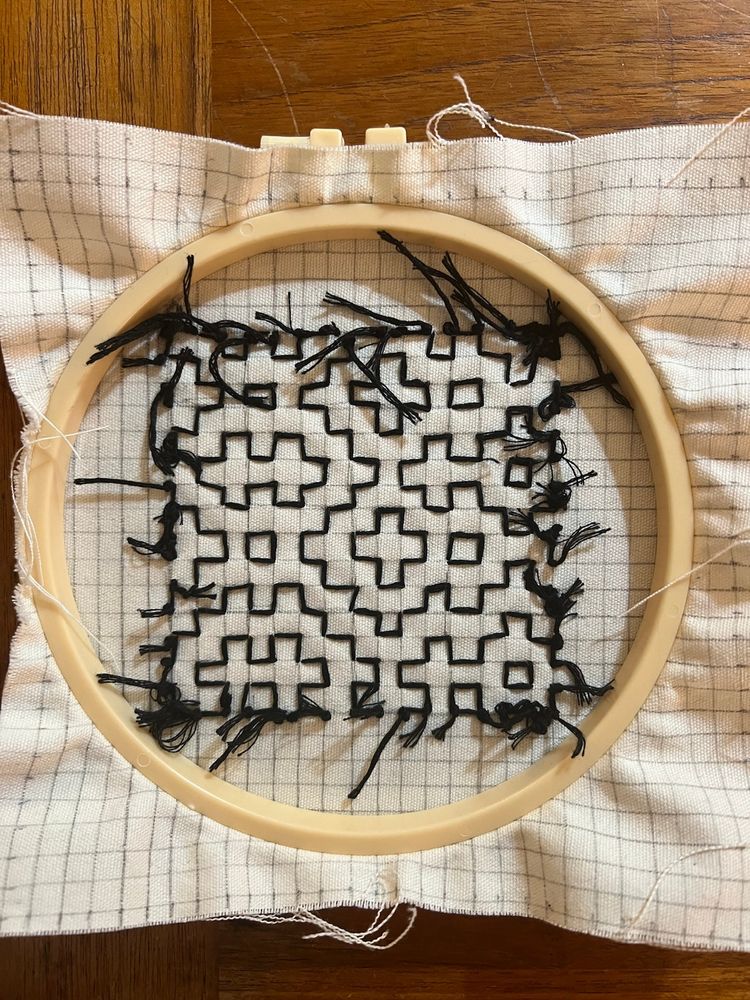
Inspired by @anniekp.bsky.social and @aliensunset.bsky.social, I created this beautiful piece of mathematical art! Hitomezashi stitching!
To read about a bit about how I stumbled on this, read on!
samjshah.com/2025/08/13/h...
#mtbos #mathart

A split screen shows a person at a podium and a slide with a diagram of a "Flat Klein Bottle with curved crease origami," which is a grid-like, cylindrical shape that has been bent into a V-shape.

A split screen shows a speaker and a slide with two identical 3D renderings of a grid-like, folded geometric object, a "flat Klein Bottle."

A person presents with a split screen, showing them and a slide featuring a complex, folded geometric object with a title "A Piecewise Smooth Isometric Immersion of a flat Klein Bottle."

A person is giving a talk, with a split screen showing them and a slide with two images of a transparent, cylindrical shape made of crisscrossing blue and white lines.
The second talk is by Stepan Paul, who tells us about "Topological Origami: Beyond the Paper Donut."🍩Flat tori are known, but what about a flat Klein Bottle? Stepan shows us a first prototype (that fails at six points ) as well as a corrected model that's on the arxiv arxiv.org/abs/2504.08826.
13.08.2025 14:42 — 👍 5 🔁 1 💬 0 📌 0
A person is giving a talk, with a split screen showing them and a slide with a hand-drawn diagram of a perfectly smooth torus with the title "The Perfect torus?".

A split screen shows a person presenting and a slide with a hand-drawn diagram illustrating the difference between "Mathematical Precision" and "Mathematical Imprecision" when constructing a torus.

A split screen shows a speaker and a slide with a hand-drawn diagram explaining the "Gauss map/Normal map," using a torus and a sphere to illustrate the concept.

A person presents with a split screen, showing them and a slide with a sketch of M.C. Escher's "Hand with Reflecting Sphere" and the word "Torus" written below it.
Starting the #illustratingMath talks at the @icerm.bsky.social today is Elliot Kienzle, who aims to settle the question how "To draw a torus." Like all good answers, his is based on differential geometry, taking the geometry of the torus into account when drawing. And Escher's there, too😄
13.08.2025 14:42 — 👍 13 🔁 4 💬 1 📌 1Today, the one-week #illustratingMath workshop at @icerm.bsky.social starts. It is a week, packed with great talks on #images, #animations, #textiles, #sculptures, #dance, and #3dPrinting. All talks are being live-streamed, so go check out the schedule at icerm.brown.edu/program/topi... and join in!
11.08.2025 09:22 — 👍 9 🔁 6 💬 1 📌 0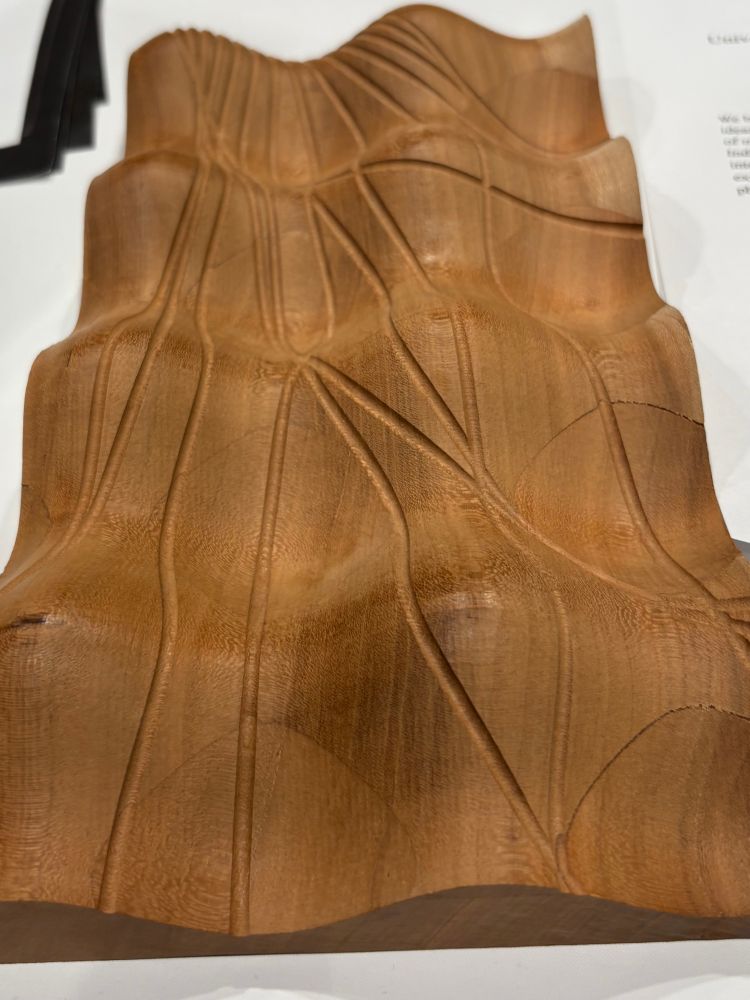
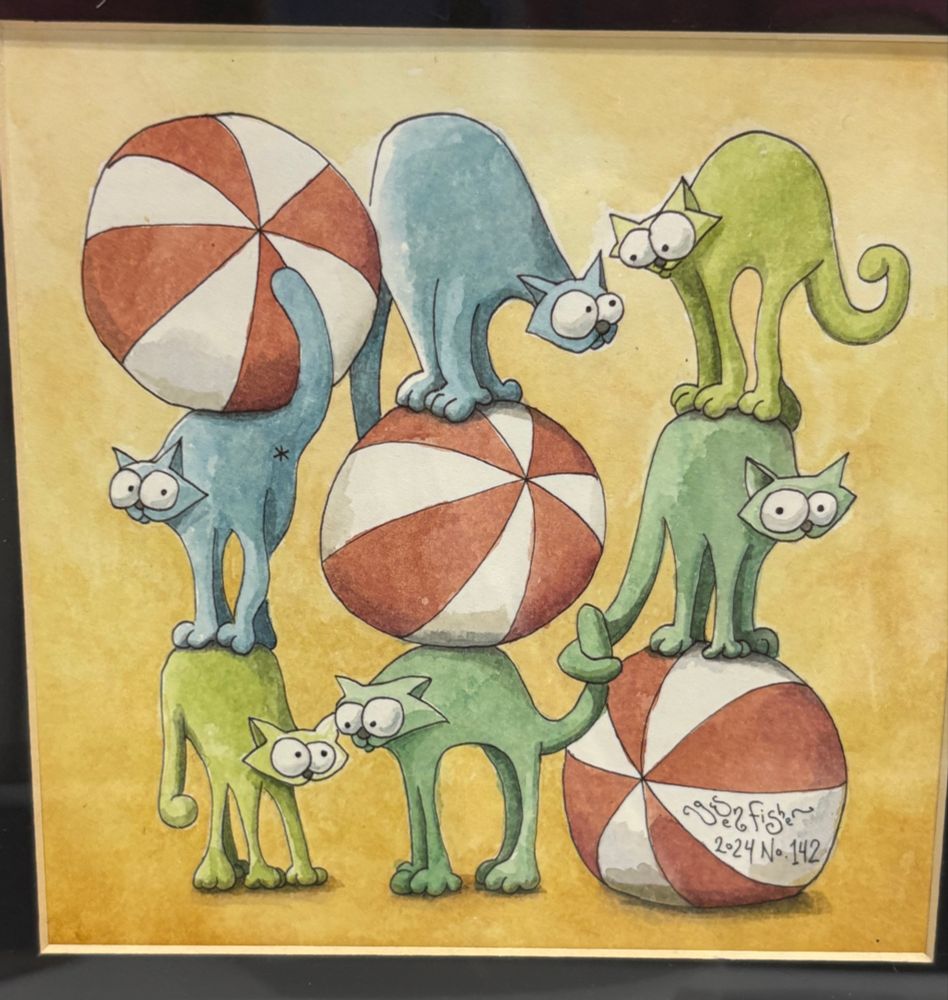
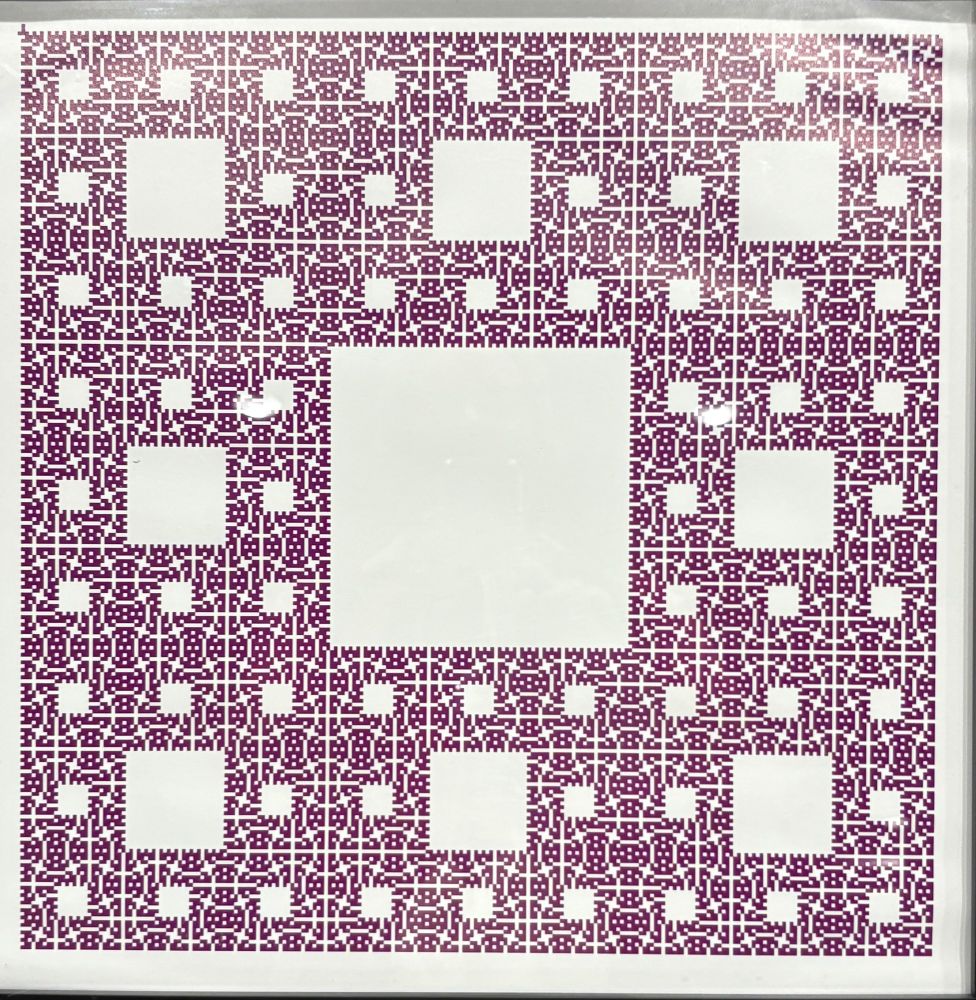
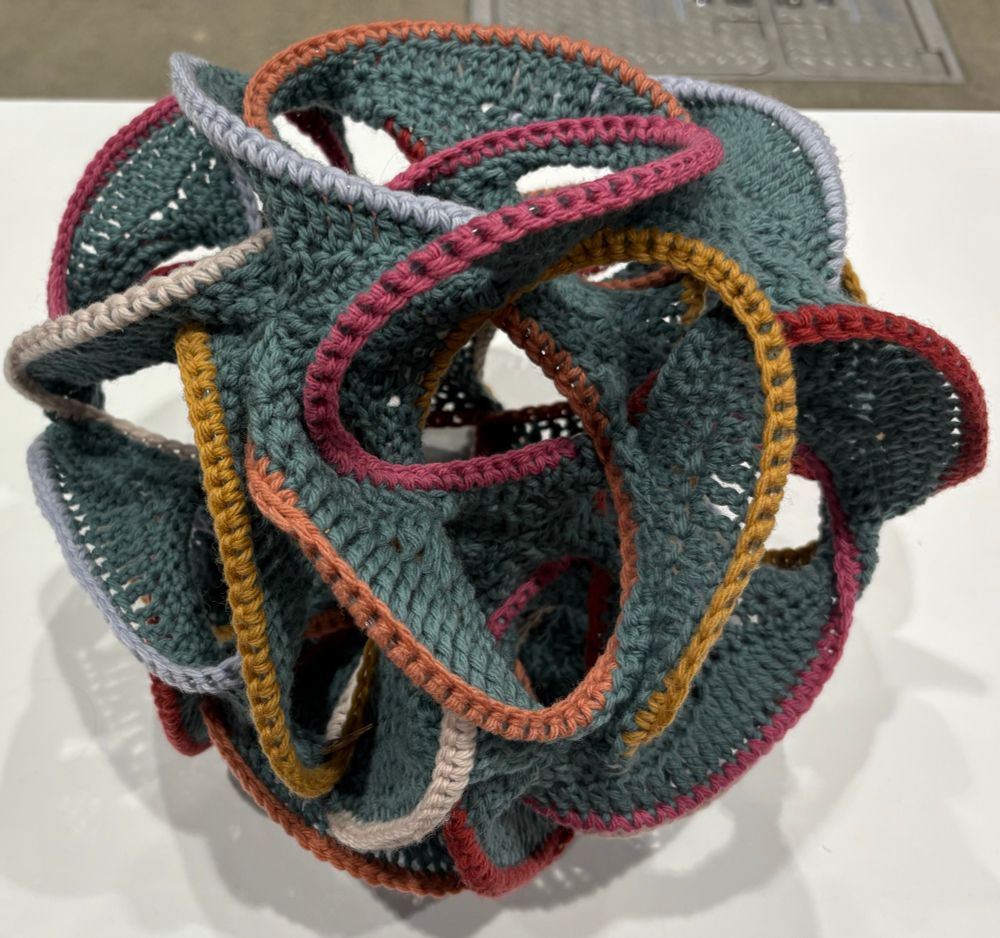
As I head home from #MAAthFest, enjoy these wonderful pieces in the Math Art exhibit including pieces by @gwenbeads.bsky.social and @gelada.bsky.social
10.08.2025 16:47 — 👍 12 🔁 2 💬 0 📌 0
Art exhibit at #MAAthFest. Wonderful dodo-cahedron by Andrea Hawksley. Read about poly-fill-hedra at: archive.bridgesmathart.org/2022/bridges...
08.08.2025 23:40 — 👍 8 🔁 3 💬 0 📌 1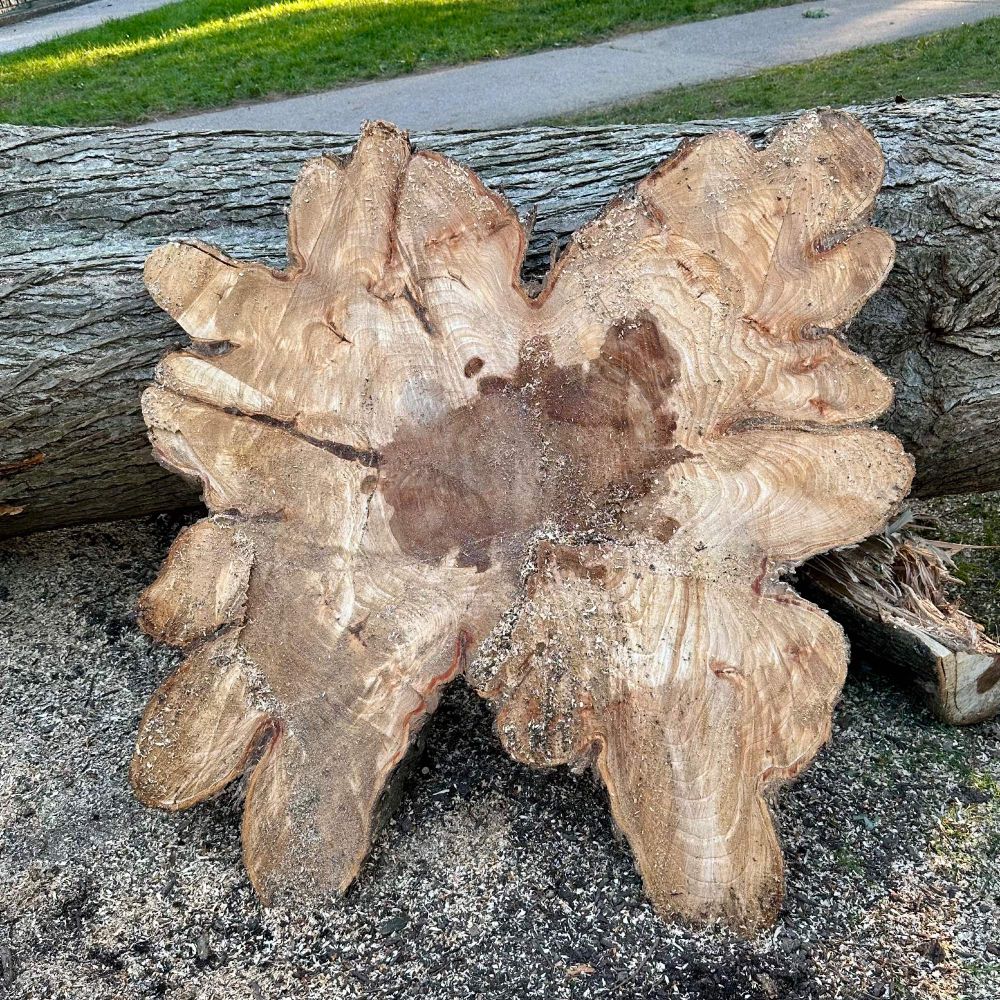
This is a photo of a tree that fell on campus during a summer storm. I wonder if there's an interesting conversation we could have with multivariable calculus students about tree rings. Tree rings are level curves. What's the function? What does the gradient vector tell us? Etc.
30.07.2025 15:34 — 👍 13 🔁 2 💬 1 📌 0
Screen with a quote referencing Kenneth Martin - "Oh all right, then I have made a mistake" when someone else referred to an artistic liberty (an imperfection) he had made in an illustration.
Thanks @gelada.bsky.social for your thought-provoking talk this morning! I appreciated many parts including where you discussed two different ways in which mathematical artists might approach artwork - create rules that must be followed to make art or use math as inspiration in the artistic process.
15.07.2025 19:01 — 👍 7 🔁 1 💬 0 📌 0