Thank you.
02.01.2024 12:55 —
👍 0
🔁 0
💬 0
📌 0
Should I install Windows 11 instead of Windows S? It is a bit annoying that Windows S does not support many softwares, including Zoom…
31.12.2023 19:36 —
👍 0
🔁 0
💬 1
📌 0
Thank you for the suggestion! It looks cool!
03.12.2023 17:57 —
👍 1
🔁 0
💬 0
📌 0
I’m looking for podcast recommendations!
Maybe something based on history, like Revolutions: open.spotify.com/show/05lvdf9T7…
Or maybe something about economic policy? Like Americas Quarterly (open.spotify.com/show/5PCntXM9L ), but about the economy?
03.12.2023 17:21 —
👍 3
🔁 0
💬 3
📌 0
Thank you!
28.11.2023 00:40 —
👍 1
🔁 0
💬 0
📌 0
It is great seeing a new WP out in the wild!
👇👇👇
27.11.2023 13:16 —
👍 11
🔁 2
💬 0
📌 0
📉📈#Econsky, some of you may be interested in my new working paper about MTE with Duration Outcomes.
@pedrosantanna.bsky.social and Santi are amazing co-authors.
27.11.2023 13:16 —
👍 8
🔁 0
💬 0
📌 0
Our QMTE point estimates suggest that designing sentencing guidelines that encourage strict judges to become more lenient could lead to increasing time-to-recidivism.
27.11.2023 12:47 —
👍 0
🔁 0
💬 1
📌 0
These point estimates
suggest that defendants whom almost all judges would punish would take longer to recidivate,
while defendants who would be punished only by tough judges would recidivate faster compared
to situations where they would not be punished.
27.11.2023 12:47 —
👍 0
🔁 0
💬 1
📌 0

All QMTE functions behave similarly. Although the level of the estimated QMTEs depends on the quantile, all functions are decreasing in the unobserved resistance to punishment.
27.11.2023 12:47 —
👍 0
🔁 0
💬 1
📌 0
To have a deeper understanding of the time trade-offs associated with the effect of punishment on time-to-recidivism, we now focus on the QMTE. They use easy-to-interpret units (days before recidivism) and may work as good summary measures.
27.11.2023 12:46 —
👍 0
🔁 0
💬 1
📌 0
This rich heterogeneity is relevant. If two researchers were to focus only on a specific but different
time frame they may get different answers, highlighting that the practice of “binarizing” duration outcomes may come with caveats.
27.11.2023 12:46 —
👍 0
🔁 0
💬 1
📌 0

But things change a lot in the long-run! The DMTEs are decreasing. This indicates that defendants whom almost all judges would punish would recidivate faster because of the punishment, while defendants who would be punished only by tough judges would take longer
to recidivate.
27.11.2023 12:45 —
👍 0
🔁 0
💬 1
📌 0

The DMTEs are increasing in the short-run. This behavior indicates that defendants whom almost all judges would punish are less likely to recidivate, while defendants who would be punished only by tough judges are more likely to recidivate.
27.11.2023 12:45 —
👍 0
🔁 0
💬 1
📌 0
For inference, you can use the weighted bootstrap! Piece of cake!
And we do show that everything is consistent and asymptotic normal!
Now, it is time to estimate the effect of misdemeanor punishment on time-to-recidivism.
27.11.2023 12:45 —
👍 1
🔁 0
💬 1
📌 0


We use a conditional local IV estimand to identify the distributional treatment responses. After that, we can get the DMTE and the QMTE.
Our estimation procedure is a bit long, but super easy to implement! You only need to run a few logit models and take some averages!
27.11.2023 12:44 —
👍 2
🔁 0
💬 1
📌 0
To look at long-run recidivism, our Econometric tools need to appropriately address right-censoring.
We also want to use the MTE to analyze heterogeneity with respect to the defendants’ punishment resistance.
So we need to develop new tools combining MTE and duration outcomes!
27.11.2023 12:42 —
👍 1
🔁 0
💬 1
📌 0

First, long-run recidivism matters in São Paulo, Brazil. A non-negligible share of recidivism events happens 6-8 years after the judge’s decision.
So analyzing the effect of judges’ decision on long-run recidivism may matter when discussing sentencing guidelines.
27.11.2023 12:42 —
👍 1
🔁 0
💬 1
📌 0

Misdemeanor punishment (fines) can have heterogeneous effects on recidivism depending on the defendants’ types and time horizon.
We explore these sources of heterogeneity by looking at the marginal treatment effect of misdemeanor punishment on recidivism at many time horizons.
27.11.2023 12:41 —
👍 1
🔁 1
💬 1
📌 0

🚨New Working Paper🚨
Was Javert right to be suspicious? Unpacking treatment effect heterogeneity of alternative sentences on time-to-recidivism in Brazil
by Acerenza (scholar.google.com/citations?user…), Possebom and Sant’Anna (@pedrosantanna.bsky.social)
Paper: arxiv.org/abs/2311.13969
27.11.2023 12:41 —
👍 15
🔁 6
💬 2
📌 2
Thank you for the kind words!
17.11.2023 21:07 —
👍 1
🔁 0
💬 1
📌 0
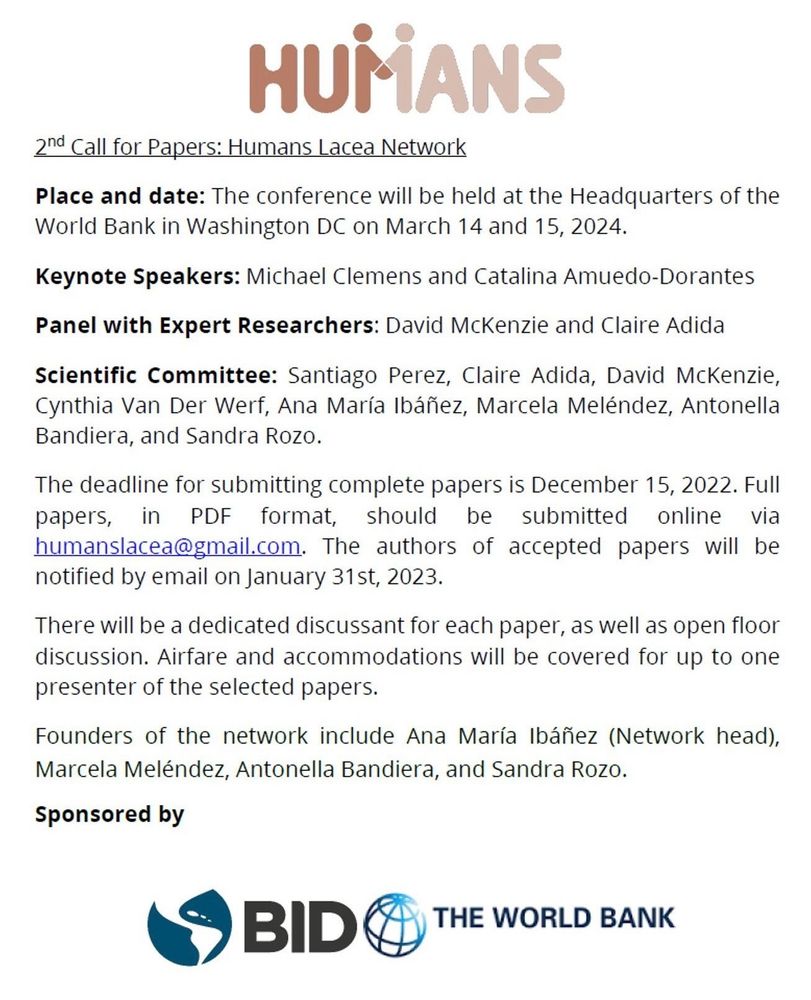
2nd Call for Papers: Humans Lacea Network. Place and date: The conference will be held at the Headquarters of the World Bank in Washington DC on March 14 and 15, 2024. Keynote Speakers: Michael Clemens and Catalina Amuedo-Dorantes Panel with Expert Researchers: David McKenzie and Claire Adida Scientific Committee: Santiago Perez, Claire Adida, David McKenzie, Cynthia Van Der Werf, Ana Maria Ibafiez, Marcela Meléndez, Antonella Bandiera, and Sandra Rozo. The deadline for submitting complete papers is December 15, 2022. Full papers, in PDF format, should he submitted online via humanslacea@gmail.com. The authors of accepted papers will be notified by email on January 31st, 2023. There will be a dedicated discussant for each paper, as well as open floor discussion. Airfare and accommodations will be covered for up to one presenter of the selected papers. Founders of the network include Ana Maria Ibanez (Network head), Marcela Meléndez, Antonella Bandiera, and Sandra Rozo.
🚨 Call for Papers
—Conference on the economics of migration in Latin America, Mar. 14–15 in Washington
—Featuring top researchers @sandrarozo.bsky.social @dmckenzie.bsky.social @claireadida.bsky.social et al., run by HUMANS network of LACEA
—With a keynote by me
—Submissions due 🔜 December 15
14.11.2023 21:50 —
👍 25
🔁 25
💬 1
📌 0

Sometimes, I think that journals do not know that many of its readers have eyesight problems...
Elsevier's font size is so small and its line spacing is miniscule.
09.11.2023 12:16 —
👍 1
🔁 0
💬 1
📌 0
QT with 10 of your favorite novels
Ubirajara by Alencar
Vidas Secas by Ramos
Harry Potter and the Order of the Phoenix
Assassin’s Apprentice by Hobb
The Final Empire by Sanderson
Percy Jackson and The Lightening Thief by Riordan
I tried to focus on the novels that marked my life in some way.
05.11.2023 23:23 —
👍 0
🔁 0
💬 0
📌 0
Following my theme of comparing academic and fictional writing, are there any similarities between economic papers and world building in fantasy?
Are theory papers hard world building (LoTR)? Are empirical work more like soft world building (Narnia)? What about Econometrics?
05.11.2023 12:34 —
👍 1
🔁 0
💬 0
📌 0
I like @peibich.bsky.social’s solution. I would also check the distribution of Z for men and women. If they differ, the weighted average of LATEs (I.e., your 2SLS) will be different, even if the underlying LATEs/MTE are the same.
04.11.2023 13:01 —
👍 3
🔁 0
💬 1
📌 0

Probable Causation is an amazing podcast and this interview with Allison Stashko is awesome: open.spotify.com/episode/0rfq...
They discuss the effect of newly elected prosecutors and police killings in the US. It is based on this paper: drive.google.com/file/d/1LwnA....
03.11.2023 15:20 —
👍 2
🔁 0
💬 0
📌 0
#EconSky 📉📈
Advances in Econometrics is putting together an issue on "Econometrics of Climate, Energy, and Green Transition" edited by Eric Hillebrand, Marina Friedrich, & @smueconomics.bsky.social's Tom Fomby.
Paper submissions due Nov 30!
Info at: tinyurl.com/py9n677y
03.11.2023 14:48 —
👍 9
🔁 7
💬 0
📌 0