🚨 Applications open: GuardIAS Summer School!
Learn how to detect aquatic #InvasiveAlienSpecies using #eDNA — from sampling design and lab workflows to bioinformatics + policy integration. Lectures + hands-on case studies.
👉 guardias.eu/welcome-to-t...
#MarineEcology #AquaticEcology #BioInvasions 🌍🌐
14.01.2026 19:01 —
👍 9
🔁 8
💬 0
📌 0

A Systems Perspective: How Social–Ecological Networks Can Improve Our Understanding and Management of Biological Invasions
Abstract. Reversing biodiversity loss and the sustainability crisis requires approaches that explicitly consider human–nature interdependencies. Social–eco
Whooop! New paper online!
"A Systems Perspective: How Social–Ecological Networks Can Improve Our Understanding and Management of Biological Invasions"
Phenomenal effort by Fiona Rickowski to pull this all together, wrangling a large co-author/bag-of-cats team into shape!
doi.org/10.1093/bios...
04.12.2025 16:34 —
👍 18
🔁 6
💬 0
📌 1
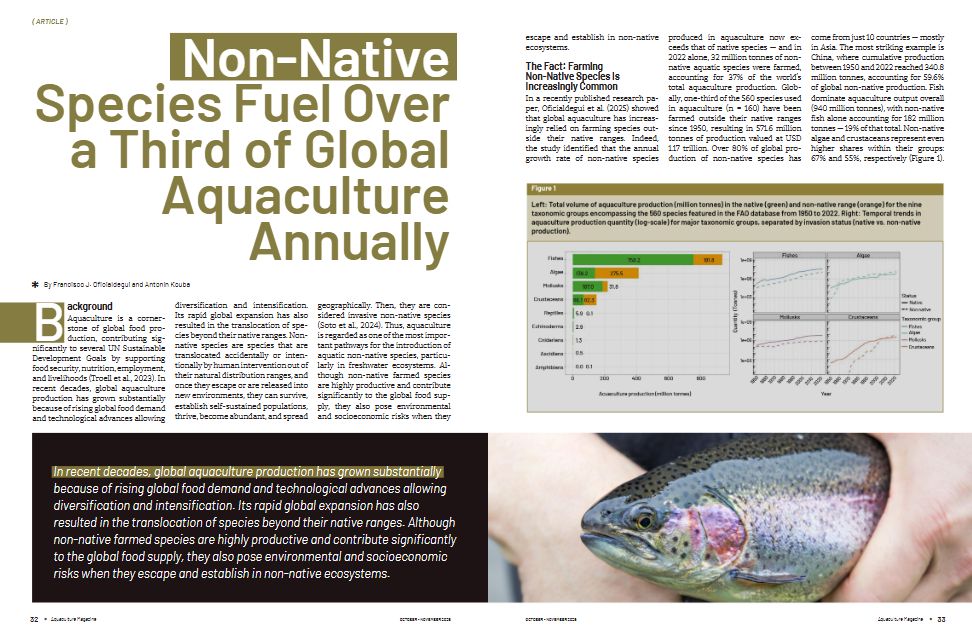
🔵 Aquaculture is one of the most important pathways for the introduction of non-native species.
Since 1950, one third of species used in aquaculture have been farmed outside of their native ranges.
📄 doi.org/10.1111/raq....
🔗 issuu.com/aquaculturem...
09.12.2025 13:08 —
👍 5
🔁 6
💬 0
📌 0

XVII SECEM congress, Évora
Mara Torreblanca explained how the otter has learned to consume on the Atlantic blue crab, /Callinectes sapidus/, a truly dangerous prey, forced by the temporal scarcity of the red swamp crayfish, /Procambarus clarkii/.
Fully American menu
@secem-sicem.bsky.social
07.12.2025 07:52 —
👍 11
🔁 4
💬 0
📌 1
The first #GuardIAS #Conference on Prevention of Invasive Alien Species Introductions and #Biosecurity Risk Assessment starts tomorrow 12/11 morning at 9:00 GMT - 10:00 CET - 11:00 EET. Don't miss it!
#bioinvasions #InvasiveSpecies #MarineEcology #AquaticEcology #IAS 🌍🌐🌊
12.11.2025 15:12 —
👍 10
🔁 8
💬 0
📌 1
Today, Mara Torreblanca successfully defended her MSc thesis on otter diet in the Río Cachón, and the role of the many, and colourful, invasive prey
At @pablodeolavide.upo.es , with @sergiobedmar.bsky.social and @oficialdegui.bsky.social
A really great work! (lucky us!)
@ebdonana.bsky.social
14.10.2025 21:46 —
👍 4
🔁 2
💬 0
📌 0

That’s a wrap for the #GuardIAS Annual Meeting! Three inspiring days of exchange, collaboration, and progress towards stronger action on #InvasiveSpecies. Grateful to all who contributed to the discussions and next steps!
#bioinvasions #AquaticEcology #MarineEcology
@guardias.bsky.social
02.10.2025 16:03 —
👍 8
🔁 5
💬 0
📌 0

🦀 La península ibérica alberga más de 1200 especies no nativas
🌾 El 75% corresponde a plantas e insectos
🐜 Estas especies modifican los ecosistemas locales y representan un riesgo para la biodiversidad autóctona
👩🔬Un estudio de la @ebdonana.bsky.social ➡️ http://tiny.cc/5q9t001
01.10.2025 17:00 —
👍 14
🔁 8
💬 0
📌 0
The otter and its colourful invasive decapod estuarine menu
Mara Torreblanca anticipates the main results of her MSc thesis at #conserbio2025
@ebdonana.bsky.social
@oficialdegui.bsky.social @sergiobedmar.bsky.social
19.09.2025 09:23 —
👍 4
🔁 3
💬 1
📌 0

🚨 New paper out! 🚨
📍 In our latest "Diversity and Distributions" study, led by Ismael Soto, we reveal that over 1,200 non-native species are already established across the Iberian Peninsula
📄 Read it here 👉 doi.org/10.1111/ddi....
#invasivespecies
22.08.2025 09:23 —
👍 13
🔁 5
💬 0
📌 0

Las plantas vasculares (Tracheophyta) y los insectos (Arthropoda) dominan entre las especies no nativas en Iberia. Asteraceae y Formicidae son las familias más frecuentes. Foto: Vespa velutina. Autor: Diego González Dopico (https://spain.inaturalist.org/people/diegodgd). Licencia: CC BY 4.0 (https://creativecommons.org/licenses/by/4.0/). Reencuadrada.

La mayoría de especies no nativas llegaron por escape de jardines, acuarios o cultivos, en especial plantas. Insectos y crustáceos se introdujeron como polizones o acompañantes involuntarios, reflejando el papel del transporte global. España y Portugal comparten patrones similares.

La mayoría de las especies provienen del Paleártico, pero también llegan desde América, África y Asia. El comercio y el clima explican esta mezcla de orígenes

Las introducciones se dispararon desde 1950, con picos en los años 70. Aunque los registros han bajado, las invasiones siguen activas y requieren vigilancia
Las #invasionesbiológicas avanzan en la Península Ibérica: más de 1200 especies no nativas ya están establecidas. Un estudio mapea rutas, orígenes y focos de invasión con la ayuda de datos de @gbif.org. ¿Cómo frenarlas antes de que sea tarde?
▶️ doi.org/10.1111/ddi.... #CiteTheDOI
03.09.2025 09:32 —
👍 5
🔁 3
💬 0
📌 0

Serendipias cangrejeras
Hoy os traemos un post escrito por Miguel Clavero (Estación Biológica de Doñana – CSIC) y Alicia Sempere Marín (Universidad de Murcia) donde nos cuentan los entresijos de la preparación de un estud…
Las casualidades nos traen bonitos regalos!
Así ocurrió con la colaboración entre un ecólogo (@chikichanka.bsky.social) y una historiadora del arte (Alicia Sempere), para encontrar los documentos de la importación del cangrejo italiano por Felipe II
ecomandanga.wordpress.com/2025/09/17/s...
17.09.2025 10:22 —
👍 3
🔁 3
💬 0
📌 0
Después de mostrar que la genética muestra que el cangrejo italiano viene de Italia (qué cosa, paper abajo), publicamos nuevo artículo documentando que la introducción de la especie en 1588 fue exitosa
@ebdonana.bsky.social nana.bsky.social @um.es
Artículo OA www.sciencedirect.com/science/arti...
01.09.2025 12:18 —
👍 22
🔁 8
💬 2
📌 3

Habemus nuevo astacoartículo en @ecosistemas-aeet.bsky.social
LINK: www.revistaecosistemas.net/index.php/ec...
La genética respalda también el origen italiano de los cangrejos de río
Va hilo
(1/14)
@sergiobedmar.bsky.social @oficialdegui.bsky.social
@ebdonana.bsky.social @eco-aeet.bsky.social
23.06.2025 09:26 —
👍 34
🔁 22
💬 3
📌 9

📝Non-Native Species in Aquaculture: Burgeoning Production and Environmental Sustainability Risks doi.org/10.1111/raq.... Finally out! 🥳@rosscuthbert.bsky.social @mkour.bsky.social
17.06.2025 09:18 —
👍 2
🔁 2
💬 1
📌 0
Non-native species have accounted for approximately one-third of global annual aquaculture production, with this proportion exceeding 35% nowadays. While offering economic opportunities and sustaining livelihoods, non-native production also pose significant environmental risks.
17.06.2025 09:18 —
👍 0
🔁 0
💬 0
📌 0

According to the proportion of species donated and received, Asia and North America were the primary donors of non-native species, while Europe and South America receive a large number of species. Asian species have been extensively translocated both inter- and intra-continentally for aquaculture
17.06.2025 09:18 —
👍 0
🔁 0
💬 1
📌 0

This total production is largely driven by a handful of commonly farmed species (see Table 2 in the paper), many of which are farmed outside their native ranges and are recognised as high-risk invaders once established in non-native areas with monetary costs
17.06.2025 09:18 —
👍 0
🔁 0
💬 1
📌 0

Over the past decades, production volumes have risen rapidly, with native production being several orders of magnitude higher than its non-native counterpart, but the annual growth rate for non-native species' production (and economic value) is currently surpassed that of native one.
17.06.2025 09:18 —
👍 0
🔁 0
💬 1
📌 0


While the production of native fish and molluscs remains higher than that of non-native ones, algae—and especially crustaceans—are predominantly produced outside their native ranges. The latter with a rate of change exceeding 11,000% since 2000 compared to the previous two decades
17.06.2025 09:18 —
👍 0
🔁 0
💬 1
📌 0
The majority of production quantity has come from farming species within their native range (67.0% of the total global production; 1160.1 million tonnes), but 33.0% (571.6 million tonnes) has stemmed from the species farmed outside their native range, amounting to USD 1.17 trillion
17.06.2025 09:18 —
👍 0
🔁 0
💬 1
📌 0
We used FAO data, species' distributions, and the InvaCost database to quantify the global production and value of non-native farmed species (also native production) and their available monetary costs from 1950 to 2022 🌍🐟🦞
17.06.2025 09:18 —
👍 0
🔁 0
💬 1
📌 0
📝Non-Native Species in Aquaculture: Burgeoning Production and Environmental Sustainability Risks doi.org/10.1111/raq.... Finally out! 🥳@rosscuthbert.bsky.social @mkour.bsky.social
17.06.2025 09:18 —
👍 2
🔁 2
💬 1
📌 0

Cangrejo rojo: 50 años de la madre de todas las invasiones
En 2023 se han cumplido 50 años desde que un aristócrata ideara la introducción de una de las especies invasoras más dañinas de España.
Hoy se cumplen 52 años de la llegada del cangrejo rojo, Procambarus clarkii, a Europa
El 17 de junio de 1973 se liberaron unos 500 ejemplares cerca de Badajoz. Un año más tarde se soltaron unos 7000 en la Marisma del Guadalquivir
Se lio parda
@ebdonana.bsky.social
theconversation.com/cangrejo-roj...
17.06.2025 07:33 —
👍 12
🔁 9
💬 1
📌 1