
A horizontal bar chart titled “Generational Turnout: From 2020 to 2024 Rates” shows turnout rate changes among registered voters by generation and party affiliation. The chart includes four generational groups—Gen Z, Millennial, Gen X, and Boomer—and tracks changes from 2020 (dot) to 2024 (arrow tip), with Democratic turnout in blue and Republican turnout in red. Key trends: • Gen Z: Democratic turnout dropped by 13.7 percentage points (pp); Republican turnout dropped by 7.9pp. • Millennials: Democratic turnout fell by 5.6pp; Republican turnout fell by 0.3pp. • Gen X: Democratic turnout dropped 4.2pp; Republican turnout dropped 0.8pp. • Boomers: Democratic turnout declined 3.2pp; Republican turnout declined 1.4pp. A note below the chart explains that all groups saw turnout declines, but Democratic voters dropped off more steeply. A boxed summary highlights the consistent pattern: Republicans started from higher turnout and maintained more of their base, while Democrats experienced longer arrows (larger drop-offs) across all generations.
6/🧵 Why does conventional wisdom miss this? We confuse electoral swings with attitude changes. Gen Z shifted 6 points toward Trump in 2024, suddenly pundits say they're "the most conservative generation in 50 years." Only 42% of Gen Z voted. We mistake turnout shifts for ideological transformation.
14.11.2025 20:43 —
👍 845
🔁 183
💬 14
📌 17
Could you clarify for me if/how this would impact unlimited independent expenditures from super PACs, individuals, and other non-corporate entities? Thanks!
02.10.2025 23:31 —
👍 0
🔁 0
💬 1
📌 0
Thanks so much for flagging this for me, @thmoore.bsky.social. Operating via the state corporate law avenue seems like a really innovative approach - looking forward to seeing how this effort plays out in Montana.
02.10.2025 23:31 —
👍 1
🔁 0
💬 1
📌 0
New @rfunkfordham.bsky.social report on the 15th anniversary of Citizens United. The evidence is now clear, in part through Rachel's research, that CitUtd has:
-increased the influence of billionaires
-reduced state democratic performance
-made state governments more rightwing
-increased corruption
02.10.2025 18:32 —
👍 146
🔁 79
💬 4
📌 3

Quote Graphic from report “Citizens United and the Decline of US Democracy: Assessing the Decision’s Impact 15 Years Later“ by Rachel Funk Fordham, with quote "The Citizens United ruling enabled concentrated economic power to bend politics to its will, amplifying the preferences of a small, ultra-wealthy minority at the expense of the vast majority of the American people. The decision was part of a coordinated effort to shift the balance of power in the US toward the wealthy."
The result of this ruling was outsized influence on legislators in passing policies that favor wealth. Reviving campaign-finance reform isn’t optional—it’s a prerequisite for a government that answers to people, not billionaires. 3/3
Read our new report ➡️ rooseveltinstitute.org/publications...
02.10.2025 13:47 —
👍 71
🔁 23
💬 1
📌 0

Graph showing breakdown of top 100 billionaire donor spending on outside political spending groups.
One hundred billionaire donors poured a record $2.6 billion into the 2024 elections—1 of every 6 dollars spent.
New analysis from @rfunkfordham.bsky.social on the last 15 years of #CitizensUnited’s impact on democracy. 2/3 rooseveltinstitute.org/publications...
02.10.2025 13:47 —
👍 91
🔁 49
💬 4
📌 1

Graph showing billionaire spending in Presidential elections before and after Citizen's United.
NEW📝: A flood of billionaire money in elections started after the SCOTUS #CitizensUnited decision.
Since 2010, billionaire 💰💰 in elections has grown 160x, giving the wealthy huge power over policy while regular voters lose influence. 🧵1/3
02.10.2025 13:47 —
👍 104
🔁 75
💬 2
📌 14
Where are we 15 years after SCOTUS sanctioned virtually unlimited campaign contributions from billionaires and large corporations? @rfunkfordham.bsky.social's new report analyzes how the Citizens United decision is corroding democracy on multiple fronts, and calls for renewed urgency for reforms.
02.10.2025 15:13 —
👍 127
🔁 66
💬 5
📌 3

@rfunkfordham.bsky.social in her NYT debut! Let's go!
www.nytimes.com/2025/07/25/n...
26.07.2025 21:23 —
👍 26
🔁 4
💬 2
📌 1
Thanks Miranda!! 🫶🏻
26.07.2025 22:01 —
👍 1
🔁 0
💬 0
📌 0
older generations have much more political experience and pragmatism. younger generations rapidly absorb new information and are full of idealism. we can learn so much from each other, and we can’t win the important fights without each other
26.07.2025 19:22 —
👍 2
🔁 0
💬 0
📌 0
generational differences in political power, participation, & priorities can make it difficult to form future-oriented winning coalitions. that’s why I loved talking about intergenerational political learning in NYC for this @nytimes.com piece - it’s an incredibly hopeful story ⬇️
26.07.2025 19:22 —
👍 3
🔁 0
💬 1
📌 0
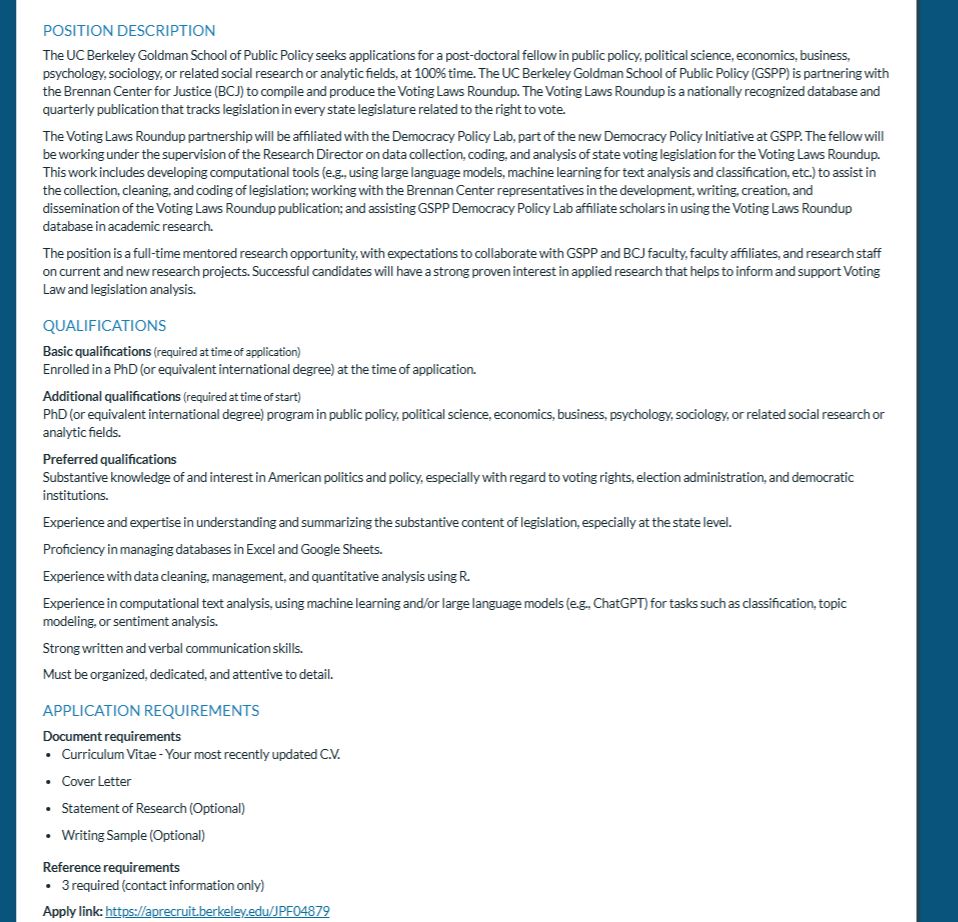
🚨🚨🚨 The Goldman School of Public Policy at UC Berkeley is looking for a postdoc on US voting/election policy. Part of a partnership with the Brennan Center running the Voting Laws Roundup. (I have a feeling this work is gonna be important...)
Apply here: aprecruit.berkeley.edu/JPF04879
21.07.2025 19:19 —
👍 59
🔁 44
💬 2
📌 0


we could fret and stew and pontificate about why millions of voters who showed up for biden didn’t vote in 2024 orrrr we could just ask them
source: waytowin.docsend.com/view/rnv5spt...
18.07.2025 03:13 —
👍 1
🔁 1
💬 0
📌 0

Guess I didn’t realize it at the time (especially since Eric Levitz at Vox made it into another “dems must be centrist” take) but the recent Pew report argues strongly that turnout was more important than persuasion
www.pewresearch.org/politics/202...
07.07.2025 21:08 —
👍 34
🔁 8
💬 2
📌 2

Figure 2: Pre- and Post-Treatment Trends showing Citizens United's impact on state democratic performance. Graph shows average State Democracy Index from 2001-2018. Two lines: "Treatment" (blue, states with former spending bans) and "No Treatment" (gray, states without bans). Before 2010, treated states had higher democracy scores. After Citizens United in 2010, treated states' scores dropped sharply while control states declined gradually. By 2018, treated states scored significantly lower than control states, demonstrating Citizens United's negative impact on democracy.
NYC's mayoral race just broke records with $25M in SuperPAC cash backing Cuomo—a poster child for corruption. Bad for democracy and the Dem brand.
@rfunkfordham.bsky.social's study shows how corrosive big $ is—states forced to allow unlimited money saw democracy scores plummet post-Citizens United.
24.06.2025 19:24 —
👍 121
🔁 36
💬 6
📌 3
thank you so much, adam! I really appreciate your thinking & writing on this topic & related topics. your work paved the way for this paper & has set the stage for really important discussions about how concentrated wealth (that can easily be converted into political power) imperils democracy
24.06.2025 19:58 —
👍 4
🔁 0
💬 0
📌 0
nearly all my friends & family are non-democrats & infrequent voters. nearly all my friends & family participated in or supported the ‘no kings’ protests. there may be several potentially viable strategies for defeating trump, but this is by far the one I find most promising. ⬇️
23.06.2025 18:04 —
👍 3
🔁 0
💬 0
📌 0
this is a really cool opportunity + you’d get to work w an incredible team of researchers, legal experts, and uc berkeley students who care about democracy. apply!!
06.05.2025 22:20 —
👍 14
🔁 3
💬 0
📌 0
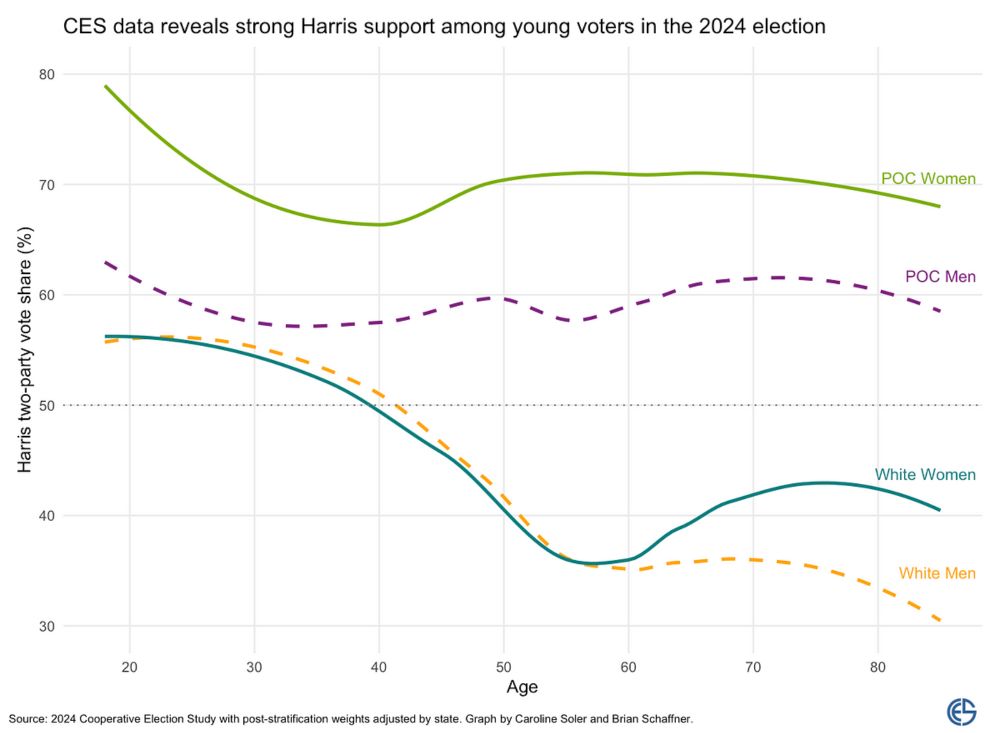
Have young voters really abandoned the Democrats?
by Caroline Soler, Brian Schaffner, and Stephen Ansolabehere
Caroline Soler, Ansolabehere, & @bfschaffner.bsky.social: “Shor’s claims about young white women and men of color supporting Trump are simply not supported by the best public data available.”
tufts-pol.medium.com/have-young-v...
19.04.2025 00:50 —
👍 309
🔁 81
💬 10
📌 5
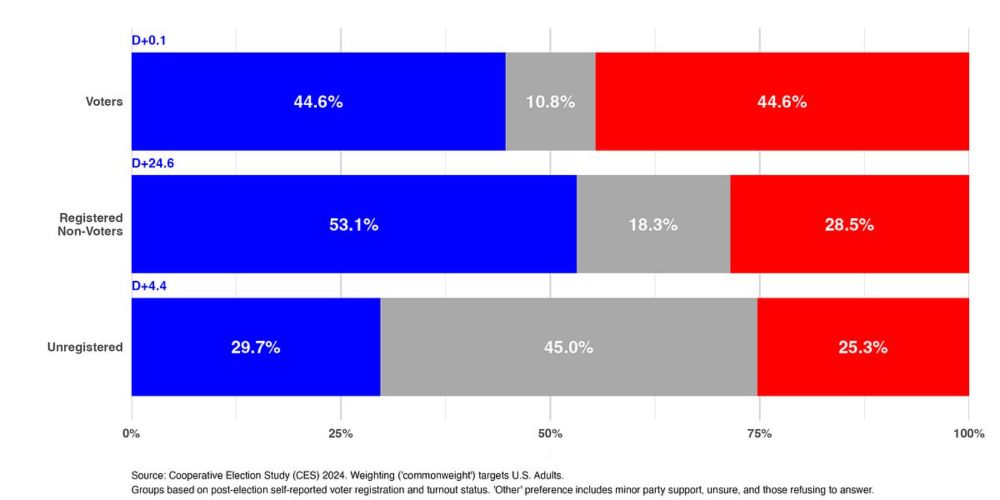
Did Non-Voters Really Flip Republican in 2024? The Evidence Says No.
Analysis of large-scale CES data shows registered non-voters retain a strong Democratic lean.
Here's Part 2 of 3 from me, @adambonica.bsky.social, @rfunkfordham.bsky.social, & @ernestotiburcio.bsky.social.
All the publicly available data suggests 2024 non-voters leaned Democratic and pro-Harris.
data4democracy.substack.com/p/did-non-vo...
1/n
10.04.2025 17:30 —
👍 412
🔁 153
💬 29
📌 31
congrats beatrice!! so so excited for you 🫶🏻🫶🏻🫶🏻
05.04.2025 20:24 —
👍 1
🔁 0
💬 1
📌 0
4/4 I don’t blame non-voters for the outcome of the 2024 election. by and large, people choose the best option available to them. when more people sit an election out than vote for the winning candidate, you gotta question the options (& the system that produced them) before you question the people.
03.04.2025 18:33 —
👍 4
🔁 0
💬 0
📌 0
3/n I believe that the best electoral strategy to defeat budding authoritarianism is to mobilize as many people as possible. it would help to win a few voters from the other side, but it would help more to bring in scores of voters from the sidelines.
03.04.2025 18:33 —
👍 4
🔁 0
💬 1
📌 0
2/n I’m hopeful bc democracy still works. when everyone has an equal say in politics, political outcomes are better. I’m frustrated bc american democracy isn’t working. majoritarian preferences are often NOT translated into election outcomes and policy outcomes.
03.04.2025 18:33 —
👍 3
🔁 0
💬 1
📌 0
1/n as someone who loves democracy & loves my country, it’s hard to grapple w the fact that an anti-democratic candidate won a national popular election. one thing keeping me equal parts hopeful & frustrated is that there are more people in the US who do not support trump than people who do.
03.04.2025 18:33 —
👍 8
🔁 2
💬 1
📌 0
9/🧵 Abandoning pro-turnout strategy based on a single analysis is premature. Understanding what happened requires grounding in data. Private polling can show patterns, but verifying such a massive political shift demands high-quality, publicly available data and replicable analysis.
02.04.2025 01:57 —
👍 142
🔁 13
💬 1
📌 2

A table titled “The Partisan Turnout Gap” shows the difference in turnout rates between registered Republicans and registered Democrats across recent U.S. election cycles. The table includes three columns: “Full Sample,” “No Party Modeling,” and “Consistent Sample (41 states w/ 2024).” Each row corresponds to an election year (2016, 2018, 2020, 2022, 2024). The values represent the Republican turnout advantage (e.g., R+5.60 means Republicans turned out at a 5.60 percentage point higher rate than Democrats).
• 2016:
• Full Sample: R+5.60
• No Party Modeling: R+3.60
• Consistent Sample: R+5.10
• 2018:
• Full Sample: R+4.20
• No Party Modeling: R+1.80
• Consistent Sample: R+3.80
• 2020:
• Full Sample: R+6.30
• No Party Modeling: R+3.90
• Consistent Sample: R+5.90
• 2022:
• Full Sample: R+12.30
• No Party Modeling: R+9.70
• Consistent Sample: R+12.10
• 2024:
• Full Sample: R+7.30
• No Party Modeling: R+6.40
• Consistent Sample: R+7.30
A note at the bottom explains that the values are based on L2 voter file analysis and represent percentage point differences in turnout rates.
7/🧵 Our analysis of voter file data suggests the real story isn't about "more voters help Republicans" — it's about DIFFERENTIAL turnout. Republicans have been better at converting their registered voters into actual voters.
02.04.2025 01:57 —
👍 148
🔁 27
💬 3
📌 3


