Well deserved! 🤩
23.02.2026 14:54 — 👍 1 🔁 0 💬 0 📌 0Well deserved! 🤩
23.02.2026 14:54 — 👍 1 🔁 0 💬 0 📌 0Haha when it rains it pours ☔
19.06.2025 20:18 — 👍 1 🔁 0 💬 0 📌 0
Paper is open access in Developmental Psychology:
dx.doi.org/10.1037/dev0...
@apajournals.bsky.social
Experience with people justifying their beliefs seems to help this emerge: the Turkish-speaking kids (whose language involves a mandatory grammatical marker of how you know something) showed that difference a little bit younger than English-speaking kids.
19.06.2025 16:54 — 👍 2 🔁 0 💬 1 📌 0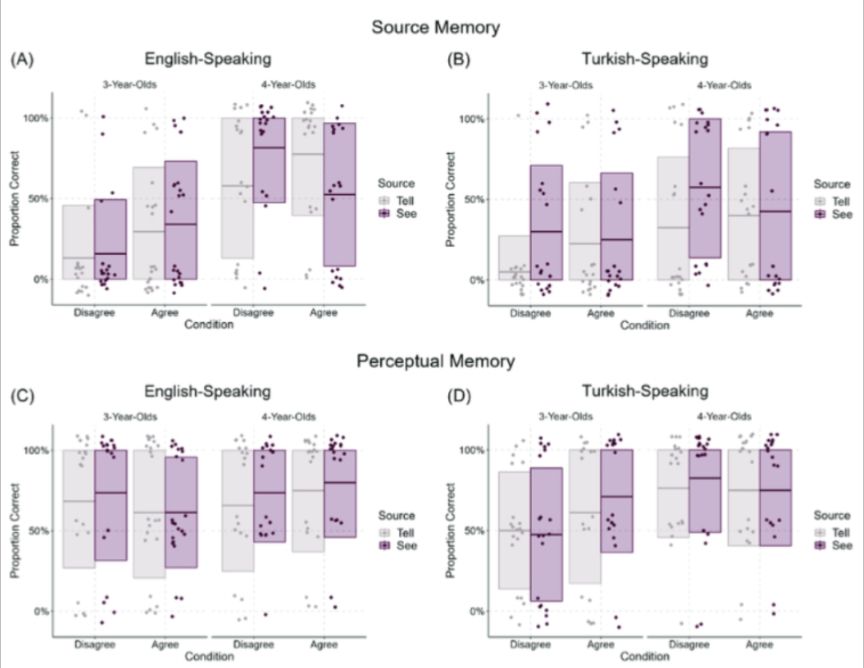
Disagreement mattered: English and Turkish-speaking kids both were more likely to correctly remember they saw the contents when facing disagreement rather than agreement.
This wasn't just about heightened attention overall: they didn't remember the perceptual features of the gift box any better.

Preschoolers helped 'pack gifts' and had to remember the contents. Sometimes a partner disagreed with them about what was inside.
We asked kids to tell us how they learned the contents (by seeing themselves or by hearing from an adult) to justify their answer.
When you remember something, you can often also remember how you learned it ("I *saw* it was raining"). Why bother encoding that extra context?
Maybe it's important info to justify your beliefs to someone who disagrees (to make better group decisions).

New paper out now asks:
Why do we bother remembering *how* we learned something?
With @antoniafl.bsky.social, Dilara Keşşafoğlu, Winuss Mohtezebsade, @celestekidd.bsky.social, Aylin Küntay, @janengelmann.bsky.social, and Bahar Köymen
dx.doi.org/10.1037/dev0...
An interesting discussion in writing group today has me wondering: What are people's norms for students doing *their own* study vs part of the lab's ongoing work?
Their own = they come up with the idea themselves
Curious about RA vs honours thesis vs grad students here too!
This looks great!
22.05.2025 11:14 — 👍 2 🔁 0 💬 0 📌 0
We're excited about this finding because it's initial evidence that kids use a rational strategy to combine old beliefs into new ones: weigh each belief according to its uncertainty.
This is an important step in their development as independent thinkers, and an essential skill in uncovering truth.
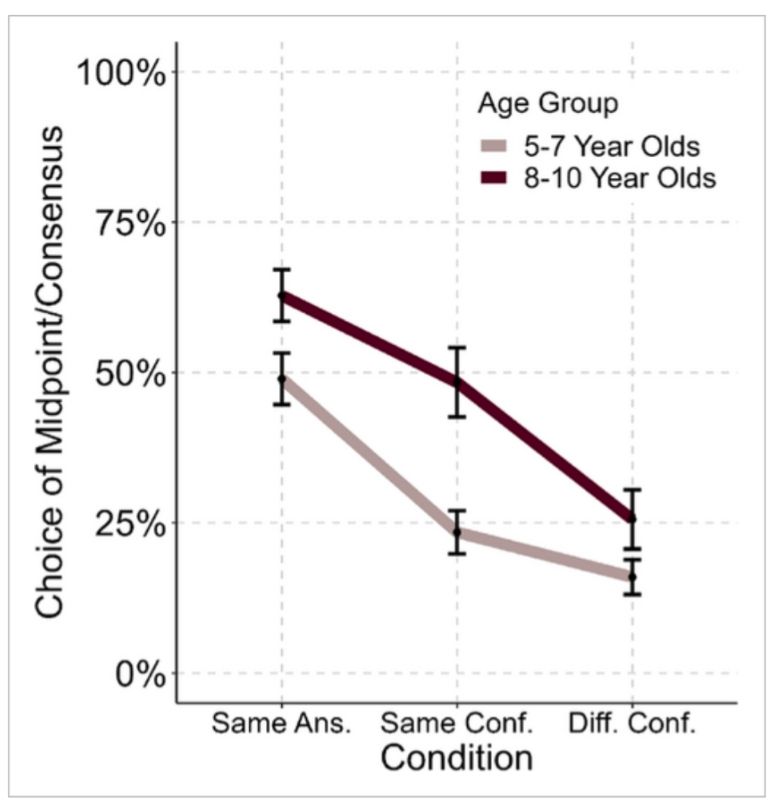
If one witness was more confident, kids trusted that witness.
But if they were both equally confident, kids 8+ tended to pick the middle option, even though no one had actually endorsed that!
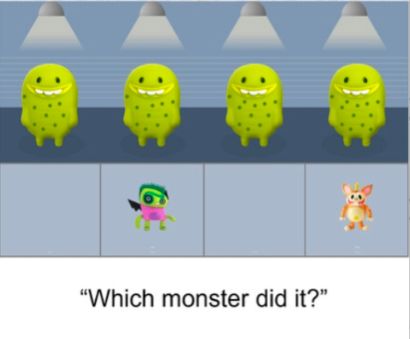
Kids 5-12 years old played detective and solved a monster crime 🔍
Two witnesses gave different descriptions of the suspect, but also gave their confidence (high or low).
We then gave kids a lineup that differed veeeery slightly (this one is the # of spots), always with an option in the middle.

New paper! When do children trust others and when do they come up with their own ideas? Kids 8+ considered and weighed each person's confidence to decide whether to form new beliefs.
With @janengelmann.bsky.social and @celestekidd.bsky.social
Free here: dx.doi.org/10.1111/desc...
Looks so fun! So sad I won't be there to see this!
20.05.2025 22:03 — 👍 1 🔁 0 💬 0 📌 0
Does anyone study how kids think about existential issues? Like why do we exist, what is our purpose, etc.
I've got a thesis student interested in this area and I have this feeling like people are doing this work. I want to point her in the right direction!
I do this too, but I honestly don't think it changed much. More useful was having a clear course website and in class reminders.
That said, I'd still do it - can't hurt to be clear and easy to follow, right?
Nooo, this sucks 😞
16.05.2025 07:10 — 👍 4 🔁 0 💬 0 📌 0Yay! 🥳
10.05.2025 01:21 — 👍 1 🔁 0 💬 0 📌 0Oh yes, good point about not knowing citizenship.
09.05.2025 01:42 — 👍 0 🔁 0 💬 0 📌 0Yeah, this is really interesting. Looking closely at the stats about % Canadians hired by uni type. <50% at the big names? 🧐
09.05.2025 00:18 — 👍 1 🔁 0 💬 1 📌 0How interesting!
30.04.2025 14:17 — 👍 1 🔁 0 💬 0 📌 0Good grief you're busy! How are we going to schedule shenanigans?
29.04.2025 22:26 — 👍 1 🔁 0 💬 1 📌 0See you there!
29.04.2025 00:16 — 👍 1 🔁 0 💬 0 📌 0Ugh I am so sorry this has happened.
26.04.2025 17:45 — 👍 4 🔁 0 💬 0 📌 0Cool work!
25.04.2025 16:53 — 👍 1 🔁 0 💬 1 📌 0I am teaching my phd writing workshop course this quarter, question: are there any words/phrases said to you by an advisor/mentor that stuck with you, were memorable, or particularly helpful? If so please reply below!
23.04.2025 19:45 — 👍 648 🔁 147 💬 340 📌 60
Congratulations to the winners of the 2025 Glushko Prize for outstanding dissertation in Cognitive Science.
Join us in congratulating the rising stars of #CogSci 🌟
We're excited to introduce the 2025 Glushko Prize winners, and the fascinating research behind their work!
Cool! Just signed up.
27.03.2025 23:44 — 👍 0 🔁 0 💬 0 📌 0