WORK-IT's Avatar

WORK-IT

@workit-hki.bsky.social

ERC-funded research group at the University of Helsinki, Faculty of Theology ๐ŸŒ helsinki.fi/work-it

27 Followers  |  23 Following  |  23 Posts  |  Joined: 07.01.2025
Posts Following

Posts by WORK-IT (@workit-hki.bsky.social)

Preview
Anthropology with Historians: Ethnography, Ethics And Reflexivity | Work without End: Informal Taxation and Forced Labor within Persian Southern Levantine Temple Economy and Society | University of He... In his research for the WORK-IT project, Anwar Arifin examines how scholars of the Ancient Near East construct the past. In this post, he explores the ethics, moral dimensions and reflexivity of doing...

In the second part of our interview, our team member Anwar reflects on moral economy, reflexivity, and what it means to do anthropology with colleagues rather than about them.

๐Ÿค“Read all about it on the blog!
#ERCAdG #workit #workingthoughts #universityofhelsinki #research @erc.europa.eu

03.11.2025 09:11 โ€” ๐Ÿ‘ 1    ๐Ÿ” 0    ๐Ÿ’ฌ 0    ๐Ÿ“Œ 0
Preview
Anthropology meets Antiquity: How We Write the Ancient World | Work without End: Informal Taxation and Forced Labor within Persian Southern Levantine Temple Economy and Society | University of Helsink... Anwar Arifin shares how his interest in political and economic anthropology led him to Finland and the WORK-IT project.

Meet Anwar Arifin, a doctoral researcher who joined our team this autumn!

๐Ÿ’ญIn the first part of his interview, Anwar reflects on his journey in anthropology, historiography, and questions of political economy.

๐Ÿ“– Read it now on our blog!

@erc.europa.eu #ERCAdG #universityofhelsinki #research

27.10.2025 12:43 โ€” ๐Ÿ‘ 1    ๐Ÿ” 0    ๐Ÿ’ฌ 0    ๐Ÿ“Œ 0
Preview
Let The Evidence Speak: On Reflexivity and The Study of The Ancient Near East | Work without End: Informal Taxation and Forced Labor within Persian Southern Levantine Temple Economy and Society | Univ... We asked our researchers questions about reflexivity in the study of antiquity and about how our own categories, assumptions, and positions shape the ways we think about the Ancient Near East. This bl...

What does reflexivity mean for us in studying the Ancient Near East?

We spoke with our colleagues and found our common troubles and solutions.

Read all about it on our blog!

#ERCAdG #workit #workingthoughts #universityofhelsinki #research @erc.europa.eu

14.10.2025 08:54 โ€” ๐Ÿ‘ 1    ๐Ÿ” 0    ๐Ÿ’ฌ 0    ๐Ÿ“Œ 0
Preview
Our WORK-ING Summer: Thoughts From Conferences and Meetings of Summer 2025 | Work without End: Informal Taxation and Forced Labor within Persian Southern Levantine Temple Economy and Society | Univers... The summer of 2025 turned out to be an active and productive season for our research group. Members of the team participated in several conferences and meetings across Europe, presenting our project, ...

From Uppsala to Berlin to Turku ๐ŸŒ It's been a summer of panels, presentations & new connections.

For the full story of a bright summer of meetings and conferences, visit our blog! โ˜€๏ธ๐Ÿ“š

#ERCAdG #workit #workingthoughts #universityofhelsinki #research @erc.europa.eu

27.08.2025 08:27 โ€” ๐Ÿ‘ 0    ๐Ÿ” 0    ๐Ÿ’ฌ 0    ๐Ÿ“Œ 0
Post image Post image

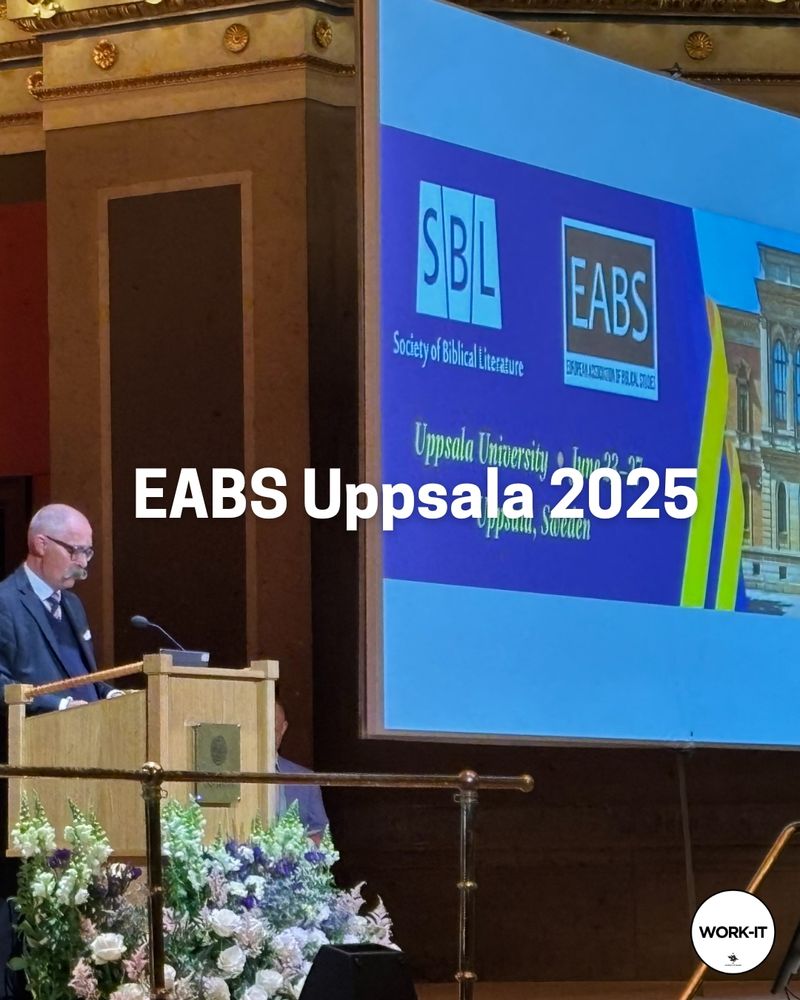
Our research group had the pleasure of attending the EABS Annual Conference at Uppsala University this June. We presented our project, shared ideas, and had great discussions with colleagues from across Europe. A great thank you to the organizers!

#EABS2025 #ERCAdG #WORKIT #UniversityOfHelsinki

17.07.2025 10:05 โ€” ๐Ÿ‘ 0    ๐Ÿ” 0    ๐Ÿ’ฌ 0    ๐Ÿ“Œ 0
Preview
Ezraโ€“Nehemiah and the Blurred Lines Between Worship and Work | Work without End: Informal Taxation and Forced Labor within Persian Southern Levantine Temple Economy and Society | University of Helsink... Temple work in Ezra-Nehemiah goes beyond faith: itโ€™s tied to social pressures, informal taxes, and forced labour under imperial rule. In our final blog post before the summer break, Daniele Soares ope...

In our final blog post before the summer break, Daniele Soares unpacks how temple labour in the Bible was shaped by social pressure, imperial systems, and economic obligation.

Read the full piece on our blog! ๐Ÿ‘‡

...
#workit #ERCAdG #blog #universityofhelsinki

27.06.2025 11:03 โ€” ๐Ÿ‘ 0    ๐Ÿ” 0    ๐Ÿ’ฌ 0    ๐Ÿ“Œ 0
Preview
Between Text and Theory: Daniele Soares on Reading the Ancient World | Work without End: Informal Taxation and Forced Labor within Persian Southern Levantine Temple Economy and Society | University of... In this WORK-ing thoughts post, doctoral researcher Daniele Soares shares her journey from economics in Brazil to theology and biblical studies across continents. She explores how ancient texts like E...

How can modern tools help us read the ancient world? In this week's blog post, Daniele Soares explores theory, theology, and why texts like Ezra and Nehemiah still matter for power, labour, and community today.

Read the full piece on our blog! ๐Ÿ‘‡
...
#workit #ERCAdG #blog #universityofhelsinki

24.06.2025 10:52 โ€” ๐Ÿ‘ 5    ๐Ÿ” 1    ๐Ÿ’ฌ 0    ๐Ÿ“Œ 0
Preview
Fragments into Frameworks: Building Meaning from the Idumean Corpus | Work without End: Informal Taxation and Forced Labor within Persian Southern Levantine Temple Economy and Society | University of Helsinki How do we build a system out of fragments? Dr. Shahryari continues our conversation by exploring the economic structures of the Persian Empire.

How do we build a system out of fragments? We continue our conversation with Dr. Mitchka Shahriyari by diving into the economic structures behind the Idumean ostraca.

Read the full post on our blog! ๐Ÿ‘‡
buff.ly/rTl0LxE
...
#workit #ERCAdG #helsinki #blog

17.06.2025 10:05 โ€” ๐Ÿ‘ 5    ๐Ÿ” 1    ๐Ÿ’ฌ 0    ๐Ÿ“Œ 0
Preview
Reading Between the Sherds: Dr. Shahryari on the Idumean Corpus | Work without End: Informal Taxation and Forced Labor within Persian Southern Levantine Temple Economy and Society | University of Hels... What can a broken jar fragment tell us about empire? Dr. Mitchka Shahryari walks us through the hidden structures behind the Idumean ostraca.

What secrets can a broken pottery sherd reveal about an empire? Join Dr. Mitchka Shahriyari as she unpacks the hidden structures behind the Idumean ostraca โ€” a fascinating set of Aramaic inscriptions.

๐Ÿ’ฌ Read the full piece on our blog! ๐Ÿ‘‡
...
#workit #ERCAdG #universityofhelsinki #blog

12.06.2025 10:48 โ€” ๐Ÿ‘ 3    ๐Ÿ” 0    ๐Ÿ’ฌ 0    ๐Ÿ“Œ 0
Preview
Informal Taxation and Temple Economics: Theory Meets the Ancient World | Work without End: Informal Taxation and Forced Labor within Persian Southern Levantine Temple Economy and Society | University ... In this deep dive into temple economics and taxation, Dr. Jeremy Land explains how limited sources and big questions reshape our understanding of ancient states.

What can ancient temples teach us about taxation today?
In the second part of our interview with Dr. Jeremy Land, we dive into temple economies, informal taxation, and what Bourdieu has to do with it all.

Read the full post on our blog๐Ÿ‘‡
...
@jeremyland.bsky.social
#workit #ERCAdG #helsinki #blog

06.06.2025 12:40 โ€” ๐Ÿ‘ 3    ๐Ÿ” 1    ๐Ÿ’ฌ 0    ๐Ÿ“Œ 0
Preview
From Smuggling to Temples: Dr. Jeremy Land on Tracing Ancient Economic Systems | Work without End: Informal Taxation and Forced Labor within Persian Southern Levantine Temple Economy and Society | University of Helsinki From colonial smugglers to Persian temples, Dr. Jeremy Land traces how informal economies continue to influence societies across time.

From colonial smugglers to ancient temples - whatโ€™s the link?

Economic historian Dr. Jeremy Land effects on how informal economies like smuggling and off-the-record taxation reveal striking parallels across time.
Read the full post ๐Ÿ‘‡
...
@jeremyland.bsky.social
#workit #ERCAdG #helsinki #blog

30.05.2025 10:35 โ€” ๐Ÿ‘ 5    ๐Ÿ” 1    ๐Ÿ’ฌ 0    ๐Ÿ“Œ 0
Preview
Uncovering the Archive: Language, Labor, and Power in Persepolis | Work without End: Informal Taxation and Forced Labor within Persian Southern Levantine Temple Economy and Society | University of Helsinki In the second part of his interview, Filippo Pedron shares how his linguistic expertise sheds new light on the Persepolis archives, revealing untold stories of labor and power in the Achaemenidโ€ฆ

In part two of our conversation with Filippo Pedron, we explore how the Persepolis archives shed light on labor, status & power in the Achaemenid Empire. How much can food rations and names really tell us? Read the full post on our blog! ๐Ÿ‘‡
...
#workit #ERCAdG #helsinki #blog

14.05.2025 10:15 โ€” ๐Ÿ‘ 3    ๐Ÿ” 0    ๐Ÿ’ฌ 0    ๐Ÿ“Œ 0
Preview
Decoding the Past: Filippo Pedron on Building a Language from Fragments | Work without End: Informal Taxation and Forced Labor within Persian Southern Levantine Temple Economy and Society | University of Helsinki Linguist and historian Filippo Pedron takes us inside the world of Elamite, a forgotten language, and shares how fragments of clay tablets are helping reconstruct a civilizationโ€™s voice.

What does it take to rebuild a language from thousands of clay tablets? Linguist and historian Filippo Pedron dives into the world of Elamite and the challenges of creating a dictionary for a language with no native speakers. Read the full piece on our blog! ๐Ÿ‘‡
...
#workit #ERCAdG #helsinki #blog

07.05.2025 10:15 โ€” ๐Ÿ‘ 3    ๐Ÿ” 0    ๐Ÿ’ฌ 0    ๐Ÿ“Œ 0
Preview
Temples, Rituals, and Reconstructing the Past | Work without End: Informal Taxation and Forced Labor within Persian Southern Levantine Temple Economy and Society | University of Helsinki Continuing our conversation with Dr. Lucia Cerullo, we dive deeper into her work on the reconstruction of ancient temples and cultic sites, uncovering the complexities of reconstructing temples andโ€ฆ

Our WORK-ing Thoughts Blog Series continues with Temples, Rituals, and Reconstructing the Past! Explore ancient cultic sites & methodologies used to reconstruct sites of religious practices of the past. Read the full piece on our blog! ๐Ÿ‘‡
...
#workit #ERCAdG #universityofhelsinki #blog

23.04.2025 10:15 โ€” ๐Ÿ‘ 3    ๐Ÿ” 1    ๐Ÿ’ฌ 0    ๐Ÿ“Œ 0
Preview
From Elam to the Levant: Dr. Lucia Cerullo on Rediscovering Ancient Lives | Work without End: Informal Taxation and Forced Labor within Persian Southern Levantine Temple Economy and Society | University of Helsinki Archaeologist and art historian Dr. Lucia Cerullo shares her journey from Elamite epigraphy to Persian-period temples in the Southern Levant โ€” and why itโ€™s the everyday people she wishes she couldโ€ฆ

Weโ€™re thrilled to kick off the WORK-ing Thoughts Blog Series with our first interview featuring Dr. Lucia Cerullo, an archaeologist and art historian whose research explores the ancient lives of the Southern Levant. Read the full piece on our blog ๐Ÿ‘‡
...
#workit #ERCAdG #universityofhelsinki #blog

15.04.2025 10:30 โ€” ๐Ÿ‘ 5    ๐Ÿ” 1    ๐Ÿ’ฌ 0    ๐Ÿ“Œ 0
Post image

๐ŸŽ‰ We are excited to announce our new blog series, WORK-ing Thoughts, where weโ€™ll bring you insights from our researchers as they share their unique perspectives, research journeys, and methodologies.

๐Ÿ“… The first post launches next week!

#workit #ERCAdG #universityofhelsinki #blog

10.04.2025 10:15 โ€” ๐Ÿ‘ 2    ๐Ÿ” 1    ๐Ÿ’ฌ 0    ๐Ÿ“Œ 0
Field refers to a structured social space where individuals or groups compete for resources, influence, and recognition. Each field has its own rules and power dynamics. The positions people hold within a field are shaped by their relationships with others, and as these positions shift, the field evolves.

Field refers to a structured social space where individuals or groups compete for resources, influence, and recognition. Each field has its own rules and power dynamics. The positions people hold within a field are shaped by their relationships with others, and as these positions shift, the field evolves.

Capital is the resource individuals compete for within a field. It goes beyond just economic wealthโ€”it includes social capital (connections and networks), cultural capital (knowledge, education, and skills), and symbolic capital (recognition and prestige). Those who control capital hold more power, while others strive to accumulate it to improve their position.

Capital is the resource individuals compete for within a field. It goes beyond just economic wealthโ€”it includes social capital (connections and networks), cultural capital (knowledge, education, and skills), and symbolic capital (recognition and prestige). Those who control capital hold more power, while others strive to accumulate it to improve their position.

Habitus is the ingrained mindset and behaviours shaped by oneโ€™s background and experiences. It influences how individuals act within a field. While habitus can change over time, it tends to be deeply rooted, shaping how people navigate different fields.

Habitus is the ingrained mindset and behaviours shaped by oneโ€™s background and experiences. It influences how individuals act within a field. While habitus can change over time, it tends to be deeply rooted, shaping how people navigate different fields.

๐Ÿ” Last week, we introduced Bourdieuโ€™s Field Theory. Today, we are exploring its three key concepts: Field, Capital, and Habitus. These elements shape social spaces, power dynamics, and how we navigate themโฌ‡๏ธ

#workit #ERCAdG #universityofhelsinki #Bourdieu

02.04.2025 11:02 โ€” ๐Ÿ‘ 3    ๐Ÿ” 0    ๐Ÿ’ฌ 0    ๐Ÿ“Œ 0
A triangular infographic showing key terms in Bourdieu's Field Theory: Field, capital and habitus.
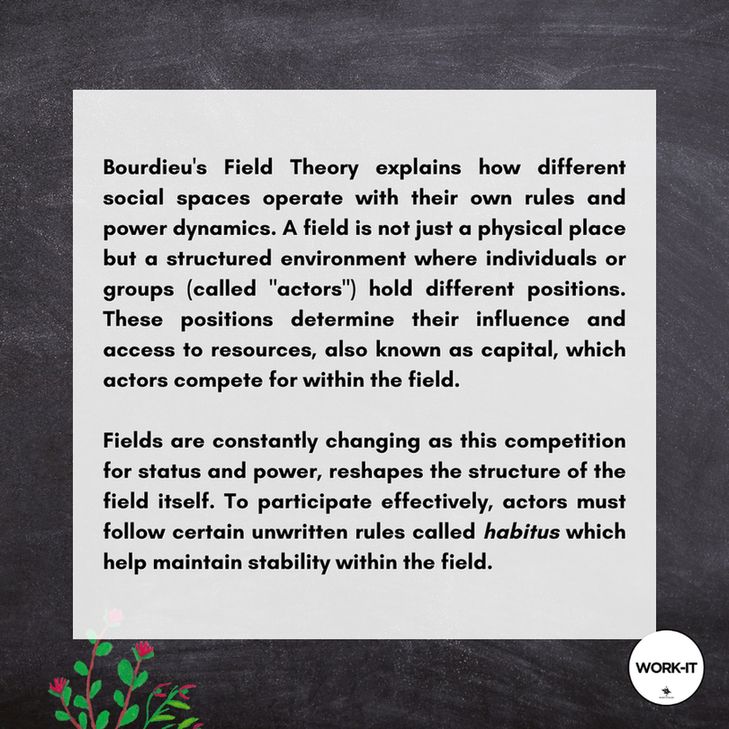
A triangular infographic showing key terms in Bourdieu's Field Theory: Field, capital and habitus.

The text reads: Bourdieu's Field Theory explains how different social spaces operate with their own rules and power dynamics. A field is not just a physical place but a structured environment where individuals or groups (called "actors") hold different positions. These positions determine their influence and access to resources, also known as capital, which actors compete for within the field. Fields are constantly changing as this competition for status and power, reshapes the structure of the field itself. To participate effectively, actors must follow certain unwritten rulesโ€”what Bourdieu calls habitusโ€”which help maintain stability within the field.

The text reads: Bourdieu's Field Theory explains how different social spaces operate with their own rules and power dynamics. A field is not just a physical place but a structured environment where individuals or groups (called "actors") hold different positions. These positions determine their influence and access to resources, also known as capital, which actors compete for within the field. Fields are constantly changing as this competition for status and power, reshapes the structure of the field itself. To participate effectively, actors must follow certain unwritten rulesโ€”what Bourdieu calls habitusโ€”which help maintain stability within the field.

๐Ÿ” Continuing from last weekโ€™s introduction to Bourdieuโ€”letโ€™s briefly take a look at his Field Theory.

#ERCAdG #workit #universityofhelsinki #Bourdieu

26.03.2025 11:30 โ€” ๐Ÿ‘ 2    ๐Ÿ” 0    ๐Ÿ’ฌ 0    ๐Ÿ“Œ 0
Portrait of Pierre Bourdieu painted on a column in black and white.

Portrait of Pierre Bourdieu painted on a column in black and white.

Text reading: Who is Pierre Bourdieu? Bourdieu (1930-2002), is a groundbreaking French sociologist whose work continues to shape the humanities and social sciences. His concept of Habitus describes how social environments shape our perceptions, behaviours and preferences. In his work 'La Distinction (1979)', Bourdieu argues that taste is not merely a personal choice but shaped by one's fieldโ€“the social and cultural environment which one operates. Those with high social and cultural capital define what is considered good taste, reinforcing class distinctions. His insights remain highly relevant in discussions on culture, power and inequality.

Text reading: Who is Pierre Bourdieu? Bourdieu (1930-2002), is a groundbreaking French sociologist whose work continues to shape the humanities and social sciences. His concept of Habitus describes how social environments shape our perceptions, behaviours and preferences. In his work 'La Distinction (1979)', Bourdieu argues that taste is not merely a personal choice but shaped by one's fieldโ€“the social and cultural environment which one operates. Those with high social and cultural capital define what is considered good taste, reinforcing class distinctions. His insights remain highly relevant in discussions on culture, power and inequality.

๐Ÿง  WORK-IT uses Bourdieusian Field Analysis to understand taxation, labor, and their interrelations within ancient states โ€” but who is Bourdieu?

๐Ÿ“ท: Thierry Ehrmann on Flickr
#ERCAdG #work-it #helsinki #bourdieu

20.03.2025 11:44 โ€” ๐Ÿ‘ 3    ๐Ÿ” 0    ๐Ÿ’ฌ 0    ๐Ÿ“Œ 0
Preview
Dr. Mitchka Shahriyari will give a presentation in ESSHC 2025 | Work without End: Informal Taxation and Forced Labor within Persian Southern Levantine Temple Economy and Society | University of Helsin... Dr. Mitchka Shahriyari will speak at the 'Towards a Hellenistic Taxation' panel in the European Social Science History Conference at KU Leauven on March 27th, 2025.

๐Ÿ“ข Dr. Mitchka Shahriyari, our Idumean corpus expert, will speak at ESSHC 2025 in KU Leuven on March 27! Sheโ€™ll present on Achaemenid & Hellenistic Taxation in the Aramaic Ostraca from Idumea, exploring fiscal systems in the Southern Levant.

Read more below!
...
#ERCAdG #work-it #helsinki #esshc25

19.03.2025 09:44 โ€” ๐Ÿ‘ 3    ๐Ÿ” 0    ๐Ÿ’ฌ 0    ๐Ÿ“Œ 0
The image contains an infographic with circles and arrows. The graphic is meant to form the question: How did ancient societies work, distribute resources and meet imperial demands? The answer is: Hidden social structures such as informal taxation and forced labor.

The image contains an infographic with circles and arrows. The graphic is meant to form the question: How did ancient societies work, distribute resources and meet imperial demands? The answer is: Hidden social structures such as informal taxation and forced labor.

The image contains a text describing the research group's topic and aim. The text reads:  Instead of focusing only on official taxation, WORK-IT examines the hidden social structures that sustained imperial economies. For example, when a ruler granted materials for construction but not the labor to transport and use them, local communities had to organize work themselvesโ€”an often-overlooked form of taxation. The project also moves beyond slavery to consider other forms of unfree labor, such as corvรฉe work (temporary, unpaid labor required by authorities). By combining historical sources from temples with Bourdieusian Field Theory, WORK-IT aims to uncover how labor and taxation shaped ancient societiesโ€”and how modern assumptions might be limiting our understanding of pre-industrial economies.

The image contains a text describing the research group's topic and aim. The text reads: Instead of focusing only on official taxation, WORK-IT examines the hidden social structures that sustained imperial economies. For example, when a ruler granted materials for construction but not the labor to transport and use them, local communities had to organize work themselvesโ€”an often-overlooked form of taxation. The project also moves beyond slavery to consider other forms of unfree labor, such as corvรฉe work (temporary, unpaid labor required by authorities). By combining historical sources from temples with Bourdieusian Field Theory, WORK-IT aims to uncover how labor and taxation shaped ancient societiesโ€”and how modern assumptions might be limiting our understanding of pre-industrial economies.

๐Ÿ”ŽHow did ancient societies organize work, distribute resources, and meet imperial demands? Our ERC-funded project (2025-2029), explores these questions by studying informal taxation and forced labor in temple economies of the Persian and Southern Levantine world.
#ERCAdG #work-it #helsinki

05.03.2025 12:33 โ€” ๐Ÿ‘ 4    ๐Ÿ” 0    ๐Ÿ’ฌ 0    ๐Ÿ“Œ 0
Preview
Doctoral Researcher in economic anthropology (southern Levant) Doctoral Researcher in economic anthropology (southern Levant)

๐Ÿ“ข We are looking for a Doctoral Researcher in economic anthropology for a four-year PhD position starting in September 2025! Check out the details and apply by 13 March 2025 via the link below:

26.02.2025 11:20 โ€” ๐Ÿ‘ 4    ๐Ÿ” 1    ๐Ÿ’ฌ 0    ๐Ÿ“Œ 0
A photo of 8 people followed by the text: Meet the WORK-IT team! Our research explores informal taxation, forced labor, and Levantine temples in Bourdieusian frame.

A photo of 8 people followed by the text: Meet the WORK-IT team! Our research explores informal taxation, forced labor, and Levantine temples in Bourdieusian frame.

An image with the following text : 

WORK-IT launched in September 2024 as an ERC-funded project and will run until August 2029. Our research examines informal taxation and forced labor in the Persian and Southern Levantine temple economies, exploring how labor obligations shaped economic structures and social hierarchies.  

The project is based at the University of Helsinki, Faculty of Theology. Our interdisciplinary team of historians, archaeologists, and social scientists brings together diverse expertise to tackle these questions. Hereโ€™s the team behind the projectโ€”stay tuned as we introduce our researchers and their work in the coming weeks!

An image with the following text : WORK-IT launched in September 2024 as an ERC-funded project and will run until August 2029. Our research examines informal taxation and forced labor in the Persian and Southern Levantine temple economies, exploring how labor obligations shaped economic structures and social hierarchies. The project is based at the University of Helsinki, Faculty of Theology. Our interdisciplinary team of historians, archaeologists, and social scientists brings together diverse expertise to tackle these questions. Hereโ€™s the team behind the projectโ€”stay tuned as we introduce our researchers and their work in the coming weeks!

๐Ÿ“ข Meet the WORK-IT Team!

#ERCAdG #firstpost #research @helsinki.fi @erc.europa.eu

26.02.2025 11:00 โ€” ๐Ÿ‘ 5    ๐Ÿ” 0    ๐Ÿ’ฌ 1    ๐Ÿ“Œ 0