This is how we fix Universal Credit
The basic rate of benefit support falls woefully short – Iain Porter, senior policy advisor at the Joseph Rowntree Foundation, explains what needs to happen now.
🗣️ 'Benefits have never been set according to any logical calculation, like the cost of food and bills.'
For @theleaduk.bsky.social, Senior Policy Adviser @iainkporter.bsky.social makes the urgent case for an independent process to set Universal Credit levels 👇
https://bit.ly/3MkEaZp
13.02.2026 08:46 —
👍 35
🔁 21
💬 0
📌 0
For more on this - and why we need an independent, evidence-based advisory process to recommend minimum Universal Credit rates that reflect essential costs - see recent thread and report: bsky.app/profile/iain...
10.02.2026 10:07 —
👍 3
🔁 2
💬 0
📌 0

'Putting our values into action: Labour should make social security work for everyone who needs it' - LabourList
Catherine West MP argues we need an independent, evidence-led body to asses Universal Credit to ensure it works for everyone who needs it.
As Parliament debates annual benefits 'uprating' today, great to see MPs calling out how arbitrary the process is. Support isn't linked to any calculation of essential costs, meaning 5 in 6 low-income families on Universal Credit going without essentials: labourlist.org/2026/02/valu...
10.02.2026 10:07 —
👍 9
🔁 9
💬 1
📌 2
Interesting - thanks Paul!
05.02.2026 16:11 —
👍 0
🔁 0
💬 1
📌 0
Yes I think the MIG phrase was originally how Gordon Brown sold Pension Credit? I hadn't made the potential link to naming of the social care charging rule too. MIG is an oft-used name actually - other example being Scottish Govt's commitment to developing a very big and broad 'MIG'.
05.02.2026 15:36 —
👍 2
🔁 0
💬 1
📌 0
2. The MIG level for social care charging is, in any case, an arbitrary amount - it's just a figure picked by Govt that historically has been the level of JSA/Income Support benefit (which is itself arbitrary) plus 25%. In contrast, the EG level is set according to the actual cost of essentials.
05.02.2026 15:11 —
👍 1
🔁 0
💬 2
📌 0
1. It's about a different thing. EG is about how much Universal Credit anyone should get - so the basic rate of UC after various deductions made at source by DWP (for debt repayments and the benefit cap). That payment should never be allowed to be less than the EG level.
05.02.2026 15:11 —
👍 1
🔁 0
💬 2
📌 0
Thanks, understood. Minimum Income Guarantee (MIG) you refer to is, as you say, a threshold specifically within the current council social care charging rules - so care charges cannot reduce someone's income below the MIG level. Our Essentials Guarantee (EG) proposal is different for 2 main reasons:
05.02.2026 15:11 —
👍 1
🔁 0
💬 1
📌 0

Statement reading:
This is a historic day for children and families across the UK as legislation to remove the two-child limit from our social security system starts to make its way through Parliament.
The two-child limit was an awful experiment that hurt children. More than any other policy, the two-child limit is responsible for driving child poverty to its current record high.
Poverty has a devastating impact on young lives. Children going without things they need to learn and grow, living in damp homes, struggling at school, facing isolation and stress.
Today marks the moment when we start to turn things around for the next generation. We commend the government for making the choice to scrap the two-child limit and ask all MPs to stand with children and support this Bill.
Every child deserves the best start in life, with a decent childhood that lays the foundations for a strong future. Ending the two-child limit sets our country on the right path to meet that ambition.
🌞Today is a turning point, as legislation to remove the two child limit starts to make its way through parliament.
The policy was a terrible idea. It drove poverty up and future prospects down.
@jrf-uk.bsky.social has joined 65 orgs to urge all MPs to stand with children & support the Bill.
03.02.2026 08:28 —
👍 46
🔁 11
💬 0
📌 1
Hi Alison. If you could share a bit more detail about what Minimum Income Guarantee you're referring to I can see if I can help.
02.02.2026 17:28 —
👍 0
🔁 0
💬 1
📌 0
Good question. The travel is based on the cost of a certain number of bus journeys per person that we found strong public support for. The clothes/shoes is based on actual spending by low-income households in ONS data.
02.02.2026 17:16 —
👍 0
🔁 0
💬 1
📌 0

Proposed benefit and pension rates 2026 to 2027
It was one of the Govt's 'u-turns'. HE for existing claimants (i.e. LCWRA) will go up a little bit, so not frozen but still less than inflation. When combined with the above-inflation SA, the total rise will equal inflation. Same for SCC. The new rates can be found here: www.gov.uk/government/p...
02.02.2026 17:11 —
👍 0
🔁 0
💬 1
📌 0
Thanks. Govt did plan to freeze HE of UC for existing claimants, but then (partly) changed its mind - so if you're already on HE then your combined standard allowance and HE will (when added together) go up by inflation (3.8%) in April.
02.02.2026 14:46 —
👍 0
🔁 0
💬 1
📌 0

Independent process to ensure Universal Credit covers essential costs
No logical calculation of essential costs underpins benefit rates, leaving families going without. An independent, evidence-led advisory process would fix this.
Instead of just uprating last year’s arbitrary amount each year, we need an independent, evidence-based advisory process to recommend minimum rates that reflect essential costs.
Our new report shows UK & international examples of how this could work: 3/4
www.jrf.org.uk/social-secur...
02.02.2026 08:38 —
👍 22
🔁 11
💬 1
📌 0

A chart showing the level of Universal Credit’s standard allowance (basic rate) in 2026/27 compared to the cost of essentials including food and basic household bills. For a single adult aged 25 or older, Universal Credit’s standard allowance is £98 a week, but the cost of essentials is around £120 a week, leaving a gap of £22 a week. For a couple where at least one member is aged 25 or older, the standard allowance is £154 a week, but the cost of essentials is around £205 a week, leaving a gap of £51 a week. The gaps are even larger for young people under the age of 25: a shortfall of £42 a week for a single young person and a shortfall of £83 a week for a young couple.
In April, Universal Credit's basic rate rises to £98 a week for a single adult, far short of what’s needed to afford essentials like food and bills.
This forces people to skip meals & turn off heating to get by, with 5 in 6 low-income families on UC going without essentials. 2/4
02.02.2026 08:38 —
👍 13
🔁 8
💬 1
📌 0

Table showing JRF’s indicative estimate of the amount needed to afford essentials for a single adult and couple in 2026/27. In total (rounded) this is at least £120 a week for a single adult and £205 for a couple. It also shows how this breaks down into different categories. For example, the total for a single adult includes weekly amounts of £42 for food, £24 for electricity and gas, £7 for water, £7 for clothes and shoes, £8 for communications (including phones, internet and postage), £21 for travel and £13 for sundries (such as toiletries, haircuts, cleaning materials, bank charges).
MPs will soon debate the annual benefits ‘Uprating Order' on how much benefits rise this year. But shockingly, support has never been set according to any logical calculation, like ensuring Universal Credit covers life's essentials - which @jrf-uk.bsky.social estimates cost £120 a week🧵1/4
02.02.2026 08:38 —
👍 44
🔁 25
💬 3
📌 9
Poverty is deepening.
🔎 Our #UKPoverty2026 report was launched this morning.
People in very deep poverty now make up the biggest group of people in poverty, at 6.8 million people.
This is unacceptable for the fifth richest country in the world, and it has consequences.
27.01.2026 07:53 —
👍 189
🔁 172
💬 6
📌 31

New DWP forecasts show that spending on working-age social security is expected to be stable over the rest of the parliament at 5.1% of GDP
This is a slight increase from the Spring, but is mainly for welcome reasons like removing the two-child limit and reversing some of the cuts put forward then
18.12.2025 11:33 —
👍 14
🔁 10
💬 1
📌 0
New analysis suggests the recent rise in health-related benefit claims is likely to be partly explained by the sharp drop in real incomes from the cost of living crisis.
Social security should be there for any of us when we need it, such as losing a job or becoming unwell.
12.12.2025 11:24 —
👍 14
🔁 5
💬 0
📌 0

Table showing change in household disposable income after housing costs at April 2025 prices, before and after removing the 2 child limit, for the 2019-24 Parliament and the current (2024-29) one. It shows that lifting the 2CL more than halves the drop in living standards for the poorest third of households.
🚨 New analysis alert!
Our latest modelling shows that living standards are still set to fall across this Parliament up to November 2029.
However, actions taken at the Budget have made this decline less pronounced *by more than half* for low-income households.
26.11.2025 18:13 —
👍 24
🔁 14
💬 1
📌 4

DWP modelling show a fall of 400,000 over the current Parliament. This would be the biggest on record, exceeding falls of 300,000 under the first Government of Tony Blair and the Government of Harold Wilson and James Callaghan.
Chancellor said lifting 2-child limit means "Biggest reduction in child poverty over a Parliament since records began." Estimated 400k reduction would be, but modelling is always uncertain. What is certain is that removing the 2 Child Limit is pivotal to the fall.
26.11.2025 16:40 —
👍 24
🔁 12
💬 3
📌 1

Every child, no matter their background, deserves to have a good start in life. Ethnic minority children were disproportionately impacted by the two child limit which widens ethnic disparities in child poverty rates.
Scrapping this cruel policy to lift 450000 children out of poverty is a huge win!
26.11.2025 14:02 —
👍 32
🔁 8
💬 0
📌 0

Estimating the impacts of extra employment support for disabled people
And the £1 billion extra employment support results in 20,000 to 40,000 people getting into work by 2029/30. This is more pessimistic than our estimates at the time (45,000-95,000), which @learnworkuk.bsky.social produced for us: 3/3 learningandwork.org.uk/resources/re...
26.11.2025 16:08 —
👍 9
🔁 4
💬 1
📌 0
Cutting Universal Credit's health element means 750,000 new claimants by 2029/30 missing out on ~£3,000 a year, but OBR says this will lead to only a 26,000 rise in employment. That’s just 3% of people hit by this deep cut, with most simply being pulled into deeper hardship. 2/3
26.11.2025 16:08 —
👍 9
🔁 3
💬 1
📌 0

Image from OBR's Budget docuoment: "Our economy forecast now incorporates the net effect of the changes to universal credit (UC)
policies which remain in force following the policy changes made in July. We estimate these will add around 15,000 average hours equivalent (AHE) to labour supply in 2029-30. This reflects
the net effect of: (1) the increase in the generosity of the UC standard allowance, which is expected to reduce recipients’ financial incentive to enter or remain in employment, leading to an estimated 11,000 AHE reduction to labour supply; and (2) the reductions in the generosity of and eligibility for health-related benefits in UC, which
are expected to lower income for new claimants, increasing work incentives, and resulting in an estimated 26,000 AHE increase in labour supply. We have also assessed the new employment support programme announced in the Green Paper. Based on evidence from similar past schemes, combined with the Department for Work
and Pensions’ range of estimates of the numbers of individuals that could be provided with support, we estimate that the programme could support 20,000 to 40,000 inactive claimants"
Today the OBR finally published employment impacts of Govt’s (remaining) disability benefit cuts, which weren’t ready in the spring. Confirms @jrf-uk.bsky.social analysis at the time that these huge cuts to disabled people’s incomes come with relatively few expected to move into work. 🧵1/3
26.11.2025 16:08 —
👍 31
🔁 16
💬 1
📌 3

Two-child benefit cap scrapped by Chancellor Rachel Reeves
Scrapping the two-child limit is a vital step towards achieving the Government's manifesto pledge to reduce child poverty and give more children the best start in life.
📉 Estimates show child poverty decreasing by 450,000 by 2029-30 as a result.
metro.co.uk/2025/11/26/t...
26.11.2025 15:12 —
👍 6
🔁 3
💬 1
📌 0
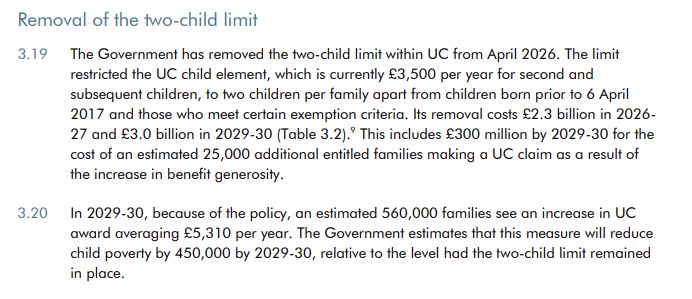
Brilliant to see that the two-child limit will be scrapped, lifting 450,000 children out of poverty in 2029/30
26.11.2025 12:08 —
👍 10
🔁 1
💬 0
📌 1
🎉Child poverty is at a record high, so the decision to end the two child limit is crucial
Poverty holds children back, with consequences for all of us. Every child should have a good start in life
This measure alone lifts 450,000 out of poverty & lessens severity for many more
26.11.2025 13:32 —
👍 19
🔁 8
💬 1
📌 0