Fengchao's Avatar

Fengchao

@fcyucn.bsky.social

Research Investigator at U of M. Interested in proteomics, etc. Developer of FragPipe, MSFragger, IonQuant, etc.

1,019 Followers  |  293 Following  |  40 Posts  |  Joined: 18.10.2023
Posts Following

Posts by Fengchao (@fcyucn.bsky.social)

Preview
Koina: Democratizing machine learning for proteomics research - Nature Communications Koina is an open-source, online platform that simplifies access to machine learning models in proteomics, enabling easier integration into analysis tools and helping researchers adopt and reuse ML mod...

Exited to share our latest work! Out now in @natcomms.nature.com

Koina aims to transform how #proteomics uses machine learning. You no longer need to be a tech wizard to use ML and now can easily run #ML models. Integrated with FragPipe, Skyline and EncyclopeDIA!

www.nature.com/articles/s41...

11.11.2025 20:06 β€” πŸ‘ 36    πŸ” 15    πŸ’¬ 0    πŸ“Œ 2

This project started 5 years ago. It led us to add isotope-labeling support to #FragPipe/#IonQuant. Since then, the tools have grown so much and are now widely used in #Chemoproteomics.

Huge thanks to everyone, and special thanks to @stephanhacker2.bsky.social and @pzanon.bsky.social

30.10.2025 14:15 β€” πŸ‘ 15    πŸ” 5    πŸ’¬ 0    πŸ“Œ 0
Preview
Profiling the proteome-wide selectivity of diverse electrophiles - Nature Chemistry Covalent inhibitors are powerful entities in drug discovery. Now the amino acid selectivity and reactivity of a diverse electrophile library have been assessed proteome-wide using an unbiased workflow...

How can we study target engagement and selectivity of covalent inhibitors? Which electrophilic probes are best suited to study a certain amino acid?

Our study on "Profiling the proteome-wide selectivity of diverse electrophiles" is published in Nature Chemistry.(1/7)

www.nature.com/articles/s41...

30.10.2025 10:27 β€” πŸ‘ 87    πŸ” 34    πŸ’¬ 3    πŸ“Œ 5
Start Page: /home/software/Skyline/events/2025 Webinars/Webinar 26

Proteomics Webinar: DIA with FragPipe, DIA-NN, and Skyline
Presenters: Eduard SabidΓ³ and Brendan MacLean
When: Tuesday, September 16, 8am (Pacific Time)
Register Now ... skyline.ms/project/home...

#massspec #proteomics

15.09.2025 08:26 β€” πŸ‘ 33    πŸ” 16    πŸ’¬ 0    πŸ“Œ 0
Post image Post image

It was a great pleasure to teach #FragPipe at the Biological Proteomics for Beginners workshop at #UCSD, sponsored by Thermo Fisher Scientific. We had a fantastic group of grad students, postdocs, and professors. Yes, I even got to teach UCSD professors how to analyze bottom-up proteomics data 😁

10.09.2025 14:52 β€” πŸ‘ 18    πŸ” 1    πŸ’¬ 1    πŸ“Œ 0
Preview
Nucleoside diphosphate kinase A (NME1) catalyses its own oligophosphorylation - Nature Chemistry Our understanding of how post-translational modificationβ€”protein phosphorylationβ€”impacts the complexity of eukaryotic signalling pathways is continuously expanding. Now, protein oligophosphorylation h...

#MSFragger Open Search has been around for a while now and used by mass spec folks to screen for chemical artifacts and adducts, e.g. in chemoproteomics data. Happy to see it got 'discovered' by a broader community who are now reporting all sort of cool biological PTMs www.nature.com/articles/s41...

20.08.2025 15:55 β€” πŸ‘ 29    πŸ” 1    πŸ’¬ 1    πŸ“Œ 0

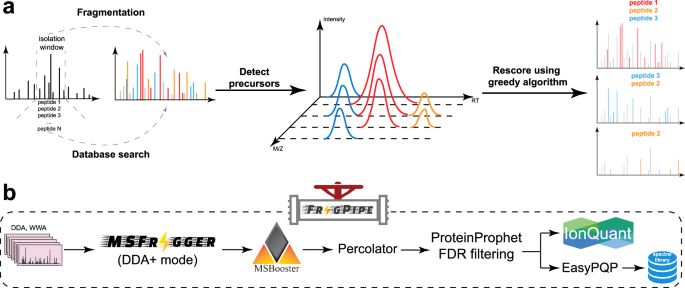
Interesting idea. May I ask two questions?
1. Is the precursor detection performed before or after the database search?
2. If it is performed before the search, how can one identify the complementary fragment ions without knowing the precursor mass or peptide sequence?
Thanks

14.08.2025 11:52 β€” πŸ‘ 0    πŸ” 0    πŸ’¬ 1    πŸ“Œ 0
Preview
Profiling the proteome-wide selectivity of diverse electrophiles Targeted covalent inhibitors are powerful entities in drug discovery, but their application has so far mainly been limited to addressing cysteine residues. The development of cysteine-directed covalen...

Interested in the proteome-wide selectivity of diverse electrophiles?

The proteomics data for our study on this headed by @pzanon.bsky.social are now public on @pride-ebi.bsky.social: www.ebi.ac.uk/pride/archiv...

Full story: chemrxiv.org/engage/chemr...

#ChemBio #ChemSky #ChemicalProteomics

12.08.2025 09:50 β€” πŸ‘ 21    πŸ” 8    πŸ’¬ 0    πŸ“Œ 0
Post image

Conventional proteomics searches struggle with many modifications and fully open searches may be difficult to interpret. We introduce a "detailed" mass offset search in #MSFragger boosting interpretability and localization especially in complex cases (e.g. FPOP data): www.biorxiv.org/content/10.1...

01.08.2025 21:33 β€” πŸ‘ 34    πŸ” 6    πŸ’¬ 0    πŸ“Œ 0

Don't tell PD, but I have quietly switched all of my analyses to Fragpipe. What an extremely powerful software. I'm often amazed at the sheer quantity of information I can get using Fragpipe. Thanks to everyone who recommended it.

11.07.2025 20:49 β€” πŸ‘ 12    πŸ” 2    πŸ’¬ 2    πŸ“Œ 0

Excited to be one of the guest editors! We’re calling for papers on cutting-edge #proteomics and #metabolomics in #multiomics research. Looking forward to your submissions!

15.07.2025 06:21 β€” πŸ‘ 15    πŸ” 3    πŸ’¬ 0    πŸ“Œ 0

In addition to these exciting events, I’ll also be one of the panel members at the single-cell proteomics Evening Workshop on Wednesday. Looking forward to the discussions ahead!

30.05.2025 21:42 β€” πŸ‘ 7    πŸ” 1    πŸ’¬ 0    πŸ“Œ 0
Post image

Wow, a record breaking number of the Nesvizhskii lab members attending #ASMS2025! 9 posters, 3 evening workshops, and one Bioinformatics Hub on #FragPipe. Plus multiple collaborative posters with other groups. See you in Baltimore! PS. Below is our recent group photo, including all those attending

30.05.2025 19:45 β€” πŸ‘ 35    πŸ” 8    πŸ’¬ 0    πŸ“Œ 1

The power of #MSFragger open search! β€œwe applied the mass-tolerant search engine MSfragger and found that phosphorylation as well as ubiquitination were well preserved after XDNAX. To our great interest, we found an additional modification of 321 Da occurring only in the irradiated SILAC channel”

23.05.2025 12:41 β€” πŸ‘ 14    πŸ” 2    πŸ’¬ 0    πŸ“Œ 0

If there any #Sciex decision makers here on Bluesky - I urge you to reconsider. Skyline/Proteowizard support is not only important for your customers using these tools, but it also benefits other bioinformatics efforts that depend on these tools.

15.05.2025 01:24 β€” πŸ‘ 25    πŸ” 9    πŸ’¬ 0    πŸ“Œ 1
Post image

We didn’t cherry-pick the dataset for the benchmarkβ€”FragPipe also delivers excellent performance on another dataset (PXD028735).

Questions are always welcome! We're always happy to hear your feedback. (3/3)

08.05.2025 01:22 β€” πŸ‘ 1    πŸ” 0    πŸ’¬ 0    πŸ“Œ 0
Post image

Peptide-level LFQbench-style plot using the PXD003881 (IonStar) dataset. (2/3)

08.05.2025 01:21 β€” πŸ‘ 1    πŸ” 0    πŸ’¬ 1    πŸ“Œ 0
Post image

We also benchmarked LFQ precision and accuracy against the latest versions of other popular tools. Here's an protein-level LFQbench-style plot using the PXD003881 (IonStar) dataset. (1/3)

08.05.2025 01:21 β€” πŸ‘ 1    πŸ” 0    πŸ’¬ 1    πŸ“Œ 0

In this release, one of the major improvements is LFQ using IonQuant. Thanks to this excellent preprint (www.biorxiv.org/content/10.1...), we identified and fixed a suboptimal step in the XIC. We're always eager to listen to feedback from the community!

07.05.2025 23:40 β€” πŸ‘ 25    πŸ” 4    πŸ’¬ 1    πŸ“Œ 0
Preview
MSFragger-DDA+ enhances peptide identification sensitivity with full isolation window search - Nature Communications Proteomics often misses co-fragmented peptides in DDA data. Here, the authors introduce MSFragger-DDA+, a database search tool that enhances peptide identification by searching the full isolation wind...

MSFragger-DDA+ is a database search tool that enhances peptide identification by searching the full isolation window. #Proteomics @fcyucn.bsky.social @nesvilab.bsky.social

www.nature.com/articles/s41...

15.04.2025 16:39 β€” πŸ‘ 8    πŸ” 1    πŸ’¬ 0    πŸ“Œ 0
Preview
MSFragger-DDA+ enhances peptide identification sensitivity with full isolation window search - Nature Communications Proteomics often misses co-fragmented peptides in DDA data. Here, the authors introduce MSFragger-DDA+, a database search tool that enhances peptide identification by searching the full isolation wind...

DDA is still great for many applications, and #MSFragger-DDA+ improves peptide identification sensitivity via full isolation window search. Huge boosts in IDs, including Astral DDA! Fully integrated in #FragPipe, simply annotate your DDA files as DDA+ and RUN. www.nature.com/articles/s41...

09.04.2025 13:27 β€” πŸ‘ 38    πŸ” 13    πŸ’¬ 1    πŸ“Œ 0

Feature request well received🫑

04.03.2025 20:05 β€” πŸ‘ 5    πŸ” 0    πŸ’¬ 0    πŸ“Œ 0
Post image

One of the most significant and challenging projects of my career so far. PepCentric: a scalable computational platform utilizing novel 2-D fragment indexing for rapid peptide-centric searches, enabling proteogenomics searches against billions of spectra in seconds. www.biorxiv.org/content/10.1...

04.03.2025 09:09 β€” πŸ‘ 72    πŸ” 23    πŸ’¬ 3    πŸ“Œ 2
Preview
DIA-Umpire: comprehensive computational framework for data-independent acquisition proteomics - Nature Methods The computational workflow of DIA-Umpire allows untargeted peptide identificationdirectly from DIA (data-independent acquisition) proteomics data without dependence on a spectral library for data extr...

It doesn't "predict" the library. It perform the spectrum-centric search to get the IDs and build the experimental library.

And for the DIA without ion mobility, it is basically what DIA-Umpire is doing: www.nature.com/articles/nme...

04.01.2025 16:23 β€” πŸ‘ 1    πŸ” 0    πŸ’¬ 1    πŸ“Œ 0
Preview
diaTracer enables spectrum-centric analysis of diaPASEF proteomics data - Nature Communications Data-independent acquisition advances proteomics quantification. Here, the authors present diaTracer, a spectrum-centric tool for diaPASEF data that supports broad proteomics applications, enabling di...

Sitting at Pike Place Market in Seattle at 7am in the morning, sipping coffee with my son, a long layover on the way home from Taipei. Otherwise I would do a long post. DiaTracer in #FragPipe work really well, making library-free analysis of any diaPASEF data possible. www.nature.com/articles/s41...

04.01.2025 16:04 β€” πŸ‘ 37    πŸ” 7    πŸ’¬ 0    πŸ“Œ 0
Preview
diaTracer enables spectrum-centric analysis of diaPASEF proteomics data - Nature Communications Data-independent acquisition advances proteomics quantification. Here, the authors present diaTracer, a spectrum-centric tool for diaPASEF data that supports broad proteomics applications, enabling di...

Perfect timing: www.nature.com/articles/s41...

04.01.2025 15:55 β€” πŸ‘ 3    πŸ” 0    πŸ’¬ 1    πŸ“Œ 0
Post image

diaTracer enables spectrum-centric analysis of diaPASEF proteomics data www.nature.com/artic...

---
#proteomics #prot-paper

03.01.2025 17:20 β€” πŸ‘ 9    πŸ” 1    πŸ’¬ 1    πŸ“Œ 0
Preview
IMTBX and Grppr: Software for Top-Down Proteomics Utilizing Ion Mobility-Mass Spectrometry Top-down proteomics has emerged as a transformative method for the analysis of protein sequence and post-translational modifications (PTMs). Top-down experiments have historically been performed prima...

Mostly, yes, AFAIK. The Gaussian feature detection was also inspired by Alexey's previous work doi.org/10.1021/acs.... Although that work was for top-down but we found that the ion mobility shapes were similar to timsTOF's.

04.01.2025 14:18 β€” πŸ‘ 2    πŸ” 0    πŸ’¬ 0    πŸ“Œ 0

Looks interesting, and they already coupled it with MSFragger/FragPipe to search MS data using their fasta. I recommend using the group FDR option (available in FragPipe; requires annotating the headers in fasta in certain way) or a two-pass search option (canonical DB->unassigned mzML->custom DB).

10.12.2024 17:31 β€” πŸ‘ 8    πŸ” 1    πŸ’¬ 1    πŸ“Œ 0

No, we didn't exclude those shifts when looking for decoys. As you can see, there is room for us to improve. And I would like to do so if time permits.

06.12.2024 20:19 β€” πŸ‘ 1    πŸ” 0    πŸ’¬ 0    πŸ“Œ 0