Stefan Borsley's Avatar

Stefan Borsley

@stefanborsley.bsky.social

Nonequilibrium chemistry. Royal Society University Research Fellow. Durham Chemistry. Occasionally I travel too.

520 Followers  |  150 Following  |  10 Posts  |  Joined: 27.11.2023
Posts Following

Posts by Stefan Borsley (@stefanborsley.bsky.social)

Preview
Chiral catalysis-driven rotary molecular motors - Nature Chemistry The structural anisotropy necessary for the powered directional rotation of chemically fuelled molecular motors had previously been provided by chiral fuels or enzymes. Now it has been shown that asym...

Out today in @natchem.nature.com πŸ˜ƒ Huakui, @stefanborsley.bsky.social @benjaminoacid.bsky.social & co illustrate why catalysis-driven motors (like motor proteins) can't use designs based on light-driven motors or molecules-that-rotate-through-multi-reaction-sequences www.nature.com/articles/s41...

16.01.2026 10:32 β€” πŸ‘ 22    πŸ” 6    πŸ’¬ 1    πŸ“Œ 2
Post image

Enjoyed the last week in WrocΕ‚aw, where @szyszkobart.bsky.social organised a fantastic supramolecular symposium. Excellent hospitality and great to spend time with the other speakers @screspi.bsky.social @annajmcconnell.bsky.social @bmschmidtlab.bsky.social and Jen Hiscock. Thanks for a great week!

28.09.2025 11:16 β€” πŸ‘ 10    πŸ” 0    πŸ’¬ 1    πŸ“Œ 0
Preview
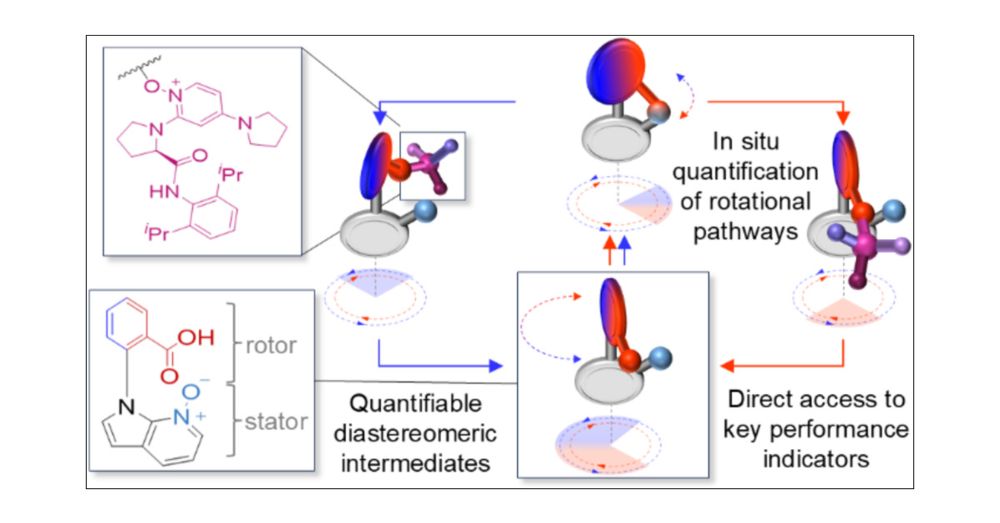
In Situ Quantification of Directional Rotation by a Catalysis-Driven Azaindole-N-Oxide–Phenoic Acid Molecular Motor We report the in situ quantification of directional rotation of a new type of catalysis-driven rotary motor featuring a phenyl carboxylic acid rotor attached to a 7-azaindole-N-oxide stator through a biaryl C–N bond. Continuous directional rotation of the rotor about the stator is driven by the achiral motor’s rotary catalysis of carbodiimide hydration in the presence of a chiral pyrrolidinylpyridine-N-oxide. The catalytic cycle features an intermediate O-acyl-azaindole-N-oxide ester tether formed between the carboxylic acid of the rotor and the N-oxide of the stator. Face-selective cleavage of the tether by the chiral pyrrolidinylpyridine-N-oxide additive generates relatively long-lived diastereomeric pyridine-N-oxide esters of the phenyl carboxylic acid. These are hydrolyzed during the catalytic cycle to reform the carboxylic acid resting state of the motor, completing net directional 360Β° rotation. In contrast to previous catalysis-driven motor-molecules, the motor’s directionality could be determined directly from the transient concentrations of the diastereomeric intermediates formed during rotary catalysis. This avoids reliance on restricted rotation models to assess motor directionality and provides direct access to other key performance indicators such as motor speed and catalytic, coupling and fuel efficiency. The in situ-determined directionality of the motor was found to be in excellent agreement with the directionality determined from a restricted rotation model, supporting both the efficacy of the new approach and the validity of using appropriately designed restricted rotation models. The results establish a straightforward method for the in situ quantification of various aspects of motor behavior, aiding the design and optimization of artificial molecular motors.

Can you work out how fast a molecular motor rotates from in situ measurments? Turns out that yes, you can, as we show today in @jacs.acspublications.org
pubs.acs.org/doi/10.1021/...
@profdaveleigh.bsky.social @stefanborsley.bsky.social

01.08.2025 09:21 β€” πŸ‘ 19    πŸ” 2    πŸ’¬ 1    πŸ“Œ 0
Post image

Great to have @benjaminoacid.bsky.social (University of Padova) visiting Durham this weekend. Ben delivered a fantastic workshop on kinetic analysis yesterday. Lots of science (and other) discussions over a barbecue today!

05.07.2025 14:45 β€” πŸ‘ 7    πŸ” 0    πŸ’¬ 0    πŸ“Œ 0
Post image Post image Post image Post image

Thanks to the organisers for an excellent conference ar #ISMSC2025. Thoroughly enjoyed some excellent science, meeting lots of new people and catching up with old friends. Thanks also for the opportunity for a talk to share some of the work we are up to in my group. See more at borslab.net.

30.05.2025 12:58 β€” πŸ‘ 3    πŸ” 0    πŸ’¬ 0    πŸ“Œ 0

Thanks to Durham Chemistry department for making us be colleagues! And thanks to @royalsociety.org for my funding.

13.05.2025 07:26 β€” πŸ‘ 1    πŸ” 0    πŸ’¬ 0    πŸ“Œ 0

An argument over a whisky turned into a paper! We apply kinetic modelling to describe Denton’s catalytic Mitsunobu reaction, and show how it can be improved! Not a paper I ever expected to write, but a testament to the benefits of chatting science with friends! Thanks @keithandrews.bsky.social!

13.05.2025 07:16 β€” πŸ‘ 28    πŸ” 3    πŸ’¬ 2    πŸ“Œ 1
Preview
Structural Influence of the Chemical Fueling System on a Catalysis-Driven Rotary Molecular Motor Continuous directionally biased 360Β° rotation about a covalent single bond was recently realized in the form of a chemically fueled 1-phenylpyrrole 2,2β€²-dicarboxylic acid rotary molecular motor. However, the original fueling system and reaction conditions resulted in a motor directionality of only ∼3:1 (i.e., on average a backward rotation for every three forward rotations), along with a catalytic efficiency for the motor operation of 97% and a fuel efficiency of 14%. Here, we report on the efficacy of a series of chiral carbodiimide fuels and chiral hydrolysis promoters (pyridine and pyridine N-oxide derivatives) in driving improved directional rotation of this motor-molecule. We outline the complete reaction network for motor operation, composed of directional, futile, and slip cycles. Using derivatives of the motor where the final conformational step in the 360Β° rotation is either very slow or completely blocked, the phenylpyrrole diacid becomes enantiomerically enriched, allowing the kinetic gating of the individual steps in the catalytic cycle to be measured. The chiral carbodiimide fuel that produces the highest directionality gives 13% enantiomeric excess (e.e.) for the anhydride-forming kinetically gated step, while the most effective chiral hydrolysis promoter generates 90% e.e. for the kinetically gated hydrolysis step. Combining the best-performing fuel and hydrolysis promoter into a single fueling system results in a 92% e.e.. Under a dilute chemostated fueling regime (to avoid N-acyl urea formation at high carbodiimide concentrations with pyridine N-oxide hydrolysis promoters), the motor continuously rotates with a directionality of ∼24:1 (i.e., a backward rotation for every 24 forward rotations) with a catalytic efficiency of >99% and a fuel efficiency of 51%.

Check out how we made a minuscule motor rotate 24 times in one direction on its own! Huge thanks to all involved, especially @profdaveleigh.bsky.social for making this work possible
@pubs.acs.org
Huakui, Axel, @stefanborsley.bsky.social @benjaminoacid.bsky.social & Alex
pubs.acs.org/doi/10.1021/...

28.02.2025 09:39 β€” πŸ‘ 14    πŸ” 4    πŸ’¬ 1    πŸ“Œ 1

Congrats, Ben!

This will be a fantastic PhD opportunity for whoever is lucky enough to get it! Can… I apply…?

26.02.2025 07:23 β€” πŸ‘ 3    πŸ” 0    πŸ’¬ 0    πŸ“Œ 0
Fielden Group - Nanotechnology Research We're an interdisciplinary research group led by Dr Stephen Fielden within the School of Chemistry at the University of Birmingham. We research polymers, nanoparticles and supramolecular chemistry.

Come and join my new group! We have two funded PhD positions available in the areas of supramolecular chemistry and polymer nanotechnology. See fieldengroup.net for more details! Reposts much appreciated!

15.01.2025 15:38 β€” πŸ‘ 11    πŸ” 14    πŸ’¬ 1    πŸ“Œ 0

A really fun project, delivered on the back of Peng-Lai’s fantastic efforts, ably assisted by Martin and of course our collaborators in Strasbourg, Alessandro and @giusepponelab.bsky.social, who taught us lots of polymer and materials chemistry.

Thanks all!

15.01.2025 17:25 β€” πŸ‘ 19    πŸ” 2    πŸ’¬ 0    πŸ“Œ 0
Post image Post image

The whole group (including Max the mascot) enjoyed a trip to York for #MASC2024. Great to catch up with old friends and new science!

18.12.2024 09:55 β€” πŸ‘ 10    πŸ” 0    πŸ’¬ 0    πŸ“Œ 0
Post image

Great to see our research group taking shape with Martha, Zac and Willow (left to right) taking the plunge and joining me for what I hope will be some fun chemistry.

More about the group on our website: www.borslab.net/meet-the-gro...

13.11.2024 14:26 β€” πŸ‘ 2    πŸ” 0    πŸ’¬ 0    πŸ“Œ 0
Post image

Check out our review on β€˜Ratcheting Synthesis’: www.nature.com/articles/s41...

We discuss ratchet mechanisms in a wide range of fields. Written with James Gallagher, Ben Roberts and Dave Leigh.

17.12.2023 11:00 β€” πŸ‘ 8    πŸ” 1    πŸ’¬ 0    πŸ“Œ 0