
See the full manuscript here: www.nature.com/articles/s41...
26.02.2026 19:24 — 👍 0 🔁 0 💬 0 📌 0See the full manuscript here: www.nature.com/articles/s41...
26.02.2026 19:24 — 👍 0 🔁 0 💬 0 📌 0
Excited to share that some of my PhD research was recently published in Nature Communications!
In short, we showed that when a spatially-structured bacterial population is exposed to antibiotics, death sweeps through it as a sharp front whose dynamics are controlled by a “nutrient bottleneck”
Great questions! Our work suggests that getting more nutrients to the local infection site is key. To determine which IV fluids accomplish this goal would require more nuanced PK/PD models, but we hope this work motivates such models to consider local nutrient conc alongside ab conc as a key metric
15.03.2025 17:52 — 👍 1 🔁 0 💬 0 📌 0See all the details of my latest manuscript here -- excited to hear your thoughts! #biophysics #microbiology
15.03.2025 17:16 — 👍 1 🔁 0 💬 0 📌 0In addition to clinical microbiologists, the results could be relevant to biophysicists interested in collective behavior & folks interested in controlling bacteria in the environment and industry. We'd love your feedback. Please repost/share with whoever might be interested! [8/8]
15.03.2025 17:06 — 👍 1 🔁 0 💬 1 📌 0It was an honor to work with Arrow Dill-Macky, Jenna Moore, Catherine Day, Mohamed Donia, and my advisor Sujit Datta to unearth this consequence of population structure—providing a mechanistic basis for the commonly-seen discrepancy between antibiotic efficacy in liquid culture versus in vivo. [7/8]
15.03.2025 17:06 — 👍 0 🔁 0 💬 1 📌 0Finally: One may expect that simply supplying more nutrients can overcome this bottleneck. But we found that in some cases, excess nutrient can unexpectedly promote the regrowth of resistant cells—which is bad! [6/8]
15.03.2025 17:05 — 👍 0 🔁 0 💬 1 📌 0
We turned this intuition into a biophysical model that recapitulates the experiments, and yields principles that explain how collective nutrient consumption can slow the progression of this death front, protecting a population from a nominally deadly antibiotic dose. [5/8]
15.03.2025 17:03 — 👍 0 🔁 0 💬 1 📌 0We found that this phenomenon arises because cells must be metabolically active to be killed by fosfomycin (& many other antibiotics). This requires nutrients — whose availability is shaped by transport & cell consumption — to penetrate into the population alongside the antibiotic. [4/8]
15.03.2025 17:02 — 👍 0 🔁 0 💬 1 📌 0
We found a surprise: nutrient-starved populations exposed to fosfomycin (the test antibiotic) did not die—even at ~250x MIC, the level needed to stop growth in liquid culture!
But simply adding nutrient unlocked a propagating front of cell death (magenta in 1st post). [3/8]

Lab tests of antibiotics usually study how they kill cells suspended in liquid. But in nature, bacteria inhabit spatially structured populations that can withstand antibiotics better. Why? We developed a way to probe this question in structured E. coli populations using granular hydrogels. [2/8]
15.03.2025 17:01 — 👍 0 🔁 0 💬 1 📌 0
Excited to share my latest thesis work:
doi.org/10.1101/2025...
Here, we show that when a bacterial population is exposed to antibiotic, death sweeps through it as a sharp front—with dynamics controlled by a "nutrient bottleneck". 🦠☠️
🧵 to follow... [1/8]
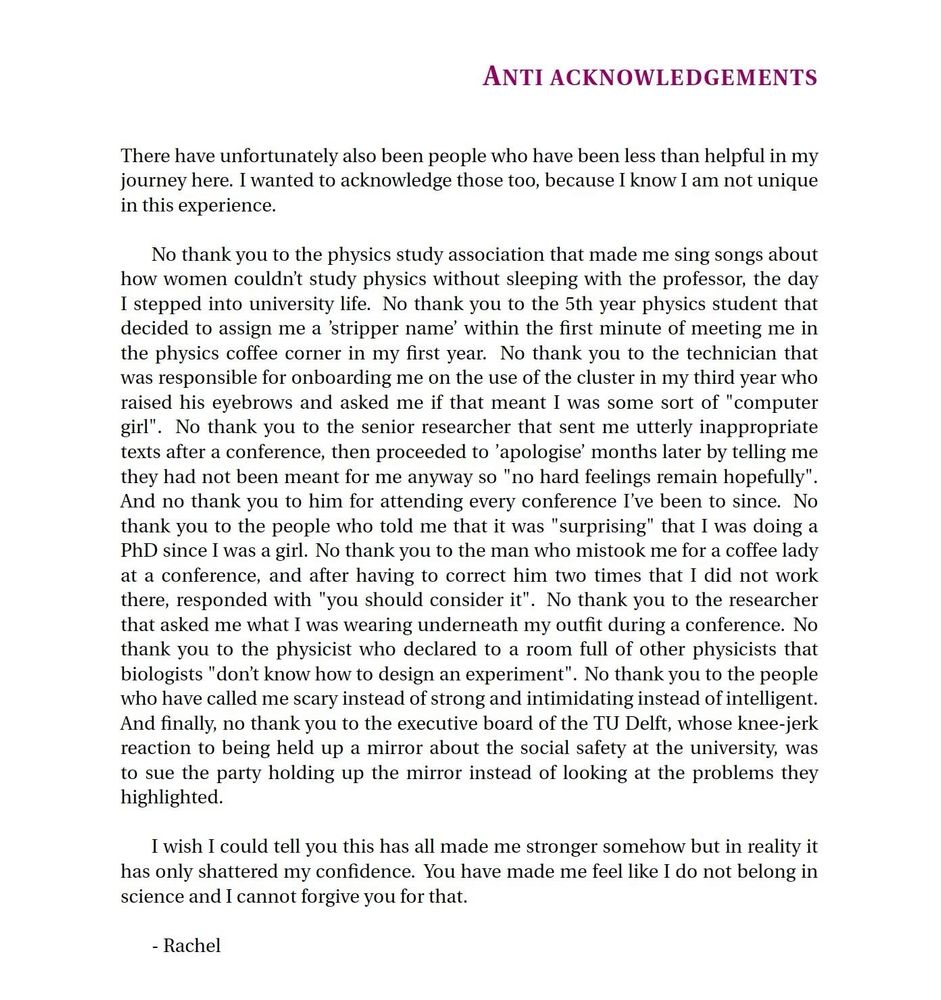
There have been people less than helpful in my journey here. I wanted to acknowledge those too, bc I know I am not unique in this experience. No thank you to the physics study assoc that made me sing songs about how women couldn't study physics without sleeping with the professor, the day I stepped into university life. No thank you to the 5th year physics student that decided to assign me a stripper name within the first minute of meeting me in the physics coffee corner in my first year. No thank you to the technician that was responsible for onboarding me on the use of the cluster in my third year who raised his eyebrows and asked me if that meant I was some sort of computer girl. No thank you to the senior researcher that sent me utterly inappropriate texts after a conference, then proceeded to apologise months later by telling me they had not been meant for me anyway so no hard feelings remain hopefully And no thank you to him for attending every conference I've been to since. No thank you to the people who told me that it was surprising that I was doing a PhD since I was a girl. No thank you to the man who mistook me for a coffee lady at a conference, and after having to correct him two times that I did not work there, responded with you should consider it. No thank you to the researcher that asked me what I was wearing underneath my outfit during a conference. No thank you to the physicist who declared to a room full of other physicists that biologists don't know how to design an experiment. No thank you to the people who have called me scary instead of strong and intimidating instead of intelligent. And finally, no thank you to the exec board of the TU Delft, whose knee-jerk reaction to being held up a mirror about the social safety at the university, was to sue the party holding up the mirror instead of looking at the problems they highlighted. ... You have made me feel like I do not belong in science & I cannot forgive you for that.
A friend included this anti-acknowledgement section on her PhD thesis. She also added the proposition: “Systematic bullying and undermining of girls and women in STEM starts early on and is the reason why they do not stay in science and related fields.”
Absurd we still need to go through this
🧪👩🔬

