New from me: Ideal (family size) compared to what?
familyinequality.wordpress.com/2025/11/23/i...
@wendymanning.bsky.social
I am a family demographer (aka population scientist) with a focus on American family and fertility patterns. Co-PI of NCHAT and co-director of NCFMR.
New from me: Ideal (family size) compared to what?
familyinequality.wordpress.com/2025/11/23/i...
So well deserved! Congratulations.
08.11.2025 14:33 — 👍 1 🔁 0 💬 1 📌 0Follow @ncfmr-bgsu.bsky.social for timely, reliable, US demographic trends. Great they're here!
23.10.2025 15:01 — 👍 8 🔁 2 💬 0 📌 0
💔 The U.S. refined divorce rate in 2024 was 14.2 per 1,000 married women, down slightly from 14.4 in 2023.
Nearly a million women divorced nationwide.
Read more → doi.org/10.25035/ncf...


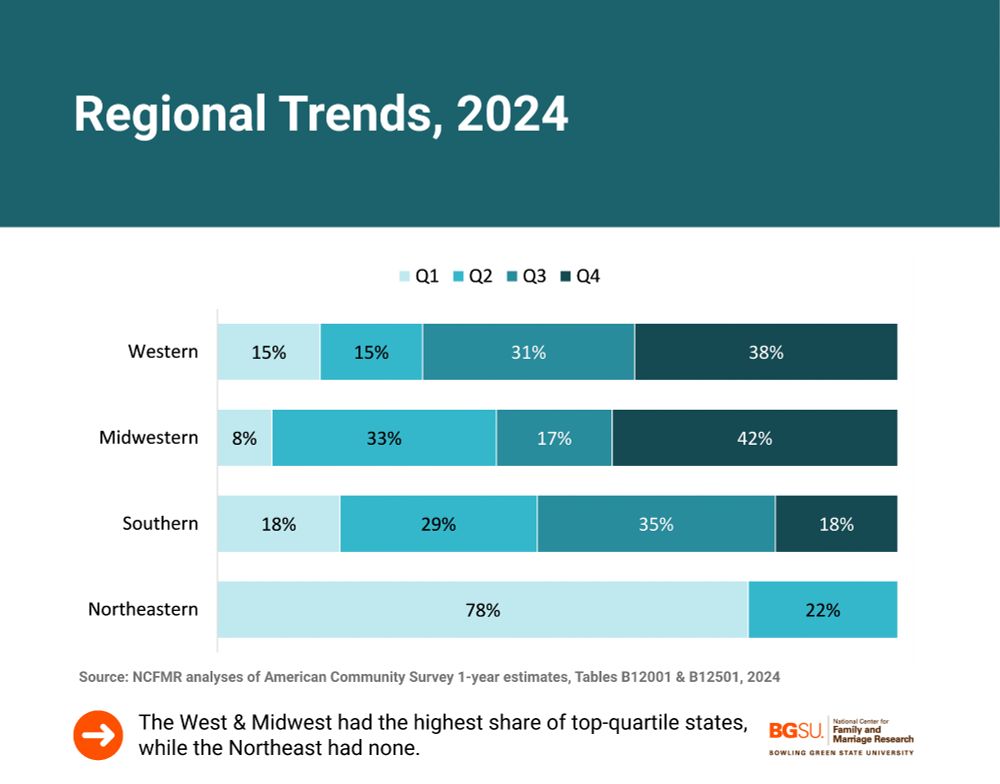

⚭ Marriage in the U.S. varies widely. In 2024, the national refined marriage rate was 31.2 per 1,000 unmarried women. Utah ranked highest (51.7), Delaware lowest (20.1). 📖 Read the new @NCFMR Family Profile → doi.org/10.25035/ncf...
20.10.2025 15:50 — 👍 6 🔁 4 💬 0 📌 0Happy Sunday! Check out this recent NCHAT publication from @chrisajulian.bsky.social, Hannah Tessler, @wendymanning.bsky.social, Alexandra VanBergen, and @clairekampdush.bsky.social.
read.dukeupress.edu/demography/a...
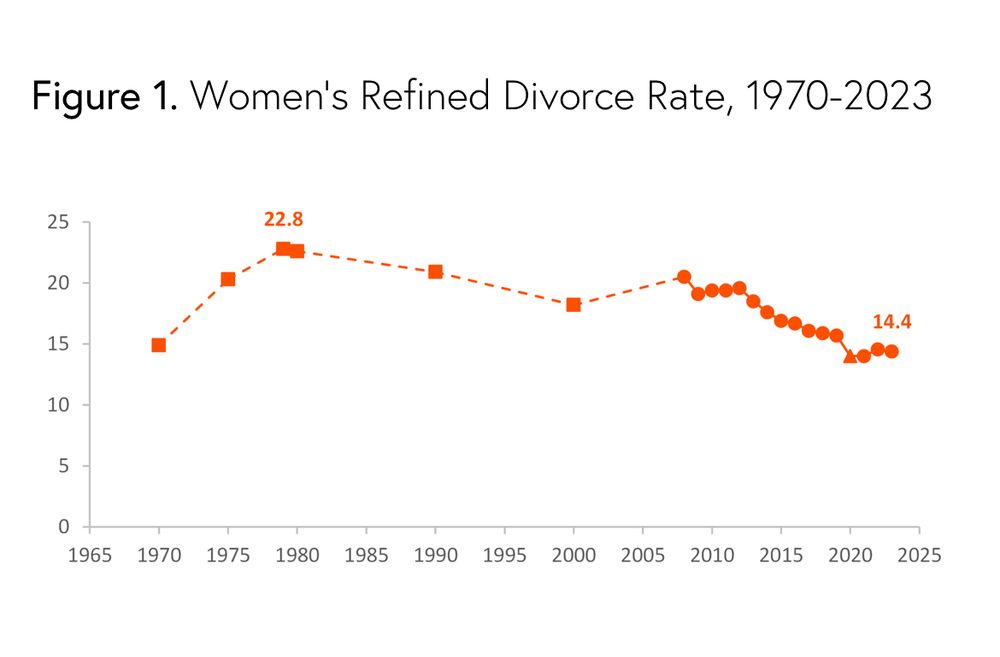
Divorce rate decline continues… we have been documenting these trends alongside marriage. @ncfmr-bgsu.bsky.social www.bgsu.edu/ncfmr/resour...
09.08.2025 13:31 — 👍 4 🔁 0 💬 0 📌 0Check out our new paper using @nchatstudy.bsky.social dyadic data to measure sexual minority couples. The levels are twice as high when you consider the sexual identity of BOTH members of the couple. @chrisajulian.bsky.social
read.dukeupress.edu/demography/a...

Three out of five recent newlyweds cohabited prior to marriage. www.bgsu.edu/ncfmr/resour... @ncfmr-bgsu.bsky.social
31.07.2025 10:39 — 👍 4 🔁 0 💬 0 📌 0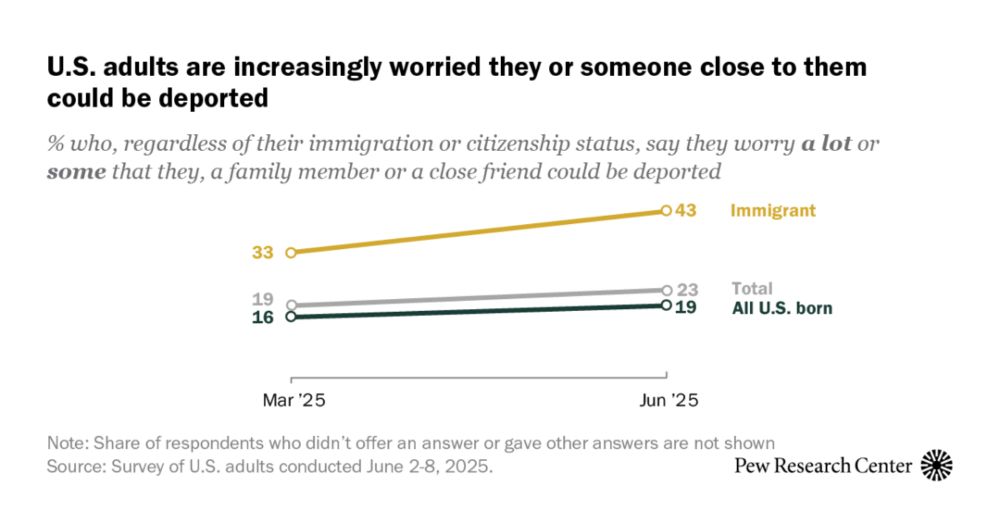
About 1 in 4 U.S. adults worry they or someone close to them could be deported
www.pewresearch.org/short-reads/...

As fertility rates in the U.S. and elsewhere continue to fall, standard demographic theories that focus on objective micro- and macroeconomic conditions seem unable to explain these trends. New approaches, such as the Narrative of the Future framework and the “uncertainty” paradigm, have emphasized the potential for subjective perceptions to be important for fertility decision-making, net of objective characteristics. We use a unique new source of data—the National Couples’ Health and Time Study, a nationally representative sample of cohabiting and married adults interviewed between September 2020 and April 2021—to examine short-term fertility intentions and better understand if and how including a general subjective evaluation (overall life satisfaction) and domain-specific subjective evaluations (economic stress and relationship satisfaction) are related to fertility intentions. We find that most respondents did not intend to have a child in the next year, though about one in seven respondents were unsure about if/when to have a(nother) child. Net of objective characteristics, overall life satisfaction was positively associated with short-term intentions to have a child, and greater economic stress was linked to uncertainty about short-term intentions. We did not observe a link in multivariable models between relationship satisfaction and intentions. Further, models stratified by parenthood indicated that both objective characteristics and subjective perceptions were more strongly linked to first-birth intentions than higher-parity intentions. Our results add to the growing body of work suggesting that (a) subjective perceptions have modest but significant links to fertility decision-making and (b) uncertainty in decision-making is important to consider.
Another new paper on fertility intentions! Using @nchatstudy.bsky.social data, we consider whether cohabiting & married people's short-term fertility intentions are subjective perceptions of well-being.
The answer? Yes! 1/
link.springer.com/chapter/10.1...

4% of marriages each year are now to same-sex marriage! 10 years of love wins! www.bgsu.edu/ncfmr/resour...
26.06.2025 10:26 — 👍 8 🔁 3 💬 0 📌 0
Support for marriage equality persists! www.nytimes.com/2025/06/22/o...
22.06.2025 15:54 — 👍 3 🔁 4 💬 0 📌 0Want to know more about same-sex couples? Check out our work. www.bgsu.edu/content/dam/...
21.06.2025 01:03 — 👍 10 🔁 3 💬 0 📌 0
Check out profiles of marriages to same-sex couples. In 2023 there were newly 73,000 marriages to same-sex couples, representing about 4% of all marriages that year.
www.bgsu.edu/ncfmr/resour...

"personal economic pessimism and concerns about having a good relationship in the future are associated with greater importance of avoiding a pregnancy in the short term" (controlling for economic and relationship status, etc) @karenguzzo.bsky.social, Belykh, @wendymanning.bsky.social , & Roza
13.06.2025 14:56 — 👍 20 🔁 8 💬 0 📌 1
The truth is that more than 1% of children live with a LGBTQ+ parent - closer to 7%. williamsinstitute.law.ucla.edu/publications...
07.06.2025 23:47 — 👍 3 🔁 2 💬 1 📌 0
Figure showing the distribution of paternal age of births to women who had a birth aged 40 and older.
It's also worth noting that when women aged 40 and over have a birth, their partners are usually over 40, too. We don't often talk about delayed parenthood among men, but it's definitely happening. 3/3 www.bgsu.edu/ncfmr/resour...
04.06.2025 16:00 — 👍 8 🔁 1 💬 0 📌 0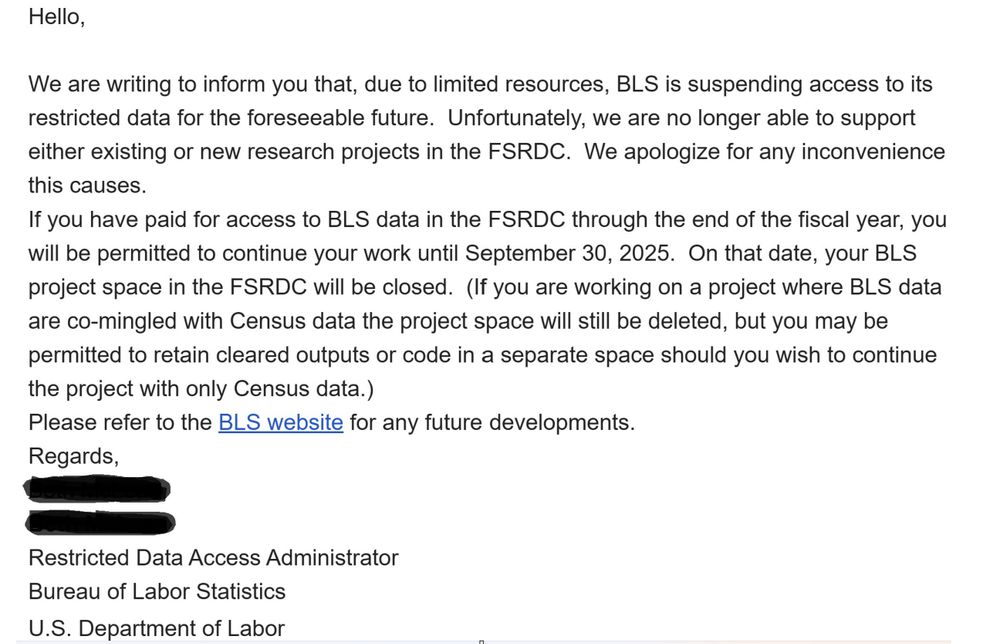
EXTREMELY BAD NEWS for economic research, per former BLS Commissioner @ericagroshen.bsky.social on LinkedIn.
BLS is suspending access to its restricted data "for the forseeable future." Applies to projects through the Federal Statistical Research Data Centers & onsite projects with BLS.
#EconSky
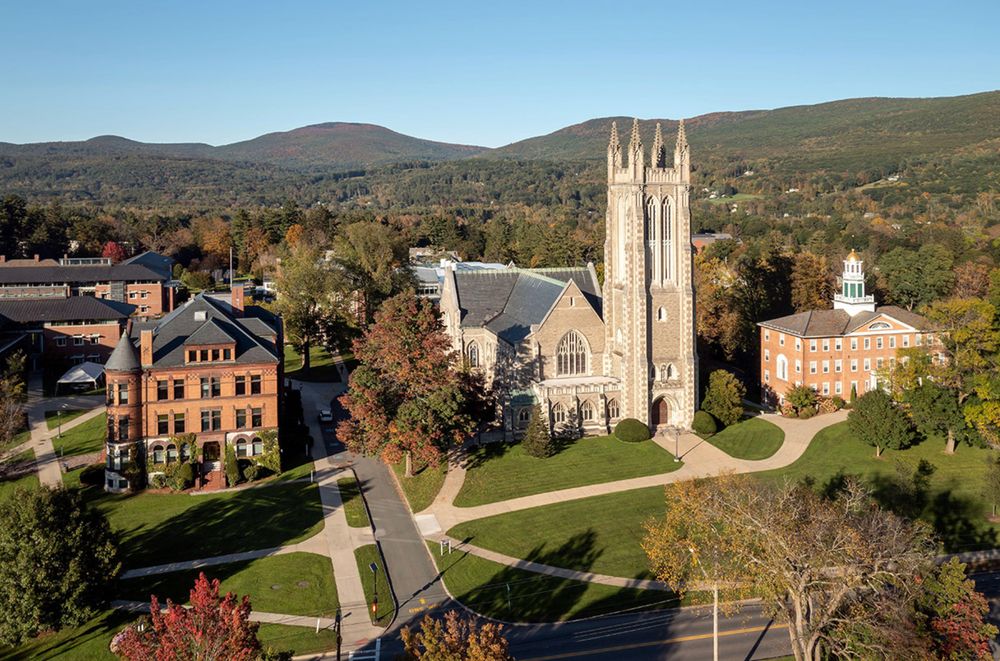
Exclusive: Confusion over new DEI language from NSF and NIH leads Williams College to be first institution to pause accepting any grants www.science.org/content/arti...
06.06.2025 19:35 — 👍 154 🔁 81 💬 5 📌 8
CHAPTER 6 SUBJECTIVE EVALUATIONS OF PERSONAL AND PUBLIC WELL-BEING AND EXPECTED FUTURE CHILDBEARING Karen Benjamin Guzzo and Sarah R. Hayford ABSTRACT Since the Great Recession, birth rates have fallen steadily in the United States and other high-income countries, even as macroeconomic conditions improved and have since remained largely positive. To understand this surprising juxta- position, scholars are increasingly turning to subjective measures of current and future conditions, hypothesizing that worries about potential negative futures may lead to lower birth rates even when economic conditions are good. Building on this literature, we use survey data from the American Trends Panel (ATP; n = 3,696) to assess how respondents’ satisfaction with their own lives, their understanding of challenges facing young people, their beliefs about problems in their community, and their predictions of future COVID-19 impacts are associated with their expectations for having children. Results show that people who are more dissatisfied with their own lives are less likely to expect a child, controlling for other perceptions as well as objective sociodemographic char- acteristics. Further analyses reveal that this association is largely restricted to childless women.
New paper alert on - you guessed it - childbearing decision-making!
@srhayford.bsky.social & I evaluate if people's perceptions of their personal lives & how things are going more broadly are associated with whether they thought it was likely they would have a(nother) child. 1/
Data were collected before Trump took office. I wonder how some responses have changed.
03.06.2025 12:04 — 👍 1 🔁 0 💬 1 📌 0
Our trans health study was terminated by the government – the effects of abrupt NIH grant cuts ripple across science and society buff.ly/eFZCL4H
02.06.2025 15:08 — 👍 21 🔁 15 💬 0 📌 0
“Job talk got you stressed? I can help. Free Masterclass: Making Academic Job Talks Fun | June 26, 2025, 2 PM CST | 60 minutes of strategy, support, & clarity. Register now!" Zoom registration link: https://us06web.zoom.us/meeting/register/3c9_zpsFSsSy6mfv0fmmAQ
Are you a grad student or postdoc stressing out about job talks? Join me on 6/26/25 at 2 PM CST for a free class. You'll learn how to:
✔️ Avoid the “Big 3” job talk killers
✔️ Use storytelling breath life into your research
✔️ Handle Q&A like a boss
Register here and please share: lnkd.in/g5f3YwtX
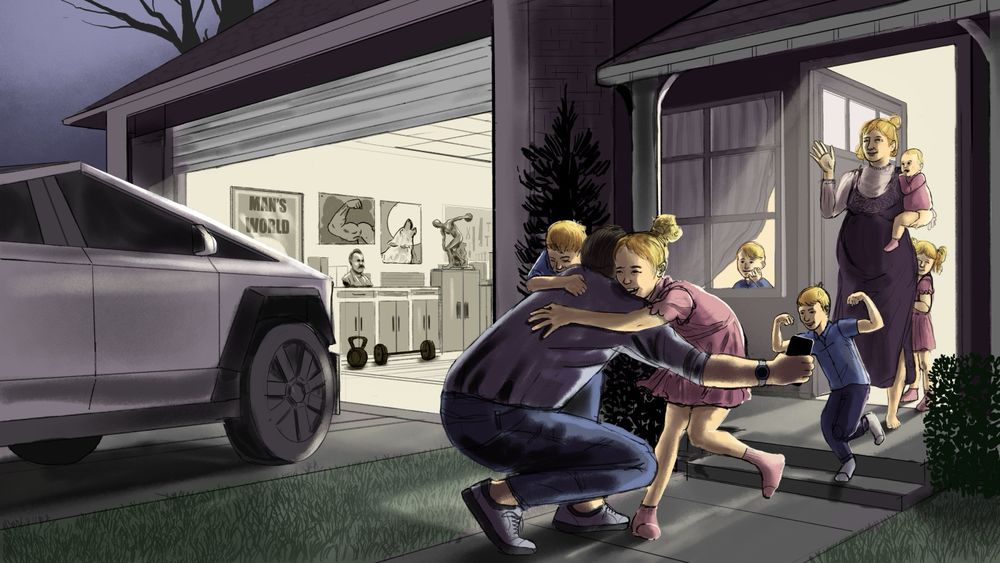
Let’s focus on the empirical evidence provided by demographic research & population science. www.npr.org/2025/04/25/n...
26.04.2025 21:51 — 👍 9 🔁 2 💬 1 📌 0Folks should appeal! Some universities don’t have resources or are not interested but it is important to appeal.
26.04.2025 21:37 — 👍 3 🔁 0 💬 0 📌 0
Great to see demographic expertise used in coverage of fertility. www.nytimes.com/2025/04/23/h...
24.04.2025 18:20 — 👍 2 🔁 1 💬 0 📌 0One last NCHAT poster presentation today at 10:30am in the Ballrooms! Go check out the poster by
@chrisajulian.bsky.social @wendymanning.bsky.social, Alex VanBergen, and
@clairekampdush.bsky.social on Collecting Dyadic Data on LGBTQ+ Partnerships!

This analysis of canceled NIH grants really hits home.
“According to a Bloomberg Opinion analysis, more than half of the 550 grants terminated over the last six weeks by the NIH addressed LGBTQ health somehow,” writes @lisamjarvis.bsky.social #LGBTQ #HealthEquity #PublicHealth #MedSky

Marriage equality has had profound impacts on LGBTQ + Americans’ lives, and even the threat of its potential loss is having serious disruptions on their individual, relational, and family well-being.
link.springer.com/article/10.1...