

We need a new lens on corporate net zero.
Today they mix what companies can control with what they depend on.
This leads to unachievable targets, inhibits certain types of action and obscures the role of policy and system change.
1/5
We need a new lens on corporate net zero.
Today they mix what companies can control with what they depend on.
This leads to unachievable targets, inhibits certain types of action and obscures the role of policy and system change.
1/5

In a new article I propose a lens for aligning targets, actions, and claims with what companies control and what they depend on.
www.milkywire.com/articles/a-n...
 21.01.2026 12:16 —
👍 1
🔁 0
💬 1
📌 0
21.01.2026 12:16 —
👍 1
🔁 0
💬 1
📌 0
How large a share of emission reductions is conditional differs a lot between sectors and business models.
Importantly, declaring emissions conditional increases the obligation to fund and push for the solutions that resolve those conditions.
4/5

In addition to reducing the emissions they have agency over, companies should help enable the world their targets require, both through funding climate solutions that unblocks global net zero, and their own advocacy.
3/5

In reality, net zero targets are conditional. Companies should specify what is needed for their target achievement. What they can do, and what external change they depend on.
2/5
We need a new lens on corporate net zero.
Today they mix what companies can control with what they depend on.
This leads to unachievable targets, inhibits certain types of action and obscures the role of policy and system change.
1/5

Slow reductions=LESS CDR
I often see the argument that the more emissions remain the more CDR is needed. Example below
But it's the opposite! If a lot of emissions remain it means there wasn't enough political will & capital to address them. That will & capital won't magically appear for CDR instead
This is an illustration of what @glenpeters.bsky.social means when he said that CDR does not "exist outside the toolbox".
(Screenshot from Allied offsets new brief on cost of CDR. Not trying to pick on them, it's an informative brief, and I would say most people make this assumption. )
Slow reductions=LESS CDR
I often see the argument that the more emissions remain the more CDR is needed. Example below
But it's the opposite! If a lot of emissions remain it means there wasn't enough political will & capital to address them. That will & capital won't magically appear for CDR instead

Most-viewed Guardian articles last night. Editors shouldn’t think that the public doesn’t want to know more about climate change.
Or about ocean science 🌊!
Read the article about our paper: www.theguardian.com/environment/...

Full analysis here: marginalcarbon.substack.com/p/what-role-...
29.08.2025 09:10 — 👍 1 🔁 0 💬 2 📌 0
Comparing different alternatives is tricky since they rest on so many assumptions. Electrofuels versus using CDR to offset fossil fuel oil depends on the cost of electricity, fossil fuels and CDR. The ISO chart below compares the interaction between them.
29.08.2025 09:10 — 👍 1 🔁 0 💬 1 📌 0
Of course this first requires that we accept permanent CDR as a solution for a limited amount of emissions.
29.08.2025 09:10 — 👍 1 🔁 0 💬 1 📌 0Today, CDR is not an option in most policy frameworks and roadmaps. This should change. We should be agnostic about which solutions are used to reach net zero. Otherwise, we risk making the transition slower, more expensive, and less politically feasible.
29.08.2025 09:10 — 👍 2 🔁 0 💬 1 📌 0
NEW ANALYSIS: What role will CDR play for shipping?
Biofuels, onboard CCS, and durable CDR are likely to be cheapest for the majority of emissions. But many roadmaps center around electrofuels, despite them looking like the most expensive alternative, as with aviation.

Paper here www.sciencedirect.com/science/arti...
16.07.2025 14:21 — 👍 1 🔁 2 💬 0 📌 0Cement requiring CCS, is still difficult to address. I see the wording "hard-to-abate" refering to activities that need forcing policy creating a level playing field. A subset of hard-to-abate is also CDR-optimal. 4/5
16.07.2025 14:21 — 👍 1 🔁 1 💬 1 📌 0
This graph compares economic & energetic needs of aviation and cement mitigation, showing cement is not hard to abate, but aviation is.
However, I prefer "CDR-optimal" instead of hard to abate here. 3/5
As long as CDR quality criteria are set high, the market will be best at figuring out which emissions are optimal to deal with using CDR. 2/5
16.07.2025 14:21 — 👍 1 🔁 2 💬 2 📌 0
All emission reductions more expensive than DACCS are hard to abate.
That's the proposed definition in this new paper. I agree, and have been arguing for a long time that there is NO need to create a special list of residual emissions... 1/5

The CO2 removal industry is about to hit a milestone: 1 million tons of durable removals. But things are moving too slowly to reach gigaton scale on time. At Carbon Unbound summit last week things felt precarious. One person told me without more buyers the industry is in a “house of delusion.”
30.05.2025 13:39 — 👍 21 🔁 13 💬 3 📌 1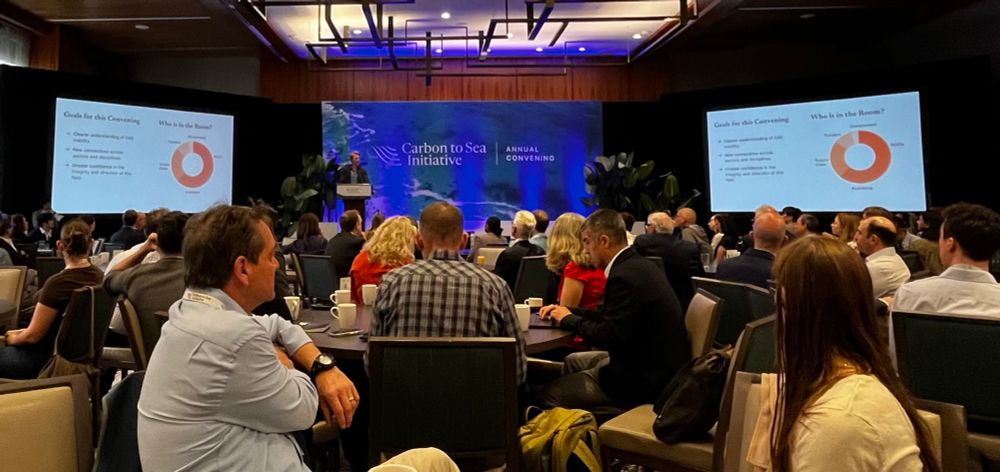
A conference in a modern venue, with attendees seated at round tables. A presenter stands at a podium in front of large screens displaying slides.
I categorically disagree with claims that CO₂ removal (CDR) is a scam. The field is full of smart people dedicated to figuring out what, if anything, works, because we’ll need CDR in the future for legacy and residual emissions. Funding via market mechanisms isn’t ideal, but doesn’t make it a scam.
20.05.2025 15:20 — 👍 280 🔁 59 💬 37 📌 6
How many tonnes would the world's biggest CDR buyer be purchasing if they were following the SBTi proposed CDR scale-up requirement?
Full article: www.cdr.fyi/blog/zero-vs...

🚨 BREAKING: The just-published draft SBTi Net Zero standard is unlikely to significantly increase demand for CDR. Crucially, CDR targets must include the total CDR needs. 1/9
marginalcarbon.substack.com/p/what-needs...
I've written a detailed analysis of what the new standard means for removals, going into much more detail on all of this (don't miss the footnotes). marginalcarbon.substack.com/p/what-needs...
9/9
Finally kudos to all the hard work from the SBTi team. I’ve seen first-hand how much hard work dedicated and smart people have put into it. Trying to balance an enormous amount of input, creating a standard that is both science-based and actually adopted by companies. Not an easy task by any means.
18.03.2025 14:47 — 👍 1 🔁 0 💬 1 📌 0
The guidelines should incentivize companies that want to support CDR but just need a push, not the opposite.
Companies should estimate how much CDR they need at net zero in total, and to start scaling up CDR in a credible manner.
7/9
There is even a risk of more harm than good for the CDR sector. Although it would increase demand among Scope-1 emitters it could hinder efforts within companies without large Scope 1 emissions to advocate for CDR purchases. CFOs can reference the SBTi's stance that only Scope 1 is needed.
6/9
🫙 A Scope-1 only requirement, means few companies are likely to buy CDR, and net zero fulfilments would be jeopardised.
At the same time the CDR Sector is dependent on an SBTi CDR interim target requirement, with the next wave of companies will only buy CDR if explicitly told so.
5/9