

Our latest study on ADP-ribosyl-linked serine ubiquitylation in the context of PARP1 signaling and the DNA damage response is out today in Nature Chemical Biology www.nature.com/articles/s41...
09.07.2025 12:00 — 👍 28 🔁 10 💬 1 📌 4
Our latest study on ADP-ribosyl-linked serine ubiquitylation in the context of PARP1 signaling and the DNA damage response is out today in Nature Chemical Biology www.nature.com/articles/s41...
09.07.2025 12:00 — 👍 28 🔁 10 💬 1 📌 4
Excited to share my PhD work in the Kranzusch Lab published in @nature.com!
Two key discoveries:
- Nucleotides can act as negative regulators of antiviral immunity
- Ion channel activation is gated by DNA
Thank you to our all collaborators! @soreklab.bsky.social
www.nature.com/articles/s41...
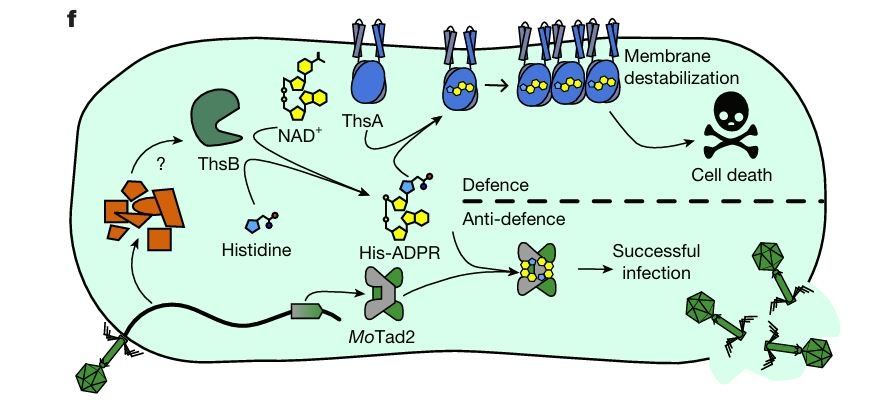
Out in Nature today: A new immune signaling molecule, His-ADPR, is produced by defensive TIR domain proteins in bacteria to protect from phage
Joint work with the Tamulaitienė and Kranzusch labs
www.nature.com/articles/s41...
Congrats Carmel Avraham, Dziugas Sabonis, Renee Chang and co-authors!

Olaparib is a widely used PARP inhibitor for the treatment of BRCA-mutated cancers. To comprehensively understand the drug's clinical impact, measuring its interactions with intended on- and off-targets is crucial. In this study, olaparib's on- and off-targets were profiled using photoaffinity labeling, a powerful, proteome-wide method for studying the direct interactions between a drug and its protein targets. A novel photoaffinity probe was designed and used in a proteomic screening to discover novel targets of olaparib in the human proteome. The probe, incorporating a pre-installed biotin group, bypasses the limitations of using a copper(I)-catalyzed click reaction in cell lysates for reporter group conjugation and revealed a broad range of olaparib interactors, including previously unreported proteins, in a quantitative mass spectrometry-based proteomic screening using HeLa whole cell lysate. This study contributes to our current understanding of the pharmacology of olaparib and provides a valuable tool for elucidating drug interactors within cell lysates, potentially guiding the development of more targeted therapeutics with fewer off-targets.
We have a new article out in collaboration with the group of Michiel Vermeulen at @nkinl.bsky.social
Photoaffinity probes based on olaparib for Proteomics profiling. Simple but powerful 💪
Read here: chemistry-europe.onlinelibrary.wiley.com/doi/10.1002/...
Interesting paper by the groups of Dima Filippov @leidenadpr.bsky.social @led3hub.bsky.social and @michielvermeulen.bsky.social in ChemBioChem. They developed a biotinylated photoaffinity probe of the PARP inhibitor Olaparib and used it to profile off-targets. chemistry-europe.onl...
19.03.2025 07:00 — 👍 6 🔁 4 💬 0 📌 0


Celebrating 14 years of science, teamwork, and resilience! To mark our lab’s anniversary, we traded pipettes for pottery—turns out shaping clay is just as therapeutic as shaping experiments. With NIH funding uncertainties, a little calm goes a long way. Grateful for this team! #LabLife
22.02.2025 00:29 — 👍 15 🔁 1 💬 0 📌 0
Check out our approach toward disciformycin and gulmirecin, spearheaded by Peter Ruehmann @nyuchemistry.
pubs.acs.org/doi/10.1021/...
💯 👇
12.02.2025 02:44 — 👍 10 🔁 4 💬 0 📌 0
Making intrabodies from antibodies just got easier! Learn how we made 𝟭𝟵 intrabodies to bind and light up peptides and histone modifications in live cells. And thanks to Academia, all sequences are freely available. (video credit: Yuko Sato @YukoSatoT2) (1/15)
www.biorxiv.org/content/10.1...
Excited to share our new review on biomolecular condensates mediated by PARPs and ADP-ribosylation @ Trends in Biochemical Sciences!
Despite the uncertainty, science must march forward. Grateful for the support that makes discovery possible. #FundScience #KeepScienceStrong
Olaparib is a widely used PARP inhibitor for the treatment of BRCA-mutated cancers. To comprehensively understand the drug's clinical impact, measuring its interactions with intended on- and off-targets is crucial. In this study, olaparib's on- and off-targets were profiled using photoaffinity labeling, a powerful, proteome-wide method for studying the direct interactions between a drug and its protein targets. A novel photoaffinity probe was designed and used in a proteomic screening to discover novel targets of olaparib in the human proteome. The probe, incorporating a pre-installed biotin group, bypasses the limitations of using a copper(I)-catalyzed click reaction in cell lysates for reporter group conjugation and revealed a broad range of olaparib interactors, including previously unreported proteins, in a quantitative mass spectrometry-based proteomic screening using HeLa whole cell lysate. This study contributes to our current understanding of the pharmacology of olaparib and provides a valuable tool for elucidating drug interactors within cell lysates, potentially guiding the development of more targeted therapeutics with fewer off-targets.
We have a new article out in collaboration with the group of Michiel Vermeulen at @nkinl.bsky.social
Photoaffinity probes based on olaparib for Proteomics profiling. Simple but powerful 💪
Read here: chemistry-europe.onlinelibrary.wiley.com/doi/10.1002/...

Nice work from the Andexer laboratory on PPK2 enzymes and their use in nucleotide synthesis
doi.org/10.1002/cbic...

great new insights from Ji Luo, Barry O´Keefe and Brice Wilson on ITPK1 inhibitors
www.sciencedirect.com/science/arti...

It is that time of year again... our Christmas tree arriving today! 🎄
(photos of the fully decorated tree to follow!)

Our Synthesis Tag (SynTag) for the synthesis of aggregating peptides and proteins is now published in JACS 🥳 Congratulations to first authors Héloïse & Elyse and everyone else involved ✨✨
pubs.acs.org/doi/10.1021/...

Interesting paper by the @roelfesgroup.bsky.social and the group of Daniel Sauer in @angewandtechemie.bsky.social. They used genetic code expansion to incorporate a thiophenol-containing amino acid into a protein and used it to make an artificial gold enzyme. onlinelibrary.wiley.com/doi/10.1002/...
06.12.2024 10:54 — 👍 12 🔁 5 💬 0 📌 0


Interesting workshop organized by the Young Academy Leiden about public outreach including through publishing news articles for the general public e.g. with @uk.theconversation.com. Great insights, how to pitch an idea to a publisher. Thank you Mike Herd for the presentation. www.theconversation.com
06.12.2024 17:07 — 👍 3 🔁 1 💬 0 📌 0
Gut microbiota-derived GlcNAc-MurNAc is a TLR4 agonist that protects the host gut https://www.biorxiv.org/content/10.1101/2024.11.27.625627v1
29.11.2024 02:47 — 👍 2 🔁 1 💬 0 📌 0
It is great to have @aekiib.bsky.social from the group of @tbpoulsen.bsky.social as visiting PhD student in the lab. His stay in our lab allows us to exchange a lot of thoughts and technologies between the labs and learn so much from each other. #ChemBio onlinelibrary.wiley....
26.11.2024 16:02 — 👍 14 🔁 3 💬 1 📌 0
'Skeetorial' of our latest paper: link.springer.com/article/10.1...
So proud of first author Christina Antoniou for this, now a postdoc with @melissa-gammons1.bsky.social.
(1) NMNAT2 is a repressor of SARM1 NADase in axons. A few people have NMNAT2 LoF mutations. Many more have low expression.
Amazing to see, how this platform is growing. This post is only 9 days old and my number of followers has tripled since then to over 1500. Very excited that we have an active scientific community on this platform again. Follow me for updates on the scientific literature with a focus on #ChemBio.
24.11.2024 19:08 — 👍 31 🔁 6 💬 0 📌 0Excellent study demonstrating that chronically low NMNAT2 levels in neurons leads to NMN-induced SARM1 activation and subsequent axon degeneration. Their findings provide critical insight into the pathogenesis of partial loss-of-function mutations in NMNAT2 in humans with early-onset neuropathy.
24.11.2024 16:49 — 👍 7 🔁 1 💬 0 📌 0This is such a cool and unexpected story.
22.11.2024 16:15 — 👍 2 🔁 1 💬 0 📌 0
Amazing talk by Thanja Lamberts at the #ReedijkSymposium. She talked about her work in the field of astrochemistry and the importance of surface chemistry, low temperature, low density, element availability, timescales and telescopes for her research. pubs.acs.org/doi/10.1021/...
22.11.2024 13:26 — 👍 6 🔁 2 💬 0 📌 0
https://doi.org/10.1016/j.str.2022.07.001 Cryo-EM structure of human fucosidase
Illuminating talk by Zach Armstrong at #ReedijkSymposium in Leiden. Cryo-EM on human fucosidase doi.org/10.1016/j.st... and more fascinating glycoscience
22.11.2024 12:52 — 👍 2 🔁 0 💬 0 📌 0Thanks to Arturo Carabias and Guillermo Montoya for the beautiful review of our discovery and especially for the very nice and clear summary figure - I will use it a lot😀
22.11.2024 06:45 — 👍 8 🔁 4 💬 0 📌 0
Andrey Klymchenko also gave an interesting overview of their efforts to use dynamic covalent chemistry to address probes and photodynamic therapy agents to different cellular compartments. (2/2) pubs.rsc.org/en/content/a...
22.11.2024 10:45 — 👍 3 🔁 2 💬 0 📌 0A new take from the Corbett lab on ubiquitin-like proteins in bacterial immune systems - oligomerization is mediated by calcium ions. Reminiscent of calcium-mediated immune signaling in human? Interesting.
22.11.2024 10:42 — 👍 33 🔁 15 💬 0 📌 1
Finally moved to #Bluesky
and happy to share our recent work about a new phage anti-defense system, based on NAD reconstitution by new enzymatic reactions.
www.nature.com/articles/s41...

Marcellus Ubbink opens the #ReedijkSymposium of the Leiden Institute of Chemistry. Great to see him highlight the achievements of the institute in the last year and excited that the namesake of the symposium, Jan Reedijk, is also personally present.
22.11.2024 08:09 — 👍 2 🔁 1 💬 0 📌 0