

Discover how ancient DNA and modern genomics can trace pathogen evolution 🦠 join us and @lucyvandorp.bsky.social tomorrow (online): www.gea.mpg.de/179333/uncov...
17.11.2025 09:43 — 👍 1 🔁 0 💬 0 📌 0
Discover how ancient DNA and modern genomics can trace pathogen evolution 🦠 join us and @lucyvandorp.bsky.social tomorrow (online): www.gea.mpg.de/179333/uncov...
17.11.2025 09:43 — 👍 1 🔁 0 💬 0 📌 0

We are happy to share the programme of speakers for our global symposium on lithic technology 🪨🔎
There are just a few spaces left for in-person participation! DM for more information.
You can join us online via this Zoom registration link: eu02web.zoom-x.de/webinar/regi...

#newpreprint: "Climate Shaped the Global Population Structure of Leopards and their Extinction in Europe": www.biorxiv.org/content/10.1...! Leopards are charming big cats but there are many mysteries around them. Thread 🧵
07.10.2025 21:31 — 👍 35 🔁 16 💬 1 📌 3Happening today! Join us at 2pm (CET) on Zoom ‼️
15.10.2025 11:11 — 👍 0 🔁 0 💬 0 📌 0
The seminar series is back! Don't miss the FIRST talk of the 2025/26 Human Palaeosystems in focus - the perfect way to get inspired for the new academic year ahead ➡️
www.gea.mpg.de/177655/the-e...
Our paper Genomic diversity of the African malaria vector Anopheles funestus was published in Science today! It features inversions, selection in action, museum specimens and putative new ecotypes. doi.org/10.1126/scie...
18.09.2025 18:45 — 👍 63 🔁 33 💬 3 📌 3
News in the history of molecular biology. The Science History Institute in Philadelphia has acquired a huge archive of correspondence and other scientific material from the pioneers of molecular biology (Franklin, Klug, Perutz, Delbrück etc, with items from Crick and Watson, too). 1/n
08.09.2025 12:24 — 👍 198 🔁 94 💬 6 📌 12Today! Don’t miss it 😊
27.08.2025 06:26 — 👍 2 🔁 1 💬 0 📌 0
Thank you @prelights.bsky.social & Alejandra Leffer's group for choosing our preprint on @biorxiv-evobio.bsky.social and for this chance to talk about human- #malaria coevolution!🦟
@eegcam.bsky.social @elliescerri.bsky.social @MPI_GEA
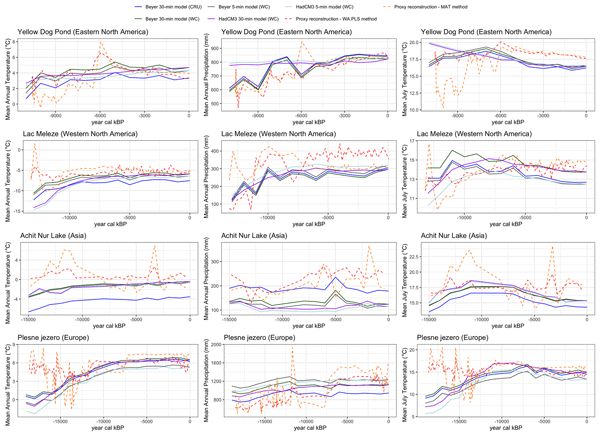
Very pleased to see our paper published online at Climate of the Past: cp.copernicus.org/articles/21/...
We present model-data comparisons of Late Quaternary climate across the Northern Hemisphere, showing that increasing model resolution has little net effect on coherence with pollen proxies 😊
New paper in collaboration with @lucytimbrell96.bsky.social and @jblinkhorn.bsky.social, with several of us involved (@mikleonardi.bsky.social @margheritac17.bsky.social @andreavpozzi.bsky.social) shows that downscaling palaeoclimate models doesn't necessarily improve coherence with proxy data.
10.07.2025 09:22 — 👍 8 🔁 5 💬 0 📌 0
Last week, Andrea sat down with Dr Chris Smith of Naked Scientists to talk about our paper on the expansion of the human niche 70k year ago: www.thenakedscientists.com/articles/int...
23.06.2025 13:14 — 👍 7 🔁 4 💬 1 📌 0
We are excited to announce that tidypopgen – a new package for rapid population genetic workflows in R – is now available at evolecolgroup.github.io/tidypopgen/ 🧬💻 Read more in the preprint describing its features here: www.biorxiv.org/content/10.1... #popgen #Rpackage #genetics 1/2
20.06.2025 12:19 — 👍 46 🔁 21 💬 2 📌 2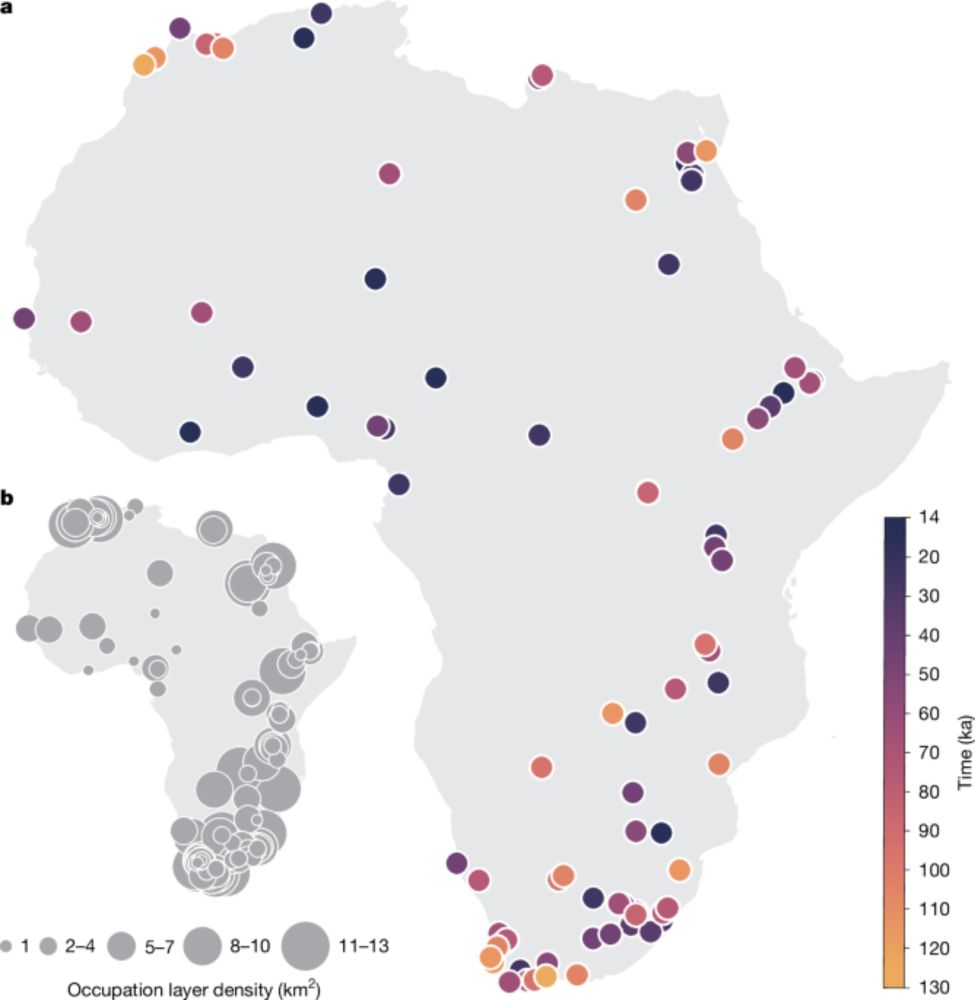
#newpaper now out in @nature.com!
A huge expansion of the human niche in Africa ~70 kya likely equipped later #outofAfrica dispersals with a unique ecological flexibility.
www.nature.com/articles/s41...
led by Emily Hallett, @mikleonardi.bsky.social, Andrea Manica, @elliescerri.bsky.social 1/4
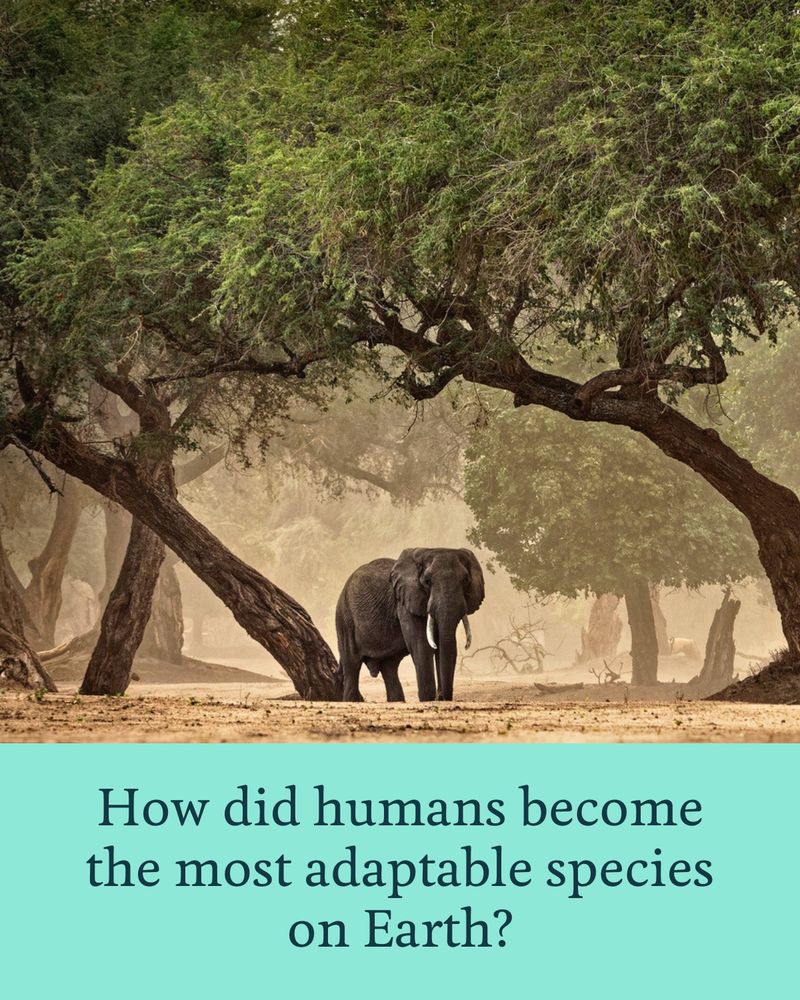
An elephant standing beneath large trees with text overlay that reads: 'How did humans become the most adaptable species on Earth?' Photo credit: Ondrej Pelanek and Martin Pelanek
Around 70,000 years ago, our ancestors in Africa began exploiting different habitats.
Flexibility to survive in deserts to rainforests enabled their successful spread ‘Out of Africa’.
Find out more about the study co-led by Andrea Manica @eegcam.bsky.social 👇
bit.ly/4e6i9H7
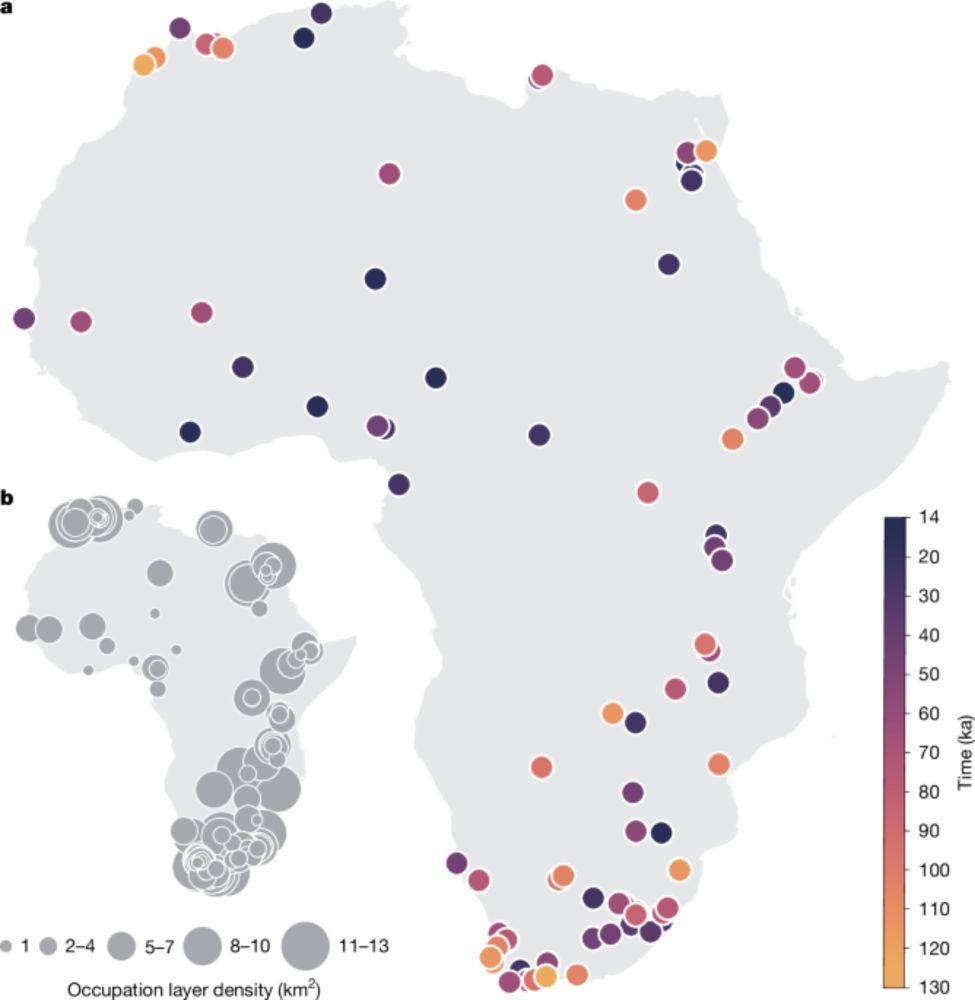
after 6 years, finally out in @nature.com!
Huge expansion of the human #niche in Africa ~70kya likely equipped later #outofAfrica dispersals with unique ecological flexibility
co-led with Emily Hallett @eegcam.bsky.social & @elliescerri.bsky.social
#prehistory #humanevolution #paleoecology #SDM
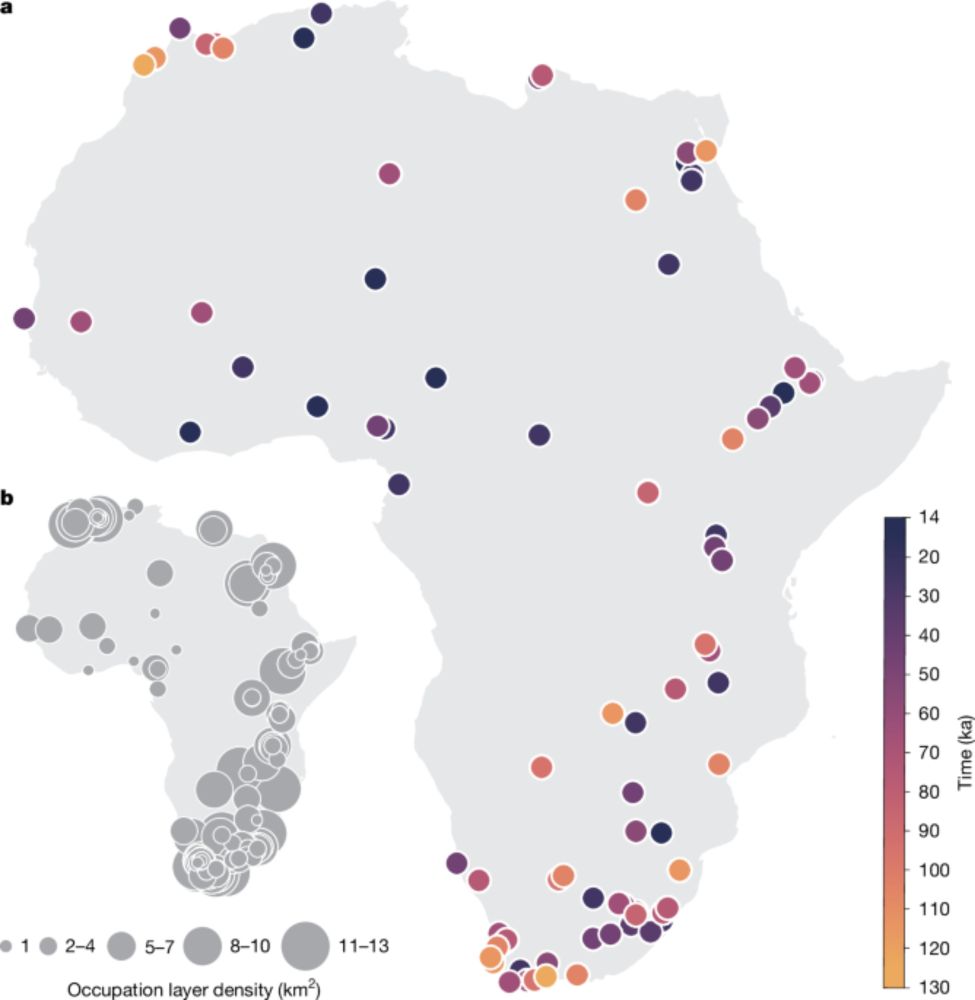
1/5 Why do all non-Africans descended from a group that left Africa 50k ago? In @nature.com we model 120k years of human niche dynamics. From 70ka, a big expansion of the human niche in Africa likely equipped later OOA dispersals with a unique ecological flexibilty.
www.nature.com/articles/s41...
Gift article about our work that also mentions our recently published paper in @nature.com on rainforests as well! Thank you @carlzimmer.com!
18.06.2025 15:24 — 👍 19 🔁 4 💬 0 📌 0
Massive congrats to the team on this amazing paper!
So happy for everyone involved!!👏

"When Humans Learned to Live Everywhere" www.nytimes.com/2025/06/18/s...
18.06.2025 15:28 — 👍 2 🔁 2 💬 0 📌 0
#HumanEvolution #Malaria #coevolution #pastdiseases #tidysdm 🦟
This is the result of incredible collaborations and hard work, thank you to all the people involved!

🚨 NEW preprint🚨 Our latest study @HPS MPI-GEA @elliescerri.bsky.social & @eegcam.bsky.social models #malaria risk over the past 74,000 years revealing its powerful role in shaping human habitat choice and dispersal since the late Pleistocene in sub-Saharan Africa 🦟🌍 www.biorxiv.org/content/10.1...
09.06.2025 16:13 — 👍 15 🔁 9 💬 2 📌 1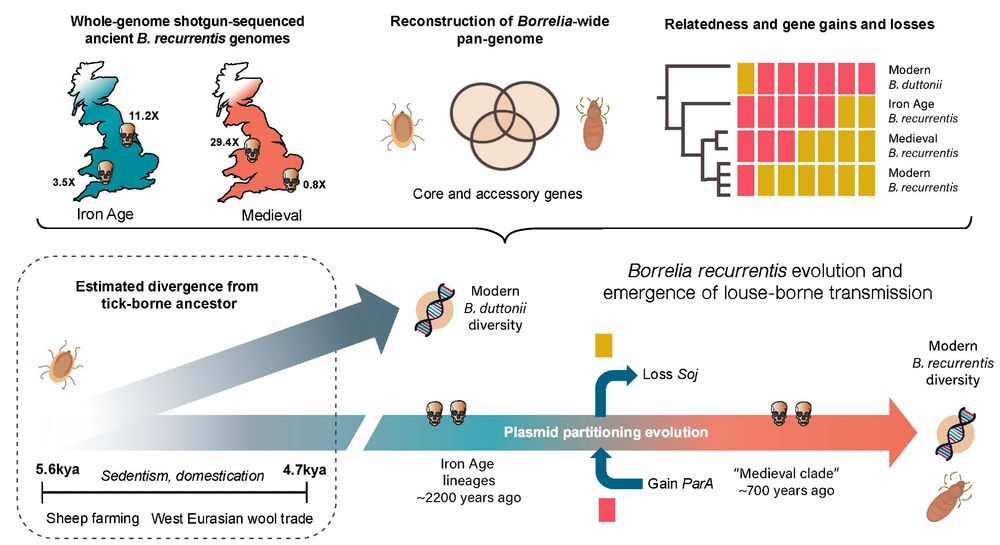
Excited to announce our paper on ancient Borrelia genomes is finally out! 🦠💀We document the evolutionary history of louse-borne relapsing fever, published today in @science.org with @lucyvandorp.bsky.social and @pontus-skoglund.bsky.social #aDNA 🏺🧪🧬
Main findings and paper below: 🧵⬇️
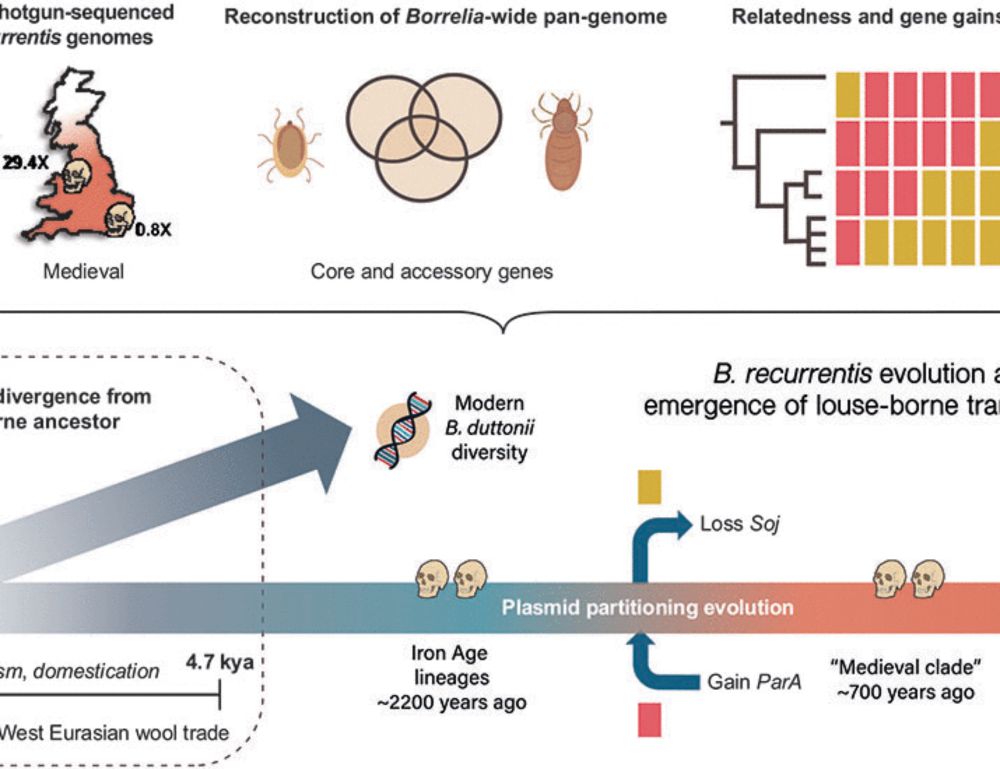
Our @ucl.ac.uk @crick.ac.uk work, out this week in @science.org, traces a genetic time series of bacterial infections to reveal when and how Borrelia recurrentis jumped from ticks to humans—via our body lice.
www.science.org/doi/10.1126/...

🚨NEW PAPER from the @eegcam.bsky.social!🚨I have never been as proud of something as of the work that finally we can share today: www.biorxiv.org/content/10.1... - we show how a climatically driven Pan African meta population model explains our species genetic and morphological diversity 🧬💀
23.05.2025 12:50 — 👍 60 🔁 28 💬 4 📌 3
Here is the latest news from @eegcam.bsky.social...
Among other VIPs (=very important publications), it includes our recent paper on Luca Cavalli-Sforza's legacy on #humanevolution 💀🧬
With @margheritac17.bsky.social Jason Hogdson, @chrisbstringer.bsky.social and @elliescerri.bsky.social
🧬💀 News from our lab: "New light on human evolution: recent papers and a podcast"💀🧬
www.zoo.cam.ac.uk/news/new-lig...
(1/17) We are thrilled to see our new paper ‘Hunter-gatherer sea voyages extended to remotest Mediterranean islands’ published in Nature. www.nature.com/articles/s41...
09.04.2025 15:10 — 👍 50 🔁 20 💬 2 📌 2
A blog post from me about our discovery pushing back Maltese prehistory to the Mesolithic, and discovering that hunter-gatherers were making epic 100 km sea journeys!
communities.springernature.com/posts/discov...

Join the Human Palaeosystems Group tomorrow (9th April 2pm CET) for a seminar by Dr Will Gosling on “Drivers of vegetation change in tropical Africa”
www.gea.mpg.de/129765/drive...