I couldn't find a tool to plot different #neuroimaging data in one consistent style, so I made one! Meet yabplot (yet another brain plot) - a #Python package for (sub)cortex & tracts.🧠
- Simple API
- Built-in atlases
- Custom atlas support
🔗 github.com/teanijarv/ya... (drop a ⭐️!)
02.03.2026 13:37 —
👍 38
🔁 15
💬 0
📌 0
#MedSky #neuroskyence #neurosky #alzsky #compneuro #datascience #neurology
09.02.2026 19:40 —
👍 2
🔁 0
💬 0
📌 0

A table showing profit margins of major publishers. A snippet of text related to this table is below.
1. The four-fold drain
1.1 Money
Currently, academic publishing is dominated by profit-oriented, multinational companies for
whom scientific knowledge is a commodity to be sold back to the academic community who
created it. The dominant four are Elsevier, Springer Nature, Wiley and Taylor & Francis,
which collectively generated over US$7.1 billion in revenue from journal publishing in 2024
alone, and over US$12 billion in profits between 2019 and 2024 (Table 1A). Their profit
margins have always been over 30% in the last five years, and for the largest publisher
(Elsevier) always over 37%.
Against many comparators, across many sectors, scientific publishing is one of the most
consistently profitable industries (Table S1). These financial arrangements make a substantial
difference to science budgets. In 2024, 46% of Elsevier revenues and 53% of Taylor &
Francis revenues were generated in North America, meaning that North American
researchers were charged over US$2.27 billion by just two for-profit publishers. The
Canadian research councils and the US National Science Foundation were allocated US$9.3
billion in that year.

A figure detailing the drain on researcher time.
1. The four-fold drain
1.2 Time
The number of papers published each year is growing faster than the scientific workforce,
with the number of papers per researcher almost doubling between 1996 and 2022 (Figure
1A). This reflects the fact that publishers’ commercial desire to publish (sell) more material
has aligned well with the competitive prestige culture in which publications help secure jobs,
grants, promotions, and awards. To the extent that this growth is driven by a pressure for
profit, rather than scholarly imperatives, it distorts the way researchers spend their time.
The publishing system depends on unpaid reviewer labour, estimated to be over 130 million
unpaid hours annually in 2020 alone (9). Researchers have complained about the demands of
peer-review for decades, but the scale of the problem is now worse, with editors reporting
widespread difficulties recruiting reviewers. The growth in publications involves not only the
authors’ time, but that of academic editors and reviewers who are dealing with so many
review demands.
Even more seriously, the imperative to produce ever more articles reshapes the nature of
scientific inquiry. Evidence across multiple fields shows that more papers result in
‘ossification’, not new ideas (10). It may seem paradoxical that more papers can slow
progress until one considers how it affects researchers’ time. While rewards remain tied to
volume, prestige, and impact of publications, researchers will be nudged away from riskier,
local, interdisciplinary, and long-term work. The result is a treadmill of constant activity with
limited progress whereas core scholarly practices – such as reading, reflecting and engaging
with others’ contributions – is de-prioritized. What looks like productivity often masks
intellectual exhaustion built on a demoralizing, narrowing scientific vision.

A table of profit margins across industries. The section of text related to this table is below:
1. The four-fold drain
1.1 Money
Currently, academic publishing is dominated by profit-oriented, multinational companies for
whom scientific knowledge is a commodity to be sold back to the academic community who
created it. The dominant four are Elsevier, Springer Nature, Wiley and Taylor & Francis,
which collectively generated over US$7.1 billion in revenue from journal publishing in 2024
alone, and over US$12 billion in profits between 2019 and 2024 (Table 1A). Their profit
margins have always been over 30% in the last five years, and for the largest publisher
(Elsevier) always over 37%.
Against many comparators, across many sectors, scientific publishing is one of the most
consistently profitable industries (Table S1). These financial arrangements make a substantial
difference to science budgets. In 2024, 46% of Elsevier revenues and 53% of Taylor &
Francis revenues were generated in North America, meaning that North American
researchers were charged over US$2.27 billion by just two for-profit publishers. The
Canadian research councils and the US National Science Foundation were allocated US$9.3
billion in that year.

The costs of inaction are plain: wasted public funds, lost researcher time, compromised
scientific integrity and eroded public trust. Today, the system rewards commercial publishers
first, and science second. Without bold action from the funders we risk continuing to pour
resources into a system that prioritizes profit over the advancement of scientific knowledge.
We wrote the Strain on scientific publishing to highlight the problems of time & trust. With a fantastic group of co-authors, we present The Drain of Scientific Publishing:
a 🧵 1/n
Drain: arxiv.org/abs/2511.04820
Strain: direct.mit.edu/qss/article/...
Oligopoly: direct.mit.edu/qss/article/...
11.11.2025 11:52 —
👍 640
🔁 453
💬 8
📌 66

 09.10.2025 02:44 —
👍 4
🔁 2
💬 0
📌 0
09.10.2025 02:44 —
👍 4
🔁 2
💬 0
📌 0
Really compelling evidence in humans for network propagation hypothesis of tau spread: individualized connectivity helps resolve individualized tau patterns.
#MedSky #neuroskyence #neurosky #alzsky #compneuro #ai #datascience #bioinformatics #neurology
08.10.2025 07:13 —
👍 19
🔁 6
💬 0
📌 0
I'm thrilled that our paper "Personalised regional modelling predicts tau progression in the human brain" is finally published in PLoS Biology!
Here's a short thread about the main findings of the paper...
11.08.2025 14:39 —
👍 15
🔁 6
💬 2
📌 0
🧵How to write and manage your first research budgets
The point of funding is to convert it into quality research. A well-spent research budget should fund the idea it was raised on, plus revision experiments, plus preliminary data for the next grant. So you need to spend, while avoiding waste.
03.09.2025 16:02 —
👍 106
🔁 36
💬 3
📌 9
Sure -- i guess the idea/hope here is that the information itself might actually be in the 3T image, but in such a manner that is not perceptible by humans, or quantifiable using current approaches. We've already seen some evidence of that, but we def need more clinical data to figure it out
25.07.2025 16:50 —
👍 1
🔁 0
💬 0
📌 0
Many included participants had fairly extensive brain atrophy due to old age and/or neurodegenerative disease. Or did you mean something else?
25.07.2025 05:11 —
👍 2
🔁 0
💬 1
📌 0
We need higher resolution brain scans for people with #MyalgicEncephalomyelitis. This is an exciting development that could lead to better clinical understanding for many of us. #Neuroskyence #medsky
23.07.2025 14:53 —
👍 8
🔁 2
💬 1
📌 0
If clinically validated, it could democratize access to advanced imaging, improve neuro-diagnostic precision, and streamline both research and patient care without requiring costly hardware upgrades.
A win for everyone
22.07.2025 15:29 —
👍 1
🔁 1
💬 0
📌 0
Led by brilliant MSc student Malo Gicquel and co-supervised by equally brilliant Gabrielle Flood. We also got great contributions from @anikawuestefeld.bsky.social @xiaoyucaly.bsky.social @rikossenkoppele.bsky.social @lemwisse.bsky.social @biofinder.bsky.social @davidberron.bsky.social
and others!
22.07.2025 03:34 —
👍 1
🔁 0
💬 1
📌 0
We are working on assessing utility of this 3T->7T model in clinical situations, improving it, making it more generalizable, and extending it to other sequences. Please get in contact if you have some paired 3T-7T data, even if its a small dataset!
22.07.2025 03:34 —
👍 0
🔁 0
💬 1
📌 0
This is super important — it means increasing the quality of the image is not just eye candy. It might actually improve some of the downstream tasks we use the MRI for, like segmentation and visual reads.
22.07.2025 03:34 —
👍 0
🔁 0
💬 1
📌 0

Most impressively, when we ran automated amygdala segmentation on the real 3T and synthetic 7T, the segmentations from the synthetic 7T better matched manual segmentations of the amygdala!!
22.07.2025 03:34 —
👍 1
🔁 0
💬 1
📌 0

Our models outperform existing models on this task in terms of traditional metrics. However, a set of four blinded radiologists and MRI professionals also subjectively rated the synthetic images to be of higher visual quality than the images they were synthesized from.
22.07.2025 03:34 —
👍 0
🔁 0
💬 1
📌 0

Shockingly, when applied to unseen 3T scans, our models produce synthetic scans that resemble the original images, but sharper and with better contrast, while avoiding common artifacts seen on 7T scans.
22.07.2025 03:34 —
👍 1
🔁 0
💬 1
📌 0

We exploited a valuable dataset of 172 cognitively impaired and unimpaired older people from
@biofinder.bsky.social with paired 3T and a 7T T1-weighted scans. To this dataset, we apply our own specialized U-Net and GAN U-Net model, as well as some previously described models.
22.07.2025 03:34 —
👍 0
🔁 0
💬 1
📌 0
To improve accessibility of these high quality scans, we look to synthetic AI “super-resolution”, which has already been successful in brining lower field (0.5T - 1.5T) to 3T resolution.
22.07.2025 03:34 —
👍 0
🔁 0
💬 1
📌 0

Ultra-High Field MRI scanners - Google My Maps
All human MRI scanners with field >= 7T,
corrections welcome (renzohuber@gmail.com).
Thanks to Allen Waggoner for many edits and updates.
7 Tesla (7T) MRI is important for studying fine anatomical morphology, and has found important applications in clinical research centers focusing on epilepsy and MS. But, its ceiling is underexplored; <150 7T scanners exist worldwide!
7T world map: google.com/maps/d/u/0/v...
22.07.2025 03:34 —
👍 0
🔁 0
💬 1
📌 0
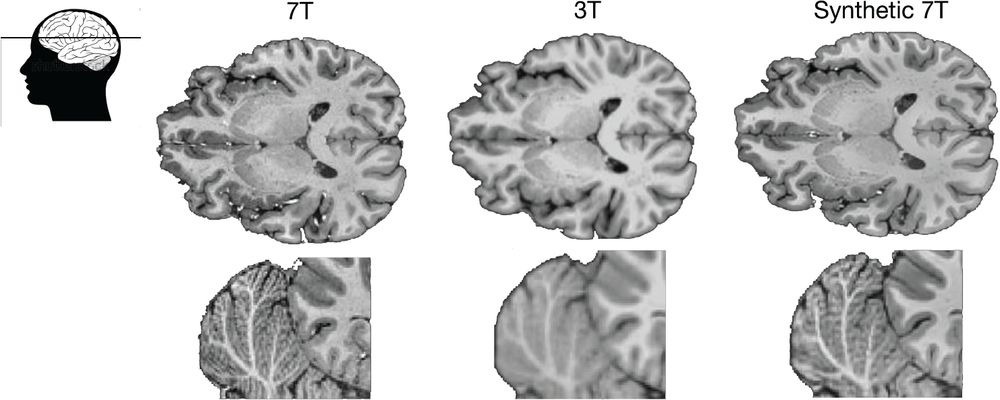
‼️NEW PREPRINT‼️
What if you could take a normal 3T T1w MRI and make it look like it was acquired from a 7T scanner?
That's exactly what we do using AI in our new preprint!
Link: arxiv.org/abs/2507.13782
#neuroskyence #neurosky #compneuro #AI #datascience #neurology #mrisky #neuroimaging
22.07.2025 03:34 —
👍 48
🔁 18
💬 1
📌 3
Incredibly excited for this new work from our lab. We test the potential of AI-based neurodegenerative disease diagnostics using plasma proteomics data from n>17,000 people, led by the brilliant and indefatigable @anlijuncn.bsky.social Check it out!👇
17.07.2025 05:51 —
👍 3
🔁 2
💬 0
📌 0
EMERGE
Have recent changes led to uncertainty in your future scientific career?
Wonder it's like in Australia?
Good news!
Monash's is seeking to hire talented EMCRs from other countries.
Come join a wonderful community of brain mappers & modellers!
www.monash.edu/research/eme...
27.05.2025 22:49 —
👍 48
🔁 31
💬 1
📌 2
‼️Preprint alert‼️
Star PhD student @jorittmo.bsky.social uses functional gradients as a framework to study longitudinal brain functional reorganization in aging and AD.
Check out the thread
👇🏼
#MedSky #neuroskyence #neurosky #alzsky #compneuro #MRI #neuroimaging
#neurology
27.05.2025 16:20 —
👍 14
🔁 2
💬 1
📌 0
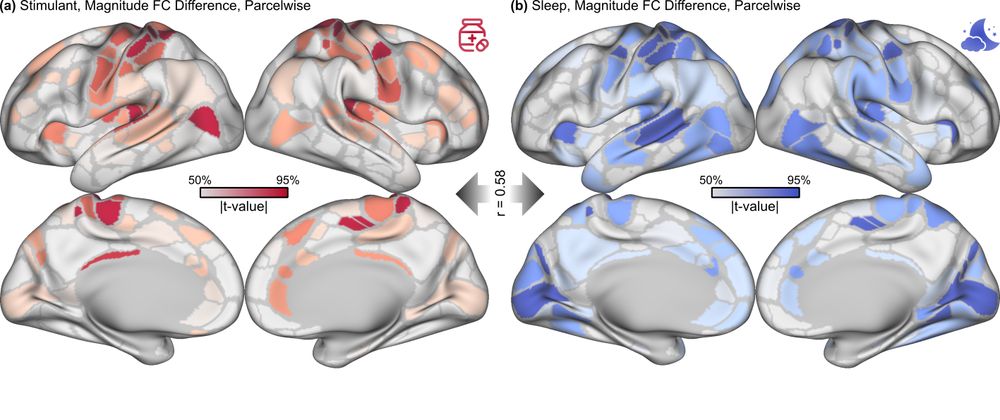
My med school textbook says stimulants like Ritalin treat hyperactivity by “stimulating” the brain’s attention and cognitive control systems. We studied children taking stimulants in the ABCD Study, and the largest differences were actually in arousal and reward networks! Check out our preprint!
22.05.2025 21:33 —
👍 145
🔁 55
💬 11
📌 10

a man applauds with the words so proud of my team above him
ALT: a man applauds with the words so proud of my team above him
Excited to share the first major piece of work and preprint from my lab! Led by Jason Kim! 🥳🎉🤘
www.biorxiv.org/content/10.1...
28.04.2025 12:56 —
👍 45
🔁 23
💬 3
📌 4
‼️New preprint!
We are happy to share our latest work led by @teanijarv.bsky.social investigating why tau pathology in AD often accumulates more in one hemisphere of the brain than the other.
Check out 🔗https://biorxiv.org/content/10.1101/2025.04.15.648728v1 or dive into the details below👇
25.04.2025 09:34 —
👍 4
🔁 4
💬 1
📌 1
🧠Exciting new findings from a great collaboration between the BioFINDER study and the talented
@xiaoyucaly.bsky.social from @jwvogel.bsky.social group!! In their preprint, they show that tau presence and tau load are guided by unique brain mechanisms. Dive into the details here 👇
25.04.2025 09:38 —
👍 2
🔁 3
💬 0
📌 0