Oliver Wenger's Avatar

Oliver Wenger

@wengeroliver.bsky.social

Professor of Chemistry at University of Basel, Switzerland

1,482 Followers  |  435 Following  |  18 Posts  |  Joined: 08.12.2023
Posts Following

Posts by Oliver Wenger (@wengeroliver.bsky.social)

Preview
Switching Spin‐States: Spin Crossover vs. Coordination‐Induced Spin‐State Switching The total spin of a metal center can be switched in different ways. In this concept, the phenomenon spin crossover is compared with coordination-induced spin-state switching. The impact of the switch....

Switching Spin‐States: Spin Crossover vs. Coordination‐Induced Spin‐State Switching - Hörner - 2024 - European Journal of Inorganic Chemistry - Wiley Online Library chemistry-europe.onlinelibrary.wiley.com/doi/full/10....

26.02.2026 15:12 — 👍 5    🔁 2    💬 0    📌 0
Preview
Controlling Redox and Photophysical Properties of First-Row Transition Metal Complexes via Ligand Perhalogenation Halogenation of ligands intensely modulates the redox and photophysical properties of transition-metal complexes, yet fully halogenated systems remain largely unexplored. Here we report the synthesis ...

What happens if you substitute all protons by halogens in a photoactive complex?
In our new publication, we show how ligand perhalogenation reshapes redox & photophysical properties in Ni(0) complexes.
@wengeroliver.bsky.social in cooperation with Malischeski-group
doi.org/10.1021/acs....

02.03.2026 08:22 — 👍 6    🔁 1    💬 0    📌 0
Preview
Sensor system for hard-to-differentiate volatile scent compounds

Researchers from the SNI network have developed a new sensor system based on platinum #nanostructures that allows the optical differentiation of terpene enantiomers at the molecular level. Published in @angewandtechemie.bsky.social

nanoscience.unibas.ch/en/news/deta...
@unibas.ch #nanoscience

04.02.2026 16:11 — 👍 2    🔁 1    💬 0    📌 0
Preview
Expanding Thermodynamic and Kinetic Frontiers in Molecular Photocatalysis Visible photons carry significantly more energy than the thermal energies typically used to overcome activation barriers in conventional chemistry. This thermodynamic advantage enables photochemical reactions that are inaccessible from electronic ground states. However, photochemistry also faces a kinetic challenge: excited states are inherently short-lived, necessitating rapid reactivity before their decay. In this Outlook, we explore the unique interplay of thermodynamics and kinetics in molecular photochemistry. We highlight current limits and knowledge gaps and propose directions for advancing the conceptual framework of photocatalysis. Topics include the design of photocatalysts with extreme redox potentials, the use of solvated electrons and visible-to-UV upconversion, and the potential to bypass Kasha’s rule for higher-energy photochemical processes. Our aim is to survey strategies for pushing the boundaries of photocatalysis and to inspire future conceptual innovation in the field.

Expanding Thermodynamic and Kinetic Frontiers in Molecular Photocatalysis

Extreme redox potentials, solvated electrons, upconversion, ultrafast photo-dissociation, slow uphill reactions and beyond

@pubs.acs.org

pubs.acs.org/doi/10.1021/...

23.01.2026 08:23 — 👍 6    🔁 2    💬 0    📌 0
Preview
Supramolecular Assembly of a Macrocyclic Rhodium(I) Isocyanide Complex with Long-Lived Near-Infrared Luminescence Strategic ligand engineering is essential for the development of new photoactive transition metal complexes. One such application is the control of supramolecular, one-dimensional stacking of square-planar d8-organometallic systems. Here, we report the synthesis of a macrocyclic, tetradentate isocyanide ligand, CN4, and facile coordination to rhodium(I) yielding [Rh(CN4)][BArF4]. Single-crystal X-ray diffraction upon acetone-solution grown crystals reveals formation of a tetrameric RhI stack, constructed of two dimeric forms of monomers. UV–visible absorption spectroscopy shows two prominent absorption bands, assigned to dimer (525 nm) and tetramer (840 nm), confirming stacked species. These assignments are further supported by DOSY measurements. Solvent control over this equilibrium is achieved first with acetonitrile, favoring only tetrameric aggregation, and also with dichloromethane, disabling aggregation completely. Upon excitation, the monomeric form returns to its electronic ground state in less than 10 ns. The near-infrared-absorbing tetramer exhibits an excited state with a lifetime of 150 ns in deaerated acetonitrile and NIR-II emission at 1040 nm. This discovery provides new opportunities for innovation in photophysics and photochemistry through polynuclear architectures that exhibit emergent properties compared to traditional mononuclear transition metal complexes.

Macrocyclic Rh(I) complexes stack into tetramers and unlock red absorption and NIR luminescence

Alex Bukvic and Mathis Brändlin in @jacs.acspublications.org

pubs.acs.org/doi/10.1021/...

14.11.2025 11:15 — 👍 17    🔁 2    💬 1    📌 0
Preview
Homomolecular Photon Upconversion in a Perylene-Decorated Iron(III) Complex Classical upconversion employs sensitizers and annihilators as two distinct molecular species and is, therefore, classified as heteromolecular. Homomolecular upconversion, the unification of both role...

A molecular dyad of an iron complex covalently bound to an annihilator exhibits three photoactive excited states — singlet, doublet, and triplet — enabling homomolecular upconversion

Florian Doettinger, Jonathan Sagaya, Giacomo Morselli in @jacs.acspublications.org

pubs.acs.org/doi/10.1021/...

09.11.2025 14:40 — 👍 24    🔁 6    💬 0    📌 0
Preview
The photophysics of photoredox catalysis: a roadmap for catalyst design Recently, the use of transition metal based chromophores as photo-induced single-electron transfer reagents in synthetic organic chemistry has opened up a wealth of possibilities for reinventing known...

pubs.rsc.org/en/content/a...

pubs.rsc.org/en/content/a...

pubs.aip.org/aip/cpr/arti...

www.cell.com/chem-catalys...

28.10.2025 12:05 — 👍 7    🔁 0    💬 1    📌 0
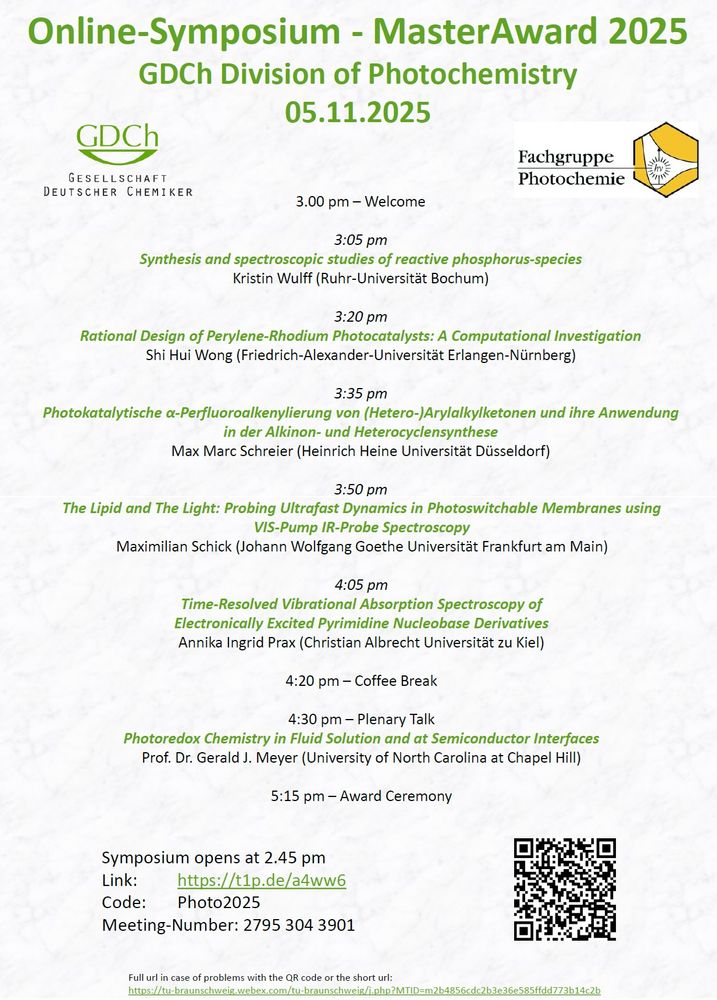
Post image

The first online symposium organized by the @gdch.de Division of Photochemistry will take place next week (Nov. 5, 2025, 3 pm CET zone).
tu-braunschweig.webex.com/tu-braunschw...
key: Photo2025
5 talks by talented students (one will be awarded🎉) followed by a plenary lecture. Save the date. ✍️

28.10.2025 07:57 — 👍 5    🔁 3    💬 0    📌 1
Preview
Spin-State and Reorganization Energy Considerations for Metal-Centered Photoredox Catalysis Transition-metal complexes featuring metal-centered excited states have recently emerged as mechanistically distinct platforms for selective photochemistry, including photoredox catalysis. Among these...

Exploring metal-centered photoredox reactivity? 🚀Don’t forget to look at the spin-state landscape and the role of reorganisation energy, they can make a difference 😉

Huge thanks to Bekah for leading the experiments and shaping the story🥳 a true collaborative effort!😃

pubs.acs.org/doi/10.1021/...

16.10.2025 15:58 — 👍 8    🔁 3    💬 1    📌 0
Preview
Molecular Design Principles for Achieving High-Efficiency Light-Induced Charge Separation at the Nanometer Scale The light-induced separation of charges, fundamental to natural photosynthesis, is key to converting solar energy into chemical energy in artificial systems. One challenge is that charges tend to spon...

Molecular Design Principles for Achieving High-Efficiency Light-Induced Charge Separation at the Nanometer Scale

Mathis Brändlin and Felix Himmelreich in jacsau.bsky.social

pubs.acs.org/doi/full/10....

15.10.2025 07:16 — 👍 7    🔁 3    💬 0    📌 0
Post image

Excited to share the publication of “Enhancing the Statistical Probability Factor in Triplet-Triplet Annihilation Photon Upconversion via TIPS Functionalization” in @chemicalscience.rsc.org

pubs.rsc.org/en/content/a...

07.10.2025 08:44 — 👍 11    🔁 6    💬 1    📌 1
Preview
Photoswitches beyond azobenzene: a beginner’s guide Beilstein Journal of Organic Chemistry

Learn more about photoswitches!
This review describes the synthesis, structure–property relationships, and examples of applications for seven important classes of photoswitches
doi.org/10.3762/bjoc...

25.09.2025 11:28 — 👍 7    🔁 5    💬 0    📌 0
Post image

Julian's manuscript dealing with a novel biphenyl annihilator and unusual effects of different substituents. Is it a new benchmark system for blue-to-UV upconversion? Read about it here: chemrxiv.org/engage/chemr...
Many thanks to our collaboration partner @nobuhiroyanai.bsky.social and Masanori.

12.09.2025 11:51 — 👍 10    🔁 1    💬 0    📌 0

Well done @labheinze.bsky.social and team! 👏🏼

11.09.2025 21:27 — 👍 8    🔁 2    💬 1    📌 0
Preview
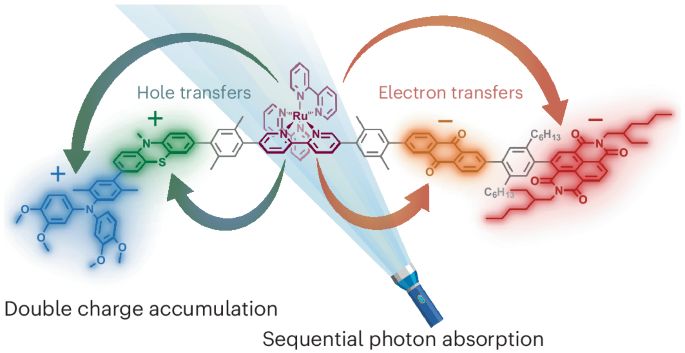
Photoinduced double charge accumulation in a molecular compound - Nature Chemistry The photoinduced accumulation of redox equivalents is a challenging requirement for artificial photosynthesis. Now a molecule has been developed in which the sequential absorption of photons results in the temporary accumulation of two holes and two electrons. The employed strategy opens up new possibilities for charge accumulation under low photon densities.

The results of a study in Nature Chemistry represent a step towards more application-oriented research on solar fuels from fundamental studies of photoinduced (single) electron transfer. #chemsky 🧪

30.08.2025 19:17 — 👍 34    🔁 5    💬 0    📌 0

Many thanks, Sascha. All the credit belongs to Mathis

27.08.2025 11:02 — 👍 3    🔁 0    💬 0    📌 0
Preview
Photoinduced double charge accumulation in a molecular compound - Nature Chemistry The photoinduced accumulation of redox equivalents is a challenging requirement for artificial photosynthesis. Now a molecule has been developed in which the sequential absorption of photons results i...

New molecular design absorbs 2 photons to store 2 positive and 2 negative charges

100 ns lifetime, 3 eV energy storage, and 37% quantum yield

A step toward multi-electron photochemistry

Mathis Brändlin and @bjoernpfund.bsky.social in @natchem.nature.com

www.nature.com/articles/s41...

27.08.2025 08:14 — 👍 58    🔁 17    💬 2    📌 0
Preview
Mechanistic Insights into Visible-Light-Induced ATRA Reactions Powered by the Symbiotic Relationship between Cu(II)/Cu(I) Phenanthroline Complexes As photoredox catalysis continues to yield promising chemical transformations, there is an increased need to understand how specific photocatalysts function to improve reaction efficiencies while expa...

Congrats to Sarah for this thorough mechanistic study on a Cu(II)/Cu(I) photocycle, now available in ACS Catalysis:
pubs.acs.org/doi/10.1021/...

26.08.2025 15:33 — 👍 7    🔁 3    💬 0    📌 0
Preview
Chemists develop molecule for important step toward artificial photosynthesis A research team from the University of Basel has developed a new molecule modeled on plant photosynthesis: under the influence of light, it stores two positive and two negative charges at the same tim...

Artificial photosynthesis could be the key to environmentally friendly fuels. A research team led by @wengeroliver.bsky.social has developed a special molecule that can store four charges simultaneously under light irradiation. Wenger calls this molecule "an important piece of the puzzle."

25.08.2025 09:39 — 👍 13    🔁 3    💬 0    📌 0
https://pubs.acs.org/doi/10.1021/acscentsci.5c01040

Beautiful work!!
Using fsTA, we discovered that charge separation mediates Energy Transfer in the long-lived⏳ iron complex-anthracene dyad designed and synthesized by Felix Glaser & @ludotroian.bsky.social - just published in ACS Central Science @pubs.acs.org 🥳

t.co/14xmp6kvHS

15.08.2025 19:34 — 👍 6    🔁 4    💬 0    📌 0

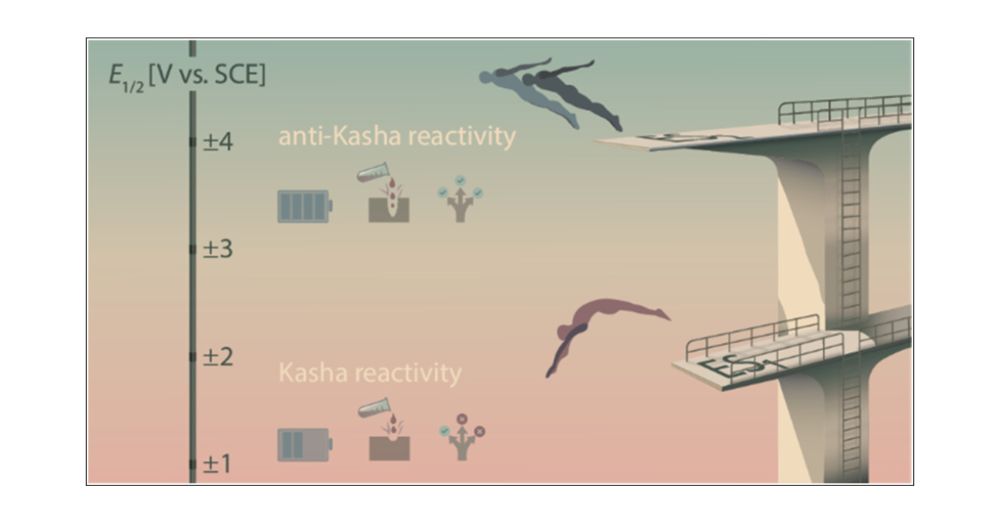
Thrilled to share our new JACS paper on anti-Kasha photoreactivity!
We show that higher-lying excited states can drive electron transfer — opening new doors for photoredox catalysis.
Huge thanks to @wengeroliver.bsky.social for the incredible mentorship!

pubs.acs.org/doi/10.1021/...

18.07.2025 10:03 — 👍 9    🔁 1    💬 0    📌 0
Preview
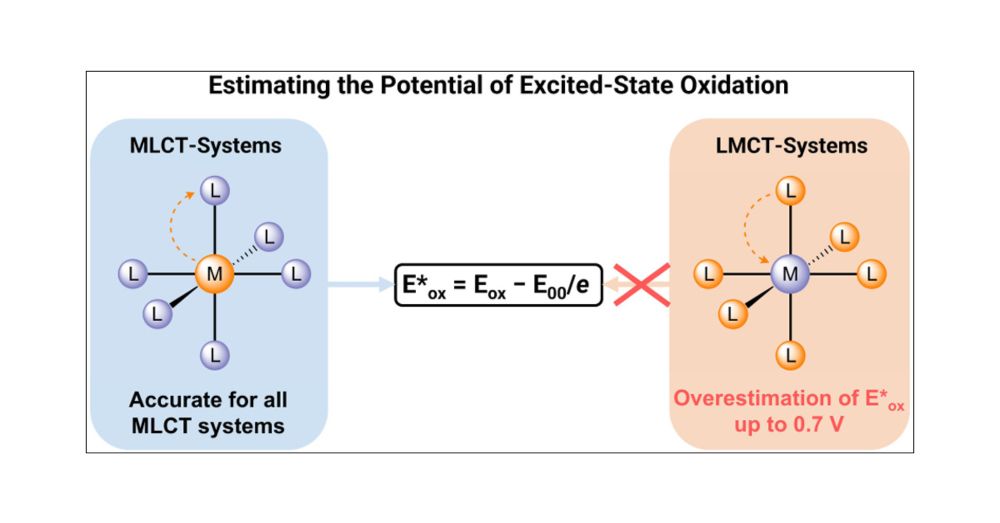
Rethinking the Excited-State Redox Properties of Iron(III) Complexes for LMCT Photoredox Catalysis The reduction potentials of electronically excited states are crucial input values for photoredox reaction design. Since they are not directly measurable, they are typically estimated from the corresp...

Rethinking Iron Photoredox Catalysis

For Fe(III) complexes, excited-state redox potentials don’t follow the usual rules - standard estimation methods fall short

Joël Wellauer with Paul Francis & colleagues at Deakin University in @jacs.acspublications.org

pubs.acs.org/doi/10.1021/...

04.08.2025 13:48 — 👍 20    🔁 5    💬 0    📌 1
Preview
Revisiting CNC6F5: The Quest for Isocyanide Ligands with Strong π-Acceptor Properties Evaluated by Energy Decomposition Analysis While perfluorinated isocyanide ligands such as CNCF3 and CNC6F5 have been known for decades, their use by organometallic chemists has been limited primarily due to the challenges associated with their cumbersome synthesis. In this study, we present an improved synthetic route to [Cr(CO)5(CNC6F5)] and present its structural characterization. For a set of isocyanide ligands (CNC6H5, p-CNC6H4F, CNCH3) and their perfluorinated counterparts (CNC6F5, CNCF3), Gibbs energies of complexation have been calculated with regard to a series of isoelectronic metal fragments [V(CO)5]−, [Cr(CO)5], [Mn(CO)5]+, and [Fe(CO)5]2+. Furthermore, the σ-donor and π-acceptor properties of these isocyanide ligands in the resulting complexes were analyzed using the EDA-NOCV method. For completeness, we have also included ligands such as CO, CNH, and N2 into the analysis. While only minor differences in complexation energies are observed for the Cr(CO)5 fragment, more pronounced effects have been observed for the charged complexes. Interestingly, perfluorinated isocyanide ligands show in all cases higher complexation energies than the carbonyl ligands, indicating their strong binding to metal centers. Their pronounced σ-donor and π-acceptor abilities reveal their potential suitability to stabilize metal centers in both positive and negative oxidation states.

New paper out in ACS Omega:
We compare the σ-donor and π-acceptor properties of fluorinated isocyanide complexes with their non-fluorinated analogues using the EDA-NOCV method.

🔗 pubs.acs.org/doi/10.1021/...
#InorganicChemistry #Organometallics #ComputationalChemistry

31.07.2025 13:52 — 👍 5    🔁 1    💬 0    📌 0
Home | Research Group Schmid | University of Basel

💥 We have 3 positions open in my lab in Basel, Switzerland🇨🇭:
#nanopores #smFRET #biomolecular #dynamics #singleMolecules

We’re looking for talented & ambitious new colleagues enthusiastic about biomolecular dynamics & single-molecule tech.

Please share broadly, thank you!🤝

schmid.chemie.unibas.ch

31.07.2025 14:34 — 👍 36    🔁 33    💬 2    📌 1
Preview
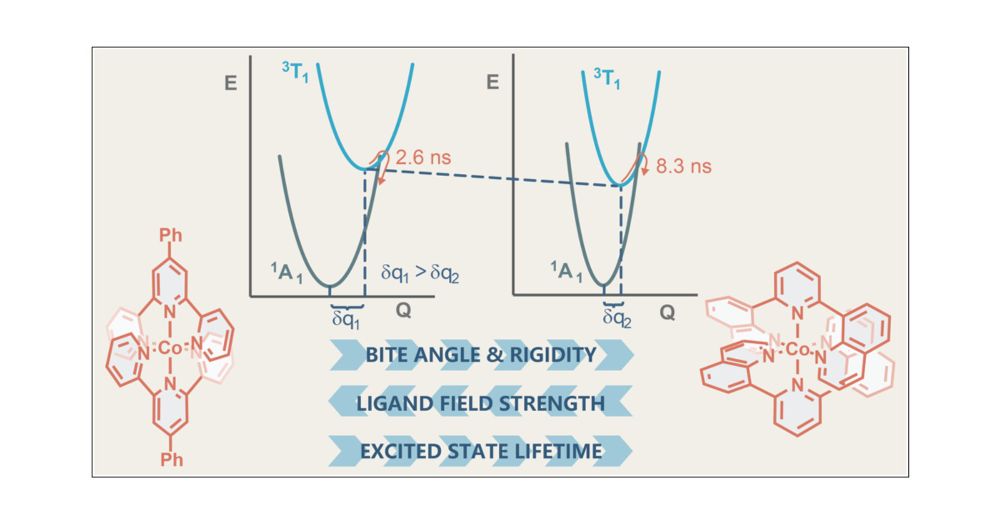
Structural Control of Metal-Centered Excited States in Cobalt(III) Complexes via Bite Angle and π–π Interactions CoIII complexes have recently become an important focus in photophysics and photoredox catalysis due to metal-centered excited states with strong oxidizing properties. Optimizing chelate ligand bite a...

Bite angle optimization weakens ligand fields in cobalt(III) complexes, yet lifetimes can increase due to rigidification

pi-donor (instead of pi-acceptor) ligand properties are key

now in @jacs.acspublications.org

pubs.acs.org/doi/10.1021/...

31.07.2025 07:35 — 👍 19    🔁 3    💬 0    📌 0
Preview
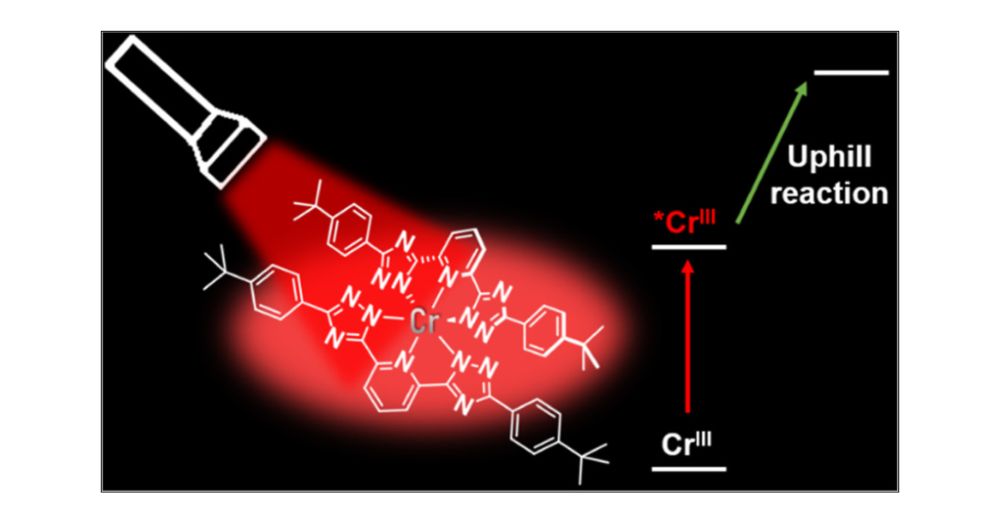
Pushing the Thermodynamic and Kinetic Limits of Near-Infrared Emissive CrIII Complexes in Photocatalysis Photoactive CrIII complexes are typically based on polypyridine coordination environments, exhibit red luminescence, and are good photo-oxidants but have modest photoreducing properties. We report new...

Cr(III) complexes with enhanced metal–ligand covalency enable tunable NIR luminescence and red-light photoreduction.

@giacomo-morselli94.bsky.social & team find signs of doublet–doublet annihilation, or excited-state disproportionation.

In @jacs.acspublications.org

pubs.acs.org/doi/10.1021/...

29.07.2025 07:20 — 👍 20    🔁 7    💬 0    📌 0
Preview
Breaking Kasha’s Rule to Enable Higher Reactivity in Photoredox Catalysis Nearly all photochemical transformations known to date follow Kasha’s rule, implying that reactions occur only from the lowest electronically excited state of a given spin multiplicity due to the fast...

We show how photoredox catalysis can bypass Kasha’s rule, enabling reactions from higher excited states.

This work, led by the exceptional @bjoernpfund.bsky.social, offers new insights into photochemical reactivity.

Published in JACS @jacs.acspublications.org

bit.ly/3IysmjX

18.07.2025 07:00 — 👍 37    🔁 12    💬 3    📌 1
Preview
Broadband transient full-Stokes luminescence spectroscopy - Nature A high-sensitivity, broadband, transient, full-Stokes spectroscopy setup is demonstrated, which can detect quickly varying small signals from chiral emitters.

Excited to share in @nature.com today: Broadband transient full-Stokes luminescence spectroscopy - detecting the most subtle changes in light polarization over time with unprecedented sensitivity. Grateful for the team that made this possible!😊 www.nature.com/articles/s41... #chirality #light

26.06.2025 06:23 — 👍 41    🔁 14    💬 0    📌 0
Post image

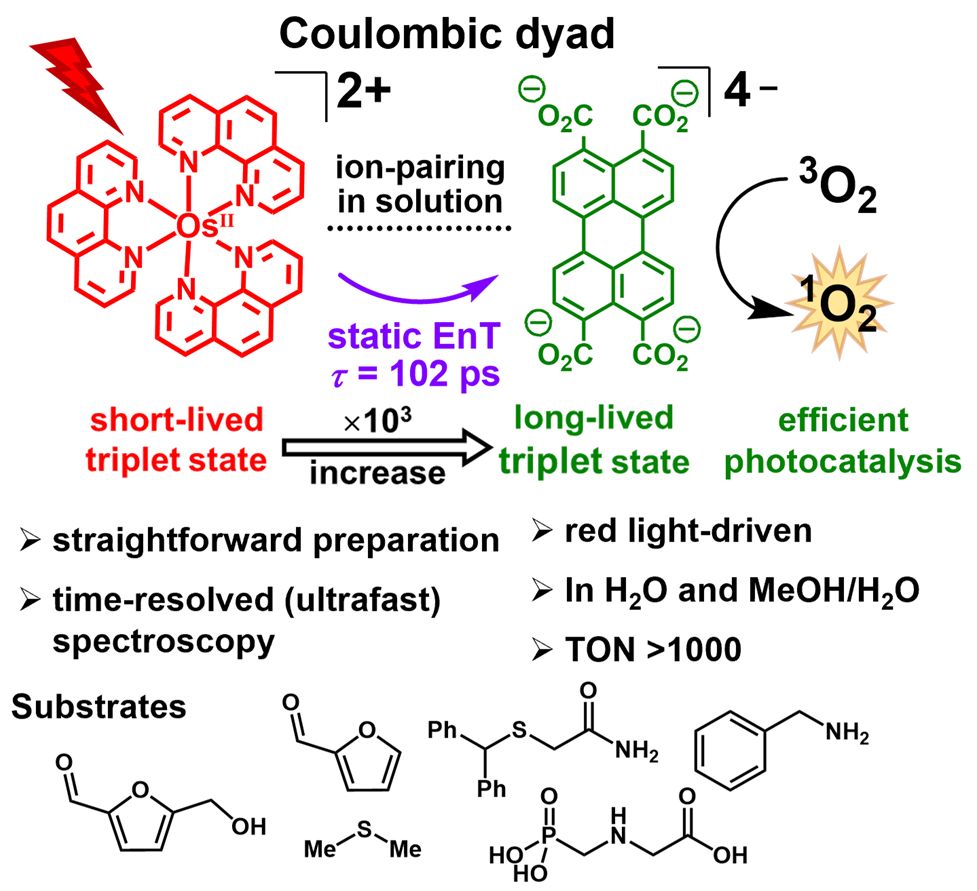
The next masterpiece from Matthias focusing on Coulombic dyads as new #photocatalyst class has been accepted in ACIE. Higher quantum yields in red-light catalysis by adding an inexpensive salt to use #Os as efficiently as possible. onlinelibrary.wiley.com/doi/10.1002/... @labheinze.bsky.social

24.06.2025 18:41 — 👍 21    🔁 9    💬 0    📌 0

Preview
Ultrafast nonradiative relaxation limits the efficiency of photoinduced bond homolysis in molecular LMCT photocatalysts Ligand-to-metal charge transfer photocatalysts (LMCT PCs) are being increasingly implemented towards construction and functionalization of organic molecules. Leveraging photoinduced metal-ligand bond ...

I’m excited to share my lab’s first research article! LMCT photocatalysts are interesting and poorly understood chromophores. We dive into their photophysics to see what limits their photoreactivity, finding an unusual and pervasive competing pathway to homolysis!

chemrxiv.org/engage/chemr...

05.06.2025 14:18 — 👍 12    🔁 1    💬 2    📌 0