A group of smiling paleontologists standing in front of signs reading "REGISTRATION" and "SVP 2025." Photo credit: Sam Giles.
Michigan paleontology family portrait, Birmingham edition #2025SVP
15.11.2025 18:04 — 👍 51 🔁 7 💬 0 📌 0
@acapomorphic.bsky.social
Vertebrate paleontologist and evolutionary biologist, currently postdoc at LMU Munich. In a love-hate relationship with phylogenies :D
A group of smiling paleontologists standing in front of signs reading "REGISTRATION" and "SVP 2025." Photo credit: Sam Giles.
Michigan paleontology family portrait, Birmingham edition #2025SVP
15.11.2025 18:04 — 👍 51 🔁 7 💬 0 📌 0
#2025SVP #SVP2025 Final Banquet loading... ⏳⏳⌛
15.11.2025 17:17 — 👍 15 🔁 2 💬 0 📌 1
I'll be presenting a poster at #2025SVP #SVP2025 about my recently published work on how many characters are needed to reconstruct a phylogeny. Come by at the poster session this Thursday if you want to chat about it! royalsocietypublishing.org/doi/abs/10.1...
11.11.2025 19:51 — 👍 16 🔁 6 💬 0 📌 0Ah, I see! That is definitely true, but that same character discretized vs in its continuous form carries a very different quantity of information. If modeled properly (maybe a big if), one continuous character should have more information content to estimate a phylogeny than its discretized version
16.10.2025 13:56 — 👍 1 🔁 0 💬 1 📌 0I like the optimism there! I guess what would be good to know is: given the amount of "perturbation" from the true phylogeny that I can expect based on the size of my data, are the main patterns I'm interested in (diversification, biogeography, phenotypic evolution) robust to that much perturbation?
16.10.2025 13:48 — 👍 2 🔁 0 💬 1 📌 0Continuous characters are not that commonly used in Bayesian morphological phylogenetics though. I want to believe that those can be a mostly unexplored source of information to infer evolutionary relationships, although I'm very aware that they come with their own set of issues and limitations
16.10.2025 10:16 — 👍 2 🔁 0 💬 1 📌 0In my simulation, a phylogeny inferred for 50 taxa with 50 binary characters on average has 50% of the nodes wrong (and this is with no model misspecification and no missing data). What can we do about it? I don't have any clear/easy solution, but at the same time I don't want to be too pessimistic
16.10.2025 10:11 — 👍 2 🔁 0 💬 1 📌 0I totally agree, for some systems there is possibly an intrinsic limit on the number of (more or less) independent variable characters that can be defined and scored that is lower than 100. Then the question is: what can we do for those? Do we just accept that our phylo estimates will always be off?
16.10.2025 10:01 — 👍 2 🔁 0 💬 2 📌 0Thank you! I would expect that adding rate heterogeneity to the model (which means adding parameters) would require at least the same minimum number of characters, if not more.
16.10.2025 09:56 — 👍 4 🔁 0 💬 0 📌 0Problem: a lot of empirical morphological datasets have fewer than 100 characters, and way fewer than 500. Possible solutions? Continuous characters; total-evidence datasets; more funding, hiring, training targeted towards characterization and digitization of interspecific morphological diversity.
15.10.2025 09:28 — 👍 15 🔁 0 💬 2 📌 0An important point: the 100-500 chars threshold refers to an ideal scenario where we know under which model the data evolved (no model misspecification), this model is relatively simple (few parameters to infer), and there is no missing data. Thus, this should be taken as a very minimum number.
15.10.2025 09:28 — 👍 8 🔁 0 💬 1 📌 0One intriguing empirical application of these findings is that, for more than 50 taxa, characters that change multiple times independently across the tree (homoplastic characters) improve tree reconstruction compared to characters that change only once (synapomorphies and autapomorphies).
15.10.2025 09:28 — 👍 10 🔁 0 💬 2 📌 1
Overall, between 100 and 500 variable characters are necessary to reach sufficient accuracy and precision of phylogenetic estimates for as low as 20 taxa. This is relevant not only for morphological phylogenetics, but also for gene trees and SNP-based estimates, and for Bayesian phylolinguistics.
15.10.2025 09:28 — 👍 6 🔁 0 💬 1 📌 0
Three different metrics of accuracy and precision were used to evaluate how good was the phylogenetic inference. General resulting patterns: more characters are better; more states are better (but this has little effect for >50 taxa); more taxa are worse for short trees, but better for long trees.
15.10.2025 09:28 — 👍 5 🔁 0 💬 1 📌 0
I designed this simulation study in RevBayes to perfectly match the models used for sim and inference. Any differences between the true tree generating data and the inferred tree(s) are due to dataset size. Parameters that varied across sims are: # characters, # taxa, tree length, and # states.
15.10.2025 09:28 — 👍 7 🔁 0 💬 1 📌 0
Out now in Biology Letters, my latest paper tackles an apparently simple question: how many characters are needed to reconstruct a phylogeny? TL;DR: in most cases between 100 and 500, more than a substantial portion of morphological datasets, but the story is more complex... doi.org/10.1098/rsbl...
15.10.2025 09:28 — 👍 90 🔁 48 💬 1 📌 1Just in time for #FossilFriday 🦖 What are the big questions in #paleontology today?
dx.doi.org/10.1017/pab.2025.10042
Nearly 200 scientists worldwide came together to map where our field is headed. Here’s the story 👇

What are the biggest questions in #paleontology? New paper out today in Paleobiology led by Smith & Kiessling with ~200 coauthors on the relevance of our field, methods, & museum collections to climate & biodiversity research🦖 #FossilFriday @paleosoc.bsky.social 🔗: www.cambridge.org/core/journal...
26.09.2025 11:53 — 👍 24 🔁 14 💬 0 📌 2I'm afraid we forgot to mention any lemurs there... 😅 But I hope you're still using them for Analytical Paleo! 😁
26.09.2025 08:42 — 👍 1 🔁 0 💬 0 📌 0Thanks Jeff! The VP lecture slides definitely left an impression, I had to use the bird somewhere 😅
25.09.2025 21:28 — 👍 1 🔁 0 💬 0 📌 0Ever wondered how to incorporate fossils as tips in a phylogenetic tree?
Our new paper provides a comprehensive guide!
#EarlyFossilFriday
#FossilFriday
#TipDating
#Phylogeny
#EvolutionaryBiology
We hope that our contribution will not only be a useful reference for all researchers wanting to perform a tip-dating analysis on their favorite group of organisms, but also a starting point of discussion to further improve this class of methods and its application to empirical data!
25.09.2025 12:40 — 👍 3 🔁 1 💬 0 📌 0
Non-exhaustive list of things you can find in our paper:
- A survey of all fossil tip-dating studies published until 2023
- A flowchart with all the steps to set up a tip-dating analysis
- Detailed discussion of all the elements making up a tip-dating analysis, from molecular alignment to FBD models

I am extremely happy to see that our review on fossil tip-dating is out in early view in Systematic Biology! A huge thanks to all the authors of this massive project (@heckeberg.bsky.social, @basantakhakurel.bsky.social, Gustavo Darlim, and @hoehna.bsky.social)! academic.oup.com/sysbio/advan...
25.09.2025 12:40 — 👍 53 🔁 38 💬 3 📌 2We (me, @barankarapunar.bsky.social, @sinjinis.bsky.social and @harriedrage.bsky.social) organized a symposium for the next IPC (Cape Town 2026!) on evolution, diversity and ecology in marine ecosystems throughout the Phanerozoic.
Contact us if you would like to participate or to know more about it!

No, it is not a dream. This actually happened!!! We had a *fantastic* #CPEGCPB26 meeting and I cannot articulate any other adjective to describe it until I recover from it. Thanks to everyone who attended and everyone who helped making this happen. @kristinakocakova.bsky.social
01.08.2025 08:12 — 👍 19 🔁 6 💬 1 📌 0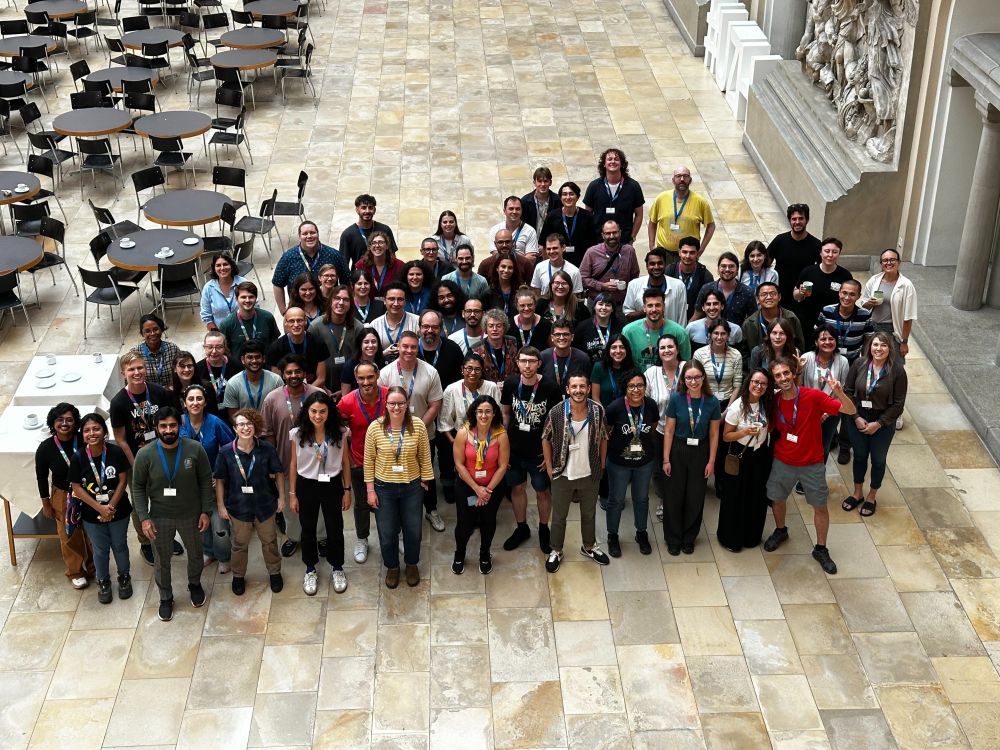
The CPEG & CPB meeting is officially underway! 🎉
We kicked things off with two fantastic workshop sessions:
📊 R-based open data science in palaeobiology and ecology
🧠 Deep learning for macroevolutionary analyses
Big thanks to all our speakers and participants - spot yourself below!
#CPEGCPB25

Here is a Nature News writeup on our work, covering also another remarkable new paper on extremely old enamel proteins by Daniel Green and colleagues. www.nature.com/articles/d41...
10.07.2025 20:38 — 👍 0 🔁 0 💬 0 📌 0According to our analysis, Elasmotherium (the "Siberian unicorn") and modern rhinos share a common ancestor in the Oligocene (more recently than previously thought), and they are more closed related to each other than to our aceratherine from the High Arctic.
10.07.2025 20:38 — 👍 0 🔁 0 💬 1 📌 0Our protein-based tip-dated phylogenetic analysis (a combination of words that would have been totally absurd until recently) shows that this aceratherine ("hornless rhino") belonged to an early-diverging lineage in the rhino family tree.
10.07.2025 20:38 — 👍 1 🔁 0 💬 1 📌 0