
ha, not a hornet's nest I want to stir up
15.09.2025 18:18 — 👍 0 🔁 0 💬 0 📌 0ha, not a hornet's nest I want to stir up
15.09.2025 18:18 — 👍 0 🔁 0 💬 0 📌 0dating apps and profiles are an attempt to make the processes of romance 'legible', and to some extent can be perceived as a 'high modernist' simplification of courtship send tweet
15.09.2025 17:34 — 👍 37 🔁 5 💬 1 📌 0
This is a fair question. My answer is here: scholarstage.substack.com/p/bullets-an...
15.09.2025 17:47 — 👍 2 🔁 0 💬 2 📌 0
I do not speculate on the motives of the assassin. That will be made clear in time.
The fight between them and Kirk was real, however, and by no means concluded at his death.
I unironically believe that Kirk was more important to shaping MAGA than Thiel was. Thiel's influence is exaggerated.
Bannon could not play nice with traditional donors and institutional actors. Limited his ability to influence the movement as a whole.

How does the old saying go "cemeteries are full of indispensable men", the problem on the right is that its movements and organizations are personality based. That said, a good explanation for how these events are making the more "revolutionary" right feel more vindicated.
14.09.2025 14:41 — 👍 2 🔁 1 💬 0 📌 0
New Essay: "Did Taiwan 'Lose Trump'?
scholars-stage.org/did-taiwan-l...
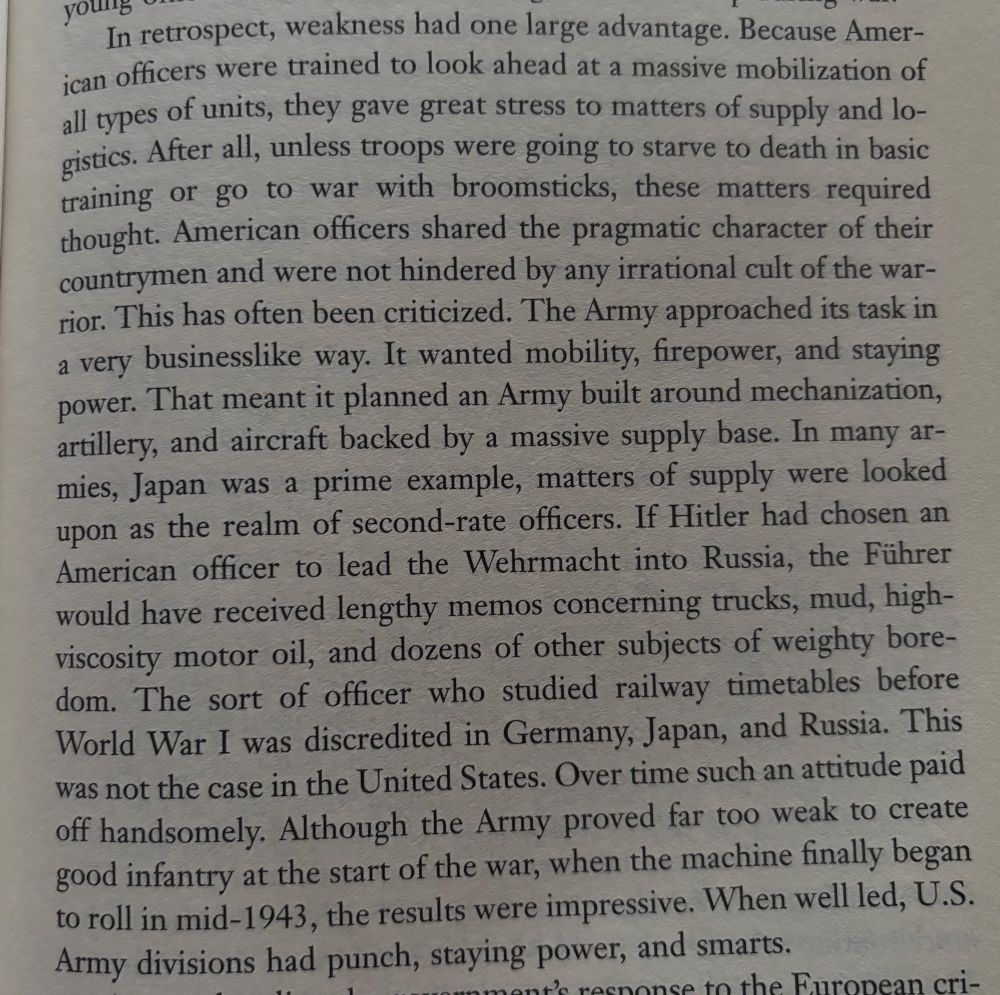
In retrospect, weakness had one large advantage. Because American officers were trained to look ahead at a massive mobilization of all types of units, they gave great stress to matters of supply and lo-gistics. After all, unless troops were going to starve to death in basic training or go to war with broomsticks, these matters required thought. American officers shared the pragmatic character of their countrymen and were not hindered by any irrational cult of the war-rior. This has often been criticized. The Army approached its task in a very businesslike way. It wanted mobility, firepower, and staying power. That meant it planned an Army built around mechanization, artillery, and aircraft backed by a massive supply base. In many ar-mies, Japan was a prime example, matters of supply were looked upon as the realm of second-rate officers. If Hitler had chosen an American officer to lead the Wehrmacht into Russia, the Führer would have received lengthy memos concerning trucks, mud, high-viscosity motor oil, and dozens of other subjects of weighty bore-dom. The sort of officer who studied railway timetables before World War I was discredited in Germany, Japan, and Russia. This was not the case in the United States. Over time such an attitude paid off handsomely. Although the Army proved far too weak to create good infantry at the start of the war, when the machine finally began to roll in mid-1943, the results were impressive. When
I don’t think I’ve seen a cleaner summation of the American strengths in WW2 that contributed to Allied victory.
29.07.2025 00:34 — 👍 121 🔁 37 💬 9 📌 4
Mood board
28.07.2025 03:21 — 👍 5 🔁 1 💬 0 📌 0
Mood board
28.07.2025 03:21 — 👍 5 🔁 1 💬 0 📌 0
Does it seem like there are conflicting explanations for these tariffs?
What if I told you that there were multiple economic schools of thought in the administration, all with different goals--including for tariffs?
Would you want to know more?
Read my latest report: www.fpri.org/article/2025...
I think the dynamics here are almost entirely internal to the admin and the cabinet secretaries having had enough.
02.04.2025 17:02 — 👍 1 🔁 0 💬 0 📌 0thanks!
02.04.2025 02:11 — 👍 2 🔁 0 💬 0 📌 0
"The x-axis of this chart describes the battleground on which econ competition with China must be fought: is this a contest to push forward the frontiers of technology and science, or does competition with China require a broader-based revitalization of American manufacturing capacity writ large?"
01.04.2025 01:32 — 👍 2 🔁 1 💬 1 📌 0
In 2024 I interviewed 30+ Republican officials--cabinet level down to congressional staff--on their ideal China policy.
At @fpri.bsky.social I have published a report that lays out my findings. Here are the eight tribes of Republican China policy:
www.fpri.org/article/2025...
May interest @beijingpalmer.bsky.social @irhottakes.bsky.social @gaodawei.bsky.social @aelkus.bsky.social @brasidas.bsky.social @gadyepstein.bsky.social @goldkorn.bsky.social @nathanattrill.bsky.social @emilyzfeng.bsky.social @mayawang.bsky.social @jacobstokes.bsky.social @jnbpage.bsky.social
01.04.2025 01:44 — 👍 5 🔁 2 💬 1 📌 0"Contrary to expectation, Trump’s inaugural address barely glanced at China. It does not outline, or even hint at, what Trump’s approach to America’s greatest challenger might be. This obscurity is by design."
01.04.2025 02:14 — 👍 2 🔁 1 💬 0 📌 0May interest @beijingpalmer.bsky.social @irhottakes.bsky.social @gaodawei.bsky.social @aelkus.bsky.social @brasidas.bsky.social @gadyepstein.bsky.social @goldkorn.bsky.social @nathanattrill.bsky.social @emilyzfeng.bsky.social @mayawang.bsky.social @jacobstokes.bsky.social @jnbpage.bsky.social
01.04.2025 01:44 — 👍 5 🔁 2 💬 1 📌 0I found that many officials' assessments of this question are based as much on cultural and social analyses of the America and its political system as they are on traditional measures of hard power.
01.04.2025 01:35 — 👍 3 🔁 0 💬 0 📌 0The most important divide in the geopolitical debate is on the x-axis: is the United States fundamentally weak, or is it fundamentally strong?
01.04.2025 01:35 — 👍 1 🔁 0 💬 1 📌 0
Here is the geopolitical 2x2:
01.04.2025 01:32 — 👍 1 🔁 0 💬 1 📌 0"The y-axis, in turn, spans the gap between those who are confident that the administrative state can be used to strengthen the American economy and those skeptical of any bureaucratically administered industrial policy."
01.04.2025 01:32 — 👍 1 🔁 0 💬 1 📌 0
"The x-axis of this chart describes the battleground on which econ competition with China must be fought: is this a contest to push forward the frontiers of technology and science, or does competition with China require a broader-based revitalization of American manufacturing capacity writ large?"
01.04.2025 01:32 — 👍 2 🔁 1 💬 1 📌 0
I think of Trumpist debates on China policy largely happening in two domains: economic and geopolitical. There is surprisingly little overlap in these two domains--your position in one is not predictive of your position in the other.
Lets start with the economic debate.

The full report is 20 pages long, full of quotes, anecdotes, and analysis.
If you want a bullet point summary, I wrote that up on my personal blog: scholarstage.substack.com/p/the-eight-...
In 2024 I interviewed 30+ Republican officials--cabinet level down to congressional staff--on their ideal China policy.
At @fpri.bsky.social I have published a report that lays out my findings. Here are the eight tribes of Republican China policy:
www.fpri.org/article/2025...


Insane how well this describes so many of us on here (I'm including myself, here)
11.03.2025 02:04 — 👍 6 🔁 5 💬 0 📌 15. Everything every right winger has ever said about how late liberal America and the late Soviet Union are similar
22.02.2025 05:32 — 👍 2 🔁 0 💬 1 📌 0
3. Emphasis on freedom of speech, free flow of destabilizing ideas, and prioritizing this first
4. Belief that geopolitical commitments stretch the country too thin for too little benefit, and must be abandoned