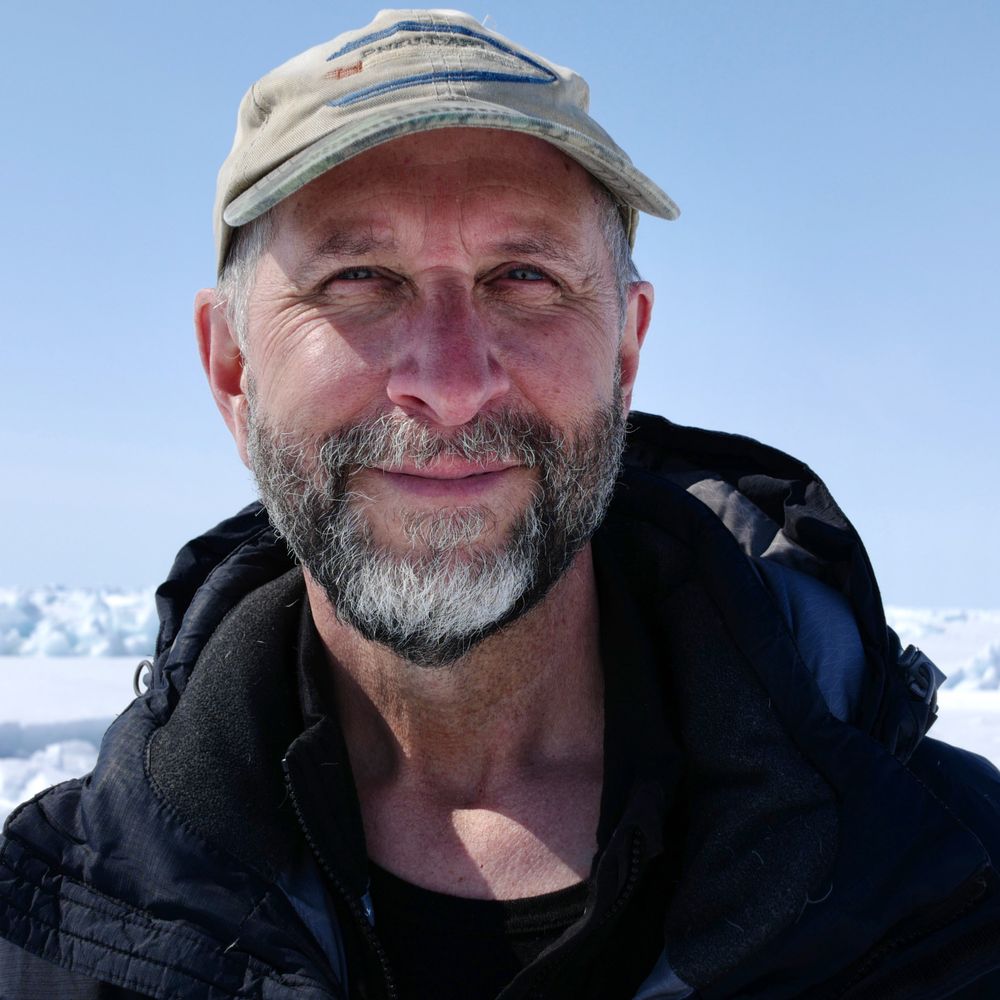
Lots of Hudson Bay polar bears are towards the NW. Something good up there this year? Some bears are right along the shore lead - an area of open water & thin ice. There are more bearded seals & harbour seals in this area so possibly the attraction.
04.03.2026 21:48 —
👍 1
🔁 1
💬 0
📌 0

Today is International Polar Bear Day – a day to recognize polar bears and the urgent need to protect them. With climate change threatening their future, conservation efforts are more important than ever.
Support bear conservation by donating to IBA: bearbiology.app.neoncrm.com/forms/donate
28.02.2026 03:17 —
👍 7
🔁 3
💬 0
📌 0

Happy International Polar Bear Day!
27.02.2026 15:27 —
👍 0
🔁 0
💬 0
📌 0

Hudson Bay polar bears took a big jump to the northwest this week. Why? I'm guessing favourable winds that made hunting that direction more effective (but we don't know for sure & it's something we're investigating).
22.02.2026 01:40 —
👍 5
🔁 1
💬 0
📌 0

Hudson Bay are well spread out & doing different things. One female (K) has moved close to shore. Bear C has emerged from a den - it's a bit early if she's got new cubs but we'll see if she stays there or moves onto the ice.
14.02.2026 17:21 —
👍 5
🔁 1
💬 0
📌 0

Line graph time series of 2026's daily Arctic sea ice extent compared to decadal averages from the 1980s to the 2010s. The decadal averages are shown with different colored lines with purple for the 1980s, blue for the 1990s, green for the 2000s, and white for the 2010s. Thin white lines are also shown for each year from 2000 to 2025. 2026 is shown with a thick gold line. There is a long-term decreasing trend in ice extent for every day of the year shown on this graph between January and March by looking at the decadal average line positions.
Friday ice update - #Arctic sea ice extent is currently the 5th lowest on record (JAXA data)...
• about 130,000 km² below the 2010s mean
• about 810,000 km² below the 2000s mean
• about 1,350,000 km² below the 1990s mean
• about 1,690,000 km² below the 1980s mean
More: zacklabe.com/arctic-sea-i...
13.02.2026 22:47 —
👍 59
🔁 21
💬 1
📌 0

Hudson Bay polar bears showing a rather typical pattern this winter. Our eartag radios (purple) are slowly disappearing (most likely antenna failure).
10.02.2026 03:25 —
👍 5
🔁 1
💬 0
📌 0


Latest paper from our Hudson Bay polar bear research. It's hard won data & explores a topic we know little about: predator / prey relationships. Lead author supported by @PolarBears post-doc.
journals.plos.org/plosone/arti... [open access]
03.02.2026 15:11 —
👍 2
🔁 1
💬 0
📌 0

A few Hudson Bay polar bears are wandering far to the east. Many seem to have a happy place just east and south of Cape Churchill. It's still lean days for the bears & they won't start adding weight for a few months.
03.02.2026 02:33 —
👍 2
🔁 0
💬 0
📌 0

New paper on Svalbard polar bears reveals the complexity of responses to sea ice loss across the Arctic. Svalbard bears are doing OK for now despite having the highest rate of sea ice loss of the 20 populations. A time-limited situation as ice declines.
www.nature.com/articles/s41... [open access]
29.01.2026 20:21 —
👍 3
🔁 1
💬 0
📌 0

Typical January distribution for polar bears in Hudson Bay but a bit more to the southeast this year. Some eartag radios (purple) are stopping transmission but at 8 months, that's pretty good. The bears have almost 8 hours of daylight now & days are getting longer fast.
26.01.2026 14:37 —
👍 1
🔁 0
💬 0
📌 0

Nanuk Narratives | Inuit Voices on Polar Bears
Documentary film series about Inuit knowledge and connections with polar bears in Nunavut, Nunavik, Nunatsiavut, and Greenland.
Interesting new website: "Nanuk Narratives" is an Inuit-led docuseries of short videos that delves into the deep and enduring relationship among Inuit and polar bears (nanuk) in and around the Davis Strait.
www.nanuknarratives.com
21.01.2026 21:49 —
👍 1
🔁 0
💬 0
📌 0

Line graph time series of 2026's daily Arctic sea ice extent compared to decadal averages from the 1980s to the 2010s. The decadal averages are shown with different colored lines with purple for the 1980s, blue for the 1990s, green for the 2000s, and white for the 2010s. Thin white lines are also shown for each year from 2000 to 2025. 2026 is shown with a thick gold line. There is a long-term decreasing trend in ice extent for every day of the year shown on this graph between January and March by looking at the decadal average line positions.
Monday ice update - #Arctic sea ice extent is currently the *lowest* on record (JAXA data)...
• about 450,000 km² below the 2010s mean
• about 1,030,000 km² below the 2000s mean
• about 1,580,000 km² below the 1990s mean
• about 2,010,000 km² below the 1980s mean
More: zacklabe.com/arctic-sea-i...
19.01.2026 14:20 —
👍 150
🔁 68
💬 4
📌 14


Hudson Bay polar bears continue their outward migration. Bear H near Cape Churchill was in the denning area last week but is now on the ice. Likely a failed litter. Bears leaving in January don't usually have cubs. Hard to say what happened.
17.01.2026 18:13 —
👍 1
🔁 1
💬 1
📌 0
Hudson Bay polar bears are well spread out. It's interesting to see bear E4 (adult male, northern most bear in centre of Bay) moving to the SW in the past week. It's a typical distribution for a time of year when hunting success is likely low (but we have little data on this).
11.01.2026 23:40 —
👍 4
🔁 1
💬 0
📌 0

Bear E4? Genetics show he has no prior history in western or southern Hudson Bay & suggests that he was visiting from Foxe Basin & just "went home" after a southern spring fling. There's a lot of gene flow between the 3 populations in the Bay & he was just looking for love.
08.01.2026 04:47 —
👍 6
🔁 1
💬 0
📌 1

Hudson Bay polar bears shifted a bit to the south this week. The bears follow sea ice habitats but are influenced by the direction of wind (affect hunting) & ice also drifts with wind & currents. Fairly normal distribution now even with late freeze up.
04.01.2026 04:12 —
👍 3
🔁 1
💬 0
📌 0

Hudson Bay polar bears are following their usual outbound migration now: get away from shore. They likely encounter unsuspecting ringed seals as they fan out across the Bay. It's surprising how prey "forget" about predators until they're reminded / re-encounter them.
28.12.2025 20:28 —
👍 2
🔁 0
💬 0
📌 0

Hudson Bay polar bears are making up for lost time and pushing offshore. Time for seals to remember what predators are: no holiday for seals but a feast ahead for the bears.
20.12.2025 01:20 —
👍 3
🔁 0
💬 0
📌 0

Line graph time series showing daily Arctic sea ice extent in the Hudson Bay for 2025 compared to each year from 1979 to 2024. There is a large seasonal cycle on this graph and a long-term decreasing trend for days during the melt season from June to December.
The freeze-up in the Hudson Bay (Canada) has been one of the latest on record for #Arctic sea ice. This is consistent with the long-term trend of a lengthening open water season.
Data from @nsidc.bsky.social at nsidc.org/data/seaice_...
18.12.2025 12:44 —
👍 87
🔁 34
💬 2
📌 2

Bar graph showing zonal mean surface air temperature anomalies for the December 2024 to November 2025 period. All latitude bands are above average.
Looking back over the last 12 months, all latitude bands observed above average temperatures. This was largest in the Arctic region.
Plot shows zonal-mean surface air temperature anomalies, where latitude = x-axis (not scaled by distance). Data from NASA GISTEMPv4 (1951-1980 baseline).
15.12.2025 13:03 —
👍 77
🔁 26
💬 3
📌 4


Western Hudson Bay polar bears are still hugging the coast this year (left map). They were farther offshore last year but a slow freeze-up has restricted where they can go. Bears on land may be pregnant females in dens.
14.12.2025 20:48 —
👍 1
🔁 1
💬 0
📌 0

It's cold in western Hudson Bay but still a bit warmer than usual today. We're definitely in ice-making temperatures but colder is better if you're a polar bear waiting for ice.
11.12.2025 02:46 —
👍 0
🔁 0
💬 0
📌 0

Wondering how Hudson Bay & area polar bear habitat is shaping up? It's pretty bad. Red areas show where there's missing sea ice. We'll know if it has affected the bears in the spring during research but it doesn't bode well. Put simply, polar bears need sea ice.
10.12.2025 23:35 —
👍 4
🔁 1
💬 0
📌 1


Sea ice observable by satellite is looking thin & unconsolidated. Nothing you or I could walk on but polar bears are less concerned about having to swim. The bears are still close to shore but it's -29 C in Arviat & that = good ice growing conditions.
07.12.2025 17:48 —
👍 4
🔁 0
💬 0
📌 0
Hudson Bay polar bears are slowly moving farther offshore. The lack of ice is constraining their movements. Colder weather will help them get to where they want to be.
07.12.2025 00:12 —
👍 3
🔁 0
💬 0
📌 0


Eastern Arctic is missing a lot of polar bear habitat this December (red areas). Things may improve for the bears as the temperatures are finally colder & sufficient for cooling the Bay & making sea ice. At this time of year, bears would normally be migrating offshore. Soon if it stays cold.
04.12.2025 17:26 —
👍 0
🔁 0
💬 0
📌 0

It's a bit hard to see with the cloud but there's precious little sea ice in Hudson Bay & thus, not much habitat for polar bears. At this time of year, they should be well out into the Bay. Some bears will kill seals under these conditions but they're far from optimal.
02.12.2025 16:56 —
👍 3
🔁 2
💬 0
📌 0

Line graph time series of 2025's daily global sea ice extent anomalies in red shading compared to each year from 1979 to 2023 using shades of purple to white for each line. The year 2024 is also highlighted in yellow, which is the current absolute magnitude record low. Anomalies are computed relative to a 1981-2010 baseline. There is substantial interannual and daily variability. Data from the NSIDC.
The extent of global sea ice cover is more than 3 million square kilometers below the 1981-2010 average. This is the 2nd lowest on record for this date over the satellite-era.
Data from nsidc.org/data/seaice_...
29.11.2025 14:50 —
👍 116
🔁 48
💬 1
📌 1