Replication studies: a win-win for early-career training and behavioral ecology
Replicating previous research builds confidence that results are real and meaningful. But close replications are rare due to limitations in resources and d
How do we know our research results are REAL? We replicate them! Most folks agree but lament on how hard it is to publish these replications.
My dearest gentle reader, lament no more! Delighted to unveil: Replication Studies, a new section of Behavioral Ecology 1/
academic.oup.com/beheco/artic...
10.02.2026 19:42 —
👍 213
🔁 110
💬 4
📌 9

Come to Hamburg and do a PhD on insect/spider traits with me!
03.02.2026 09:08 —
👍 24
🔁 23
💬 0
📌 0

Interested in doing a #PhD? Passionate about biodiversity monitoring and technology development?? Def check out this advertisement from Uni #Bonn and #LIB! Deadline Feb 17th - 4 year position!
01.02.2026 14:32 —
👍 6
🔁 9
💬 0
📌 1
🕸️ Massive web stretch from our cribellating friend (Asianopis subrufa) recorded in the field. If you’re intrigued by this fabulous #spider #silk read on doi.org/10.1073/pnas.2529200123 by @evoimec.bsky.social et al :) 🕸️
27.01.2026 18:17 —
👍 29
🔁 8
💬 0
📌 1

Experimental setup for testing the effect of different winter temperatures on survival, physiology and gene expression in the wasp spider.
Here comes Carolina's first paper on the effects of winter temperatures on survival, physiology and gene expression in wasp spiders. Thanks go to all coauthors for their various contribution that made this work possible!🧪🕷
onlinelibrary.wiley.com/doi/10.1002/...
#climatechange
27.11.2025 20:35 —
👍 16
🔁 7
💬 0
📌 0

🚨 Uh-oh!!! A suuuper hot #PhD opportunity just dropped! My friend and collaborator Massimo De Agrò is looking for someone to explore jumping spider vision and neurophysiology! #psychophysics #jumpingspiders #greatPI - apply!!!! (Deadline December 17th) 🚨
21.11.2025 21:49 —
👍 34
🔁 22
💬 0
📌 2

Meet our Plenary Speaker Daniela Rößler
Fueled by curiosity and a deep love of natural history Daniela discovered a REM-like sleep state in spiders and uses integrative field, lab and comparative approaches to investigate the function, ecology, and evolution of sleep across the spider tree of life.
16.11.2025 07:37 —
👍 42
🔁 16
💬 0
📌 1
How cool is this?!!
04.11.2025 07:11 —
👍 7
🔁 1
💬 0
📌 0
Exciting times ahead - I'm beyond delighted to be joining @bristolbiosci.bsky.social in 2026! 🎉🕷️🎉🐌🎉
I'm also looking for a PhD student to join @multipleye-lab.bsky.social in our new home! Come and study the effects of light pollution on the evolution and development of spider eyes with us 🌃🕷️👀 👇
17.10.2025 13:38 —
👍 73
🔁 28
💬 9
📌 4

Close up of golden orb weavers mating. The male's body is around 10% the length of the female's.
A pair of golden orb weavers from S. Africa (Trichonephila inaurata) mating back in 2016.
#Arachtober
16.10.2025 17:04 —
👍 19
🔁 4
💬 0
📌 0

Join — Sydney Functional Ecology
Excited to share a PhD opportunity in my upcoming lab at The University of Sydney!
Join an ARC-funded project on the ecology of ant invasions in 2026 🐜
🇦🇺 Live in Sydney, ant around Australia
🌍 Intl + Domestic applicants welcome
markwongecology.com/join
#PhD #Ecology #Biodiversity
Pls share, thx 🙏
03.10.2025 16:14 —
👍 21
🔁 16
💬 1
📌 0
This is so cool! Great job!
17.09.2025 17:58 —
👍 1
🔁 0
💬 1
📌 0

Spiders have personalities—and in Pisaura mirabilis, opposites might attract: adventurous males and cautious females mate longer, revealing hidden personality-driven patterns in romance. Lead by @cristinatuni.bsky.social Read more here: link.springer.com/article/10.1...
16.09.2025 12:10 —
👍 17
🔁 6
💬 0
📌 0

🕷️ 🚨 Are you at the #DZG in Berlin next week? @dzg2025berlin.bsky.social my PhD @nadjageiger.bsky.social and I are very excited to tell you the latest about our spider sleep 💤 work! Come check out our talks on Friday and ask all your questions! :) 🚨 🕷️
06.09.2025 09:02 —
👍 32
🔁 12
💬 1
📌 0

We’re offering a fully funded 4 yr PhD position to work on Sexual selection in complex environments at the @uv.es. Co-supervised by @dbergerbiol.bsky.social. Find details below 👇
01.09.2025 13:25 —
👍 31
🔁 57
💬 0
📌 2

W1TTW2 Professorship in Membrane Biology (m/f/d)
Job alert 📣 Our faculty looks for a Junior Professor W1 with tt to W2 in Membrane Biology! We are looking for #ECRs working on membrane biogenesis,contact sites,composition & other aspects of membranes in 🌱 and other organisms! DM me if you need more details!
jobs.ruhr-uni-bochum.de/jobposting/f...
22.08.2025 13:47 —
👍 33
🔁 60
💬 1
📌 1

Our new paper is out @royalsociety.org! We discovered that crustaceans are, like many insects, chemically defended. The woodlouse Porcellio scaber secretes quinoline-derivates which deter predators. Three of the four identified metabolites were previously unknown.
doi.org/10.1098/rsif.2025.0260
09.08.2025 09:34 —
👍 13
🔁 4
💬 0
📌 0
Hi! No, it’s definitely not Mermessus. Nice pics!
01.08.2025 18:20 —
👍 0
🔁 0
💬 0
📌 0
Chemical Ecology of Widow Spiders
We are hiring for a funded PhD positionapply here Untangling pheromonal communication between and within the sexes of widow spiders Our group is undertaking a comprehensive exploration of the chemi…
🎓 #PhD in Animal Metabolomics & Ecology @unigreifswald🇩🇪
Sexual and non-sexual communication in a widow spider 🕷️⚗️
DFG-funded | 3 years | behavioral ecology & chemical ecology
Details: bit.ly/widow-phd
Apply by Sept 24, start in February 2026
#AcademicSky #pleaserepost
31.07.2025 09:26 —
👍 7
🔁 7
💬 0
📌 1
Thanks Maria! I used Perplexity for that 🙂
24.07.2025 13:36 —
👍 0
🔁 0
💬 1
📌 0
Take-home: genes make the invader! ✔️ High dispersal is heritable & recessive ✔️ Fast genotypes accumulate at range edge ✔️ No microbial drivers. Understanding the success of #MermessusTrilobatus means understanding its #genetics! (work in progress - stay tuned!) 🧬🕸️ #EvolutionInAction
24.07.2025 09:12 —
👍 0
🔁 0
💬 1
📌 0

A two-panel boxplot comparing bacterial richness (number of observed OTUs) across spider groups.
Panel a that high-dispersive spiders (left box) have lower microbial OTU richness (median ≈ 7.5) than low-dispersive spiders (right box; median ≈ 12).
Panel b shows similar richness between spiders from the invasion front (Horsens; median ≈ 10.5) and those from the invasion core (Wilgartswiesen; median ≈ 9.8).

A two-panel NMDS ordination of microbial community composition (Bray–Curtis dissimilarity) for spider groups.
Panel a plots high-dispersive and low-dispersive spiders; points for both overlap, indicating no distinct clustering (stress = 0.17).
Panel b plots spiders from Horsens versus Wilgartswiesen; points largely overlap, showing no separation by origin (stress = 0.18).
No microbial puppet-masters here. European populations of #MermessusTrilobatus lack Rickettsia/Wolbachia; high-flyers host FEWER bacteria. Dispersal is most likely coded in genome, not microbiome. #Microbiome #Genetics doi.org/10.1007/s002...
24.07.2025 09:12 —
👍 0
🔁 0
💬 1
📌 0

Three-panel bar chart showing dispersal behaviour frequencies in Mermessus trilobatus offspring. Panel (a) shows tiptoe frequency, panel (b) shows rafting frequency, and panel (c) shows take-off frequency. Each panel displays four bars representing offspring from different locations: W = Wilgartswiesen (core, first found 1981), L = Landau (core, first found 1981), V = Vienna (front, first found 2009), and H = Horsens (front, first found 2018). Error bars show standard error. Statistical differences between locations are marked with letters a and b, where locations sharing the same letter are not significantly different. Generally, offspring from area with the most recent colonisation (Horsens) show twice higher dispersal frequencies than those from long-established populations (Vienna, Wilgartswiesen and Landau).
The key: highly dispersive spiders accumulate at invasion edge with the most recent spread, mate with each other → super-dispersive offspring → faster spread. Genetic spatial sorting in action or microbial puppets? ⬇️ #EvolutionaryBiology #InvasionGenetics #SpatialSorting doi.org/10.1111/geb....
24.07.2025 09:12 —
👍 0
🔁 0
💬 1
📌 0

Figure shows three side-by-side bar charts (a, b, c), each comparing the mean frequency (± SE) of a dispersal behaviour in F2 offspring across four parental breeding: HH (both parents high-dispersive), HL (high-dispersive dam, low-dispersive sire), LH (low-dispersive dam, high-dispersive sire), and LL (both parents low-dispersive). Panel (a) plots tiptoe frequency, panel (b) rafting frequency, and panel (c) take-off frequency. In each chart, the HH group bar is about three times taller than the other three bars, which are all similar in height; letters above bars (“a” for HH and “b” for HL, LH, LL) denote that HH differs significantly from the other groups, which do not differ from each other.
Dispersal isn’t random – it’s heritable! Offspring of two high-flying parents show 3× higher dispersal rates in #MermessusTrilobatus. High dispersal is recessive, helping founders race ahead then ‘dial back’ later. #Dispersal #Heritability #Evolution doi.org/10.1016/j.an...
24.07.2025 09:12 —
👍 0
🔁 0
💬 1
📌 0
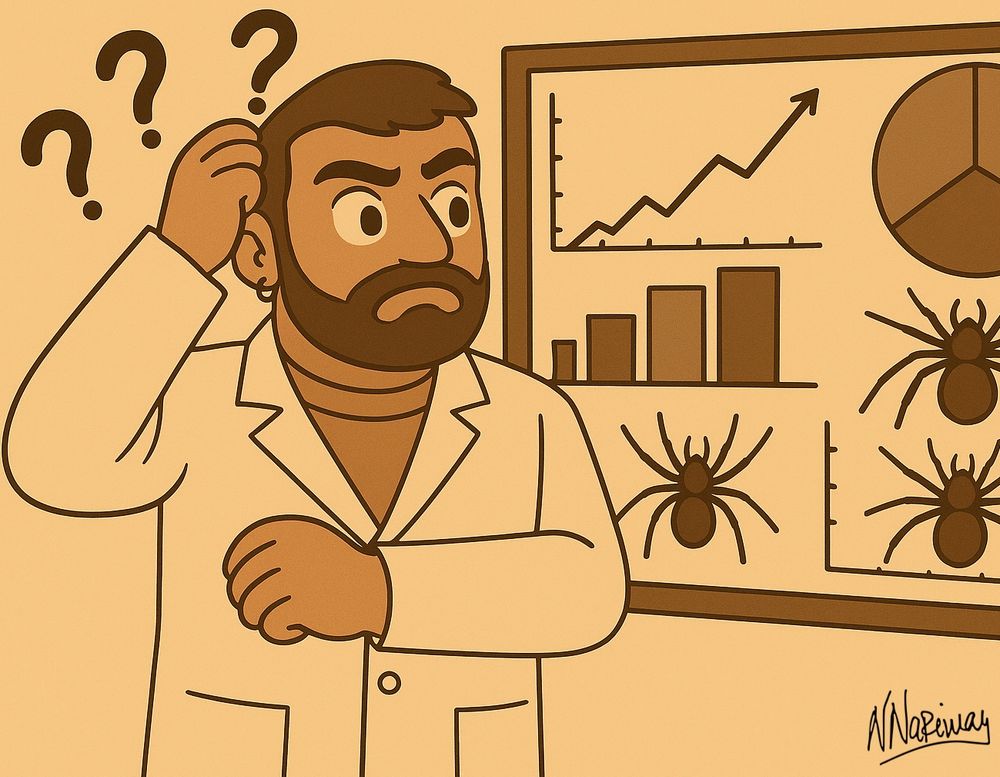
Cartoon illustration of a dark-haired, bearded researcher wearing a white lab coat and a small hoop earring. He scratches his head with a worried expression while standing in front of a presentation board. The board shows a zig-zagging upward line graph, a vertical bar chart, a circular pie chart, and several spider silhouettes, all hinting at invasion data. Three large black question marks hover above his head, emphasizing confusion. The background and chart elements use muted beige and brown tones that match the scientist’s lab coat and overall palette.
Wait...🤔 They're TERRIBLE at handling disturbance, get eaten more by native predators, yet somehow conquered 1,400km of Europe in 45 years? HOW?! 🤯 The answer in establishment might lie in their reproductive behaviour (work in progress - stay tuned!). But let's look at how they spread so fast! ⬇️
24.07.2025 09:12 —
👍 3
🔁 1
💬 2
📌 0

Map of Europe displaying ~4,000 collection records of the invasive spider Mermessus trilobatus. Grey circles mark records from 1981–2001, black circles records from 2002–2021. Red markers highlight four sampling localities: two core sites in south-west Germany (Landau and Wilgartswiesen, red squares), a mid-range site near Vienna, Austria (red rhombus), and a recent-front site near Horsens, Denmark (red triangle). Latitudinal and longitudinal grid lines and a scale bar illustrate spatial spread over 1,300 km from the original 1981 detection.

Line scatter-plot showing the progressive expansion distance of Mermessus trilobatus in Europe from 1981 to 2021. Each point represents the furthest yearly record from the 1981 introduction site, with red-filled circles marking years when the invasion front advanced. Distances increase from ~150 km in the 1980s to ~1,350 km by 2021. A quadratic red curve fits the maximum distances, illustrating an accelerating, super-linear expansion rate (r² ≈ 0.98). Horizontal and vertical axes denote calendar year and great-circle distance in kilometres, respectively.
Range expansion is speeding up! We mapped 4,000 records: front advanced from 150 km/decade in the 1980s to 400 km/decade after 2010. #Biogeography #RangeShifts #ClimateChange doi.org/10.1111/geb....
24.07.2025 09:12 —
👍 3
🔁 0
💬 1
📌 0