
Alexander the Great's Palace at Pella Opens to the Public
greekcitytimes.com/2025/12/27/a...

@phoenixjournal.bsky.social
Founded in 1944, we publish scholarly articles on all aspects of the Classical world: its history, literature, philosophy, art and archeology. https://phoenix.utoronto.ca
Alexander the Great's Palace at Pella Opens to the Public
greekcitytimes.com/2025/12/27/a...

Decorated silver platter or lanx. The scene shows, left to right: the goddess Artemis, holding a bow; the helmeted goddess Athena, her hand raised to indicate conversation; a standing female figure; a seated female figure; the god Apollo at the entrance to a shrine, holding a bow, his lyre at his feet. In the foreground stands an altar flanked by Artemis's hound and fallen stag and a griffin, a mythical beast associated with Apollo. The two female figures in the centre are less easily identified than the principles. The entire scene is clearly a shrine of Apollo. The Greek island of Delos was the birthplace of Apollo and Artemis, and Athena was also worshipped there. If the Delian shrine is depicted then the older woman sitting spinning may be Leto, the mother of the twins, and the standing woman her sister Ortygia, who was transformed into the island of Delos. In the foreground stands an altar flanked by Artemis's hound and fallen stag and a griffin, a mythical beast associated with Apollo. British Museum, London (1993,0401.1)
When you're serving holiday canapés, only the best serving tray will do. May I suggest the Corbridge Lanx? A beautiful 4th c. CE Roman silver platter depicting a shrine of Apollo and a garden of gods standing beneath the branches of a tree. 🏺 1/
📸 me

journal cover
New issue of Phoenix Vol. 79, No. 1 (2025) muse.jhu.edu/issue/55982 @phoenixjournal.bsky.social @projectmuse.bsky.social @hopkinspress.bsky.social @cacscec.bsky.social
24.11.2025 13:30 — 👍 12 🔁 7 💬 0 📌 0
Oedipus: Fate Comes for Us All - New York Stage Review
nystagereview.com/2025/11/13/o...

How Women Became Poets: A Gender History of Greek Literature by Emily Hauser

Emily Hauser
Tomorrow (Nov 17) at 6:00 pm CST, the University of Illinois welcomes Emily Hauser for a discussion and signing of her book, How Women Became Poets, which redefines the classical literature canon as a struggle to be heard through and despite gender.
This is a free, in-person event: buff.ly/hjRkrcA
@phoenixjournal.bsky.social
19.09.2025 21:49 — 👍 0 🔁 1 💬 0 📌 0
Gold aureus minted in Rome by the emperor Titus to celebrate the opening of the Flavian Amphitheater, better known today as the Colosseum, in 80 CE (some historians say 81 CE). The obverse has a profile portrait of Titus, and the reverse - seen in this photo - depicts a tusked African elephant, facing left, surrounded by an inscription: TR P IX IMP XV COS VIII P P. This means “Tribunician Power, Ninth Time; Imperator, Fifteenth Acclamation; Consul, Eighth Term; and PP means Pater Patriae, Father of the Fatherland”. Getty Villa Museum, long term loan
The Roman emperor Titus only reigned for two years, starting in 79 CE, the year of the Vesuvian disaster. But he had good news the following year: the opening of the Colosseum in Rome. To commemorate it, he released this gold aureus with an African elephant on the reverse. 🏺 1/
📸 me (see ALT)
Our managing editor Judith is retiring this month and would like everyone to know that she is hanging out her shingle as a freelance editor. In her time with us, she sent 39 of our 78 volumes to press, and typeset and edited 35 of them. She can be found on Bluesky at academic-editor.bsky.social.
21.07.2025 16:31 — 👍 2 🔁 0 💬 0 📌 0Just watched the leadership debate (Canadian federal election). Carney clearly has Singh’s respect, and I think the Liberals, Block and NDP will make a great team working together for our country.
18.04.2025 01:04 — 👍 4 🔁 1 💬 1 📌 0
I see one calm and collected intelligent wartime leader on the stage and three volatile overly emotional clods.
You figure out which is which.
#cdnpoli #debate
The ONLY crisis leader on that stage is Carney.
Full stop.
Period.
I don’t need sound bites.
I don’t need fluffy.
I don’t need slogans.
I want calm and focus and brains in my crisis leader.
#cdnpoli #debate
Imaginings of Greek Antiquity and the Performing Arts, Visual Arts and Cinema: International Conference, 27-28/9/2025 – School of Drama – Faculty of Fine Arts – Aristotle University of Thessaloniki
www.thea.auth.gr/website/wp-c...
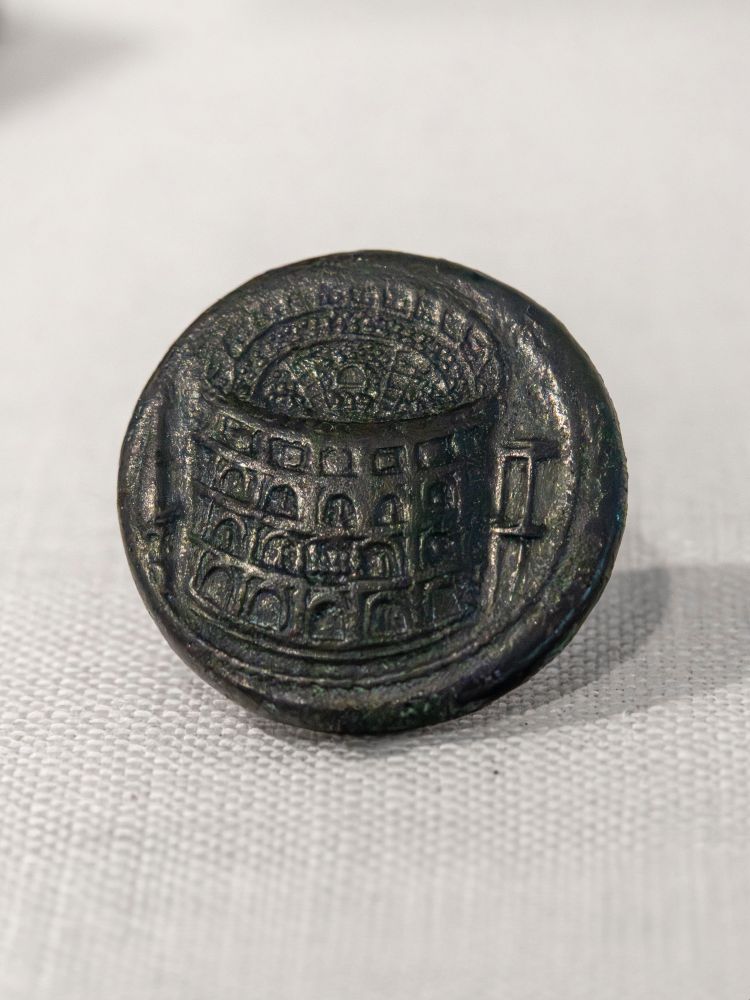
A dark bronze sestertius from the reign of the Roman emperor Titus (79-81 CE), aka Titus Caesar Vespasianus, son of the emperor Vespasian. The coin depicts the Colosseum (Flavian Amphitheatre) in great detail - you can see the four arched stories, statues within the arches, and a two story portico (perhaps a connection between the Colosseum and Titus' baths) on the right side. It even depicts the alternating clypea, the huge circular bronze shields once placed on the cornice of the fourth floor, and in the center - facing us - the gilded quadriga sculpture over the north-east entry. On the left is the large conical monumental fountain - the Meta Sudans - which stood outside the Colosseum until 1936, when Mussolini had it destroyed to create a traffic circle for his fascist parades.
This is one of the earliest depictions of the Colosseum, a bronze sestertius issued by the emperor Titus to commemorate the amphitheater's completion. Only ten are known to exist. You can see the spectators, the statues in the arches, even the quadriga over the entrance. 🏺 #ancientbluesky 1/
📸 me

Went to check on my new rose bush.. it got hot the past few days and I was blessed with 4 new blooms! #roses #photography
27.03.2025 05:03 — 👍 289 🔁 14 💬 9 📌 1@phoenixjournal.bsky.social
23.03.2025 19:34 — 👍 0 🔁 1 💬 0 📌 0
The Ides of March denarius, issued by Marcus Junius Brutus, is one of the most famous and historic coins ever minted. It commemorates the assassination of Julius Caesar on March 15, 44 BCE, an event that later inspired many works of art, literature, opera, and film. Caesar had declared himself "perpetual dictator" at the beginning of that year, thereby directly prompting the assassination plot by Brutus and a group of other senators who feared for the survival of the Republic under his tyrannical rule. The reverse of the coin shown here not only bears the inscription naming the day of the murder but also depicts two daggers representing the weapons used to stab Caesar to death, as well as a cap usually worn by slaves who had earned their freedom, symbolizing here the liberation of Rome. Inscription: BRVT IMP L PLAET CEST (Brutus, Imperator, Lucius Plaetorius Cestianus), head of Brutus, EID MAR (Ides of March), pilleus (felt cap), and two daggers. Rome, 43-42 BCE. Met Museum (L.2012.74, (ANS 1001.1.24742 Private collection, on loan to the American Numismatic Society)
For the #IdesofMarch, here's one of the most famous coins to ever be minted: the silver denarius of M. Junius Brutus commemorating the assassination of Julius Caesar. It depicts two daggers, a slave's cap of freedom (pileus), and the inscription EID MAR. 🏺 #ancientbluesky
43-42 CE. #MetMuseum
📸 me
@phoenixjournal.bsky.social
15.03.2025 03:42 — 👍 0 🔁 1 💬 0 📌 0
Historian likens Trump to Nero and Caligula / The New Voice of Ukraine
english.nv.ua/russian-war/...

The wreath of ivy leaves and berries encircling this chubby toddler’s head identify him as the wine god Bacchus (previously identified as Cupid). The son of Jupiter and the mortal woman Semele, Bacchus was raised by nymphs in a mountain cave in the mythical land of Nysa. The objects he may have been carrying in his outstretched hands are now missing, but he probably once held a drinking cup. The young god wears a leafy wreath entwined with a fillet, or ribbon, the copper ends of which fall over his shoulders. The hollowed-out irises of his eyes would have been inlaid with colored stone or glass and the whites covered in silver. In the Hellenistic period, the creation of genre scenes led to an interest in depicting children, which in turn inspired images of the gods and heroes as infants. Roman artists continued this practice, with Bacchus a favorite among these representations. Bronze statues like this one were popular decorative additions to the gardens and courtyards of Roman houses. Roman, bronze with silver and copper, 1st century CE. His patina is kind of wild, very mottled, with brown, orange, yellow, pale green, and very vibrant darker green; he looks like he's wearing a camo outfit! Getty Villa Museum, Pacific Palisades, California (96.AB.53) *Note that this was formerly in the possession of the notorious looted antiquities trafficker Robin Symes, who sold it to Barbara and Lawrence Fleischman in 1987. The Fleischmans then sold it to the J. Paul Getty Museum in 1996. No provenance exists before Symes sold the statuette, and no findspot is known.
Say hello to my little friend, the infant Bacchus. Bronze, with silvered eyes (he once had irises of stone/glass) and copper, he wears an ivy leaf wreath tied with a ribbon, which falls onto his shoulders. He once held a wine cup in his outstretched hand. 🏺
Roman, 1st c. CE. #GettyVilla 📸 me
National Greek and Latin Sight Translation Competitions (Scheduled March 24)/ Concours national de versions grecque et latine (Prévu pour le 24 mars) - The Classical Association of Canada
www.cac-scec.ca/2025/02/sigh...

The Largest Harbor in Ancient Greece Is Centuries Older Than We Thought
news.artnet.com/art-world/th...

Breaking digital silos to share cultural heritage collections | Yale News news.yale.edu/2025/02/24/b...
03.03.2025 19:54 — 👍 10 🔁 6 💬 0 📌 0
Visiting Assistant Professor in Classics job with Colgate University | 37798354
jobs.chronicle.com/job/37798354...
@phoenixjournal.bsky.social
23.02.2025 01:25 — 👍 2 🔁 1 💬 0 📌 0
The Light of the Patara Lighthouse will Shine Again After Centuries
🏺 #ClassicsBluesky #BlueskyClassics #AncientBluesky 🏛️

See the Stunning Frescoes of a Mysterious Dionysian Cult Discovered in Ancient Pompeii | Smithsonian
www.smithsonianmag.com/smart-news/s...

How Ancient Greek Physicians Redefined the Understanding of Epilepsy.
🏺 #ClassicsBluesky #BlueskyClassics #AncientBluesky 🏛️
greekreporter.com/2025/02/28/e...

The Skene and the Mind of Oedipus.
🏺 #ClassicsBluesky #BlueskyClassics #AncientBluesky 🏛️
www.youtube.com/watch?v=cN8Y...

The danger of golden statues | Blog post | Mary Beard
🏺 #ClassicsBluesky #BlueskyClassics #AncientBluesky 🏛️

Bronze cauldrons set on tripods or conical stands were among the most spectacular votive gifts dedicated in Greek sanctuaries from the eighth to the sixth centuries B.C. Cast-bronze griffins' heads often decorated the cauldron rims; they projected outward from the shoulder of the vessel on long necks made of hammered or cast bronze. Some of the dedicated cauldrons were colossal. The Greek historian Herodotus describes one made for King Kroisos of Lydia that could hold 2,700 gallons and another dedicated on the island of Samos that was supported by huge kneeling figures. Over six hundred bronze griffins' heads from cauldrons are known today; most have been found at the sanctuary of Zeus at Olympia or at that of Hera on Samos. This enormous head is one of the finest. The griffin has its eagle beak open, calling out, and its thin sharp tongue is curled upwards in its mouth. It also has a knob-like finial atop a stalk on top of its head and is missing one of its long upright ears. A very nice patina, part green, part orange, but mostly dark. You can see little feather patterns in the bronze if you zoom in.
This bronze head of a griffin - once an attachment for a cauldron - was discovered to have been stolen from the museum at Olympia in the 1930s. It's been in the #MetMuseum since the 70s, and it's back in Greece for now, but part of a long-term loan to the Met. 🏺 #ancientbluesky
7th c. BCE. 📸 me