Anthony Nash PhD's Avatar

Anthony Nash PhD

@anthonyc1nash.bsky.social

Computational Chemist. Theoretical Biophysicist (physics-based modelling). Protein Dynamics. Unconventional Computing. Metalloproteases.

52 Followers  |  55 Following  |  53 Posts  |  Joined: 02.12.2024
Posts Following

Posts by Anthony Nash PhD (@anthonyc1nash.bsky.social)

Good read: www.mdpi.com/2571-9394/6/...
"Data-Centric Benchmarking of Neural Network Architectures for the Univariate Time Series Forecasting Task"

#timeseries #LSTM #realworlddata #neuralnetworks

18.09.2025 08:23 โ€” ๐Ÿ‘ 2    ๐Ÿ” 0    ๐Ÿ’ฌ 0    ๐Ÿ“Œ 0
Post image

The latest @livecomsjournal.bsky.social tutorial "Molecular Dynamics: From Basics to Application" by Vollmers, Chen et al is out now! doi.org/10.33011/liv...

It includes comprehensive MD tutorials in GROMACS, covering forcefields, thermodynamic ensembles, long-range electrostatics and much more!

09.09.2025 12:19 โ€” ๐Ÿ‘ 29    ๐Ÿ” 10    ๐Ÿ’ฌ 1    ๐Ÿ“Œ 1
Preview
Development of Coarse-Grained Lipid Force Fields Based on a Graph Neural Network Coarse-grained (CG) lipid models enable efficient simulations of large-scale membrane events. However, achieving both speed and atomic-level accuracy remains challenging. Graph neural networks (GNNs) ...

#compchem #compbio Good read: Development of Coarse-Grained Lipid Force Fields Based on a Graph Neural Network pubs.acs.org/doi/10.1021/...

13.09.2025 07:07 โ€” ๐Ÿ‘ 4    ๐Ÿ” 2    ๐Ÿ’ฌ 0    ๐Ÿ“Œ 0
Post image

4๏ธโƒฃ Featuring the fourth of our showcase projects

Upgrading GROMACS to handle billion-atom systems and enhancing I/O performance and precision, making the first-ever whole-cell simulation possible โžก๏ธ bioexcel.eu/uw67

#MolecularDynamics #GROMACS #ComputationalBiology

12.09.2025 06:21 โ€” ๐Ÿ‘ 29    ๐Ÿ” 11    ๐Ÿ’ฌ 1    ๐Ÿ“Œ 1

Absolutely stunning.

08.09.2025 19:10 โ€” ๐Ÿ‘ 1    ๐Ÿ” 0    ๐Ÿ’ฌ 1    ๐Ÿ“Œ 0
Preview
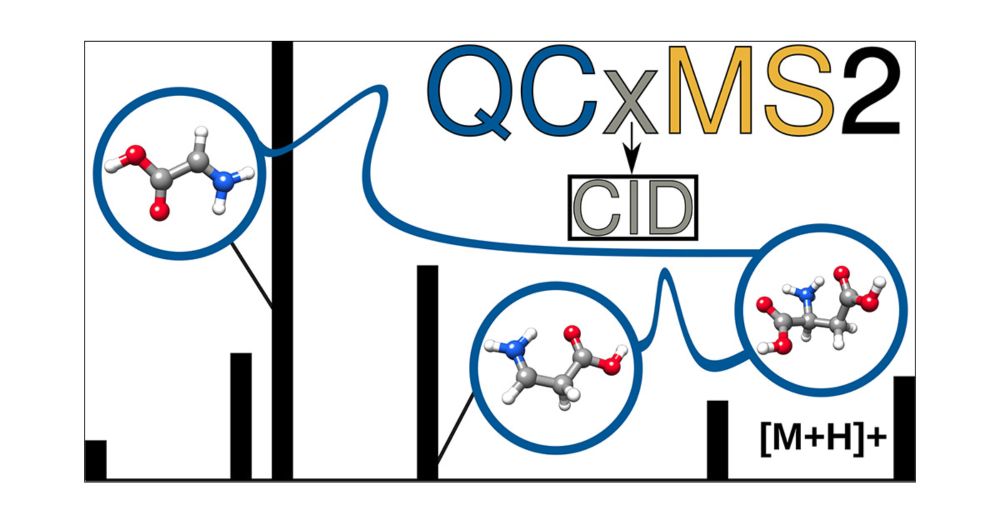
Evaluation of the QCxMS2 Method for the Calculation of Collision-Induced Dissociation Spectra via Automated Reaction Network Exploration Collision-induced dissociation mass spectrometry (CID-MS) is an important tool in analytical chemistry for the structural elucidation of unknown compounds. The theoretical prediction of the CID spectra plays a critical role in supporting and accelerating this process. To this end, we adapt the recently developed QCxMS2 program originally designed for the calculation of electron ionization (EI) spectra to enable the computation of CID-MS. To account for the fragmentation conditions characteristic of CID within the automated reaction network discovery approach of QCxMS2 we adapted the internal energy distribution to match the experimental conditions. This distribution can be adjusted via a single parameter to approximate various activation settings, thereby eliminating the need for explicit simulations of the collisional process. We evaluate our approach on a test set of 13 organic molecules with diverse functional groups, compiled specifically for this study. All reference spectra were recorded consistently under the same measurement conditions, including both CID and higher-energy collisional dissociation (HCD) modes. Overall, QCxMS2 achieves a good average entropy similarity score (ESS) of 0.687 for the HCD spectra and 0.773 for the CID spectra. The direct comparison to experimental data demonstrates that the QCxMS2 approach, even without explicit modeling of collisions, is generally capable of computing both CID and HCD spectra with reasonable accuracy and robustness. This highlights its potential as a valuable tool for integration into structure elucidation workflows in analytical mass spectrometry.

QCxMS2 can now also simulate CID mass spectra.

Just published in #JASMS : doi.org/10.1021/jasms.5c00234

Grateful to my coauthors Stefan Grimme @grimmelab.bsky.social & Marianne Engeser @unibonn.bsky.social - this is the last project of my PhD and completes my work on QCxMS2!

#MassSpec #compchem

08.09.2025 09:10 โ€” ๐Ÿ‘ 9    ๐Ÿ” 4    ๐Ÿ’ฌ 2    ๐Ÿ“Œ 1
Preview
The Arch from the Stones: Understanding Protein Folding Energy Landscapes via Bioinspired Collective Variables Protein folding remains a formidable challenge despite significant advances, particularly in sequence-to-structure prediction. Accurately capturing thermodynamics and intermediates via simulations dem...

How do proteins really fold? Our latest @pubs.acs.org JPCL paper with @saureli.bsky.social @valeriorizzi.bsky.social @mheritier.bsky.social unveils a new MD strategy to investigate it in atomistic resolution by focusing on water and side-chain interactions. check it out pubs.acs.org/doi/10.1021/...

08.09.2025 13:13 โ€” ๐Ÿ‘ 5    ๐Ÿ” 2    ๐Ÿ’ฌ 0    ๐Ÿ“Œ 0
Preview
Martini 3 Coarse-Grained Models for Carbon Nanomaterials The Martini model is a coarse-grained force field allowing simulations of biomolecular systems as well as a range of materials including different types of nanomaterials of technological interest. Recently, a new version of the force field (version 3) has been released that includes new parameters for lipids, proteins, carbohydrates, and a number of small molecules, but not yet carbon nanomaterials. Here, we present new Martini models for three major types of carbon nanomaterials: fullerene, carbon nanotubes, and graphene. The new models were parametrized within the Martini 3 framework, and reproduce semiquantitatively a range of properties for each material. In particular, the model of fullerene yields excellent solid-state properties and good properties in solution, including correct trends in partitioning between different solvents and realistic translocation across lipid membranes. The models of carbon nanotubes reproduce the atomistic behavior of nanotube porins spanning lipid bilayers. The model of graphene reproduces structural and elastic properties, as well as trends in experimental adsorption enthalpies of organic molecules. All new models can be used in large-scale simulations to study the interaction with the wide variety of molecules already available in the Martini 3 force field, including biomolecular and synthetic systems.

Martini 3 Coarse-Grained Models for Carbon Nanomaterials | Journal of Chemical Theory and Computation pubs.acs.org/doi/full/10....

04.09.2025 10:07 โ€” ๐Ÿ‘ 15    ๐Ÿ” 4    ๐Ÿ’ฌ 0    ๐Ÿ“Œ 0

There we go... manuscript accepted in Nature.

From now on, I'm painting, playing games, and travelling ๐Ÿ˜€

02.09.2025 21:08 โ€” ๐Ÿ‘ 2    ๐Ÿ” 0    ๐Ÿ’ฌ 0    ๐Ÿ“Œ 0
Preview
acnash - Overview Senior Computational Biophysicist and Chemist, Software Engineer, and Medical Statistician. I build novel chemical software to solve protein-disease models. - acnash

Cleaning up my GitHub page. Most repositories are outdated, and the majority of work has been conducted on private company repositories. Nice picture of me and the dog, though ๐Ÿ˜…๐Ÿ˜
github.com/acnash

21.07.2025 06:35 โ€” ๐Ÿ‘ 0    ๐Ÿ” 0    ๐Ÿ’ฌ 0    ๐Ÿ“Œ 0

Thanks so much. Sounds like I'm after MolecularNodes in Blender :-)

05.07.2025 13:14 โ€” ๐Ÿ‘ 1    ๐Ÿ” 0    ๐Ÿ’ฌ 1    ๐Ÿ“Œ 0
Preview
Methodological developments in electronic structure theory and chemical dynamics This Collection aims to highlight research that advances our understanding of electronic structure and chemical dynamics, as well as the application of ...

#compchem Our recent work "๐’๐ก๐จ๐ซ๐ญ๐œ๐ฎ๐ญ ๐ญ๐จ ๐œ๐ก๐ž๐ฆ๐ข๐œ๐š๐ฅ๐ฅ๐ฒ ๐š๐œ๐œ๐ฎ๐ซ๐š๐ญ๐ž ๐ช๐ฎ๐š๐ง๐ญ๐ฎ๐ฆ ๐œ๐จ๐ฆ๐ฉ๐ฎ๐ญ๐ข๐ง๐  ๐ฏ๐ข๐š ๐๐ž๐ง๐ฌ๐ข๐ญ๐ฒ-๐›๐š๐ฌ๐ž๐ ๐›๐š๐ฌ๐ข๐ฌ-๐ฌ๐ž๐ญ ๐œ๐จ๐ซ๐ซ๐ž๐œ๐ญ๐ข๐จ๐ง " has been selected in the following Nature collection ( #quantumcomputing for Quantum Chemistry section). www.nature.com/collections/...

28.06.2025 11:01 โ€” ๐Ÿ‘ 12    ๐Ÿ” 4    ๐Ÿ’ฌ 2    ๐Ÿ“Œ 0
GitHub - acnash/gamd-openmm at feature-periodic Gaussian Accelerated Molecular Dynamics (GaMD) is a computational method for both unconstrained enhanced sampling and free energy calculations of biomolecules. It works by adding a harmonic boost p...

Currently living here
github.com/acnash/gamd-...

#moleculardynamics #openmm #chemistry

26.06.2025 10:22 โ€” ๐Ÿ‘ 0    ๐Ÿ” 0    ๐Ÿ’ฌ 0    ๐Ÿ“Œ 0
Post image

I've adjusted the source code of Gaussian accelerated molecular dynamics (GAMD) with OpenMM (github.com/MiaoLab20/ga...) to accept periodic molecules, such as a sequence bonded to itself across the periodic boundary.

26.06.2025 08:48 โ€” ๐Ÿ‘ 2    ๐Ÿ” 0    ๐Ÿ’ฌ 1    ๐Ÿ“Œ 0

And Python 2.7 on a different package. That's a sackable offense, surely ;-)

28.05.2025 11:53 โ€” ๐Ÿ‘ 0    ๐Ÿ” 0    ๐Ÿ’ฌ 0    ๐Ÿ“Œ 0

I'm exploring some software. I check out the dependencies... Perl, MatLab, BLAST, and DSSP.

This is going to break. I just know it.

#sciencesoftware

28.05.2025 11:39 โ€” ๐Ÿ‘ 0    ๐Ÿ” 0    ๐Ÿ’ฌ 1    ๐Ÿ“Œ 0
Video thumbnail

Our new preprint PharmacoForge: Pharmacophore Generation with Diffusion Models is out now! PharmacoForge quickly generates pharmacophores for a given protein pocket that identify key binding features and find useful compounds in a pharmacophore search. Check it out! ๐Ÿงช doi.org/10.26434/che...

27.05.2025 19:11 โ€” ๐Ÿ‘ 21    ๐Ÿ” 9    ๐Ÿ’ฌ 1    ๐Ÿ“Œ 0

I've had to increase the font size used by the favourite IDE. Time stands still for no man.

27.05.2025 16:25 โ€” ๐Ÿ‘ 0    ๐Ÿ” 0    ๐Ÿ’ฌ 0    ๐Ÿ“Œ 0
Preview
On the failure of rescoring in virtual screening Why automated virtual screening and docking remains hard and why expertise remains essential

New post: On the failure of rescoring in virtual screening.
Or why automated virtual screening and docking remains hard and why expertise remains essential. medchemash.substack.com/p/on-the-fai...

22.05.2025 19:39 โ€” ๐Ÿ‘ 28    ๐Ÿ” 9    ๐Ÿ’ฌ 0    ๐Ÿ“Œ 0

Thanks. MACE-MP-0 has zinc data, but further training would still be required to compensate for changes in the zinc coordination number in the binding pocket relative to my system. Thanks, this is a start.

21.05.2025 12:21 โ€” ๐Ÿ‘ 1    ๐Ÿ” 0    ๐Ÿ’ฌ 0    ๐Ÿ“Œ 0

This looks great. Is it suitable for metalloproteases? Zinc protein binding centres, in particular?

21.05.2025 11:42 โ€” ๐Ÿ‘ 0    ๐Ÿ” 0    ๐Ÿ’ฌ 1    ๐Ÿ“Œ 0
Preview
MACE-OFF: Short-Range Transferable Machine Learning Force Fields for Organic Molecules Classical empirical force fields have dominated biomolecular simulations for over 50 years. Although widely used in drug discovery, crystal structure prediction, and biomolecular dynamics, they generally lack the accuracy and transferability required for first-principles predictive modeling. In this paper, we introduce MACE-OFF, a series of short-range transferable force fields for organic molecules created using state-of-the-art machine learning technology and first-principles reference data computed with a high level of quantum mechanical theory. MACE-OFF demonstrates the remarkable capabilities of short-range models by accurately predicting a wide variety of gas- and condensed-phase properties of molecular systems. It produces accurate, easy-to-converge dihedral torsion scans of unseen molecules as well as reliable descriptions of molecular crystals and liquids, including quantum nuclear effects. We further demonstrate the capabilities of MACE-OFF by determining free energy surfaces in explicit solvent as well as the folding dynamics of peptides and nanosecond simulations of a fully solvated protein. These developments enable first-principles simulations of molecular systems for the broader chemistry community at high accuracy and relatively low computational cost.

Now out in @jacs.acspublications.org ! ๐ŸŽ‰ : "MACE-OFF: Short-Range Transferable Machine Learning Force Fields for Organic Molecules" by Dรกvid Kovรกcs, @jhmchem.bsky.social, & team:
pubs.acs.org/doi/10.1021/...

19.05.2025 15:49 โ€” ๐Ÿ‘ 14    ๐Ÿ” 5    ๐Ÿ’ฌ 2    ๐Ÿ“Œ 1

Agreed. I worked incredibly hard, but my career was derailed twice: Brexit and the Pandemic.

21.05.2025 08:18 โ€” ๐Ÿ‘ 10    ๐Ÿ” 0    ๐Ÿ’ฌ 2    ๐Ÿ“Œ 0

#compchem

14.05.2025 21:59 โ€” ๐Ÿ‘ 8    ๐Ÿ” 2    ๐Ÿ’ฌ 0    ๐Ÿ“Œ 0
Post image

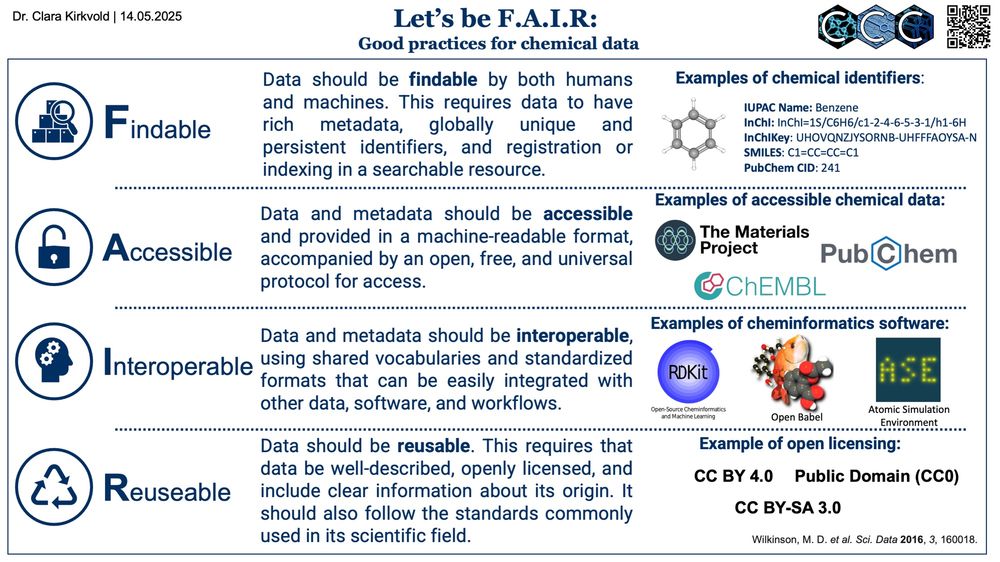
In todayโ€™s #good_practices #Journal_Club @clarakirkvold.bsky.social discusses the #FAIR #data principles and their implementations in #chemistry www.grynova-ccc.org/journal-club...

14.05.2025 17:45 โ€” ๐Ÿ‘ 13    ๐Ÿ” 3    ๐Ÿ’ฌ 0    ๐Ÿ“Œ 1
Preview
facebook/OMol25 ยท Hugging Face Weโ€™re on a journey to advance and democratize artificial intelligence through open source and open science.

This is impressive! A huge QM structure of small molecules, ligands, biomolecules, etc., database.
Organisational skills must be at another level.

huggingface.co/facebook/OMo...

And the paper:
arxiv.org/abs/2505.08762

14.05.2025 20:59 โ€” ๐Ÿ‘ 0    ๐Ÿ” 0    ๐Ÿ’ฌ 0    ๐Ÿ“Œ 0
Preview
Ten quick tips to perform meaningful and reproducible molecular docking calculations Author summary The ten quick tips presented here are aimed at understanding the drug target thoroughly and performing molecular docking to ensure maximum precision and biological relevance. The emphas...

Can you keep up? I sometimes feel like I can't, but remember you're not alone. Just keep reading.

Some tips for performing meaningful and reproducible docking calculations.
journals.plos.org/ploscompbiol...

#docking #moleculardocking #liganddocking #compchem

12.05.2025 10:45 โ€” ๐Ÿ‘ 1    ๐Ÿ” 0    ๐Ÿ’ฌ 1    ๐Ÿ“Œ 0
Preview
A guide to machine learning for biologists - Nature Reviews Molecular Cell Biology Machine learning is becoming a widely used tool for the analysis of biological data. However, for experimentalists, proper use of machine learning methods can be challenging. This Review provides an o...

ML/AI in the sciences is moving at an extraordinary pace. It's easy to feel left behind. Here's an excellent introduction to ML/AI concepts for the experimentalist and theoretician who is frantically reading to keep up.

#AI #ML #machinelearning #science

www.nature.com/articles/s41...

12.05.2025 10:39 โ€” ๐Ÿ‘ 0    ๐Ÿ” 0    ๐Ÿ’ฌ 0    ๐Ÿ“Œ 0

Yep! The absolute worst are applications that require your CV and a form dump of bits of your CV in a web portal. I've raised issues with admin staff about the replication of information. Sadly, it gets you know where.

12.05.2025 10:06 โ€” ๐Ÿ‘ 1    ๐Ÿ” 0    ๐Ÿ’ฌ 0    ๐Ÿ“Œ 0
Variety name origins

Did you know I'm immortalized in plant form? There is a flower named after me.

Danum Anthony

www.dahliaworld.co.uk/dnamesv.htm#A

11.05.2025 20:39 โ€” ๐Ÿ‘ 0    ๐Ÿ” 0    ๐Ÿ’ฌ 0    ๐Ÿ“Œ 0