Greenhouse Book Talks. Hosted by Dolly Jørgensen & Finn Arne Jørgensen. A pair of hands holds up a pot with a plant growing into a book
Great news to start off 2026: Audio versions of all episodes of the Greenhouse #envhum book talks -- that's 188 episodes! -- are now available for you to listen to.
Audio feed you can subscribe to: newnatures.org/greenhouse/f...
(also available via many standard podcast listening services)
01.01.2026 08:41 —
👍 41
🔁 18
💬 0
📌 0
Nineteenth Ischia Summer School - Ischia Summer School on the History of the Life Sciences
2013 Ischia Summer School on the History of the Life Sciences, 29 June -- 6 July 2013: "Creating Life --- From Alchemy to Synthetic Biology"
The 19th Ischia Summer School in the History of the Life Sciences will take place 28 Jun - 5 July 2026. Interested graduate students should apply by 27 February. This year's theme? PROBLEMS of GROWTH! ischiasummerschool.org/theme #histSTM #histbio #histsci
05.01.2026 22:12 —
👍 11
🔁 10
💬 0
📌 1

Catalogue cover with beautiful Isotype symbols

My essay
New essay in this exhibition catalogue (Vienna/ in German) - the exhibition looks great!
06.12.2025 08:04 —
👍 8
🔁 2
💬 0
📌 0
Meetings - ISHPSSB.org
Welcome to the ISHPSSB.
ISHPSSB 2027 will be in Buenos Aires, Argentina 3rd week July. #HPS
ishpssb.org/meetings
20.12.2025 19:37 —
👍 24
🔁 9
💬 0
📌 0

Out now: "Christentum und Ökologie" in der "Kirchlichen Zeitgeschichte"
U.a. zu dunkelgrüner Religion, katholischer Resonanz, grünen Hähnen, christlichem Umweltprotest, Rechten der Natur, Schöpfungsverantwortung in der Ökumene und Naturerfahrungen des Pilgerns.
www.vr-elibrary.de/toc/kize/38/1
15.12.2025 16:03 —
👍 9
🔁 3
💬 0
📌 1

The Future That Was
How Third World women seized the means of knowledge production to fight against rising authoritarianism and imagine a future freer than our present
The Introduction, “What is the Future We Yearn For?,” to my book, *The Future That Was*, is now live and freely available to all on the book’s @princetonupress.bsky.social website
press.princeton.edu/books/hardco...
03.12.2025 01:12 —
👍 78
🔁 35
💬 0
📌 7
Three cheers, Melissa! ✨
18.11.2025 14:33 —
👍 1
🔁 0
💬 0
📌 0
Knowledge and Power: Projecting the Modern World
| Journal for the History of Knowledge
Very happy to announce that the
@jhokjournal.bsky.social
special issue "Knowledge and Power: Projecting the Modern World," edited by Vera Keller, Kelly Whitmer, and me, is starting to be published: the first three articles are here, the rest to follow.
journalhistoryknowledge.org/Knowledge_an...
21.09.2025 23:27 —
👍 24
🔁 9
💬 1
📌 0

Dolphin drawings
Some dolphin sketches. Part of a commission for
@emilam.bsky.social and Princeton University Press
@princetonupress.bsky.social
#SciArt #mammals #art #dolphins
27.08.2025 17:05 —
👍 615
🔁 56
💬 8
📌 0

S5 E4 - Heather Douglas on Rethinking Science’s Social Contract
The HPS Podcast - Conversations from History, Philosophy and Social Studies of Science · Episode
What happens when the old contract between science and society no longer fits?
This week, Prof. Heather Douglas unpacks the legacy of the value-free ideal, examines research ethics & funding — and proposes a new social contract for science. This was an illuminating conversation.
Listen now! 🎧
07.08.2025 21:13 —
👍 63
🔁 26
💬 2
📌 3
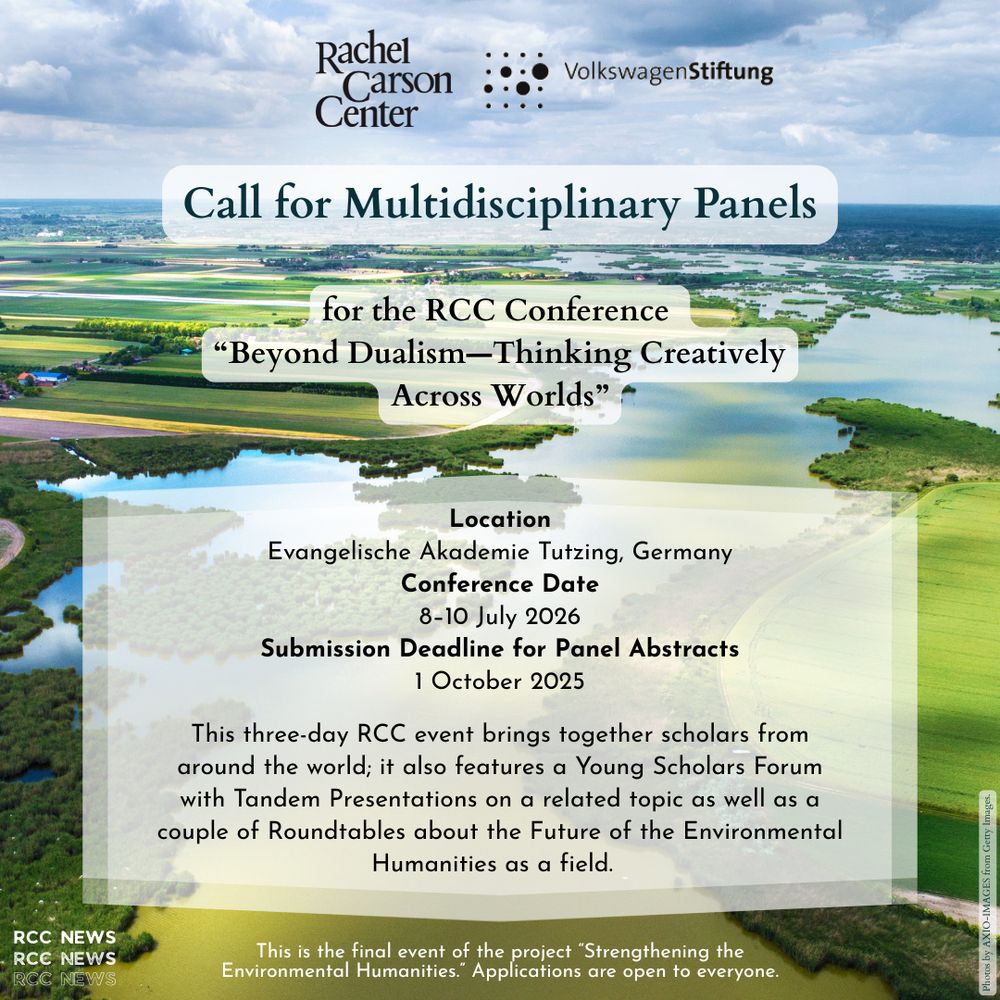
The graphic shows cultivated lands bordering on a river/wetland and collections of trees (credit: AXIO-IMAGES from Getty Images) in the background of text bubbles. The text summarizes key details of the conference. Please read the description and the full call on the RCC website for this information.
We are looking for multidisciplinary panels to be presented at our upcoming conference "Beyond Dualism—Thinking Creatively Across Worlds," which takes place in July next year.
The full call can be found in the news section on our website: www.carsoncenter.uni-muenchen.de/news/news_ev... (1/?)
04.08.2025 13:05 —
👍 43
🔁 24
💬 1
📌 2
Which Science? Which Women? on JSTOR
Margaret W. Rossiter, Which Science? Which Women?, Osiris, Vol. 12, Women, Gender, and Science: New Directions (1997), pp. 169-185
My favorite, though? "Which Science? Which Women?" (1997) in which she discusses how and why some female scientists built networks of support and others instead sought to distance themselves from other women in their field: www.jstor.org/stable/301904
05.08.2025 16:36 —
👍 4
🔁 0
💬 0
📌 0
The Matthew Matilda Effect in Science on JSTOR
Margaret W. Rossiter, The Matthew Matilda Effect in Science, Social Studies of Science, Vol. 23, No. 2 (May, 1993), pp. 325-341
She's probably best known for her paper on the "Matilda Effect" (1993), the flip side of the "halo" surrounding already well-known Matthews that leads them to be credited for work they did not do, where the "have-nots" of science were repeatedly ignored despite successes: www.jstor.org/stable/285482
05.08.2025 16:36 —
👍 3
🔁 0
💬 1
📌 0
RIP Margaret Rossiter. She took "Science & History" at Harvard in the e.1960s. Her instructor commented “your powers of analysis are far superior to your powers of articulation." Oof, we all start somewhere & I appreciated her willingness to share! watermark.silverchair.com/hsns_2012_42...
05.08.2025 16:36 —
👍 7
🔁 0
💬 1
📌 1
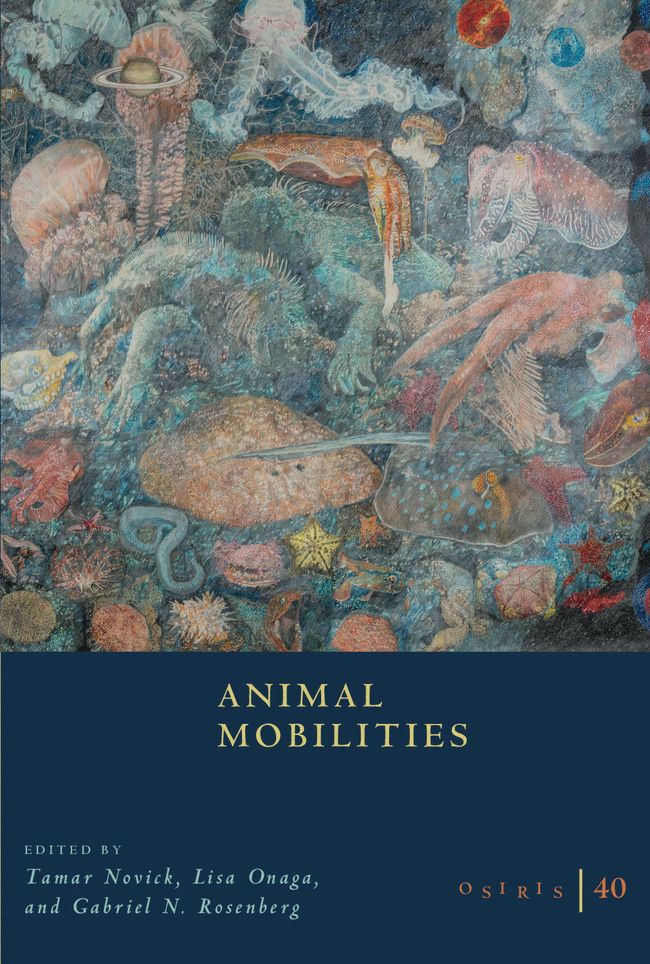
Cover of OSIRIS, volume 40. The title reads "Animal Mobilities" in yellow letters on a blue background. Above there is a colorful illustration showing animals and planets on the seabed.
New special issue of OSIRIS: "Animal Mobilities" 🐫🐠🐛
The volume was edited by MPIWG Research Scholars Tamar Novick, @lisaonaga.bsky.social, and Gabriel N. Rosenberg of the working groups "Out of Place, Out of Time" and "Proteins and Fibers."
🔗 bit.ly/amv4025
#HistSci #EnvHist #STS #Zoology
17.06.2025 09:52 —
👍 46
🔁 20
💬 1
📌 3
Osiris Volume 40: 'Knowing Animals, Moving Animals' Roundtable
Human societies often come to know the natural world by examining animals, even as animals, frequently both willful and animate, elude human grasps and challenge human aims. Animals and their movement...
The "Animal Mobilities" special issue will also be discussed at this year's History of Science Society conference in New Orleans, USA.
🐫🐠🐛 The roundtable is organized by @lisaonaga.bsky.social, co-editor of the volume.
🗓️ November 14, 2025, 11:00 (CST)
📍Sheraton NOLA
🔗 bit.ly/hssam25
#HistSci #HSS
16.07.2025 14:45 —
👍 7
🔁 2
💬 0
📌 2

S5 E3 - Hans-Jörg Rheinberger on Epistemic Things
The HPS Podcast - Conversations from History, Philosophy and Social Studies of Science · Episode
It was a true privilege to have had the chance to interview Hans-Jörg Rheinberger, whose work has long influenced both my research interests and engagement with this discipline.
It's this week's episode of
The HPS Podcast – out now! 🎧
@hpspodcast.bsky.social
#hps #histsci #experiments
31.07.2025 18:36 —
👍 32
🔁 12
💬 1
📌 0
Awesome -- thank you ✨
02.02.2025 19:16 —
👍 1
🔁 0
💬 0
📌 0
Any chance that a former student could purchase one? 😉
02.02.2025 19:01 —
👍 2
🔁 0
💬 1
📌 0
Love it!
02.02.2025 18:11 —
👍 1
🔁 0
💬 1
📌 0
These are gold!
26.01.2025 19:09 —
👍 1
🔁 0
💬 1
📌 0
This is officially my horizontally longest image to date, depicting some of the earliest complex animals on the planet from 565 to 505 million years ago and how they changed over time.
Thank you to @egmitchell.bsky.social and Steve Pates for trusting me with this gargantuan task! #Art #SciArt
22.01.2025 18:49 —
👍 751
🔁 172
💬 26
📌 6
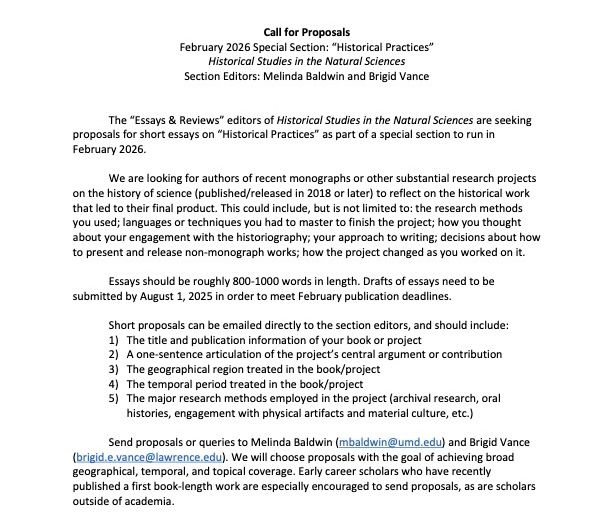
Image Text: Call for Proposals
February 2026 Special Section: “Historical Practices”
Historical Studies in the Natural Sciences
Section Editors: Melinda Baldwin and Brigid Vance
The “Essays & Reviews” editors of Historical Studies in the Natural Sciences are seeking proposals for short essays on “Historical Practices” as part of a special section to run in February 2026.
We are looking for authors of recent monographs or other substantial research projects on the history of science (published/released in 2018 or later) to reflect on the historical work that led to their final product. This could include, but is not limited to: the research methods you used; languages or techniques you had to master to finish the project; how you thought about your engagement with the historiography; your approach to writing; decisions about how to present and release non-monograph works; how the project changed as you worked on it.
Essays should be roughly 800-1000 words in length. Drafts of essays need to be submitted by August 1, 2025 in order to meet February publication deadlines.
Short proposals can be emailed directly to the section editors, and should include:
1) The title and publication information of your book or project
2) A one-sentence articulation of the project’s central argument or contribution
3) The geographical region treated in the book/project
4) The temporal period treated in the book/project
5) The major research methods employed in the project (archival research, oral histories, engagement with physical artifacts and material culture, etc.)
Send proposals or queries to Melinda Baldwin (mbaldwin@umd.edu) and Brigid Vance (brigid.e.vance@lawrence.edu). We will choose proposals with the goal of achieving broad geographical, temporal, and topical coverage. Early career scholars who have recently published a first book-length work are especially encouraged to send proposals, as are scholars outside of academia.
Fellow #histSTM scholars! The "Essays and Reviews" section of Historical Studies in the Natural Sciences (@hsnatsci.bsky.social) is looking for contributors to a February 2026 special section on "Historical Practices." More information in this Call for Proposals + in this thread. (1/?)
15.01.2025 16:08 —
👍 20
🔁 19
💬 1
📌 0

Illustration of bumble bee on aster; illustration of ammonoid; illustration of rainbow trout head; image of American Silver Eagle coin
For my first post here, I'm sharing a little collage of my work: three natural science illustrations and one coin design. I've been a self-employed illustrator for nearly 25 years now, so this is a small sampling. Many more examples here: emilydamstra.com
#sciart #paleoart #coindesign #fishart
10.01.2025 23:57 —
👍 403
🔁 59
💬 20
📌 5