
My rad colleague @RebeiroBradley (on X) just finished his book manuscript, “Frederick Douglass and Constitutional Abolitionism”!!!! Coming soon from #HarvardUniversityPress.
#FrederickDouglass
My rad colleague @RebeiroBradley (on X) just finished his book manuscript, “Frederick Douglass and Constitutional Abolitionism”!!!! Coming soon from #HarvardUniversityPress.
#FrederickDouglass

This is a super-cool article looking at 33,000+ search warrant applications filed electronically in Utah to figure out how long it takes to review warrant applications, how often they are granted, and the like.
harvardlawreview.org/print/vol-13...

My colleague is a big deal! Read his latest here: harvardlawreview.org/print/vol-13...
17.06.2025 22:02 — 👍 2 🔁 0 💬 0 📌 0New: "An Evidence-Based Approach to Fair Use" (Ga. L. Rev. w coauthors). Argue courts should utilize modern access to data & analytical tools in resolving fair use factor 4 Qs. Proof of concept: find sampling a song causes on average 50% increase in streams. Details: papers.ssrn.com/sol3/papers....
21.03.2025 00:51 — 👍 5 🔁 4 💬 0 📌 0It was surreal to learn Justice Sotomayor quoted me in her blistering Grants Pass v. Johnson dissent. My latest, Unavoidable Consequences, critiques the Johnson majority for stripping Eighth Amendment protections away from unhoused people. Forthcoming in Utah L. Rev.: ssrn.com/abstract=515...
18.03.2025 15:48 — 👍 73 🔁 10 💬 2 📌 7![INTERPRETIVE FACTS: TEXTUALISM, EMPIRICISM, AND THE LAW-FACT DIVIDE
Hannah Walser
ABSTRACT
What a word means may seem to be a paradigmatic question of law. We reach conclusions about the meaning of a word or a sentence through interpretation; interpretation is one of judges’ core tasks in the United States court system; meaning is therefore a matter of law to be determined by judges. Yet thanks to technological advances in corpus linguistics permitting the quantitative analysis of large numbers of texts, as well as methodological shifts that frame ordinary meaning as an empirical question, courts and legal scholars are increasingly apt to frame interpretive inquiries as factual ones.
This Article offers the first systematic examination of where linguistic evidence used in statutory and constitutional interpretation should fit in the federal court system’s division of labor based on law and fact. First, I identify and label “interpretive facts”: generalized empirical evidence about how a particular word or phrase has been used by a population of speakers, understood by a population of listeners, or both. Then, I explain the complications that interpretive facts create for two specific aspects of the law-fact division of labor: the default expectation that questions of fact be submitted to a jury, and the more deferential standard of appellate review that applies to a trial court’s findings of fact. Applying either presumption to interpretive facts would seem to threaten the judiciary’s authority over questions of law and to undermine interpretive consistency. Yet failing to apply these presumptions risks flooding the courts with inaccurate empirical claims about language use—no small problem when the “ordinary meaning” of a legal term, as established through quantitative evidence, may be outcome-determinative.
[Alt text continued in next image]](https://cdn.bsky.app/img/feed_thumbnail/plain/did:plc:pwlygq4vcnwe4wzqxgczcv5u/bafkreiex5srywoxshp52bmyuhs4iacubq6xcc6jsahjrt2rot6c3hhg4qq@jpeg)
INTERPRETIVE FACTS: TEXTUALISM, EMPIRICISM, AND THE LAW-FACT DIVIDE Hannah Walser ABSTRACT What a word means may seem to be a paradigmatic question of law. We reach conclusions about the meaning of a word or a sentence through interpretation; interpretation is one of judges’ core tasks in the United States court system; meaning is therefore a matter of law to be determined by judges. Yet thanks to technological advances in corpus linguistics permitting the quantitative analysis of large numbers of texts, as well as methodological shifts that frame ordinary meaning as an empirical question, courts and legal scholars are increasingly apt to frame interpretive inquiries as factual ones. This Article offers the first systematic examination of where linguistic evidence used in statutory and constitutional interpretation should fit in the federal court system’s division of labor based on law and fact. First, I identify and label “interpretive facts”: generalized empirical evidence about how a particular word or phrase has been used by a population of speakers, understood by a population of listeners, or both. Then, I explain the complications that interpretive facts create for two specific aspects of the law-fact division of labor: the default expectation that questions of fact be submitted to a jury, and the more deferential standard of appellate review that applies to a trial court’s findings of fact. Applying either presumption to interpretive facts would seem to threaten the judiciary’s authority over questions of law and to undermine interpretive consistency. Yet failing to apply these presumptions risks flooding the courts with inaccurate empirical claims about language use—no small problem when the “ordinary meaning” of a legal term, as established through quantitative evidence, may be outcome-determinative. [Alt text continued in next image]
[continued from previous image] Although interpretive facts are relatively new to constitutional and statutory interpretation, courts have long used them to make sense of other types of legal texts. In particular, contract and patent law have developed techniques of interpretive fact-finding to evaluate claims of idiosyncratic or technical meaning. If courts continue to rely on corpus linguistics, I suggest they should avoid procedural and conceptual incoherence by drawing upon these existing techniques. Linguists offering evidence that bears upon questions of statutory or constitutional interpretation should present their arguments to a jury or to the judge as fact-finder. District courts should be required to make explicit findings of interpretive fact, and those findings should be reviewed for clear error by appellate courts. In closing, I situate interpretive facts in the context of scholarly conversations about the increasingly dispositive role of historical facts in the Supreme Court’s jurisprudence, offering a legal realist account of the turn to corpus linguistics.
It feels absurd to post about this, but—since the good people of #lawsky patiently encouraged me when I was freaking out about placing my paper, I wanted to share that it has found a home in the Indiana Law Journal. “Interpretive Facts,” coming 2026! (Two images below to fit the full alt text) 1/3
15.03.2025 15:18 — 👍 93 🔁 13 💬 14 📌 2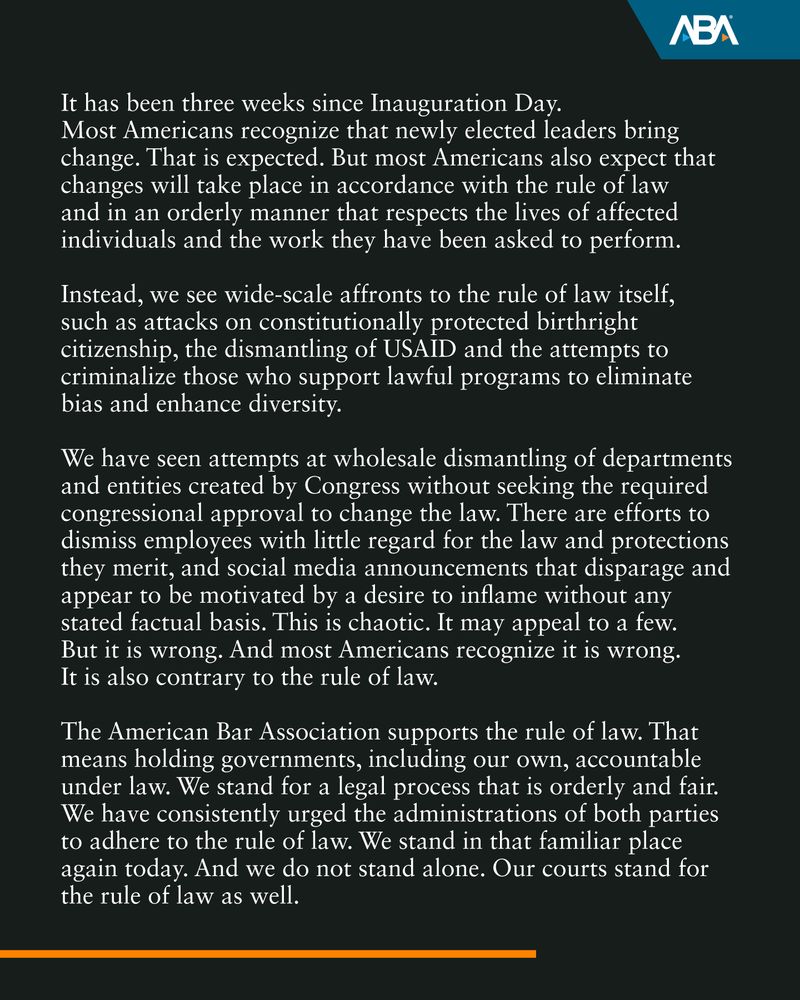
The ABA supports the rule of law. Read full message: www.americanbar.org/news/abanews...
10.02.2025 22:06 — 👍 4125 🔁 1510 💬 168 📌 227Thank you!
20.11.2024 14:13 — 👍 0 🔁 0 💬 0 📌 0Thanks for compiling this! Would love to be added if there’s room.
20.11.2024 04:30 — 👍 0 🔁 0 💬 0 📌 0Looks great! I’ve written a little bit about Obama’s eulogies. Can’t wait to read this.
18.11.2024 19:59 — 👍 1 🔁 0 💬 1 📌 0Pepsi is better than Coke, and bottled is better than canned.
13.11.2024 04:47 — 👍 2 🔁 0 💬 1 📌 0Agreed re: grossness, but at least they’re predictable. A good banana is roughly the same as a bad banana. But good peach/ watermelon / pear / pineapple / {insert pretty much any other fruit here}? SIGNIFICANTLY better than a bad one.
13.11.2024 04:45 — 👍 0 🔁 0 💬 0 📌 0Thanks Alan! And thanks for your very helpful feedback on my early draft. Check out the acknowledgments for your shout-out :)
11.11.2024 22:58 — 👍 1 🔁 0 💬 0 📌 0
Image of academic journal with title “The First Amendment and Constitutive Rhetoric: A Policy Proposal.”
Happy mail day! Received offprints of my latest piece, “The First Amendment and Constitutive Rhetoric” (w/ M. Spedding), from the NYU L. Rev.
The article considers how constitutive rhetorical theory might help judges solve tricky free speech problems. Read it here:
nyulawreview.org/issues/volum...
Thank you for this.
11.11.2024 20:03 — 👍 0 🔁 0 💬 0 📌 0George Saunders’ writing, the social and professional benefits of watching “The Bachelor”
11.11.2024 05:31 — 👍 0 🔁 0 💬 0 📌 0📌
10.11.2024 22:50 — 👍 0 🔁 0 💬 0 📌 0Thanks so much.
09.11.2024 04:00 — 👍 1 🔁 0 💬 0 📌 0Yes please! Thanks for doing this.
08.11.2024 21:36 — 👍 1 🔁 0 💬 1 📌 0
"American Exceptionalism And/In Affirmative Action" is now live in the Arizona State Law Journal! Huge thanks to the editors who believed in my work and helped polish it for publication.
arizonastatelawjournal.org/wp-content/u...
Congrats!!!
12.03.2024 22:30 — 👍 1 🔁 0 💬 1 📌 0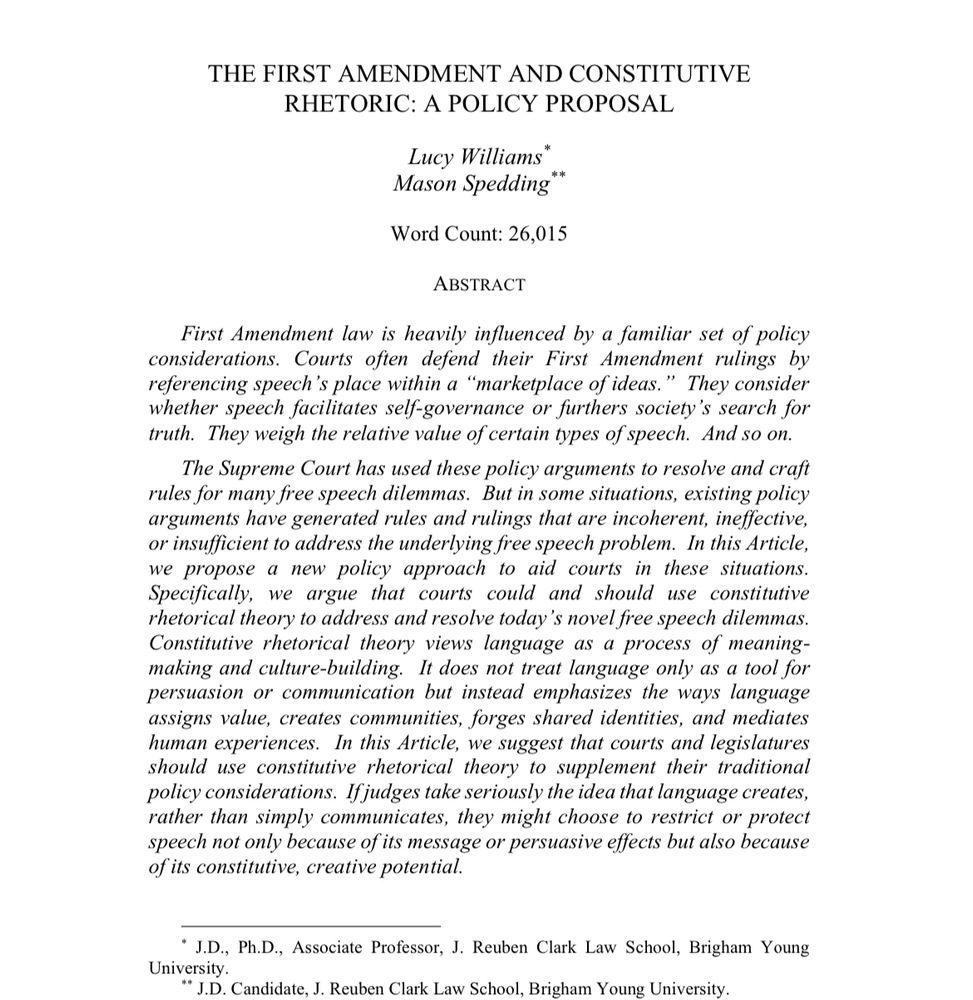
[Repeat post from that other platform] My new article (co-authored with Mason Spedding) found an incredible home! Thank you NYU Law Review for believing in this project. We can’t wait to work with you. #newlawrevarticles
Draft available @ssrn.bsky.social: papers.ssrn.com/sol3/papers....
Making my Bluesky debut to announce that “Making a Mother: The Supreme Court and the Constitutive Rhetoric of Motherhood” is now published in the North Carolina Law Review! Endless thanks to the editorial team for their excellent feedback and revisions. northcarolinalawreview.org/wp-content/u...
16.02.2024 22:02 — 👍 6 🔁 0 💬 0 📌 0
Highly recommend his podcast episode about it (and all his episodes, really):
open.spotify.com/episode/6O9k...
Goodbye Earl, but not for the reasons you might expect. Per Rob Harvilla, the most important line of the song is “Right away MaryAnn flew in from Atlanta…”. Why? Because “Goodbye Earl was never a song about Earl. It’s about Earl’s wife and the friend who came to her aid.”
14.12.2023 03:20 — 👍 0 🔁 0 💬 0 📌 0