Key points: Strong intermolecular interactions in the organic layer, low steric hindrance around the ammonium group, horizontally oriented inorganic sheets, and high hydrophobicity all lead to increased stability.
12.11.2024 14:42 — 👍 0 🔁 0 💬 0 📌 0@grahamlab.bsky.social
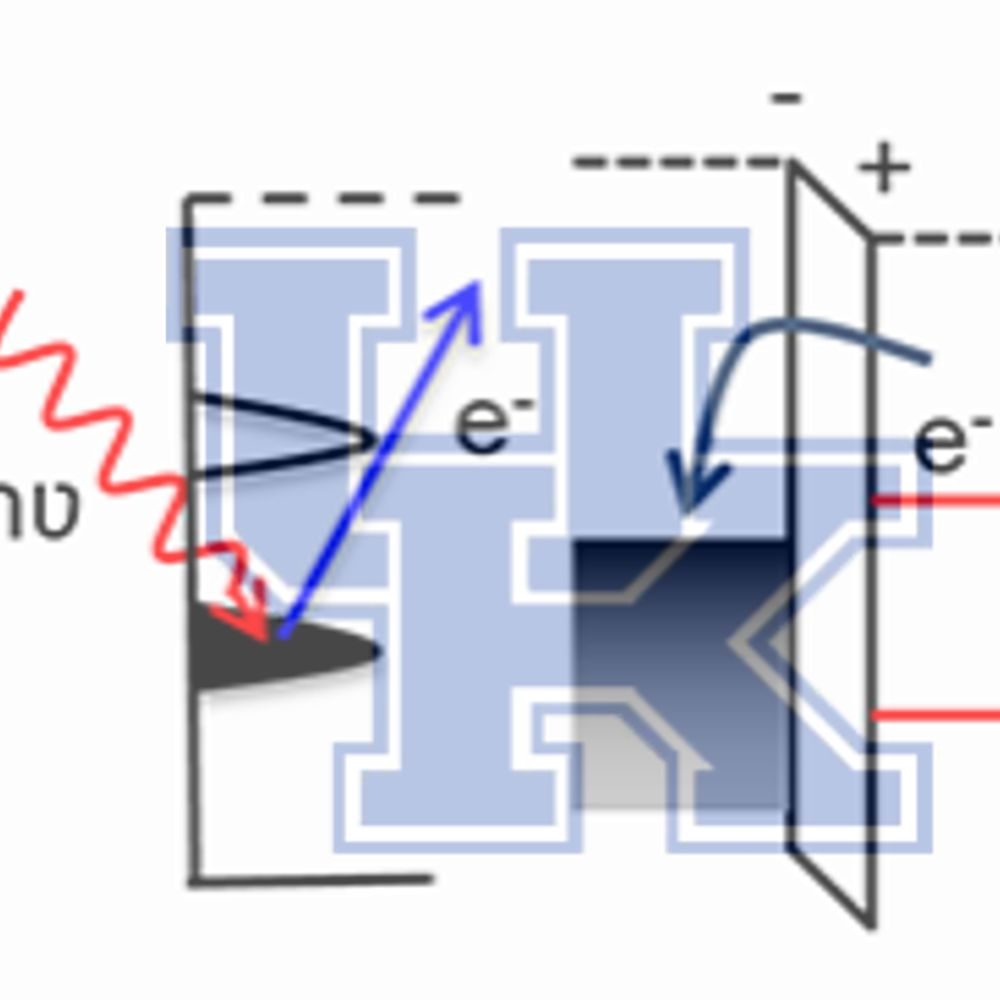
We're focused on developing and applying photoemission spectroscopies, admittance spectroscopies, and electrochemical methods to understand doping, defects, and degradation in organic semiconductors and organic metal halide perovskites.
Key points: Strong intermolecular interactions in the organic layer, low steric hindrance around the ammonium group, horizontally oriented inorganic sheets, and high hydrophobicity all lead to increased stability.
12.11.2024 14:42 — 👍 0 🔁 0 💬 0 📌 0Increasing the stability of organic metal halide perovskites remains a major challenges. Led by Tareq Hossain, we show how the ammonium cation structure can be used to increase stability in 2D tin halide perovskites: pubs.acs.org/doi/10.1021/...
12.11.2024 14:42 — 👍 1 🔁 0 💬 1 📌 0Congratulations to Augustine Yusuf for leading the work and thanks to MRS Communications for including Ken Graham as an Early Career Distinguished Presenter at the 2023 Fall MRS Meeting.
12.11.2024 14:42 — 👍 0 🔁 0 💬 0 📌 0The counterion can significantly influence the electronic and thermoelectric properties of doped conjugated polymers. Here, we show that the counterion size plays a role in determining whether the Seebeck coefficient changes sign upon heavy doping. link.springer.com/article/10.1...
12.11.2024 14:42 — 👍 0 🔁 0 💬 1 📌 0The Graham Lab is now on Bluesky! Follow us at @grahamlab.bsky.social to hear about our recent work, thoughts, and group activity. Posts will now appear on both bluesky and X.
12.11.2024 14:41 — 👍 0 🔁 0 💬 0 📌 0