Promotional graphic on a white background for short course registration. At the top left, the title reads “Groundwater Modeling and More 2026,” followed by “Conference & short course registration opening next week!” and the dates “June 7–10th, 2026.” At the top right is a bold blue “#GWM².” A semi-thick blue line appears beneath the date. Below the line, the text reads “Check Out Our Amazing Short Course Line Up!” followed by a list of short course titles, each marked with a blue check. On the right side, the conference logo appears over a blue wavy graphic. At the bottom left is a QR code linking to the website, and to its right the text reads: “For more information: https://igwmc.princeton.edu/groundwater-modeling-and-more/short-courses-more/” and Underneath that the text reads “Abstracts due March 3rd, Submit Yours Today! https://igwmc.princeton.edu/groundwater-modeling-and-more/abstract-submission/”.
Registration opens next week for #GWM2 Conference & Short Courses! 💧
Explore this year’s offerings and strengthen your groundwater modeling skills.
For more details:
igwmc.princeton.edu/groundwater-...
#Groundwater #Hydrology #Modeling @reedh2o.bsky.social
19.02.2026 20:18 —
👍 1
🔁 2
💬 0
📌 0

An abstract reminder promotional graphic on a dusky blue background. The event title, “Groundwater Modeling and More: From Raindrop to Reservoir,” appears in the top right next to a small drone photo of a mountain landscape, with #GWM² in the top left. Beneath the title, the text reads, “Three more weeks to go! Submit your abstract today!”followed by the date “Tuesday, March 3, 2026 at 5:00 PM EST.”
To the right is a QR code linking to the abstract submission page, followed by the abstract submission URL. In the bottom right corner is the conference logo. To the left of the logo is another QR code linking to the main conference website, with the website URL displayed below it. Along the bottom center, the text reads, “Questions? Reach out to us at igwmc@princeton.edu.”
⏰ 3 weeks left to submit abstracts for Groundwater Modeling and More 2026: From Raindrop to Reservoir!
📍 Princeton University | June 7–10, 2026
🗓️ Abstracts close March 3, 2026 (5pm EST)
🔗 igwmc.princeton.edu/groundwater-...
#GWM2 @reedh2o.bsky.social
10.02.2026 16:15 —
👍 1
🔁 1
💬 0
📌 0

Scientists create the most detailed groundwater map yet — with big implications for the West
As much of the Mountain West faces another dry winter, researchers are turning their attention underground to the water many communities rely on but rarely see.
"You always think the closest water is like a lake or a river or stream, but the closest water is beneath your feet."
Princeton's @reedh2o.bsky.social talks about new research that maps out groundwater below the surface — a vital tool during times of drought.
09.02.2026 17:46 —
👍 4
🔁 3
💬 0
📌 0

Report: 13 Great Lakes’ Worth of Water Underlies the Contiguous United States - Eos
Researchers used 1 million data points and a machine learning algorithm to estimate groundwater stores with higher resolution than ever before.
If surface water is our checking account and groundwater is our all-important savings account, "we don’t know how much is in our savings account,” said @reedh2o.bsky.social.
Now, he and his colleagues have developed an estimate.
eos.org/articles/rep...
27.01.2026 21:45 —
👍 7
🔁 5
💬 0
📌 0

Call for abstract promotional graphics on a white background. The event title reads “Groundwater Modeling and More: From Raindrop to Reservoir,” followed by the dates “June 7 - June 10, 2026”. A thin blue line appears underneath that. The text “Call for Abstracts!” followed by the link to abstract submission, the text “Open January 20th Close: March 3rd” and the location “Princeton University, Princeton, New Jersey.” A second thin blue line appears below the text, with the “Integrated GroundWater Modeling Center” centered under the line and the IGWMC logo under that.
Abstract submission is now open for Groundwater Modeling and More 2026: From Raindrop to Reservoir.
📍 Princeton University | June 7–10, 2026
🗓️ Deadline: March 3, 2026 (5pm EST)
🔗 event.fourwaves.com/gmm26/pages
@reedh2o.bsky.social
20.01.2026 16:20 —
👍 2
🔁 2
💬 0
📌 0
All data and code are open:
📄 Paper: www.nature.com/articles/s43...
💧 Data: hydroframe.org/hydrodata
💻 Code: github.com/HydroFrame-ML/high-res-WTD-static
Led by Yueling Ma with Laura Condon, Julian Koch, and team at Princeton + Arizona.
16.01.2026 12:09 —
👍 4
🔁 1
💬 0
📌 0
Why it matters: groundwater has a scale problem.
National policy: ~8M km²
Major aquifers: ~50K km²
A single irrigation well: ~500 m²
That's 7 orders of magnitude. Until now, no product could bridge that gap.
16.01.2026 12:09 —
👍 0
🔁 0
💬 1
📌 0
We estimate ~306,500 km³ of groundwater beneath North America.
That's 13× the volume of all the Great Lakes — hidden beneath our feet.
~40% of the country has water within 10 meters; shallow groundwater sustains streams and farms during drought; existing maps systematically undercount it.
16.01.2026 12:09 —
👍 2
🔁 0
💬 1
📌 0

Map of water table depth across the continental United States at 30-meter resolution, with inset panels showing detail at 100km, 10km, and 1km scales in both eastern and western US locations. Color scale shows depth from shallow (blue) to deep (yellow) on a log scale.
New work from our team: we mapped water table depth at 30-meter resolution across the entire continental US.
That's ~8 billion grid cells, trained on over 1 million well observations. Highest-resolution estimate to date.
16.01.2026 12:09 —
👍 17
🔁 3
💬 1
📌 1
For all we know about the planet, we still don't really know how much freshwater we have.
Surface water? About 1% of the total.
The rest is groundwater — varying wildly over short distances, poorly observed, hard to model.
16.01.2026 12:09 —
👍 2
🔁 0
💬 1
📌 0
🎲🌋 Games for Geoscience at #EGU26!
Session EOS1.3 highlights games and gamified approaches to geoscience teaching and learning.
Abstract submissions close Jan 15 — submit yours today!
🔗 games4geoscience.wordpress.com/egu-games-day/
@reedh2o.bsky.social @egu.eu
09.01.2026 15:39 —
👍 3
🔁 1
💬 0
📌 0

A digital graphic with a teal background featuring the text “Where Science Connects Us” and the AGU25 logo at the top. A dark blue wavy line runs horizontally across the design behind a photo of a diverse group of smiling people standing in front of an AGU backdrop, with a white AGU sign placed on the ground in front of them. Below the photo, the IGWMC logo and the Princeton University shield logo appear in the bottom left corner.

A 12-photo collage highlighting poster presentations, conversations, and virtual research displays.

An eight-photo collage highlighting oral presentations, set on a teal background. Dark blue squiggly lines intersect and weave between several of the photos, which show presenters speaking and engaging with audiences during oral presentation sessions.

A four-photo collage on a teal background with two dark blue squiggly lines at the top and bottom. The images include a two-tone blue AGU sign, two photos from a group dinner, and a playful group photo at the bottom showing a sillier moment.
AGU 25 — IGWMC edition 🌎
Posters, talks, #hydrology, #machinelearning, community, and lots of great conversations.
So grateful for everyone who made this week what it was.
Already looking ahead to doing it all again at AGU 26!
#AGU25 @reedh2o.bsky.social @agu.org
12.01.2026 20:27 —
👍 1
🔁 1
💬 0
📌 0

Save the Date promotional graphic on a white background. At the top, the text “Save the Date!” appears with a thin blue line beneath it. Below, the event title reads “Groundwater Modeling and More: From Raindrop to Reservoir,” followed by the dates “Sunday June 7 to Wednesday June 10, 2026” and the location “Princeton University, Princeton, New Jersey.” A second thin blue line appears below the text, with the IGWMC logo centered at the bottom.
Save the date! 📅 Join us for Groundwater Modeling and More 2026: From Raindrop to Reservoir, June 7–10, 2026 at Princeton University. A refreshed name, new formats, and longstanding traditions. More details coming soon! @reedh2o.bsky.social
22.12.2025 19:23 —
👍 3
🔁 2
💬 0
📌 0
Thanks so much for entrusting me to kick off #USRSE25! What a great conference and a super engaged audience. So much fun
07.10.2025 00:05 —
👍 2
🔁 0
💬 0
📌 0

Graphic titled "What is an Aquifer?" with a stick figure shrugging and question marks above its head. Text explains that an aquifer is a body of rock or sediment that contains and transmits groundwater, acting as an underground reservoir. Images include a screenshot of the virtual ParFlow Sandtank and a group of teachers working with a physical aquifer model. Logo of the Integrated GroundWater Modeling Center at the bottom.
What’s an aquifer? It’s layers of rock or sediment that hold and move water underground —like a hidden reservoir beneath our feet. We demo this with both a physical & virtual model for outreach events. Curious? Ask us more!
#Groundwater #Hydrology @reedh2o.bsky.social
26.09.2025 12:30 —
👍 5
🔁 3
💬 0
📌 0

A graphic with four blue boxes surrounding a central white circle that says "Let's Learn Some Hydrology Lingo." Each box contains a hydrology-related term and its definition:
Top left: "Evapotranspiration – The process by which water is transferred from land to the atmosphere through evaporation, the conversion of liquid water to vapor from soil and surfaces, and transpiration, the release of water vapor from plants."
Top right: "Precipitation – Water that falls from the atmosphere to earth’s surface as a liquid or solid."
Bottom left: "Runoff – A portion of water from precipitation that does not infiltrate into the ground and flows over the land surface, ending up in streams, rivers, or other surface waters."
Bottom right: "Hydrology – The science of water which deals with the properties, distribution, and circulation of water on and below the earth's surface and in the atmosphere."
At the bottom is the logo for the Integrated GroundWater Modeling Center (IGWMC).
💧 Water science has a language all its own.
Here’s a quick look at some essential hydrology terms—perfect for students, educators, and water nerds alike.
#Hydrology #WaterScience
🔁 Repost to help folks learn the lingo!
@reedh2o.bsky.social
12.09.2025 12:55 —
👍 2
🔁 2
💬 0
📌 0
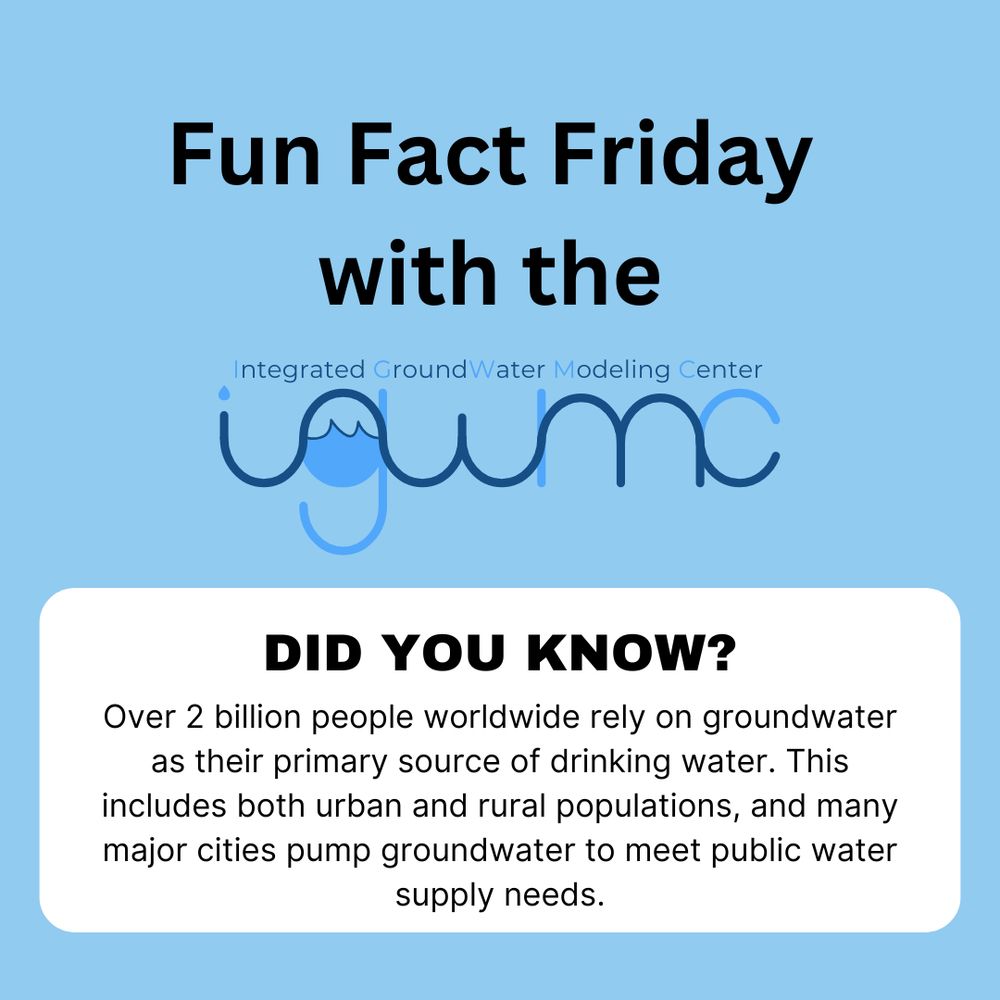
A light blue square graphic with bold black text at the top reading ‘Fun Fact Friday with the Integrated GroundWater Modeling Center.’ Below, the IGWMC logo features stylized blue and black text with a wave design. A white rounded rectangle contains bold black text saying ‘DID YOU KNOW?’ followed by a fact in smaller black font ‘Over 2 billion people worldwide rely on groundwater as their primary source of drinking water. This includes both urban and rural populations, and many major cities pump groundwater to meet public water supply needs.’
💧 #FunFactFriday 💧
Billions of people rely on groundwater every day—but most don’t even know it! 💧🌍 Do you know where your water comes from? 👇 #WaterFacts #Hydrology @reedh2o.bsky.social
29.08.2025 12:05 —
👍 3
🔁 2
💬 0
📌 0

Promotional graphic with a blue curved border design. Text announces that the Organizing Committee has started planning discussions for a possible MODFLOW & More Conference in 2026 and invites people to complete a short survey to help guide early conversations. A central QR code links to the survey. Below, two additional QR codes provide access to highlights from 2024 and short course information. The bottom includes the IGWMC logo and the Princeton University shield.
Discussions are beginning around a possible MODFLOW & More Conference in 2026.💧We’d love your input as we consider options. Please take a few minutes to complete our short survey: igwmc.princeton.edu/modflow-2026...
Also, check out 2024 highlights + past short course info
@reedh2o.bsky.social
22.08.2025 11:49 —
👍 4
🔁 3
💬 0
📌 0

A group sits at a table engaged in discussion on the distribution of saltwater and freshwater on earth. On the table are tall cups of blue liquid that are meant to represent the proportion of saltwater and freshwater on earth.
PC: Jasmine Pinchinat / Community Organizer

A group gathers around a table, exploring freshwater distribution with stacks of LEGO bricks. Each stack represents the proportion of freshwater in different reservoir types, sparking discussion and engagement among participants.
PC: Jasmine Pinchinat / Community Organizer

Three adults engage with a physical aquifer model demonstration. One woman injects dye into the tank to simulate contamination, while the other two observe the spreading dye and groundwater flow.
PC: Jasmine Pinchinat / Community Organizer

Lisa Gallagher, Education and Outreach Specialist, stands at the front of a classroom instructing a group of teachers. The participants are seated and listening attentively, with presentation materials visible in the background.
PC: Jasmine Pinchinat / Community Organizer
IGWMC led a hydrology unit for QUEST teachers last week! 💧 Participants learned how Earth’s water is distributed through the #Freshwater #Saltwater Challenge, then used #aquifer models to explore groundwater flow and aquifer types. @reedh2o.bsky.social
15.08.2025 12:30 —
👍 4
🔁 2
💬 0
📌 1

Students participate in a water balance activity outdoors using measuring cups and clear plastic buckets. One student pours water from a labeled “atmosphere” container into a “precipitation” measuring cup held by another student, while a third student observes the process attentively.
PC: Jasmine Pinchinat / Community Organizer

Students engage in a decision tree activity using a scatter ball board. One student drops a ball into the board while others look toward an instructor who is outside the frame, waiting for guidance.
PC: Jasmine Pinchinat / Community Organizer

A student stands behind a table, speaking to an older man wearing a bright yellow shirt with nature-themed illustrations. The table displays the students' artwork. Other people are visible interacting in the background.
PC: Lisa Gallagher/ Education and Outreach Specialist
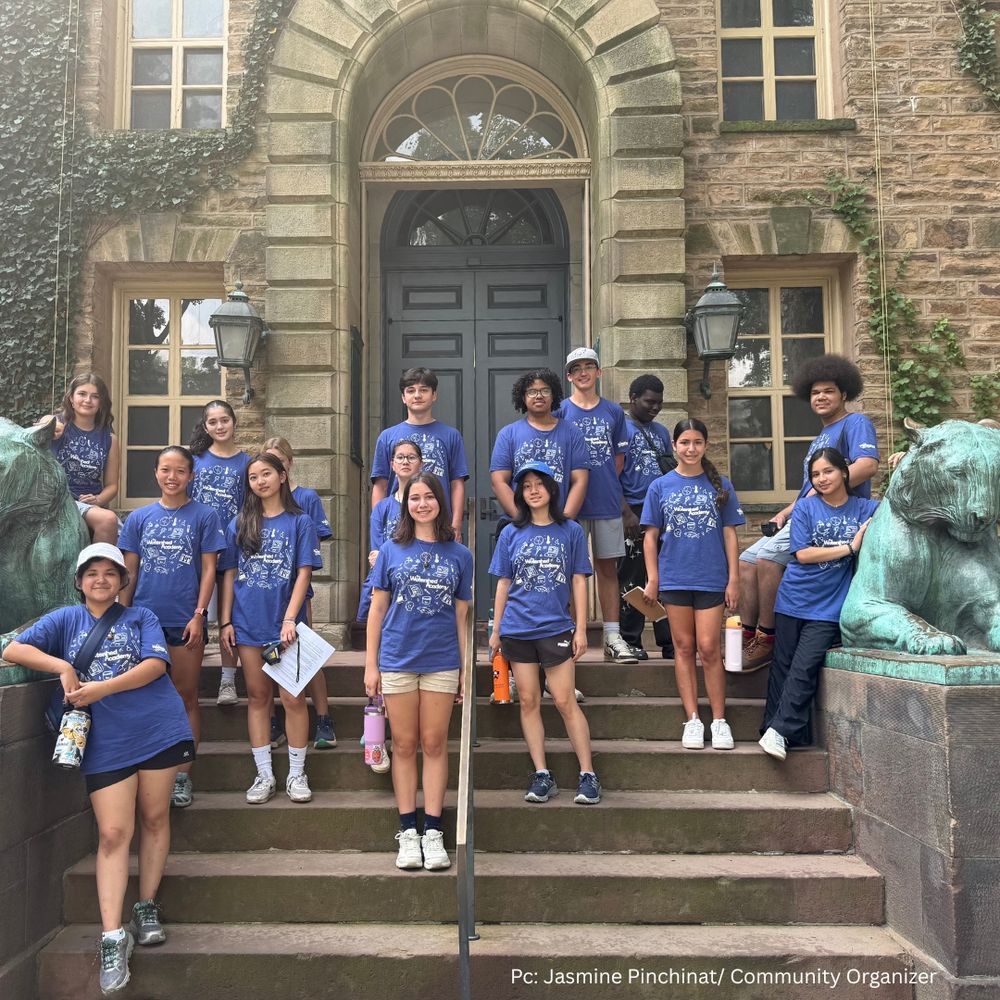
A group of students and a volunteer pose together in front of Nassau Hall at Princeton University during their campus heat tour. The students are smiling with the historic building behind them.
PC: Jasmine Pinchinat / Community Organizer
Students took on Water and Climate Week at @thewatershedinstitute —exploring #hydrology, #modeling, #ML, #coastalhydrology & #SciComm. The week ended with climate art inspired by places they love. @reedh2o.bsky.social
08.08.2025 13:15 —
👍 4
🔁 2
💬 0
📌 0
Thanks so much for the highlight!!
04.08.2025 03:28 —
👍 1
🔁 0
💬 0
📌 0

A graphic titled “What is a Hydrograph? Let’s talk about it!” with a diagram underneath. The diagram shows a hydrograph, a graph of time on the x-axis (in hours), precipitation in millimeters on the left y-axis, and discharge in cubic meters per second on the right y-axis. A grey bar chart represents precipitation, peaking early in the time period, labeled “Peak rainfall.” A blue line shows discharge rising after rainfall, labeled with “Rising limb,” peaking later at “Peak discharge,” and then decreasing, labeled “Falling limb.” The time between peak rainfall and peak discharge is marked as “Lag time.
Ever wondered how hydrologists observe water movement over time? A hydrograph shows streamflow changes from rain, snowmelt, and more. We use them to study floods, seasonality, and how water moves through landscapes.
#Hydrology #Groundwater #Hydrograph @reedh2o.bsky.social
25.07.2025 12:45 —
👍 6
🔁 2
💬 0
📌 0
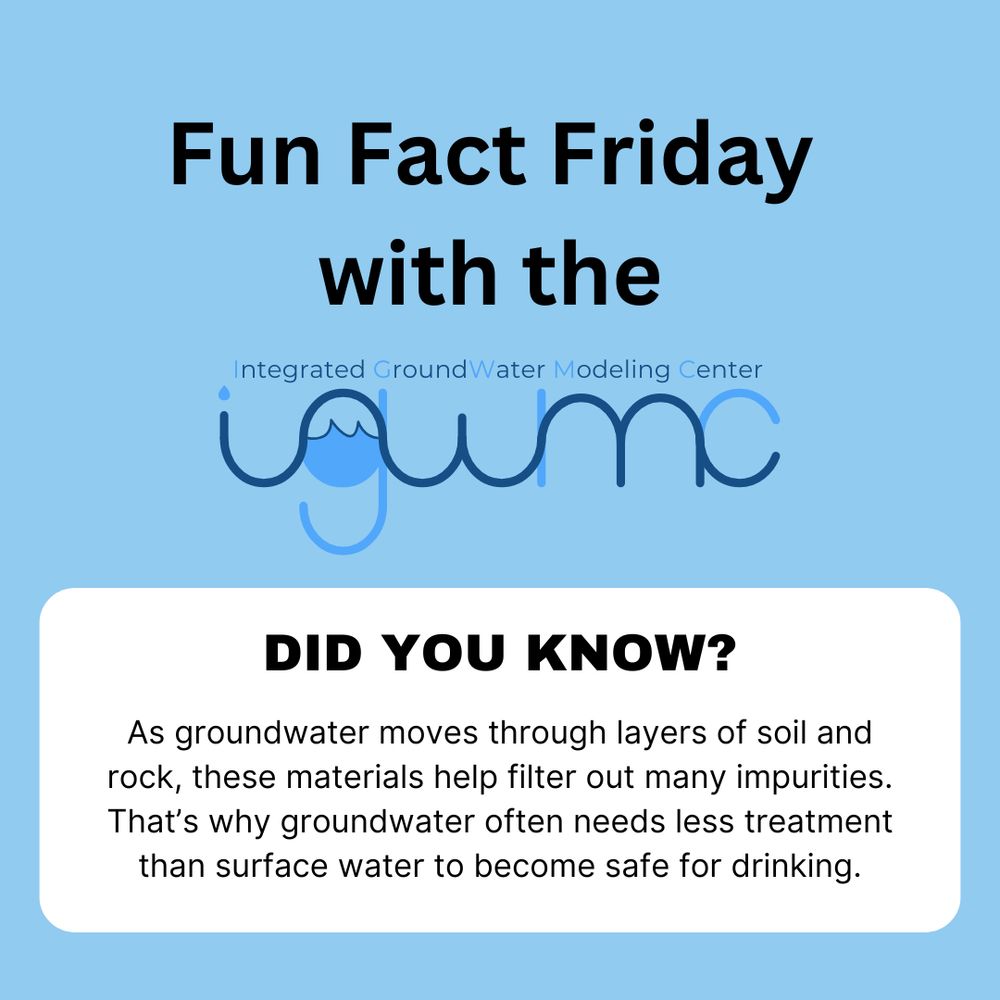
A light blue square graphic with bold black text at the top reading “Fun Fact Friday with the Integrated GroundWater Modeling Center.” Below, the IGWMC logo features stylized blue and black text with a wave design. A white rounded rectangle contains bold black text saying “DID YOU KNOW?” followed by a fact in smaller black font: “As groundwater moves through layers of soil and rock, these materials help filter out many impurities. That’s why groundwater often requires less treatment than surface water to become safe for drinking.”
As groundwater flows through layers of soil and rock, those materials help filter out impurities. 💧⏳ That’s why water from aquifers often needs less treatment than surface water.
What’s a cool science fact you love? Drop it below! ⬇️
#FunFactFriday #WaterScience @reedh2o.bsky.social
27.06.2025 12:55 —
👍 4
🔁 2
💬 0
📌 0
Congratulations Matthias!
19.06.2025 18:49 —
👍 1
🔁 0
💬 0
📌 0

A group of enthusiastic students from Foundation Academies Charter School gather around a table during a hands-on science activity. One student pours blue liquid from a measuring cup into a graduated cylinder while others look on with curiosity and excitement.

A smiling student in a blue Foundation Academies Charter School fleece proudly holds up a beaded bracelet they created, displaying it toward the camera in both hands.

A student and an adult volunteer work closely together on a beading activity. The adult leans over to assist the student as they thread blue and white beads at a table covered with cups of colorful beads.
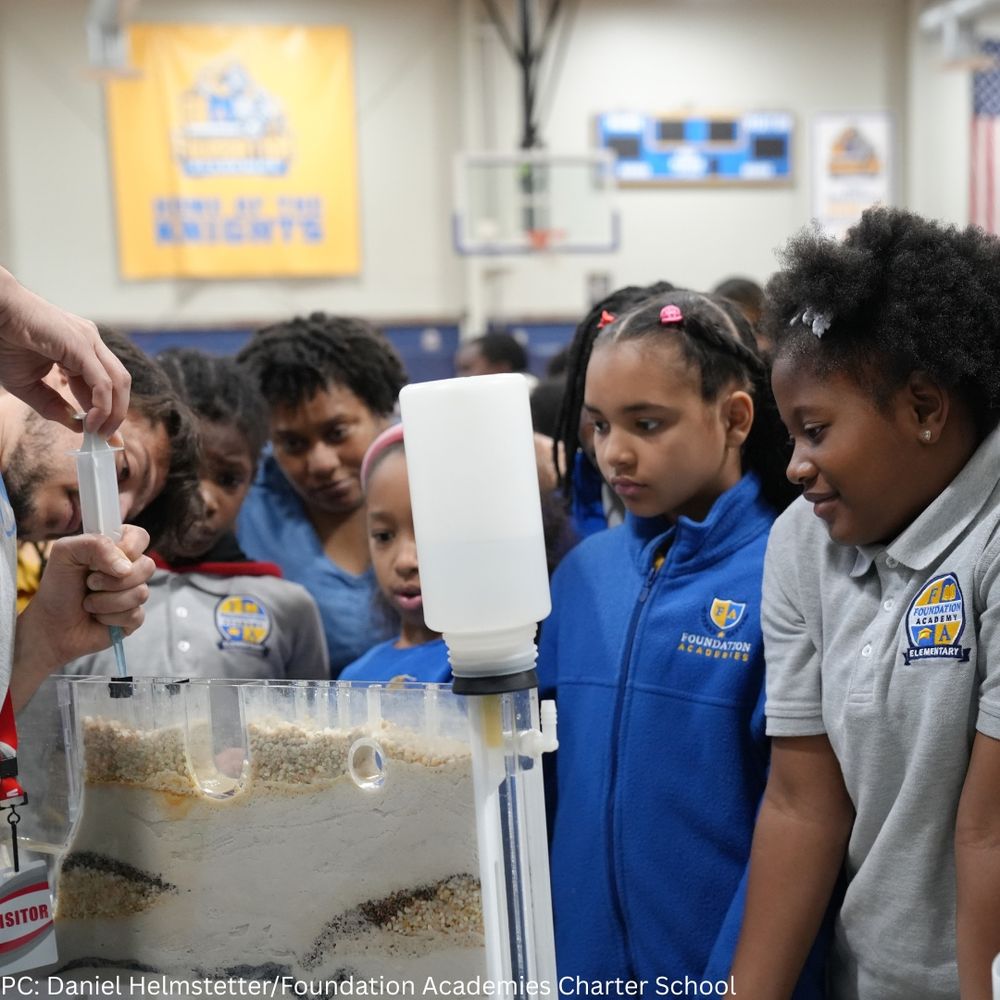
A group of students from Foundation Academies Charter School gather around an interactive groundwater model demonstration. The model shows layers of sand and soil, and an adult uses a syringe to “pump” liquid from the model, simulating water movement. The students watch attentively, engaged and curious.
We were so excited to be invited to facilitate Mole Day at Foundations Academy Charter School on June 2!
Students explored water science through aquifer models, crafting water cycle bracelets, and taking the freshwater challenge.💧
#STEM #WaterEducation #MoleDay @reedh2o.bsky.social
13.06.2025 13:24 —
👍 2
🔁 2
💬 1
📌 0
US climate scientists need all the help they can get. Including from foul-mouthed comedians! 🤡😱😱
Watch Emmy Award-Winning David Cross team up with Prof Michael Oppenheimer in the US launch of the hit series "Climate Science Translated".
#climate #arresteddevelopment #climatescience
02.06.2025 11:54 —
👍 1173
🔁 648
💬 23
📌 103

A congratulatory graphic featuring David van Velden, who is smiling and holding a plaque while standing next to Mario Soriano outside a building. He is wearing a Princeton jacket. The text below reads: "David graduated from Princeton’s Civil and Environmental Engineering department and will be working with Arcadis on water engineering projects in New York City. Originally from just outside Amsterdam, he joined the IGWMC through the High Meadows Environmental Institute, contributing to a joint project with Yale on groundwater vulnerability in the Appalachian region. His senior thesis used integrated hydrologic modeling to assess contamination risks from abandoned oil and gas wells, identifying nearly 400,000 people at risk." The graphic includes Princeton and IGWMC logos.

A congratulatory graphic featuring Brooke Beers, who is smiling and standing in front of a stone archway wearing a white outfit. The text below reads: "Brooke is from Winter Springs, FL, and her passion for environmental engineering grew from a deep love of the outdoors. At Princeton, she played varsity Women’s Rugby, led Outdoor Action orientation trips, and earned a certificate in Sustainable Energy. Through the IGWMC, she conducted fieldwork at Snodgrass hillslope near Crested Butte, CO, where she gathered data used in her senior thesis on predictors of plant species diversity. Brooke will be returning there this coming summer!" The graphic includes Princeton and IGWMC logos.

A congratulatory graphic featuring Ashley DeFrates, who is smiling and holding her senior thesis in front of green ivy. She is wearing a Princeton jacket. The text below reads: "Ashley, from Audubon, NJ, graduated from Princeton’s Civil and Environmental Engineering department and will begin a PhD in Earth System Science at Stanford. She worked with the IGWMC on bias-correcting meteorological inputs for ParFlow and conducted fieldwork at Snodgrass hillslope in Colorado. Her senior thesis used ParFlow to model the effects of warming on transpiration in the East-Taylor Watershed." The graphic includes Princeton and IGWMC logos.
We’re sending a big congratulations to 3 graduating undergrads from PU’s Class of 2025! 🎓These 3 have done great work with HMEI and the IGWMC.
👩🔬Ashley DeFrates
🌍Brooke Beers
💧 David van Velden
We can’t wait to see what’s next!
#Princeton25 #Research @acee.princeton.edu @reedh2o.bsky.social
30.05.2025 12:47 —
👍 5
🔁 3
💬 0
📌 0

Promotional graphic for IGWMC’s Short Courses – Summer 2025, taking place from June 12 to June 21, 2025. The orange background features the Integrated GroundWater Modeling Center (IGWMC) logo and Princeton University crest. The listed courses include:
MODFLOW 6 and FloPy: Take Your Groundwater Modeling Skills to the Next Level
An Introduction to Predictive Modeling Workflows with Python, pyEMU, and PEST++
Polishing Your Groundwater Modeling Skills
Integrated Simulation of Watershed Systems Using ParFlow
Subsetting Using HydroFrame and HydroData
Contaminant Transport
Interpretation of Pumping Tests
Conceptual Modeling and Model Parameterization Using Texture2Par
At the bottom, there are two QR codes: one labeled "More Information" and the other "To Register."
📢 Registration is now OPEN for IGWMC’s Summer 2025 Short Courses!
We’re offering hands-on sessions in groundwater modeling, hydrologic systems, and open-source tools.
Register here: princeton.irisregistration.com/Form/Short25
@reedh2o.bsky.social
#groundwater #hydrology #training
13.05.2025 21:36 —
👍 2
🔁 2
💬 0
📌 0

This is figure 4, which shows conceptual models of streamflow generation in mountain catchments.
A study in Communications Earth & Environment finds that snowmelt runoff in the western US is composed primarily of older groundwater, dating back 5.7 years on average. go.nature.com/4iXF5ZX ⚒️ 🧪
09.05.2025 13:22 —
👍 33
🔁 11
💬 0
📌 0